This article explains kW to kVA conversion considering power factor for accurate instantaneous measurement results.
It provides formulas, variable explanations, tables, normative references, and practical conversion examples for engineers worldwide.
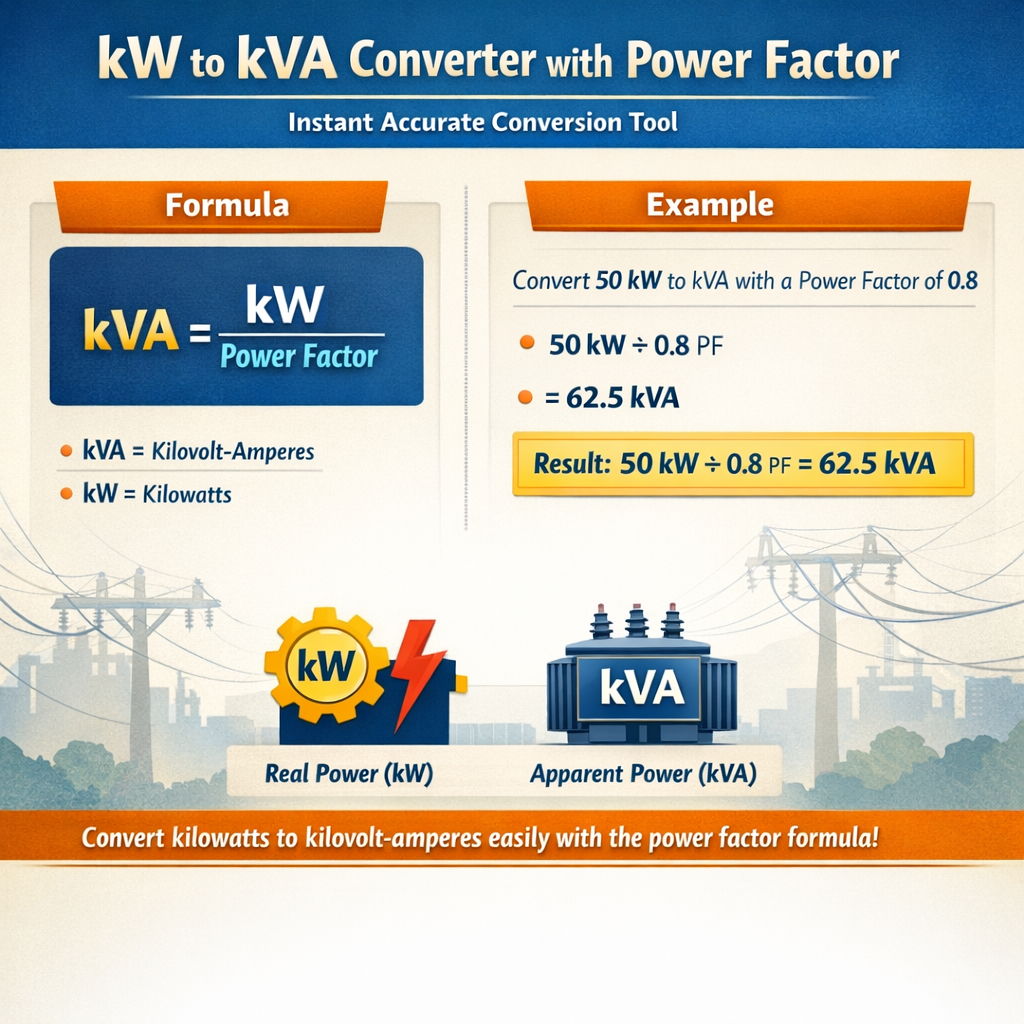
kW to kVA Converter with Power Factor – Instant Apparent Power Calculation
Theory of kW, kVA and Power Factor
Active power (kW) is the real power consumed by loads performing work. Apparent power (kVA) is the vector magnitude combining active and reactive components. Power factor (PF) is the ratio of active power to apparent power and indicates how effectively current is converted into useful work.
Two PF definitions are important: displacement PF (fundamental component phase shift) and true PF (includes harmonic distortion). Accurate kW-to-kVA conversion requires understanding both when harmonics or nonsinusoidal waveforms are present.
Fundamental Conversion Formulas and Variable Definitions
Core formula for conversion between kilowatts and kilovolt-amperes:
Alternate expression for apparent power S and current I in three-phase systems:
Solving for current:
Single-phase current formula:
Variable definitions
- kW — Active power, kilowatts. Typical values: 0.1 kW (small loads) up to multiple megawatts (large plants).
- kVA — Apparent power, kilovolt-amperes. Always ≥ kW for PF ≤ 1.
- PF — Power factor (unitless), ranges from 0 to 1 (or negative for reverse power flow). Typical industrial PF: 0.80–0.99. Commercial/residential lower under light loads.
- V_L-L — Line-to-line voltage in three-phase systems (V). Common standards: 400 V (Europe), 480 V (North America industrial), 600 V (some industrial), 208 V, 230 V.
- I — Current in amperes (A).
- sqrt(3) — Square root of 3 (≈1.73205), used in three-phase power relationships.
Mathematical Notes and Units Consistency
Always maintain unit consistency: use kW and kVA both in kilo-units or convert W and VA accordingly. When computing current from kVA, multiply kVA by 1000 to obtain VA before dividing by volts.
When PF is expressed as percentage (for example 85%), convert to unitless decimal before use (0.85).
Instant Accurate Conversion Tool: Functional Requirements
An instant converter must deliver numerically accurate and context-aware conversions in real time. Key functional capabilities include:
- Inputs: measured kW, PF (decimal or percentage), voltage, phase selection (single/three-phase), measurement window, sampling rate.
- Outputs: kVA, line and phase currents, real-time updating numeric values, uncertainty estimate, sign of reactive power (leading/lagging).
- Data handling: live RMS measurement, harmonics analysis, timestamping, smoothing/averaging options.
- Standards compliance flags: indicate whether measurement method complies with relevant normative references (IEEE, IEC).
Algorithmic workflow for instant conversion
- Acquire instantaneous voltage and current waveforms with synchronized sampling (minimum sample rate > 2× highest harmonic of interest; practically ≥10 kHz for power analyzers).
- Compute RMS values and fundamental phasors using windowed DFT or digital filters.
- Compute true instantaneous active power P = Vrms × Irms × cos(ϕ) or sum(v(t)×i(t)) / N for sampled signals.
- Compute apparent power S = Vrms × Irms (for three-phase S_total = sqrt(3) × V_L-L × I_line), and PF = P / S.
- Apply kW to kVA conversion: kVA = kW / PF. Propagate measurement uncertainty from RMS and PF measurement.
- Display kVA, current, and diagnostic flags (distortion PF vs displacement PF, overload warnings).
Measurement Accuracy Considerations
Accuracy requires addressing:
- Sampling resolution and aliasing: choose anti-aliasing filters and adequate ADC sample rates.
- Phase error between voltage and current channels: calibrate for time skew and gain.
- Harmonics and waveform distortion: measure total harmonic distortion (THD) and apply IEEE 1459 definitions for nonsinusoidal power.
- Temperature and sensor drift: use sensor compensation and periodic calibration to maintain accuracy.
Tables: Common kW to kVA Conversions at Typical Power Factors
Below are precomputed conversions for common kW ratings across representative PFs. These tables assist rapid lookup and validation of instant converter outputs.
| kW | PF 0.60 | PF 0.70 | PF 0.80 | PF 0.85 | PF 0.90 | PF 0.95 | PF 1.00 |
|---|---|---|---|---|---|---|---|
| 1 | 1.67 | 1.43 | 1.25 | 1.18 | 1.11 | 1.05 | 1.00 |
| 5 | 8.33 | 7.14 | 6.25 | 5.88 | 5.56 | 5.26 | 5.00 |
| 10 | 16.67 | 14.29 | 12.50 | 11.76 | 11.11 | 10.53 | 10.00 |
| 20 | 33.33 | 28.57 | 25.00 | 23.53 | 22.22 | 21.05 | 20.00 |
| 50 | 83.33 | 71.43 | 62.50 | 58.82 | 55.56 | 52.63 | 50.00 |
| 100 | 166.67 | 142.86 | 125.00 | 117.65 | 111.11 | 105.26 | 100.00 |
| 200 | 333.33 | 285.71 | 250.00 | 235.29 | 222.22 | 210.53 | 200.00 |
| 500 | 833.33 | 714.29 | 625.00 | 588.24 | 555.56 | 526.32 | 500.00 |
Interpretation: For example, 100 kW at PF 0.85 corresponds to approximately 117.65 kVA.
Tables: Three-Phase Current from kW Using Typical Voltages and PFs
These tables compute approximate line current for three-phase installations, using the formulas above. Current values are rounded to two decimals.
| kW | PF | Voltage | kVA | I (A) |
|---|---|---|---|---|
| 50 | 0.85 | 400 V | 58.82 | 84.95 |
| 50 | 0.85 | 480 V | 58.82 | 70.74 |
| 100 | 0.90 | 400 V | 111.11 | 160.40 |
| 100 | 0.90 | 480 V | 111.11 | 127.16 |
| 200 | 0.80 | 400 V | 250.00 | 360.84 |
| 200 | 0.80 | 480 V | 250.00 | 300.63 |
| 500 | 0.95 | 400 V | 526.32 | 760.12 |
| 500 | 0.95 | 480 V | 526.32 | 634.74 |
Detailed Example Calculations (Case Studies)
Case 1: Industrial Motor Plant — Real-time kW to kVA and Current
Scenario: A factory reports a steady electric input to a motor bank measured as 350 kW. The measured true power factor is 0.88 (includes distortion). The supply is 3-phase, 480 V line-to-line. Determine kVA and line current. Show uncertainty estimate assuming ±1% PF measurement uncertainty and ±0.5% kW measurement uncertainty.
Step 1 — Convert kW to kVA:
Step 2 — Compute line current, I:
Step 3 — Uncertainty propagation (first-order approximation):
- Relative uncertainty in kVA due to kW and PF: δ(kVA)/kVA ≈ sqrt[ (δP/P)^2 + (δPF/PF)^2 ].
- Given δP/P = 0.5% = 0.005, δPF/PF = 1% = 0.01.
- δ_rel = sqrt(0.005^2 + 0.01^2) = sqrt(0.000025 + 0.0001) = sqrt(0.000125) ≈ 0.01118 (1.118%).
- Absolute uncertainty in kVA ≈ 397.73 × 0.01118 ≈ 4.45 kVA.
- Propagate to current: relative uncertainty same ≈ 1.118%, absolute current uncertainty ≈ 478.30 × 0.01118 ≈ 5.35 A.
Result: kVA = 397.73 ± 4.45 kVA; Line current = 478.30 ± 5.35 A. The instant conversion tool should display both nominal values and uncertainty bands and flag whether PF measurement precision is sufficient for contractual metering.
Case 2: Commercial Building—Sizing a UPS System with Distorted Loads
Scenario: A data center reports measured active power consumption of 120 kW per rack array. Measured power factor due to harmonics and nonlinear loads is 0.78 (true PF). The UPS vendor recommends sizing in kVA and must specify current at 208 V three-phase. Determine required kVA and expected line current per array; also compute if a PF correction to 0.95 would reduce UPS kVA requirement.
Step A — kVA at PF 0.78:
Step B — Line current at 208 V:
Step C — If PF improved to 0.95 by power factor correction capacitors or active filters:
Benefit: kVA reduced by 27.53 kVA (≈17.9% reduction), and line current reduced by ≈76.28 A per array. The converter should therefore present both baseline and corrected scenarios, indicating potential infrastructure savings and the cost/benefit of PF correction.
Handling Harmonics and Non-Sinusoidal Waveforms
When waveforms are non-sinusoidal, displacement PF (angle between fundamental voltage and current) differs from distortion PF (harmonics influence). The true power factor = P / (Vrms × Irms × sqrt(3) for three-phase) accounts for all harmonics and must be used for kW-to-kVA conversion. IEEE Std 1459-2010 provides definitions for power components under nonsinusoidal conditions.
- Measure THD (Total Harmonic Distortion) for current and voltage to classify the waveform distortion level.
- If THD > 5–10%, use harmonic-aware analyzers; instantaneous conversion assuming sinusoidal behaviour will produce significant error.
Practical Implementation Details for a Converter Tool
Key engineering design choices for a production-level converter tool:
- Sampling and timing: use synchronized voltage/current sampling with precision GPS or PTP for distributed systems.
- Windowing: implement selectable averaging windows (1 s, 10 s, 1 min) and overlapping windows for smooth output.
- Signal processing: implement anti-aliasing filters, windowed DFT for fundamental extraction, and harmonic spectra calculation if requested.
- Calibration and diagnostics: built-in channel calibration, drift compensation, and a self-test routine to detect CT/VT wiring errors.
- UI/UX: display kW, measured PF (true), calculated kVA, line currents, and trend charts; include exportable data and API endpoints for SCADA/BMS integration.
Edge cases and warnings the tool must present
- PF near zero: conversion becomes ill-conditioned; warn when PF < 0.2 or unstable.
- Reverse power flow: indicate negative kW or negative reactive sign (leading PF).
- Saturated CTs or clipped waveforms: if waveform peaks hit ADC rails, flag measurement invalid.
- Unbalanced three-phase: compute per-phase values and display phase-specific kVA and currents.
Regulatory and Normative References
Standards and normative documents relevant to measurement and conversion processes:
- IEEE Std 1459-2010 — Definitions for the Measurement of Electric Power Quantities Under Sinusoidal, Nonsinusoidal, Balanced, or Unbalanced Conditions. Link: https://standards.ieee.org/standard/1459-2010.html
- IEC 60051 / IEC 62053 — Instrument transformers and electricity metering standards (general guidance and accuracy classes). Link: https://www.iec.ch/standards
- IEC 61000 series — Electromagnetic compatibility and measurement guidance where EMI affects measurement instrumentation. Link: https://www.iec.ch/standards
- NIST — Measurement traceability and instrument calibration best practices. Link: https://www.nist.gov
- Manufacturer application notes (Schneider Electric, Siemens, ABB) on sizing UPS and power factor correction provide practical guidance and examples. Example: Schneider Electric white papers on PF correction: https://www.se.com
Best Practices for Site Measurement and Tool Verification
- Use class-rated CTs and VTs sized for the expected current and voltage ranges; avoid CT saturation.
- Perform on-site verification with reference meters or calibration sources accredited to national labs (NIST, UKAS).
- Document measurement uncertainty and include it on reports; include sample rates, averaging windows, and filter settings.
- For billing or contractual applications, ensure instruments meet local metering standards and that PF measurement method is compliant with relevant standards.
SEO and Implementation Notes for a Web-based Conversion Tool
To maximize usability and discoverability:
- Expose structured inputs and outputs (kW, PF, voltage, phase) and include machine-readable endpoints (JSON) for integration with monitoring systems.
- Cache common conversion tables for instant lookup and present downloadable CSV/Excel tables for engineers.
- Include conservation of units and descriptive alt text for graphs to aid accessibility.
- Provide clear links to normative references and explain measurement assumptions (e.g., true PF vs displacement PF) within the UI so users know the basis of computed kVA values.
Summary of Key Conversion Formulas (Quick Reference)
Primary conversion relationships to implement in the tool:
- kVA = kW / PF
- S (kVA) = (sqrt(3) × V_L-L × I) / 1000
- I (A) = (kVA × 1000) / (sqrt(3) × V_L-L) for three-phase
- I (A) = (kVA × 1000) / V for single-phase
- PF = kW / kVA (ensure PF is capped at 1.0 for practical outputs)
Additional Practical Examples and Validation Tests
Validation tests for an instant conversion tool should include:
- Sine-wave baseline: verify that for a pure sinusoidal load measured kW 50 kW at PF 0.95 the computed kVA equals 52.63 kVA within instrument accuracy.
- Harmonic-loaded case: inject known harmonic content to confirm PF and kVA computations follow IEEE 1459 definitions and that discrepancies between displacement PF and true PF are displayed.
- Unbalanced three-phase: apply asymmetrical loads and verify per-phase kVA computations and total kVA sum consistency.
Further Reading and Authority Links
- IEEE Std 1459-2010 — Definitions for the Measurement of Electric Power Quantities: https://standards.ieee.org/standard/1459-2010.html
- International Electrotechnical Commission (IEC) — Standards index and metering standards: https://www.iec.ch/standards
- National Institute of Standards and Technology (NIST) — Calibration and traceability information: https://www.nist.gov
- Example vendor technical resources (reference only): Siemens energy efficiency guides: https://new.siemens.com
Operational Checklist for Deploying an Instant Converter
- Verify sensor selection and CT/VT ratios match expected measurement range.
- Calibrate instrument channels and verify phase alignment.
- Define averaging windows and confirm sample rates exceed Nyquist for harmonics of interest.
- Test with known loads to validate kW-to-kVA conversion and uncertainty reporting.
- Integrate alarms/warnings for PF thresholds, CT saturation, and sample underrun.
Final Notes for Engineers
kW-to-kVA conversion with PF consideration is straightforward algebraically but can be complex in practice when measurements include distortion, unbalance, and transient disturbances. Implementing an instant accurate conversion tool requires rigorous measurement architecture, compliance with standards (for legal or contractual applications), and clear reporting of uncertainties and assumptions. Use the precomputed tables, formulas, and case studies here as baseline checks when validating any conversion implementation.