kVA = (HP × 0.746) ÷ (PF × η) — works for both single-phase and three-phase systems. Reverse: HP = (kVA × PF × η) ÷ 0.746📊 Quick Reference Table (PF=0.8, η=0.9)
| HP | kVA | HP | kVA |
|---|---|---|---|
| 1 | 1.04 | 50 | 51.81 |
| 5 | 5.18 | 75 | 77.71 |
| 10 | 10.36 | 100 | 103.61 |
| 20 | 20.72 | 150 | 155.42 |
| 30 | 31.08 | 200 | 207.22 |
❓ Common Questions
1 HP = ? 1.04 kVA (at PF=0.8, η=0.9).
Why does voltage not appear? kVA already accounts for voltage and current. The formula only needs PF and η.
Single vs 3-phase difference? The HP-to-kVA formula is the same. Phase type affects current, not kVA.
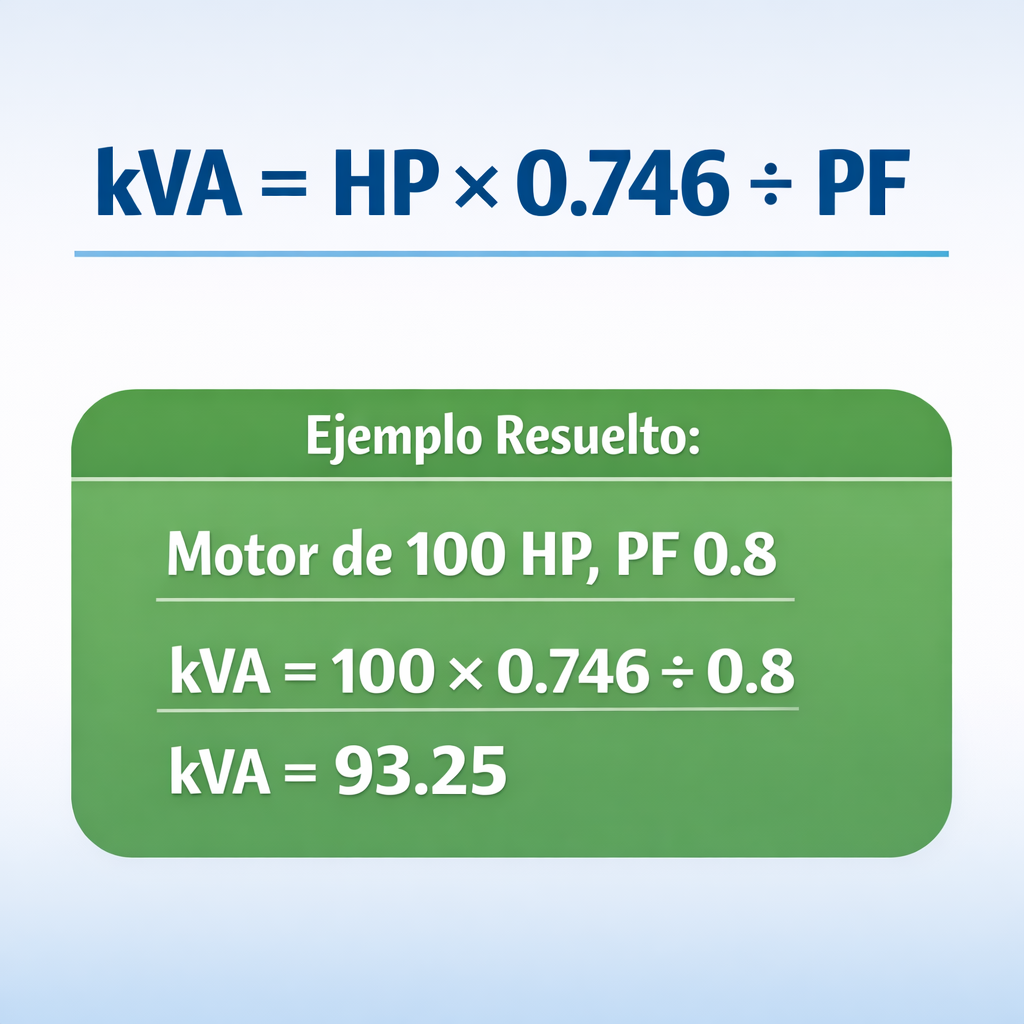
Convert motor shaft horsepower to running apparent power with kVA = HP × 0.746 ÷ (PF × η). Enter the motor efficiency η and power factor PF at the operating load. The calculator uses the rounded mechanical-horsepower constant 0.746 kW/HP and works in either direction. The tables and six worked examples show how changing those inputs changes the result.
HP to kVA: choose efficiency before converting
For mechanical horsepower, use kVA = HP × 0.745699872 ÷ (efficiency × PF). With illustrative efficiency 0.90 and PF 0.80, 1 HP needs 1.036 kVA, 15 HP needs 15.54 kVA and 200 HP needs 207.14 kVA at that operating point.
Efficiency and power factor are different inputs. These results estimate running apparent power, not motor-starting demand or generator size. Using 0.746 kW/HP gives a slightly different rounded answer.
Continue your calculation:
HP to kVA Conversion Table (PF = 0.8, η = 0.9)
This table uses illustrative power factor 0.80 and motor efficiency 90%, not universal or guaranteed conservative equipment values. Use actual motor data at the relevant operating load. With the calculator’s rounded 0.746 kW/HP constant, multiply HP by approximately 1.0361 to estimate running kVA under these assumptions. Starting demand and generator selection require separate checks.
| HP | kVA | Typical Application |
|---|---|---|
| 1 | 1.04 | Small fans, bench tools |
| 2 | 2.07 | Residential well pumps |
| 3 | 3.11 | Conveyor drives |
| 5 | 5.18 | Air compressors, mixers |
| 7.5 | 7.77 | Small HVAC units |
| 10 | 10.36 | Centrifugal pumps |
| 15 | 15.54 | Workshop machinery |
| 20 | 20.72 | Grain elevators, blowers |
| 25 | 25.90 | Medium HVAC chillers |
| 30 | 31.08 | Irrigation pumps |
| 40 | 41.44 | Industrial crushers |
| 50 | 51.81 | Large compressors |
| 75 | 77.71 | Water treatment plants |
| 100 | 103.61 | Mining hoists |
| 125 | 129.51 | Paper mill drives |
| 150 | 155.42 | Production line motors |
| 200 | 207.22 | Steel rolling mills |
| 250 | 259.03 | Large centrifugal compressors |
| 300 | 310.83 | Oil refinery pumps |
Equipment sizing: These values describe running load. They do not establish generator, transformer, UPS or breaker ratings. Motor starting, other connected loads and the supply equipment’s operating limits require a separate assessment; a fixed percentage margin cannot establish starting capability.
Step-by-Step Formulas to Convert HP to kVA
The HP to kVA conversion formula is the same for both single-phase and three-phase systems because kVA already combines voltage and current into a single apparent-power figure. The phase type affects the current calculation (where you’d need voltage and √3 for three-phase), but not the total kVA demand.
Where:
- HP = mechanical horsepower (motor nameplate output).
- 0.746 = conversion constant (1 HP = 0.746 kW).
- PF = electrical input kW divided by input kVA. It equals cosφ for sinusoidal voltage and current; use true power factor where waveform distortion is significant.
- η = motor shaft-output power divided by electrical input power, expressed as a decimal. For example, enter 0.90 for 90%. Do not include a pump or gearbox efficiency when HP already refers to the motor shaft.
Step-by-step example (quick)
Convert 50 HP to kVA at PF = 0.8 and η = 0.9:
- Multiply: 50 × 0.746 = 37.30 kW (mechanical shaft output).
- Divide by PF × η: 37.30 ÷ (0.8 × 0.9) = 37.30 ÷ 0.72 = 51.81 kVA.
At these inputs, mechanical output is 37.30 kW, electrical input is 37.30 ÷ 0.90 = 41.44 kW, and running apparent power is 41.44 ÷ 0.80 = 51.81 kVA. These are three different quantities.
Why voltage doesn’t appear in the formula
A common question: shouldn’t voltage affect the kVA? No. kVA = V × I ÷ 1000 (single-phase) or V × I × √3 ÷ 1000 (three-phase). When you convert from HP (which is mechanical output), you’re calculating total apparent power. Voltage determines the current at that kVA — a higher voltage means lower current for the same kVA — but the kVA demand itself depends only on the mechanical load, PF, and efficiency.
Single-Phase vs Three-Phase — Key Differences
| Parameter | Single-Phase | Three-Phase |
|---|---|---|
| HP to kVA formula | kVA = (HP × 0.746) ÷ (PF × η) | kVA = (HP × 0.746) ÷ (PF × η) |
| Current from kVA | I = kVA × 1000 ÷ V | I = kVA × 1000 ÷ (V × √3) |
| Typical voltages | 120 V, 230 V, 240 V | 208 V, 400 V, 480 V |
| Motor rating | Use the actual motor data | Use the actual motor data |
| Power factor | Equipment- and load-dependent | Equipment- and load-dependent |
| Efficiency | Use motor data at the operating load | Use motor data at the operating load |
| Starting demand | Requires motor and starter data | Requires motor and starter data |
With the same shaft power, efficiency and power factor, total running kVA is the same for either phase configuration. Current depends on supply voltage and phase configuration. The three-phase current formula assumes a balanced load and line-to-line voltage.
Reverse Conversion: kVA to HP
To go from kVA back to horsepower, invert the formula:
| kVA | HP (PF=0.8, η=0.9) | HP (PF=0.9, η=0.95) |
|---|---|---|
| 5 | 4.83 | 5.73 |
| 10 | 9.65 | 11.46 |
| 25 | 24.13 | 28.65 |
| 50 | 48.26 | 57.31 |
| 100 | 96.51 | 114.61 |
| 150 | 144.77 | 171.92 |
| 200 | 193.03 | 229.22 |
| 250 | 241.29 | 286.53 |
For a dedicated inverse tool, use the kVA to HP calculator. Use electrical input kVA and the corresponding motor efficiency and power factor.
Solved Examples — 6 Real-World HP to kVA Conversions
Example 1 — Running kVA of a 150 HP Production Motor
Data: 150 HP, three-phase induction motor, PF = 0.80, η = 0.92.
Formula: kVA = (150 × 0.746) ÷ (0.80 × 0.92) = 111.90 ÷ 0.736 = 152.04 kVA
The 152.04 kVA result is the motor’s running demand at the stated shaft load. Generator selection also needs the starting load and transient performance data.
Example 2 — Running kVA of a 75 HP Water Pump
Data: 75 HP, three-phase supply, PF = 0.85, η = 0.90.
Formula: kVA = (75 × 0.746) ÷ (0.85 × 0.90) = 55.95 ÷ 0.765 = 73.14 kVA
The result is 73.14 kVA at this operating point. A transformer selection cannot be determined from the running conversion alone.
Example 3 — 10 HP Air Compressor for a Workshop
Data: 10 HP, three-phase, PF = 0.80, η = 0.88.
Formula: kVA = (10 × 0.746) ÷ (0.80 × 0.88) = 7.46 ÷ 0.704 = 10.60 kVA
The 10 HP shaft output is 7.46 kW. At 88% motor efficiency the electrical input is 8.48 kW; dividing by PF 0.80 gives 10.60 kVA.
Example 4 — 50 HP HVAC Chiller Motor
Data: 50 HP, three-phase, PF = 0.85, η = 0.91.
Formula: kVA = (50 × 0.746) ÷ (0.85 × 0.91) = 37.30 ÷ 0.7735 = 48.22 kVA
The result is 48.22 kVA for this motor. A complete chiller may also contain pumps, fans and controls whose electrical input must be assessed separately.
Example 5 — 200 HP Industrial Motor on an Emergency Generator
Data: 200 HP, three-phase, PF = 0.80, η = 0.93.
Formula: kVA = (200 × 0.746) ÷ (0.80 × 0.93) = 149.20 ÷ 0.744 = 200.54 kVA
The result is 200.54 kVA while running. It does not establish a minimum generator size or mandate a particular starter.
Example 6 — 30 HP Agricultural Irrigation Pump
Data: 30 HP, three-phase, PF = 0.82, η = 0.88.
Formula: kVA = (30 × 0.746) ÷ (0.82 × 0.88) = 22.38 ÷ 0.7216 = 31.01 kVA
The result is 31.01 kVA under these assumed operating conditions. Changing efficiency or power factor changes running kVA even when shaft HP remains unchanged.
HP to kVA in Electric Motors — Reading the Nameplate
A motor nameplate gives you output horsepower — the shaft power delivered to the load. The electrical input is always higher because of losses. Here’s how to interpret the nameplate data for an accurate HP-to-kVA conversion:
Nameplate HP = mechanical output. This is the number you plug into the formula.
Nameplate FLA (Full Load Amps) = the current drawn at rated HP. You can verify your kVA calculation: kVA = V × FLA × √3 ÷ 1000 (three-phase). If the result differs significantly from your formula-based kVA, the motor’s actual PF or η differs from your assumptions.
Efficiency (η) = motor shaft output divided by motor electrical input. Use manufacturer data appropriate to the load; an efficiency class alone does not supply the exact value for every motor rating.
Power factor = electrical input kW divided by input kVA. Obtain it from suitable motor data or measurements at the operating load. The calculator’s preset is an example, not a conservative default.
Service factor (SF) = an overload capability subject to the motor’s stated conditions. It is not a routine operating target; consult the manufacturer before using an overload operating point in a load calculation.
Alternative Assumptions — Conversion Table (PF = 0.9, η = 0.95)
The following table assumes PF 0.90 and efficiency 0.95. These inputs are illustrative and do not follow automatically from an IE3 or IE4 motor designation.
| HP | kVA | HP | kVA |
|---|---|---|---|
| 1 | 0.87 | 50 | 43.63 |
| 5 | 4.36 | 75 | 65.44 |
| 10 | 8.73 | 100 | 87.25 |
| 15 | 13.09 | 150 | 130.88 |
| 20 | 17.45 | 200 | 174.50 |
| 30 | 26.18 | 250 | 218.13 |
| 40 | 34.90 | 300 | 261.75 |
For 100 HP, the two sets of assumed inputs give 87.25 kVA and 103.61 kVA, a difference of about 15.8%. This compares operating points, not guaranteed savings from replacing a motor. Electricity charges depend on the applicable tariff and actual operation.
Quick Equivalences — HP to kVA
The following running-load equivalents use PF 0.80, efficiency 0.90 and 0.746 kW/HP. They are conditional examples, not equipment ratings.
1 HP to kVA
1.04 kVA
At PF 0.80 and motor efficiency 90%; shaft output is 0.746 kW.
3 HP to kVA
3.11 kVA
At PF 0.80 and motor efficiency 90%; shaft output is 2.238 kW.
10 HP to kVA
10.36 kVA
At PF 0.80 and motor efficiency 90%; shaft output is 7.46 kW.
15 HP to kVA
15.54 kVA
At PF 0.80 and motor efficiency 90%; shaft output is 11.19 kW.
20 HP to kVA
20.72 kVA
At PF 0.80 and motor efficiency 90%; shaft output is 14.92 kW.
30 HP to kVA
31.08 kVA
At PF 0.80 and motor efficiency 90%; shaft output is 22.38 kW.
50 HP to kVA
51.81 kVA
At PF 0.80 and motor efficiency 90%; shaft output is 37.30 kW.
100 HP to kVA
103.61 kVA
At PF 0.80 and motor efficiency 90%; shaft output is 74.60 kW.
150 HP to kVA
155.42 kVA
At PF 0.80 and motor efficiency 90%; shaft output is 111.90 kW.
200 HP to kVA
207.22 kVA
At PF 0.80 and motor efficiency 90%; shaft output is 149.20 kW.
Why does the 1 HP equivalent vary?
1.04 kVA
At PF 0.80 and efficiency 0.90, the rounded result is 1.04 kVA. Other inputs produce different results.
HP to kVA formula 3 phase
kVA = (HP × 0.746) ÷ (PF × η)
The conversion is unchanged for three-phase motors. To obtain balanced line current, use I = kVA × 1000 ÷ (√3 × line-to-line volts).
Frequently Asked Questions — HP to kVA Conversion
How many kVA is 1 HP?
1 HP equals approximately 1.04 kVA at a power factor of 0.8 and efficiency of 0.9. The exact value depends on your equipment’s actual PF and η. Use the formula kVA = (1 × 0.746) ÷ (PF × η) with your specific values.
Is the HP to kVA formula different for single-phase and three-phase?
No, the HP-to-kVA formula is identical: kVA = (HP × 0.746) ÷ (PF × η). Phase type only affects the current calculation. For three-phase, amps = kVA × 1000 ÷ (V × 1.732). For single-phase, amps = kVA × 1000 ÷ V.
Does voltage affect the HP to kVA conversion?
Voltage does not appear explicitly in this conversion. If shaft load, PF and efficiency stay the same, the kVA result stays the same. Actual motor performance can change with voltage; the formula does not assume a motor can operate at any supply voltage.
What power factor should I use for a motor?
Use manufacturer data or a suitable measurement for the motor’s operating load. If PF is unknown, use the calculator to compare clearly labelled assumptions. PF 0.80 is not guaranteed to overestimate running demand.
Why is the kVA always higher than the kW for the same HP?
Apparent power satisfies kVA = electrical input kW ÷ PF. For 50 HP at efficiency 0.90, shaft output is 37.30 kW and electrical input is 41.44 kW. At PF 0.80, apparent power is 51.81 kVA. At unity PF, input kW and kVA are numerically equal.
How do I convert HP to kVA for a generator?
First calculate each motor’s running electrical demand using its shaft load, efficiency and PF. Then assess the complete load and starting sequence with the generator manufacturer. The running conversion alone cannot establish a suitable generator rating.
What is the difference between HP to kVA and HP to kW?
To express mechanical shaft HP in kW, use kW shaft = HP × 0.746. To estimate motor electrical input, divide shaft kW by motor efficiency. To obtain AC input kVA, divide electrical input kW by PF.
Can I use HP to kVA for DC motors?
DC motors don’t have a power factor because DC circuits have no reactive component. For DC, simply use kW = HP × 0.746 ÷ η. The concept of kVA doesn’t apply to pure DC systems. However, if the DC motor is fed through a rectifier from an AC supply, size the AC side in kVA normally.
How does motor starting affect the kVA calculation?
Starting demand depends on the motor, driven load, starting method and supply. Use locked-rotor or manufacturer starting data and assess acceleration and voltage recovery. Running kVA alone does not define the starting current or its duration.
What if I only know amps and voltage, not HP?
Calculate kVA directly: kVA = V × I × √3 ÷ 1000 (three-phase) or kVA = V × I ÷ 1000 (single-phase). If you then need HP, use HP = kVA × PF × η ÷ 0.746. For help with this conversion, try our Amps to HP calculator.
Is there a fixed HP-to-kVA conversion factor?
No. The factor is 0.746 ÷ (PF × η) for the rounded mechanical-horsepower constant used here. At PF 0.80 and η 0.90 it is approximately 1.0361 kVA/HP; other operating conditions give different factors.
How accurate are online HP to kVA calculators?
This calculator applies the stated running-power formula with a rounded 0.746 kW/HP constant. Its result depends on the accuracy of the shaft load, PF and efficiency entered. It does not model starting transients or independently select equipment ratings.
Related Conversions
- Amps to kW — Calculator, Formula & Table
- Amps to Watts Calculator: Formula, Conversion Table & Free Online Converter
- Amps to HP Calculator — Must-Have Effortless Guide
- Amperes to VA — Calculator
- Efficiency of an Electric Motor — Calculator & Table
- Balanced and Unbalanced Load Calculation
Technical references
- U.S. Department of Energy: Determining Electric Motor Load and Efficiency — input power, shaft output and load-dependent motor performance.
- Cummins: How to size a genset — factors beyond a running-power conversion.