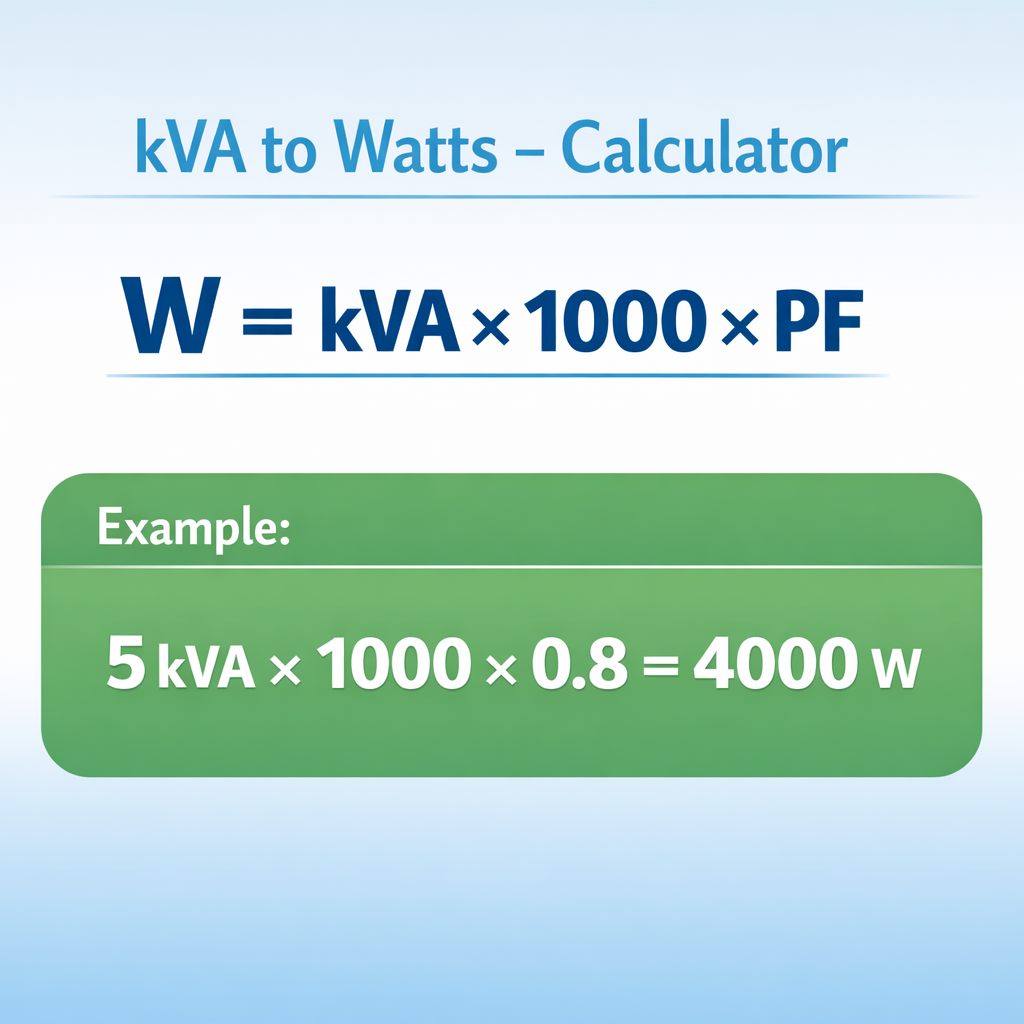
W = kVA × 1000 × PF · kVA = W ÷ (1000 × PF) · Illustrative PF; use actual load data: 0.8Formulas used
kVA → Watts: W = kVA × 1000 × PF
Watts → kVA: kVA = W ÷ (1000 × PF)
For DC: PF = 1, so W = kVA × 1000
What PF should I use?
Use the load PF at the operating point. The preset 0.80 is an example, not a universal safe value. If PF is unknown, compare assumptions and label the result as an estimate.
Converting kVA to Watts is fundamental for sizing electrical equipment correctly. kVA (kilovolt-amperes) measures apparent power — the total power the source must deliver — while Watts measure real power, the portion that actually does useful work. The relationship between them is governed by the power factor (PF). This kVA to Watts calculator gives you instant results: enter your kVA rating, select the power factor, and get the exact Watts output. Whether you are sizing a transformer, selecting a generator, or verifying a UPS capacity, the formulas and tables below cover every scenario.
Convert a kVA rating into the unit you need
5 kVA is 4,000 W at PF 0.80, or 5,000 W at PF 1. For 10 kVA, the corresponding values are 8,000 W and 10,000 W. There is no single watts equivalent without a power factor.
Use the load power factor for the conversion. When checking a UPS or generator, also check its separate rated watts or kW limit; a converted value does not override that limit.
Continue your calculation:
1. kVA to Watts Conversion Table (Standard Equipment Ratings)
This kVA to Watts table covers the ratings you encounter on transformers, generators, UPS systems, and industrial equipment. All values use the formula W = kVA × 1000 × PF at four standard power factors.
| kVA | PF = 1.0 (W) | PF = 0.9 (W) | PF = 0.8 (W) | PF = 0.7 (W) | Typical Application |
|---|---|---|---|---|---|
| 0.5 kVA | 500 W | 450 W | 400 W | 350 W | Small control transformer |
| 1 kVA | 1000 W | 900 W | 800 W | 700 W | Desktop UPS, home inverter |
| 2 kVA | 2000 W | 1800 W | 1600 W | 1400 W | Rack-mount server UPS |
| 3 kVA | 3000 W | 2700 W | 2400 W | 2100 W | Small office UPS, generator |
| 5 kVA | 5000 W | 4500 W | 4000 W | 3500 W | Workshop generator, distribution transformer |
| 7.5 kVA | 7500 W | 6750 W | 6000 W | 5250 W | Small commercial generator |
| 10 kVA | 10000 W | 9000 W | 8000 W | 7000 W | Industrial UPS, panel transformer |
| 15 kVA | 15000 W | 13500 W | 12000 W | 10500 W | Medium commercial generator |
| 20 kVA | 20000 W | 18000 W | 16000 W | 14000 W | Data center UPS module |
| 25 kVA | 25000 W | 22500 W | 20000 W | 17500 W | Distribution transformer |
| 30 kVA | 30000 W | 27000 W | 24000 W | 21000 W | Commercial standby generator |
| 50 kVA | 50000 W | 45000 W | 40000 W | 35000 W | Industrial generator, substation |
| 75 kVA | 75000 W | 67500 W | 60000 W | 52500 W | Large distribution transformer |
| 100 kVA | 100000 W | 90000 W | 80000 W | 70000 W | Industrial plant feeder, large generator |
| 200 kVA | 200000 W | 180000 W | 160000 W | 140000 W | Primary substation transformer |
| 500 kVA | 500000 W | 450000 W | 400000 W | 350000 W | Utility distribution transformer |
Note: All values are mathematically exact (W = kVA × 1000 × PF). In practice, actual wattage may vary with operating temperature, load conditions, and equipment age. Always verify with nameplate data.
2. Step-by-Step kVA to Watts Formulas
The kVA to Watts conversion is straightforward: multiply kVA by 1000 (to get VA) and then by the power factor. Here are all the formulas you need, broken down by circuit type.
Primary Formula
This is the core kVA to Watts formula. Multiply the apparent power in kilovolt-amperes by 1000 to convert to VA, then multiply by the power factor to get real power in Watts. For example, a 5 kVA transformer at PF 0.80: 5 × 1000 × 0.80 = 4000 W.
Simplified Version (PF = 1.0)
For purely resistive loads like heaters, incandescent bulbs, and electric ovens, the power factor is 1.0. In this case, kVA and kW are identical, so you simply multiply by 1000 to get Watts. A 3 kVA heater load delivers exactly 3000 W.
Three-Phase Systems
The three-phase kVA rating already includes the √3 factor in its calculation (kVA = √3 × V × I ÷ 1000). So to convert kVA to Watts, you still use the same formula regardless of whether the system is single-phase or three-phase. This is one of the advantages of working in kVA.
DC Systems
In DC circuits there is no phase angle between voltage and current, so PF is always 1.0. The kVA and kW values are identical for DC — no power factor adjustment needed.
Variable Reference
| Variable | Unit | Description |
|---|---|---|
| kVA | Kilovolt-Amperes | Apparent power — total power the source delivers (1 kVA = 1000 VA) |
| W | Watts | Real power — the portion that performs actual useful work |
| PF | Dimensionless (0–1) | Power factor — ratio of real power to apparent power |
| kW | Kilowatts | Real power in thousands (1 kW = 1000 W). kW = kVA × PF |
| VA | Volt-Amperes | Apparent power (1 kVA = 1000 VA) |
| VAR | Volt-Amperes Reactive | Reactive power — the non-working component of apparent power |
3. Types of Loads & Power Factor Differences
The power factor determines how much of the kVA supply actually becomes useful Watts. Understanding the differences helps you pick the right PF for your kVA to Watts calculator input.
| Load Type | Typical PF | Why | W per kVA | Examples |
|---|---|---|---|---|
| Purely Resistive | 1.0 | V and I perfectly in phase | 1000 W | Heaters, ovens, incandescent bulbs |
| Slightly Inductive | 0.85 – 0.95 | Small inductive component | 850 – 950 W | HVAC, fluorescent ballasts |
| Moderately Inductive | 0.70 – 0.90 | Motor windings lag current | 700 – 900 W | Induction motors, pumps, compressors |
| Highly Non-Linear | 0.60 – 0.95 | Switching PSUs distort waveform | 600 – 950 W | Computers, servers, LED drivers |
| Capacitive (Rare) | 0.90 – 0.99 leading | Current leads voltage | 900 – 990 W | PF correction banks, synchronous motors |
Key insight: A 10 kVA transformer feeding a purely resistive load delivers 10,000 W. The same transformer feeding induction motors at PF 0.75 delivers only 7,500 W. The kVA rating stays the same — it is the Watts output that changes with PF. This is why the kVA to Watts calculator always asks for power factor.
4. Reverse Conversion: Watts to kVA
When you know the real power (Watts) your load consumes and need to find the required kVA rating for a transformer, generator, or UPS, use the reverse formula:
This is critical for equipment sizing. If you size a transformer by Watts alone and ignore the kVA requirement, you risk overloading because the apparent power demand is always higher than real power when PF < 1. For precise transformer sizing, see our transformer kVA sizing calculator.
| Load (W) | PF 0.70 → kVA | PF 0.80 → kVA | PF 0.90 → kVA | PF 1.0 → kVA |
|---|---|---|---|---|
| 1000 W | 1.43 kVA | 1.25 kVA | 1.11 kVA | 1.00 kVA |
| 2000 W | 2.86 kVA | 2.50 kVA | 2.22 kVA | 2.00 kVA |
| 3000 W | 4.29 kVA | 3.75 kVA | 3.33 kVA | 3.00 kVA |
| 5000 W | 7.14 kVA | 6.25 kVA | 5.56 kVA | 5.00 kVA |
| 10000 W | 14.29 kVA | 12.50 kVA | 11.11 kVA | 10.00 kVA |
| 20000 W | 28.57 kVA | 25.00 kVA | 22.22 kVA | 20.00 kVA |
| 50000 W | 71.43 kVA | 62.50 kVA | 55.56 kVA | 50.00 kVA |
5. Solved Examples — Real-World kVA to Watts Conversions
Here are six practical kVA to Watts conversion examples covering transformers, generators, UPS systems, and motors.
Example 1 — Home Standby Generator
Data: Generator rated at 10 kVA. Mix of residential loads (lighting, fridge, HVAC fan) with average PF = 0.85.
Formula: W = kVA × 1000 × PF = 10 × 1000 × 0.85 = 8,500 W
Your 10 kVA generator delivers up to 8,500 W of real power. If your total connected load is 7,000 W, you have about 18% headroom — enough for motor startup surges from the AC compressor.
Example 2 — Data Center UPS Module
Data: UPS module rated at 20 kVA. Servers with active PFC, combined PF = 0.98.
Formula: W = 20 × 1000 × 0.98 = 19,600 W
Modern server PSUs with active power factor correction let you use nearly the full kVA rating as real power. This 20 kVA UPS delivers 19.6 kW — only 400 W lost to reactive power. For accurate UPS sizing, try our UPS sizing calculator.
Example 3 — Distribution Transformer for Motor Load
Data: Transformer rated at 75 kVA. Connected induction motors with average PF = 0.78.
Formula: W = 75 × 1000 × 0.78 = 58,500 W
The 75 kVA transformer delivers only 58.5 kW of real power at this low PF. If you install capacitor banks to raise PF to 0.95, the same transformer could deliver 71,250 W — a 22% increase in usable capacity without changing any hardware.
Example 4 — Portable Generator for Event
Data: Portable generator rated at 5 kVA. Sound system + lighting, PF = 0.90.
Formula: W = 5 × 1000 × 0.90 = 4,500 W
Your 5 kVA generator can power up to 4,500 W of sound and lighting equipment. Keep 10–15% margin for startup surges from amplifiers, so plan for about 3,800–4,000 W of continuous load.
Example 5 — Industrial Welding Transformer
Data: Welding transformer rated at 30 kVA. Welders have PF = 0.65 during arc operation.
Formula: W = 30 × 1000 × 0.65 = 19,500 W
Welding equipment typically has very low power factor due to the arc’s nonlinear nature. A 30 kVA transformer only delivers 19.5 kW of real welding power. The remaining 10.5 kVA is reactive power that heats cables and transformers without doing useful work.
Example 6 — Watts to kVA (Reverse)
Data: Office floor needs 12,000 W total. Mixed load PF = 0.82.
Formula: kVA = W ÷ (1000 × PF) = 12000 ÷ (1000 × 0.82) = 14.63 kVA
You need at least a 15 kVA transformer (next standard size) to serve this 12 kW office floor. Choosing a 15 kVA unit provides about 2.5% headroom at this PF — tight but acceptable if the load is well characterized. A 20 kVA transformer would give comfortable 37% margin for growth.
6. kVA to Watts in Electric Motors
Electric motors are rated in kW or HP for their mechanical output, not in kVA. But the transformer or generator feeding the motor must be rated in kVA for the electrical input. Understanding the conversion helps you match supply to demand.
Motor kVA vs. Watts Delivered
A motor’s apparent power input (kVA) is always higher than its real power output (Watts) because of two loss factors: power factor and motor efficiency.
| Motor Rating | kVA Input | PF | W Input (kVA×1000×PF) | η | W Output (Shaft) |
|---|---|---|---|---|---|
| 1 HP (0.746 kW) | 1.1 kVA | 0.82 | 902 W | 0.83 | 749 W |
| 5 HP (3.73 kW) | 4.8 kVA | 0.84 | 4032 W | 0.89 | 3588 W |
| 10 HP (7.46 kW) | 9.2 kVA | 0.86 | 7912 W | 0.91 | 7200 W |
| 25 HP (18.65 kW) | 22 kVA | 0.87 | 19140 W | 0.93 | 17800 W |
| 50 HP (37.3 kW) | 42 kVA | 0.88 | 36960 W | 0.94 | 34742 W |
For detailed motor efficiency analysis, check our electric motor efficiency calculator. To convert between amps and watts for motor circuits, use our Amps to Watts calculator.
7. Quick Equivalences — Common kVA to Watts Values
Instant answers for the most searched kVA to Watts conversions. Each assumes PF = 0.80 unless noted otherwise.
1 kVA to Watts
800 W (at PF 0.8)
Desktop UPS or home inverter. At PF 1.0 (resistive): 1000 W exactly.
2 kVA to Watts
1,600 W (at PF 0.8)
Rack-mount server UPS. Supports 1–2 servers depending on PSU rating.
3 kVA to Watts
2,400 W (at PF 0.8)
Small office UPS or portable generator. Enough for workstation + peripherals.
5 kVA to Watts
4,000 W (at PF 0.8)
Workshop generator or distribution transformer. At PF 0.9: 4,500 W. At PF 1.0: 5,000 W.
7.5 kVA to Watts
6,000 W (at PF 0.8)
Small commercial generator. Can run a central AC unit or multiple power tools.
10 kVA to Watts
8,000 W (at PF 0.8)
Industrial UPS or panel transformer. Standard size for small commercial buildings.
15 kVA to Watts
12,000 W (at PF 0.8)
Medium commercial generator. Powers an office floor with lighting, computers, and HVAC.
20 kVA to Watts
16,000 W (at PF 0.8)
Data center UPS module. With modern server PFC (PF 0.98): 19,600 W.
30 kVA to Watts
24,000 W (at PF 0.8)
Commercial standby generator. Powers a mid-size retail store or restaurant.
50 kVA to Watts
40,000 W (at PF 0.8)
Industrial generator or substation transformer. Supports heavy motor loads.
100 kVA to Watts
80,000 W (at PF 0.8)
Large plant feeder or primary distribution transformer. Enough for a small factory.
8. FAQ — kVA to Watts Conversion
What is the formula to convert kVA to Watts?
W = kVA × 1000 × PF. Multiply kVA by 1000 to get VA, then by the power factor to get real power in Watts. For example, 5 kVA × 1000 × 0.80 = 4,000 W.
How many Watts is 1 kVA?
At PF = 1, 1 kVA corresponds to 1,000 W. At an assumed PF of 0.80 it corresponds to 800 W; at PF 0.60, to 600 W. These conversions do not establish a particular source’s watts rating.
Is kVA the same as kW?
Only when PF = 1.0. kVA measures apparent power (total power delivered by the source), while kW measures real power (power that does useful work). The relationship is kW = kVA × PF. For resistive loads, kVA = kW. For motors and other inductive loads, kVA is always greater than kW.
What power factor should I use for kVA to Watts conversion?
Use measured load PF or manufacturer data for the relevant operating point. If unknown, 0.80 is only an assumption. For example, 5 kVA corresponds to 3,000 W at PF 0.60 and 4,000 W at PF 0.80. Check both the source’s watts and VA limits; see Schneider Electric’s explanation of UPS ratings.
How do I convert Watts to kVA?
kVA = W ÷ (1000 × PF). For example, a 12,000 W load at PF 0.80: 12000 ÷ (1000 × 0.80) = 15 kVA. This is critical for transformer and generator sizing — you must account for reactive power.
Why does my generator list both kVA and kW?
Because they represent two different limits. The kVA rating limits the alternator’s current capacity (apparent power), while the kW rating limits the engine’s mechanical output (real power). Most generators assume PF = 0.80, so a 10 kVA generator is typically rated at 8 kW. You can hit either limit first depending on your load’s power factor.
Can power factor change the Watts I get from the same kVA source?
Yes — dramatically. A 50 kVA transformer delivers 50,000 W at PF 1.0 but only 35,000 W at PF 0.70. The transformer is the same size and cost, but the usable Watts drop by 30%. Installing power factor correction (capacitors) raises PF and increases usable Watts.
Is the kVA to Watts formula the same for single-phase and three-phase?
Yes. W = kVA × 1000 × PF works for both. The kVA rating already accounts for whether the system is single-phase or three-phase — that distinction is built into how kVA is calculated from voltage and current, not into the kVA-to-Watts conversion.
What is the difference between kVA and VA?
1 kVA = 1000 VA. They measure the same thing (apparent power) in different scales, just like kW = 1000 W. Small equipment like desktop UPS is rated in VA; larger equipment like generators and transformers uses kVA. Use our Amperes to VA calculator for VA-level conversions.
How does reactive power relate to kVA and Watts?
Reactive power (kVAR) is the non-working component of kVA. It relates through the power triangle: kVA² = kW² + kVAR². When PF = 1, kVAR = 0 and kVA = kW. When PF < 1, some kVA capacity goes to reactive power, reducing the usable Watts.
What standards define kVA ratings on electrical equipment?
IEEE C57.12 governs transformer kVA ratings. IEC 62040 covers UPS ratings (requiring both kVA and kW on the label). NEMA MG 1 defines motor nameplate data including the kVA code letter for locked-rotor current.
How do I convert kVA to HP?
HP = (kVA × PF × η) ÷ 0.746. First convert kVA to Watts using W = kVA × 1000 × PF, then account for motor efficiency (η), and divide by 746 (since 1 HP = 746 W). For a complete tool, use our Amps to HP calculator.
9. Related Conversions
If you found this kVA to Watts calculator useful, these related tools can help with your next project:
- Amps to kW Calculator — convert current to kilowatts for any voltage and circuit type.
- Amps to Watts Calculator — convert current to real power in Watts.
- Amperes to VA Calculator — find apparent power from current and voltage.
- Amps to HP Calculator — convert current to horsepower for motors.
- Electric Motor Efficiency Calculator — motor input vs. output power analysis.
- Balanced and Unbalanced Load Calculation — distribute loads across three-phase panels.