This article provides a precise technical method to predict UPS runtime from battery parameters accurately.
Includes formulas, variable explanations, tables, normative references, and real worked examples for engineers design validation.
UPS Runtime Calculator from Load, Battery Voltage, Capacity and Efficiency
Fundamental runtime calculation principles
Predicting UPS runtime requires converting load in kilowatts to watts, accounting for battery energy, inverter losses, and usable capacity. The core energy balance is simple conceptually but requires several correction factors for realistic predictions: inverter efficiency, battery state of charge (SoC), depth of discharge (DoD), temperature effects, and Peukert-related rate losses for lead-acid cells.
Primary runtime equation
Use the following principal equation to compute theoretical runtime in hours:
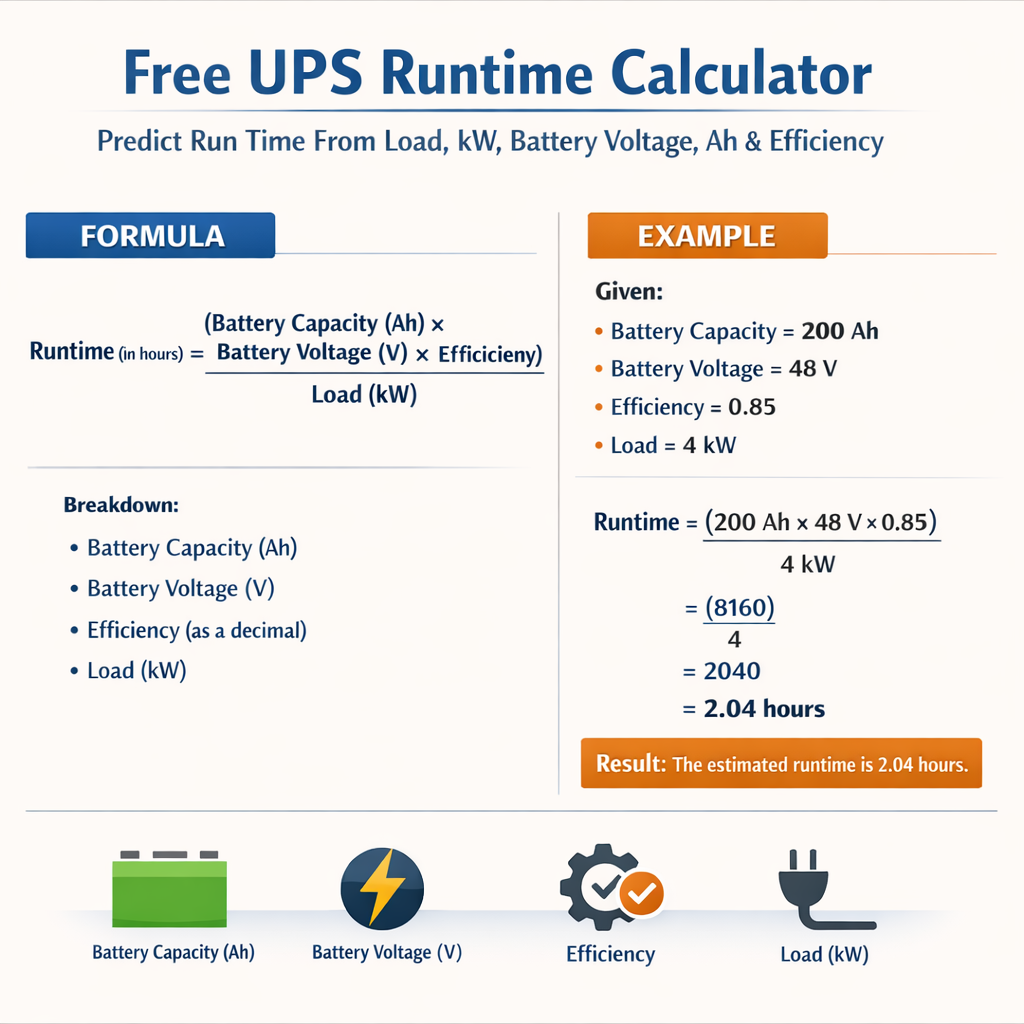
Where the multiplication and division are standard arithmetic operations. This equation assumes conversion between units is already performed (kW to W where required).
Variable definitions and typical engineering values
- Battery Voltage (V): nominal string voltage of the battery bank (typical values: 12 V, 24 V, 36 V, 48 V, 96 V, 240 V).
- Battery Ah (Ah): ampere-hour rating of the battery bank (typical: 100 Ah, 200 Ah, 400 Ah, 1000 Ah depending on bank configuration).
- Battery Utilization (fraction 0–1): fraction of rated Ah that is actually usable given DoD and aging. Typical design values: 0.5–0.8 for lead-acid (VRLA), 0.8–0.9 for lithium-ion systems.
- Inverter Efficiency (fraction 0–1): conversion efficiency from battery DC to AC. Typical modern values: 0.90–0.98; mission-critical systems often assume 0.95.
- Load (W): real power consumed by the load in watts. Use active power (kW × 1000) for calculations.
Unit conversions and derived formula forms
Load in kilowatts must be converted to watts for the equation:
To compute required battery amp-hours for a given runtime target:
To compute runtime directly from rated Ah:
Peukert's law and high discharge rate corrections
Lead-acid batteries show reduced effective capacity at high discharge currents; represent this with a Peukert exponent k (>1 for lead-acid):
Effective Capacity (Ah_eff) ≈ Rated Ah × (Rated Current ÷ Actual Current)^(k − 1)
Alternatively, Peukert's time-based form (common in engineering) is:
Where t is hours until discharge at current I (A), C is Peukert constant linked to capacity, and k is the Peukert exponent. Typical k values: lead-acid 1.1–1.3, valve-regulated lead-acid ~1.15, lithium-ion ≈1.01–1.05 (near ideal).
Common parameter tables
| Battery Bank Nominal Voltage (V) | Typical Cell Configuration | Common Application | Typical Bank Ah Range (Ah) |
|---|---|---|---|
| 12 | Single 12V block | Small UPS, telecom cabinets | 50 – 250 |
| 24 | 2 × 12V series | Medium UPS, small inverters | 100 – 500 |
| 48 | 4 × 12V series | Data centers, rack UPS | 50 – 1200 |
| 96 | 8 × 12V series | Large UPS banks, longer runtime | 200 – 2000 |
| 240 | High-voltage string | Paralleled strings for high-power UPS | 100 – 2000 (per string) |
| Load (kW) | Load (W) | Example Current at 48 V (A) | Example Current at 240 V (A) |
|---|---|---|---|
| 0.5 | 500 | 10.4 | 2.08 |
| 1.0 | 1000 | 20.8 | 4.17 |
| 5.0 | 5000 | 104.2 | 20.8 |
| 10.0 | 10000 | 208.3 | 41.7 |
| 20.0 | 20000 | 416.7 | 83.3 |
| Component | Typical Efficiency Range | Design Value to Use |
|---|---|---|
| Inverter/UPS conversion | 90% – 98% | 95% (0.95) |
| Battery round-trip efficiency (lead-acid) | 70% – 85% | 80% (0.8) |
| Battery round-trip efficiency (Li-ion) | 90% – 98% | 95% (0.95) |
| Battery utilization (usable fraction) | 50% – 90% | Lead-acid 0.6, Li-ion 0.85 |
Detailed derivation: step-by-step calculation chain
- Convert load to watts: Load_W = Load_kW × 1000.
- Determine inverter efficiency & battery utilization (fractional).
- Compute available DC energy in watt-hours: E_available_Wh = Battery Voltage × Battery Ah × Battery Utilization × Inverter Efficiency.
- Compute runtime hours: Runtime_h = E_available_Wh ÷ Load_W.
- Apply Peukert correction if lead-acid and discharge currents are high: compute Ah_eff from Peukert and substitute Ah_eff for Rated Ah.
- Apply temperature correction factors and aging derating (capacity fade percent per year or cycle).
Example of algebraic rearrangement
Given target runtime t (hours) and known load and inverter efficiency, solve for required Ah:
Use this to size battery strings to meet an expected runtime at a specific DoD and efficiency.
Practical worked example 1 — Small data closet UPS
Scenario: a small server rack draws 5.0 kW steady; design a 48 V battery string to supply runtime target of 30 minutes (0.5 hours). Use conservative parameters: inverter efficiency 95% (0.95), battery utilization 60% (lead-acid VRLA), Peukert exponent 1.15.
Step 1: Convert load to watts
Step 2: Determine required energy in watt-hours
Step 3: Account for inverter and utilization
But battery utilization (DoD and safety) is 0.6, so battery nominal energy must be DC energy ÷ 0.6
Step 4: Convert nominal battery energy to Ah at 48 V
Step 5: Peukert correction (increment effective Ah requirement). Determine discharge current:
If the battery is rated at e.g. 100 Ah at a C20 rate (5 A), the actual discharge is much higher. Using Peukert exponent k = 1.15, approximate correction:
Peukert factor ≈ (104.17 ÷ 5)^(0.15) ≈ (20.834)^(0.15) ≈ 1.54
Effective required Ah ≈ 91.37 × 1.54 ≈ 140.75 Ah
Step 6: Choose battery configuration
Common commercial 48 V banks use four 12 V blocks. Select four 12 V × 150 Ah VRLA batteries in series to achieve 48 V and 150 Ah capacity. This satisfies the ~141 Ah requirement and leaves small margin for aging.
Result: A 48 V, 150 Ah bank (four × 12 V × 150 Ah in series), inverter 95% efficiency, 60% usable fraction, yields approximately 30 minutes runtime at 5 kW accounting for Peukert effects.
Practical worked example 2 — Medium data center N+1 string
Scenario: a medium data center critical load is 15 kW. Target runtime is 120 minutes (2 hours). System uses a 240 V battery string comprised of series-connected modules; choose Li-ion chemistry with utilization 85% and inverter efficiency 96%.
Step 1: Convert load to watts
Step 2: Required energy in Wh
Step 3: Account for inverter and utilization
Step 4: Convert to Ah at 240 V
Step 5: Check current draw
Li-ion has negligible Peukert penalty; assume Peukert exponent ≈ 1.02. Minimal correction:
Peukert factor ≈ (I ÷ I_ref)^(0.02) ≈ close to 1. If I_ref=10 A, (6.25)^(0.02)≈1.04 — small effect.
Adjusted Ah ≈ 153.19 × 1.04 ≈ 159.3 Ah
Step 6: Select battery modules
Choose 240 V string made of modules sized 50 V nominal each (example only) — actual modules vary. For commercial design, you might parallel two strings each 240 V × 160 Ah to provide N+1 redundancy. Each string provides the required ~160 Ah so parallel strings increase runtime and redundancy.
Result: A 240 V Li-ion string with ~160 Ah capacity per string, inverter 96% efficient, and 85% usable capacity will provide about two hours at 15 kW. Adding an additional string in parallel improves runtime and fault tolerance.
Design considerations, degradations, and safety margins
- Aging and calendar fade: battery capacity typically falls a few percent per year depending on chemistry and operating conditions. For long-term predictions, include a capacity fade term (e.g., −3%/year for lead-acid under poor conditions, lower for lithium-ion).
- Temperature correction: elevated or low temperatures reduce available capacity. Use manufacturer temperature correction curves; common design practice: assume −1% to −2% capacity per °C above optimum for lead-acid.
- Depth of Discharge (DoD): frequent deep discharges accelerate cycle aging. Design for conservative DoD where long life is required.
- Inrush and non-linear loads: UPS must handle surge currents. Sizing for peak apparent power (kVA) and considering power factor is essential when computing current draws; use real power (kW) for runtime energy calculations.
- Battery internal resistance and voltage sag: at high currents, terminal voltage sags; battery management system (BMS) and inverter low-voltage cutoffs will reduce usable capacity at high loads.
Algorithm outline for a free runtime calculator
- Input fields: Load_kW, Battery_Voltage, Battery_Ah, Inverter_Efficiency (default 0.95), Battery_Utilization (default 0.6 for VRLA, 0.85 for Li-ion), Chemistry selector (lead-acid/li-ion), Ambient Temperature, Target_Runtime (optional).
- Compute Load_W = Load_kW × 1000.
- Compute Raw_Runtime = (Battery_Voltage × Battery_Ah × Battery_Utilization × Inverter_Efficiency) ÷ Load_W.
- If chemistry == lead-acid, compute Peukert correction: calculate I = Load_W ÷ Battery_Voltage; apply Peukert exponent k (user or default 1.15) to adjust effective Ah.
- Apply temperature correction factor from lookup table or linear approximation.
- Apply aging correction if battery age provided.
- Present final runtime in hours and minutes and show intermediate values and assumptions for auditability.
Extensive lookup tables for design reference
| Battery Type | Nominal Energy Density | Round-trip Efficiency | Typical DoD for Design | Common Peukert Exponent (k) |
|---|---|---|---|---|
| VRLA lead-acid | 30–40 Wh/kg | 70%–85% | 50%–60% | 1.12–1.25 |
| Flooded lead-acid | 30–40 Wh/kg | 70%–85% | 50%–70% | 1.1–1.3 |
| Li-ion NMC | 100–250 Wh/kg | 90%–98% | 80%–90% | 1.01–1.05 |
| LiFePO4 | 90–140 Wh/kg | 92%–97% | 80%–90% | 1.01–1.03 |
| Temperature (°C) | Lead-acid capacity correction | Li-ion capacity correction |
|---|---|---|
| 0 | −15% (approx) | −10% (approx) |
| 10 | −5% (approx) | −3% (approx) |
| 20 (nominal) | 0% | 0% |
| 30 | −2% to 0% | −1% to 0% |
| 40 | −6% to −10% and accelerated aging | −3% to −6% and accelerated aging |
Verification and validation best practices
- Always validate computed runtime with an actual discharge test at the design current when possible, following safe battery discharge procedures and manufacturer guidelines.
- Log battery voltage and current during a controlled discharge to compare predicted vs measured Wh delivered.
- Include instrumentation (battery monitoring systems, shunts, voltage sensing) to continuously monitor SoC and forecast runtime in operational systems.
- Use conservative defaults in any free runtime tool: assume lower inverter efficiency, lower utilization, and include margins for aging and temperature.
Normative references and authoritative resources
Designers should consult standards and manufacturer documentation for compliance and precise data:
- IEC 62040 series — Uninterruptible power systems (UPS) standards, including safety and performance (see https://www.iec.ch).
- IEEE recommended practices for battery maintenance and testing: IEEE Std 450 (IEEE Recommended Practice for Maintenance, Testing, and Replacement of Vented Lead-Acid Batteries for Stationary Applications) and IEEE Std 1188 (maintenance of lead-acid batteries) — access via https://standards.ieee.org.
- National Electrical Code (NEC) NFPA 70 — for electrical installation and battery room requirements: https://www.nfpa.org/NEC.
- Manufacturer application notes and runtime calculators: Schneider Electric (APC) runtime and battery selection guides (https://www.se.com), Eaton UPS technical documents (https://www.eaton.com).
- Battery testing and Peukert-related theory: academic references and battery manufacturers’ datasheets provide Peukert exponent data for specific models.
References for specific parameters
- APC White Paper: Battery Runtime and Calculations — Schneider Electric technical literature provides practical examples and typical inverter efficiencies.
- Eaton technical documentation: UPS sizing and battery string configuration recommendations for data center installations.
- IEEE Std. 450 and 1188 for recommended maintenance and test practices for stationary batteries.
Frequently used checklist for accurate runtime estimation
- Record actual steady-state load in kW (not nameplate kVA) and confirm power factor.
- Measure battery voltage under load and confirm nominal bank voltage.
- Obtain manufacturer’s Ah rating at specific discharge rates (C20, C10) and Peukert exponent if available.
- Select conservative inverter and battery utilization values for initial sizing.
- Include temperature and age derating factors in predictions and communicate uncertainty bands to stakeholders.
Final practical notes for a “free UPS runtime calculator” implementation
- Provide editable defaults but allow expert users to specify Peukert exponent, temperature, aging percentage, and SoC constraints.
- Display both theoretical runtime and corrected runtime (Peukert, temperature, aging). Show the formula breakdown for transparency.
- Exportable report: include inputs, intermediate steps, assumptions, and final results for engineering records and procurement.
- Warn users when discharge currents exceed typical manufacturer test rates (e.g., discharge >> C10), as capacity curves may be non-linear and error increases.
Accurate runtime prediction balances simple energy arithmetic with realistic derating for battery behavior. Using the equations and tables above, engineers can produce defensible estimates and tune them with test data and manufacturer specifications. Implement a calculator that outputs both nominal and corrected runtimes, and always validate with measured discharges for critical systems.