Accurate inrush current calculation prevents oversized protection and reduces equipment stress during energization startup events.
This guide presents IEEE and IEC best practices, formulas, tables, and worked examples for engineers.
Inrush Current Calculator — IEEE / IEC oriented estimations
Why precise inrush calculation matters for IEEE and IEC compliance
Inrush current phenomena influence protective device selection, transient stability, and mechanical stress. Standards such as IEEE and IEC require conservative verification of transient currents to avoid nuisance trips and long-term equipment damage.
Practical calculators must balance fidelity and simplicity: model source impedance, device magnetics, switching instant, and residual flux for robust results.
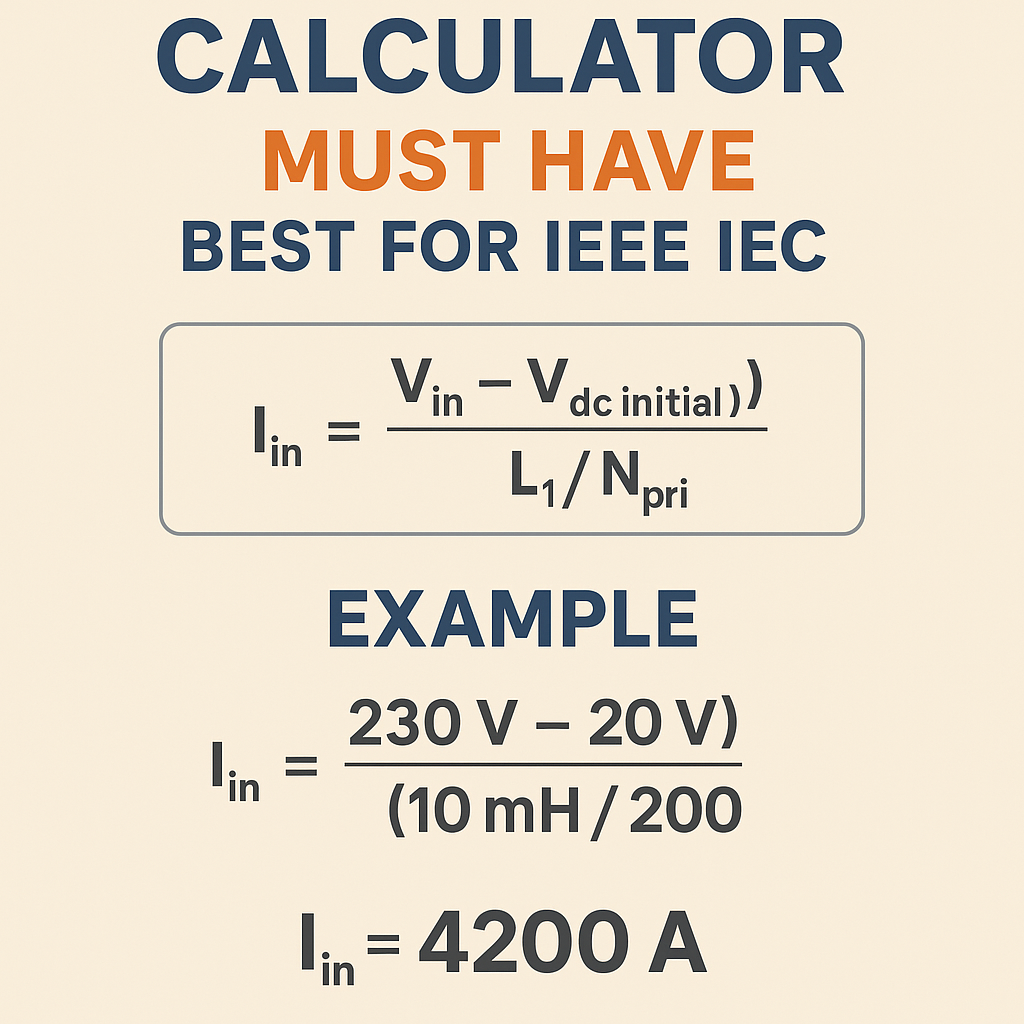
Fundamental categories of inrush phenomena
- Capacitor charging inrush (RC transient).
- Transformer magnetizing inrush at energization (residual flux and point-on-wave dependent).
- Induction motor locked-rotor and starting inrush (locked-rotor impedance and starting torque profile).
- Electronic power supplies and DC-link capacitors (high peak currents during capacitor charging and rectifier conduction).
Core mathematical models and formulas
Presenting core equations with defined variables and typical values used in IEEE/IEC guidance.
Capacitor charging through source impedance (RC)
Equation for voltage across capacitor when charged through series resistance R from step voltage V_s:
V_c(t) = V_s · (1 - e-t/(R C))
Current through resistor and capacitor:
I(t) = (V_s / R) · e-t/(R C)
Variables and typical values:
- V_s = source voltage (V). Typical: 400 V, 480 V.
- R = source series resistance + insertion resistance (Ω). Typical effective R: 0.01 – 1 Ω depending on upstream impedance and surge limiting devices.
- C = capacitance (F). Typical large DC-link: 1 mF – 100 mF per phase.
Inductive motor locked-rotor current (steady locked-rotor magnitude)
Per-phase locked-rotor current magnitude (when rotor locked):
Z_locked = sqrt(R_a2 + X_s2)
Variables and typical values:
- V_line = rated line-to-line voltage (V). Typical: 400 V, 690 V.
- R_a = stator resistance (Ω). Typical: very small, e.g., 0.01 – 0.3 Ω depending on frame size.
- X_s = locked-stator reactance (Ω). Typical yields locked-rotor currents 5–10 times rated current.
Transformer magnetizing inrush (phenomenological model)
Transformer inrush contains steady sinusoidal component and transient DC-decaying component. A commonly used compact model:
I(t) = I_ss · sin(ωt + φ) + I_DC · e-t/τ
Where:
- I_ss = V_m / |Z_s| is the steady-state sinusoidal magnetizing current magnitude, with V_m the supply phasor amplitude and Z_s the source plus transformer magnetizing impedance.
- I_DC = initial DC offset due to residual flux and switching instant (A). Worst-case I_DC can be several times rated magnetizing current and can lead to inrush peaks of 10–30·I_rated.
- τ = L_m / R_s is the decay time constant (s); L_m magnetizing inductance, R_s equivalent source resistance.
This representation matches IEC/IEEE guidance for first-order approximation and is suitable for engineering calculators that include residual flux and switching angle.
Source impedance and short-circuit relationship
Source impedance is critical in converting calculated flux-driven voltage differences into current peaks. Use base MVA/percent impedance or short-circuit level representation.
| System Short-Circuit Level (MVA) | Equivalent Z_source (% at base) | X/R Typical | Approx. Source R (Ω per phase at 11 kV) |
|---|---|---|---|
| 1000 MVA | 0.5% | 10 | ~0.0012 Ω |
| 500 MVA | 1.0% | 8 | ~0.0024 Ω |
| 100 MVA | 5.0% | 6 | ~0.012 Ω |
| 50 MVA | 10.0% | 5 | ~0.024 Ω |
| 10 MVA | 50.0% | 3 | ~0.12 Ω |
Source impedance must be converted to per-phase or per-unit when used with transformer or motor base values. IEC 60076 and IEC 60909 provide methodologies for converting fault levels to impedances suitable for transient analysis.
Key parameters that an inrush calculator must capture
- System short-circuit level or source impedance (magnitude and X/R).
- Switching instant (point-on-wave) and whether pre-insertion resistors or vacuum/power switching are used.
- Residual flux in transformer cores (per unit of saturation flux).
- Device characteristics: transformer magnetizing inductance and leakage, motor locked-rotor impedance, and capacitor ESR/ESL.
- Protection device characteristics: instantaneous trip levels, thermal time constants, and inverse-time curves (IEC 60255 / IEEE device curves).
Extensive tables of common values and multipliers
These tables give reference multipliers and ranges used by engineers when exact parametric data is unavailable.
| Device / Load | Typical Inrush Multiplier (peak / rated) | Typical Duration | Notes |
|---|---|---|---|
| Power transformer (cold-start, worst-case residual flux) | 5 – 30 x I_rated | ~50 ms – few seconds (decay dependent on τ) | Highly dependent on residual flux and switching angle; IEC recommends worst-case checks. |
| Distribution transformer (small units) | 3 – 20 x I_rated | ~100 ms | Smaller cores often saturate more easily; single-phase transformers show pronounced inrush. |
| Induction motor (locked rotor) | 4 – 9 x I_rated | 0.2 s – 5 s (start time) | Depends on design and starting method (direct-on-line, star-delta, soft-start). |
| Capacitor bank (unlimited source) | Large peak determined by V/R, up to tens of kA for distribution banks | Transient < 10 ms to several cycles | Limited by series impedance or pre-charge resistors. |
| Inverter front-end (bulk capacitor) | High instantaneous pulses, limited by input choke or NTC | < 1 ms | NTC or pre-charge circuits recommended. |
| Motor Type | Locked Rotor Current (I_LR / I_rated) | Typical X/R | Typical Starting Time |
|---|---|---|---|
| Small induction (IEC frame) | 6 – 8 | 2 – 6 | 0.5 – 3 s |
| Medium industrial | 5 – 7 | 1.5 – 4 | 1 – 10 s |
| Large high-inertia machines | 4 – 6 | 1 – 3 | 5 – 30 s |
Protection coordination and device selection per IEC/IEEE
Protective relays and circuit breakers must be selected with both steady-state short-circuit and transient inrush in mind. Two common failure modes are nuisance tripping due to transient peaks and inadequate clearing of genuine faults.
Selection checklist for protection engineers
- Compare calculated peak inrush with device instantaneous trip setting. Use time-delayed or adjustable instantaneous to prevent nuisance trips.
- Verify thermal energy (I2t) during starting or inrush against fuse or relay thermal trip characteristics.
- Apply time-coordination curves (IEC 60255, IEEE C37 series) and perform sensitivity analyses for worst-case switching angles and residual flux.
- Consider insertion of pre-insertion resistors, NTCs, soft-starters, or inrush limiting devices to reduce peaks below trip thresholds.
Worked example 1 — Transformer energization (three-phase 1000 kVA 11 kV/415 V)
Scenario: Energize a 1000 kVA three-phase power transformer (delta-wye) from an 11 kV bus. System short-circuit level at the transformer HV bus: 200 MVA. Transformer %Z (rated) = 6%. Residual flux = 0.25 pu. Switching at voltage zero worst-case angle.
Step 1: Compute base currents and source impedance
Transformer rated HV current per phase (line):
Using numeric values:
Convert system short-circuit level to equivalent source impedance at HV base:
Z_source = (V_base2) / S_sc = (11,0002) / (200,000,000) = 0.605 Ω (three-phase equivalent)
Step 2: Estimate magnetizing inductance and steady-state magnetizing current
Step 3: Compute steady sinusoidal component I_ss
Combine the source impedance and the magnetizing reactance in series (approx): |Z_s| ≈ sqrt(R_source2 + X_m2), but R_source small; use |Z_s| ≈ X_m for magnetizing-limited case. Thus:
I_ss ≈ V_phase / X_m = 6,350 / 12,095 = 0.525 A (consistent).
Step 4: Estimate DC offset and peak inrush
Worst-case DC offset is driven by residual flux 0.25 pu and switching at voltage zero, which can superimpose to produce additional flux up to 1.25 pu. Using a simplified proportional relation between flux change and DC current amplitude:
I_DC ≈ (ΔΦ / Φ_base ) · (V_phase / |Z_s|)
Assume ΔΦ = 1.0 pu (worst-case added flux). Then I_DC ≈ 1.0 · 0.525 A = 0.525 A. Exponential decay time constant:
τ = L_m / R_source. Using X_m = ω L_m => L_m = X_m / ω with ω = 2 · π · 50 = 314.16 rad/s.
τ = 38.5 / 0.1 = 385 s (note: large L and small R produce long decay; in real installations eddy currents and core nonlinearity shorten effective time constant; typical measured decay may be a few seconds due to nonlinear magnetics and damping through leakage).
Step 5: Approximate peak current
Using the compact form: I_peak ≈ I_ss + I_DC (for worst instantaneous polarity) => I_peak ≈ 0.525 + 0.525 = 1.05 A. That is far below rated current, which indicates that magnetizing reactance estimated here yields low magnetizing current. However, real transformers saturate; nonlinear magnetizing inductance reduces X_m near saturation and causes inrush much larger.
Using empirical multiplier approach from table: conservative inrush multiplier for power transformer = 5 – 30 times rated. For a 1000 kVA transformer rated HV current = 52.5 A, worst-case peak could be up to 1,575 A (30 · 52.5 A).
Design decision
Protection settings must assume worst-case inrush (e.g., 10x – 30x). Use inrush-blocking features, delayed instantaneous thresholds, or pre-insertion resistors. IEEE C57.12.x and IEC 60076 recommend verification with detailed nonlinear magnetizing models or measurement if risk warrants.
Worked example 2 — Direct-on-line (DOL) motor start (400 V, 200 kW)
Scenario: A 200 kW, 400 V, 50 Hz slip-ring induction motor. Motor rated current I_rated = 350 A (approx). Locked-rotor current ratio 6 x rated. System short-circuit level at bus: 100 MVA.
Step 1: Compute locked-rotor current
I_LR = 6 · I_rated = 6 · 350 A = 2,100 A (peak magnitude near). For three-phase steady RMS locked condition, this is RMS value; instantaneous peaks may be up to sqrt(2) · I_LR if sinusoidal.
Step 2: Determine source contribution and voltage dip
System short-circuit current at 400 V for 100 MVA:
Equivalent source impedance per phase: Z_source = V_phase / I_sc_phase; since three-phase magnitude extremely stiff, voltage dip under starting current approximated by:
Voltage drop fraction = I_start / I_sc = 2,100 / 144,337 = 0.0145 => ~1.45% voltage dip, negligible.
Step 3: Protection setting check for MCCB or breaker
If instantaneous trip of feeder breaker is set to 3,000 A, the starting current 2,100 A will not trip instantaneously. Check thermal I2t for overload protection during start time 2 s. Use motor starting energy: energy = I_rms2 · t.
Assume I_rms during start ~ I_LR = 2,100 A. Energy = (2,100)2 · 2 = 8.82 · 106 A2s.
Compare to fuse or relay thermal capability curve; choose protective device with appropriate long-time pickup and time delay to tolerate start energy.
Step 4: Mitigation options
- If nuisance trips occur, consider reduced instantaneous setting or use soft starter/VFD to limit starting current.
- Star-delta or autotransformer starting can reduce initial current by approximate factors (star reduces by sqrt(3) on line current).
Practical guidance for building an inrush current calculator
Key features to include for compliance with IEEE and IEC practices:
- Inputs: system short-circuit MVA or source R/X, device rated data (S, V, %Z, X/R), residual flux (for transformers), switching angle selection, pre-insertion resistor or pre-charge options.
- Model choices: simple empirical multipliers for early assessment; linearized RL/RC models for capacitive/inductive circuits; nonlinear magnetization curve option for transformers (B-H curve or lookup table).
- Output: peak instantaneous current, RMS energy (I2t) for specified duration, expected voltage dip, time-domain waveform preview (one cycle to several seconds), and recommended protection settings.
- Standards checks: flag if calculated inrush > device instantaneous pickup or if I2t exceeds fuse/relay thermal withstand thresholds.
Validation, measurement, and uncertainty
Always corroborate calculated results with field measurements where possible. Transformer inrush is strongly nonlinear and sensitive to small changes:
- Residual flux uncertainty is a major contributor to inrush variance.
- Switching time (point-on-wave) alters DC component direction and magnitude.
- Source impedance varies with network topology; use worst credible case for conservative design.
Standards and normative references
Key standards and guidelines to consult when developing calculators and setting protection:
- IEC 60076 series — Power transformers (general guidance on transformer performance and testing). Link: https://www.iec.ch/
- IEEE C57.12.x — Transformer standard series (IEEE Xplore / IEEE Standards). Link: https://standards.ieee.org/
- IEC 60909 — Short-circuit currents in three-phase AC systems (methodology for source and fault level calculations). Link: https://www.iec.ch/
- IEC 60255 / IEEE C37.xx — Relay and protective device performance and testing methodologies.
- NEMA MG1 and IEEE 141 — Electric machine performance and short-circuit considerations.
Best practices and mitigation techniques
- Use pre-insertion resistors or NTC thermistors for large capacitor banks to limit initial peak.
- For transformers, consider restrike-proof switching, synchronized switching at voltage peak, or inrush-limiting reactors if space allows.
- For motors, soft-starters or VFDs provide controlled ramp and substantially reduced inrush and mechanical stress.
- Coordinate protection with time grading and thermal capability checks rather than instantaneous magnitude alone.
Additional calculation tips and common pitfalls
- Never ignore nonlinear magnetization curves for transformers when accuracy is needed; linear models underpredict inrush during saturation events.
- When using empirical multipliers, document the assumed condition (residual flux, switching angle) and apply safety margins.
- Report both peak instantaneous and RMS (I_rms) during inrush period; devices respond differently to peaks and thermal energy.
- Model the source as frequency-dependent when using long cables or transformers with significant leakage impedance.
Further reading and authoritative resources
- IEC 60076 series — general transformer guidance: https://www.iec.ch/
- IEEE Transformer and Generator groups publications — search IEEE Xplore for "transformer inrush" papers for practical measurement data: https://ieeexplore.ieee.org/
- IEC 60909 for systematic fault level and source impedance calculation: https://www.iec.ch/
- NEMA and Manufacturer application guides for motor starting and transformer energization procedures.
Summary of actionable recommendations
- Implement calculator inputs for source impedance, device parametrics, switching instant, and residual flux.
- Provide both simplified empirical multiplier mode and detailed time-domain mode (RL/RLC or nonlinear B-H).
- Always compare peak and I2t against protection device settings; include time delays and thermal curves.
- Document assumptions clearly and recommend field verification for high criticality installations.
Accurate inrush current calculation aligned with IEEE and IEC best practices prevents nuisance trips, ensures equipment longevity, and supports reliable coordination of protection systems. Use conservative worst-case modeling for protection settings and refine with measurements or nonlinear models where available.