I = kW × 1,000 ÷ (V × √3 × PF) | I = HP × 746 ÷ (V × √3 × PF × η) | I = kVA × 1,000 ÷ (V × √3)Choose the matching power: kW = electrical input; HP = motor shaft output (enter efficiency); kVA = total apparent power. For shaft output in kW, divide by efficiency before using kW mode. These calculations assume a balanced three-phase load.
📊 Calculated Motor Current Examples
| HP | A at 480 V | A at 415 V |
|---|---|---|
| 5 | 5.86 | 6.78 |
| 10 | 11.73 | 13.57 |
| 25 | 29.32 | 33.92 |
| 50 | 58.65 | 67.83 |
| 100 | 117.29 | 135.67 |
Three-phase current calculator
Choose the power shown on your meter or nameplate. Motor shaft kW includes the efficiency step automatically.
Compare current at seven voltages
Same entered power, PF and efficiency at each voltage. This does not establish that equipment can operate at another voltage.
| Line-to-line voltage | Calculated line current |
|---|
Balanced running current only. Motor starting, unbalanced loads, cable ampacity and protective-device selection need separate checks.
Check cable voltage drop with this currentThe next tool receives voltage, current and PF. Enter your cable length, material, resistance, reactance and temperature there. No cable is selected for you; the initial 3% target is editable.
The three-phase current calculator estimates line current from electrical input kW, motor shaft kW or HP, or total kVA for a balanced AC load. Enter line-to-line voltage and the power factor at the operating load; both shaft-output modes need motor efficiency. For electrical input, I = kW × 1000 ÷ (√3 × V × PF). Select Motor shaft output kW to apply efficiency automatically; the result also shows the electrical input power. The result describes running current at those inputs.
Use the examples to compare voltage and power assumptions, then check the actual equipment data. Cable sizing, motor overload settings and short-circuit protection require their own installation checks; this conversion is not a code-table motor current or an automatic equipment selection.
Use the current result to check a three-phase cable
For a balanced load drawing 15 kW of electrical input at 480 V and PF 0.85, the estimated line current is 21.23 A. Keep the distinction between electrical input and motor shaft output when transferring values between tools.
- Compare conductor candidates with the wire size and ampacity calculator. Its ampacity result still needs the circuit’s applicable load, terminal and installation checks.
- Then use the three-phase voltage drop calculator with resistance and reactance. Enter line-to-line voltage, line current, the stated power factor and the cable data in the units requested by that tool.
Check running and starting conditions separately for motors: this steady-state current calculation does not predict starting voltage dip.
Three-Phase Motor Current Estimates
The values below are calculated examples using power factor 0.85, efficiency 90%, and 746 watts per mechanical HP, matching the calculator with those inputs. They are not standardized motor full-load current values. Actual current depends on the motor and operating conditions; verify the motor nameplate and the applicable installation rules separately.
| Shaft HP | A at 208 V | A at 380 V | A at 415 V | A at 480 V |
|---|---|---|---|---|
| 1 | 2.71 | 1.48 | 1.36 | 1.17 |
| 2 | 5.41 | 2.96 | 2.71 | 2.35 |
| 3 | 8.12 | 4.44 | 4.07 | 3.52 |
| 5 | 13.53 | 7.41 | 6.78 | 5.86 |
| 7.5 | 20.30 | 11.11 | 10.17 | 8.80 |
| 10 | 27.07 | 14.82 | 13.57 | 11.73 |
| 15 | 40.60 | 22.22 | 20.35 | 17.59 |
| 20 | 54.14 | 29.63 | 27.13 | 23.46 |
| 25 | 67.67 | 37.04 | 33.92 | 29.32 |
| 30 | 81.20 | 44.45 | 40.70 | 35.19 |
| 40 | 108.27 | 59.26 | 54.27 | 46.92 |
| 50 | 135.34 | 74.08 | 67.83 | 58.65 |
| 75 | 203.01 | 111.12 | 101.75 | 87.97 |
| 100 | 270.68 | 148.16 | 135.67 | 117.29 |
| 150 | 406.02 | 222.24 | 203.50 | 175.94 |
| 200 | 541.36 | 296.32 | 271.33 | 234.59 |
These reference values are approximate and are not a cable-sizing table. Use the applicable installation rules to determine whether tabulated motor current or nameplate current governs each calculation; conductor sizing, short-circuit protection and overload protection are different checks.
Three-Phase Current Formulas Step by Step
Choose electrical input kW, motor shaft output kW, shaft HP or total kVA. Shaft-output modes apply efficiency automatically; measured electrical input does not need another efficiency adjustment.
From kW (kilowatts)
Use electrical input kW, line-to-line voltage and the corresponding power factor. If a motor is rated in shaft-output kW, first use input kW = shaft kW ÷ efficiency. Do not divide measured input kW by efficiency again.
From motor shaft output kW
Select Motor shaft output kW and enter the nameplate output power with efficiency at the operating load. The calculator shows the corresponding electrical input kW and applies efficiency once.
From HP (horsepower)
Use motor shaft horsepower and efficiency at the operating load. The calculator keeps the rounded mechanical-horsepower conversion of 746 W/HP used in the examples and tables. Efficiency converts shaft output to electrical input; power factor then relates electrical input power to current.
From kVA (kilovolt-amps)
For transformer and generator nameplate ratings. No power factor is needed because kVA already represents apparent power (the full current product). This formula is the simplest of the three.
Step-by-step: Calculate amps for a 15 kW load at 480 V, PF 0.85
- Identify values: kW = 15, V = 480, PF = 0.85.
- Apply formula: I = 15 × 1,000 ÷ (480 × 1.732 × 0.85).
- Calculate denominator: 480 × 1.732 = 831.36 → 831.36 × 0.85 = 706.66.
- Calculate current: 15,000 ÷ 706.66 = 21.23 A.
- Context: This result assumes 15 kW of electrical input. If 15 kW is motor shaft output, divide it by motor efficiency before using kW mode.
kW vs. HP vs. kVA — Which Formula to Use
| Starting Unit | Formula | PF Needed? | η Needed? | When to Use |
|---|---|---|---|---|
| kW | I = kW × 1,000 ÷ (V × √3 × PF) | Yes | No | Measured electrical input or a load stated as input kW |
| Shaft kW | I = shaft kW × 1,000 ÷ (V × √3 × PF × η) | Yes | Yes | Mechanical motor output in kW |
| HP | I = HP × 746 ÷ (V × √3 × PF × η) | Yes | Yes | Motor nameplates (NEMA rated) |
| kVA | I = kVA × 1,000 ÷ (V × √3) | No | No | Transformer / generator nameplates |
Match the power to the measurement point. Electrical input kW already includes the motor’s losses; shaft HP does not. Total kVA uses neither another efficiency adjustment nor another PF adjustment. A VFD’s mains input and motor output are separate measurement points. The balanced-load formula does not calculate individual currents for an unbalanced panel.
Amps to kW / HP — Inverse Calculation
To go the other direction — from measured amps to power — rearrange the formulas:
| Line voltage (V) | Line current (A) | PF | Electrical input kW | Shaft HP at η = 0.90 |
|---|---|---|---|---|
| 208 | 28 | 0.85 | 8.57 | 10.34 |
| 380 | 30 | 0.85 | 16.78 | 20.25 |
| 415 | 30 | 0.85 | 18.33 | 22.11 |
| 480 | 65 | 0.87 | 47.01 | 56.72 |
| 480 | 124 | 0.86 | 88.66 | 106.96 |
For more detail on the amps-to-kW direction, use our Amps to kW Calculator. And to convert amps directly to horsepower, try the Amps to HP Calculator.
5.5, 15 and 22 kW three-phase motors: how many amps?
A motor’s rated kW is normally mechanical output. Convert it to electrical input before using this calculator’s kW mode: input kW = output kW ÷ efficiency. Enter the voltage measured between phases.
| Motor output | Voltage | Input kW to enter | Current |
|---|---|---|---|
| 5.5 kW | 415 V | 6.1111 | 10.00 A |
| 15 kW | 400 V | 16.6667 | 28.30 A |
| 15 kW | 480 V | 16.6667 | 23.58 A |
| 22 kW | 380 V | 24.4444 | 43.69 A |
| 22 kW | 415 V | 24.4444 | 40.01 A |
| 22 kW | 480 V | 24.4444 | 34.59 A |
5.5 kW to amps at 415 V
With PF 0.85 and 90% efficiency: I = 5,500 ÷ (√3 × 415 × 0.85 × 0.90) = 10.00 A. Select Motor shaft output kW, enter 5.5, then 415 V, PF 0.85 and efficiency 0.90.
22 kW to amps at 415 V
With the same assumptions: I = 22,000 ÷ (√3 × 415 × 0.85 × 0.90) = 40.01 A. Select Motor shaft output kW and enter 22, 415 V, PF 0.85 and efficiency 0.90.
Use the actual nameplate efficiency and power factor when available. These are running-current estimates, not starting currents or cable and breaker selections. If your kW already measures electrical input, do not divide it by efficiency again.
Formula reference: Schneider Electric — induction motor current demand.
6 Solved Examples — Real-World 3-Phase Amp Calculations
Example 1 — 15 kW Electrical Input at 480 V
Data: 15 kW electrical input, 480 V line-to-line, PF 0.86.
Formula: I = 15000 ÷ (√3 × 480 × 0.86) = 20.98 A.
If 15 kW is shaft output instead, divide by motor efficiency first. At efficiency 0.90 and the same PF, the estimate is 23.31 A.
Example 2 — 50 HP Motor at 415 V
Data: 50 HP shaft output, 415 V, PF 0.85, efficiency 0.91.
Formula: I = (50 × 746) ÷ (√3 × 415 × 0.85 × 0.91) = 67.09 A.
This is running current at the stated operating point. Motor starting and protective-device settings require separate data.
Example 3 — 100 kVA Transformer at 480 V
Data: 100 kVA total three-phase rating, 480 V.
Formula: I = 100000 ÷ (√3 × 480) = 120.28 A.
The result is rated line current on the 480 V side. Actual load current may be lower. It does not by itself select a breaker or conductor.
Example 4 — 22 kW Compressor Input at 380 V
Data: 22 kW measured electrical input, 380 V, PF 0.85.
Formula: I = 22000 ÷ (√3 × 380 × 0.85) = 39.32 A.
If 22 kW is the motor’s shaft-output rating, include efficiency. At η = 0.90, the corresponding current is 43.69 A.
Example 5 — 7.5 HP Motor at 208 V
Data: 7.5 HP shaft output, 208 V, PF 0.82, efficiency 0.88.
Formula: I = (7.5 × 746) ÷ (√3 × 208 × 0.82 × 0.88) = 21.52 A.
Changing voltage changes current for the same power, PF and efficiency. Keep all three assumptions visible when comparing results.
Example 6 — 75 kW Electrical Input at 400 V
Data: 75 kW electrical input, balanced 400 V supply, measured true PF 0.95.
Formula: I = 75000 ÷ (√3 × 400 × 0.95) = 113.95 A.
This example refers to the supply measurement point. Do not treat it as motor shaft power or infer VFD output current from the input PF. For a VFD, use its rated input/output data and suitable measurements at each side.
Where You Need the 3-Phase Current Calculation
Breaker and cable sizing
Use the current estimate to understand the operating load. Then establish the design current required for that circuit and check conductor ampacity, terminals, installation conditions, voltage drop and protective-device coordination. For motor circuits, the required basis may be a code-table current or nameplate current depending on the check; these quantities are not interchangeable.
Motor overload relay settings
Use the motor nameplate, service information and the relay manufacturer’s setting instructions. A calculated running current cannot replace missing nameplate information. Overload protection and short-circuit protection perform different functions and must be selected separately.
Transformer and generator load verification
Compare measured phase currents with the equipment ratings and operating limits. An 80% loading value is not a universal transformer thermal limit. Generator assessment also needs active-power capacity, starting demand and transient performance; use the manufacturer’s data.
Load balancing across phases
The calculator returns one line-current estimate for a balanced load. For a panel with single-phase or unequal loads, calculate each branch with its own connection and PF, then combine currents as phasors where needed. Neutral current and phase imbalance are separate checks. Use the balanced and unbalanced load guide for that workflow.
Quick Equivalences
3-Phase Current Formula
I = electrical input kW × 1000 ÷ (√3 × V × PF). Use line-to-line voltage and a balanced load.
3-Phase Amp Calculator
Choose the matching electrical-input, motor-shaft or kVA basis, enter the data, then select Calculate Amps. PF is needed for kW and HP; efficiency is needed for shaft kW and HP.
kW to Amps 3-Phase
15 kW electrical input at 480 V and PF 0.85 gives 21.23 A. If 15 kW is shaft output at efficiency 0.90, it gives 23.58 A.
3-Phase Motor Amps Calculation
50 HP at 480 V, PF 0.85 and efficiency 0.90 gives 58.65 A. Change PF and efficiency to match the motor.
Amperage Calculator 3-Phase
Amperage means current in amperes. For the same balanced power and PF, higher line voltage produces a lower calculated line current.
3-Phase Load Calculator
Use this tool for one balanced load or a balanced total with a known overall PF. A panel with unequal single-phase loads needs a phase-by-phase calculation; adding all current magnitudes does not calculate neutral current.
Three-Phase Current Calculation
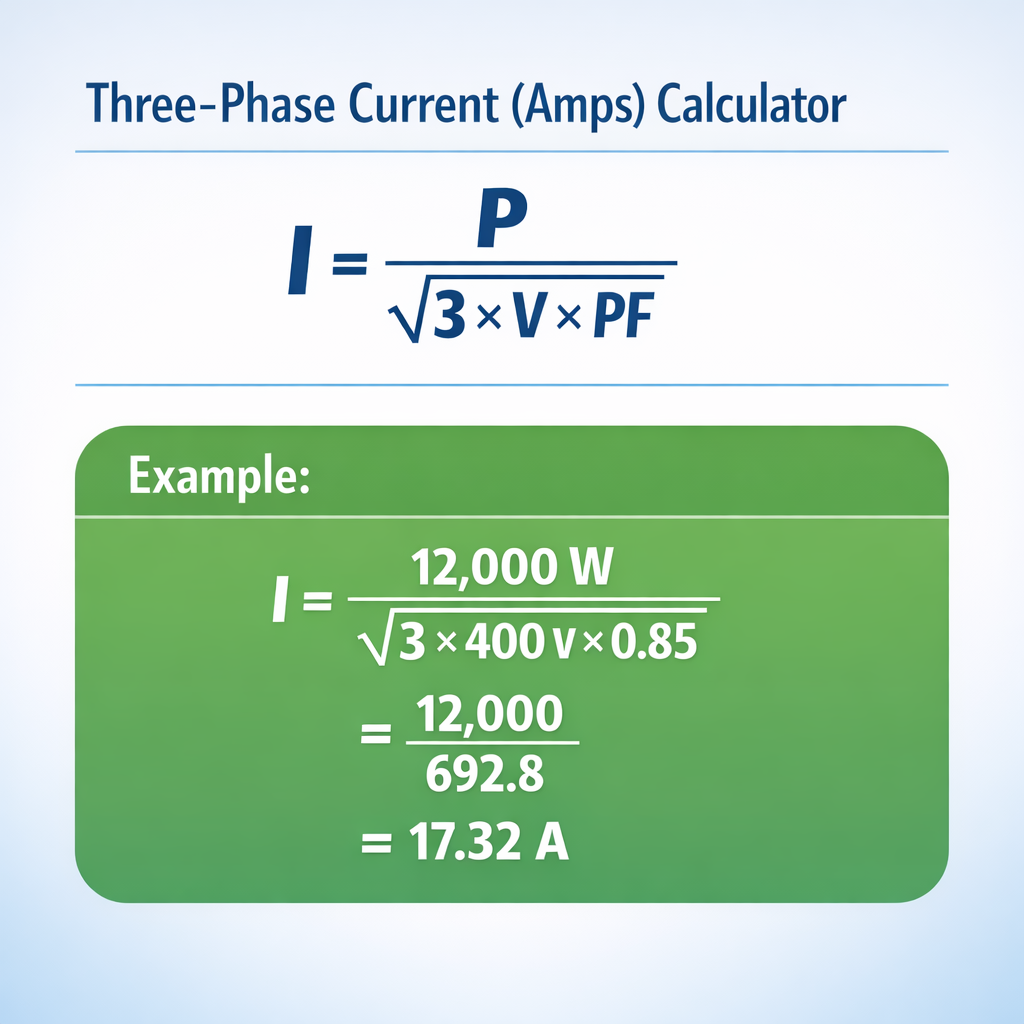
When input power is in watts, use I = P ÷ (√3 × V × PF). The ×1000 factor is only needed when input power is in kW.
Calculating 3-Phase Amps
From total kVA, use I = kVA × 1000 ÷ (√3 × V). A 75 kVA load at 480 V gives 90.21 A, with no additional PF factor.
FAQ — Three-Phase Current Calculation
What is the formula for three-phase current?
For balanced electrical input, I = kW × 1000 ÷ (√3 × V × PF), using line-to-line voltage. For 22 kW input at 380 V and PF 0.85, I = 39.32 A.
Why is √3 used in three-phase calculations?
For a balanced three-phase system, √3 relates line-to-line voltage and line current to total power. The line voltages have 120° phase separation; the single-phase formula cannot be applied to the same total power and line voltage.
How do I calculate amps from HP for a three-phase motor?
Use I = HP × 746 ÷ (√3 × V × PF × η). For 50 HP at 480 V, PF 0.85 and efficiency 0.91, the estimate is 58.00 A.
What is a typical power factor for a three-phase motor?
Use the motor data or a suitable measurement at the operating load. PF changes with loading. The preset 0.85 is an example, not a value established for your motor. For a VFD, distinguish true input PF from displacement PF and motor-side quantities.
How many amps does a 100 HP motor draw at 480 V?
At PF 0.86 and efficiency 0.93, I = (100 × 746) ÷ (√3 × 480 × 0.86 × 0.93) = 112.19 A. This estimate is not a standardized motor full-load current; use the required data source for each installation check.
What is the difference between line current and phase current?
For a balanced wye connection, line current equals winding current. For balanced delta, line current is √3 times winding current. The formulas on this page use line current and line-to-line voltage.
Can I use the same formula for 208 V and 480 V?
Yes, for the same balanced-load assumptions. Enter the actual line-to-line voltage. With unchanged power, PF and efficiency, current at 208 V is 480 ÷ 208 = 2.31 times current at 480 V.
How do I calculate three-phase amps from kVA?
Use I = kVA × 1000 ÷ (√3 × V). At 75 kVA and 480 V, the current is 90.21 A. Do not apply PF a second time.
What happens if I use single-phase formula for a three-phase load?
For 15 kW electrical input at 480 V and PF 0.85, the balanced three-phase result is 21.23 A. Omitting √3 gives 36.76 A, which represents a different circuit assumption.
How do I size a breaker from calculated amps?
First identify the circuit and the applicable design-current basis. Motor short-circuit protection, overload protection and general-load protection have different requirements. Also check starting conditions, conductor protection, interrupting capacity and the equipment instructions; this calculator does not select a breaker.
What motor efficiency should I use if it is not on the nameplate?
Check the manufacturer’s data for that motor and operating load. If it is unavailable, compare explicitly labelled assumptions such as 0.85, 0.90 and 0.95 to see the sensitivity. Do not present an assumed efficiency as a certified or conservative value.
Does frequency (50 Hz vs. 60 Hz) affect the current calculation?
Frequency is not an explicit variable in these power-to-current formulas. It can change a motor’s operating voltage, speed, efficiency and PF. Use data matching the actual frequency and the manufacturer’s permitted operating conditions.
Technical reference: U.S. Department of Energy — Determining Electric Motor Load and Efficiency, for input power, motor loading, PF and efficiency.
Related Calculators
- mm² to AWG converter: compare metric wire cross sections with AWG sizes.
- kVA to amps calculator: calculate current from apparent power and voltage.
- Amps to kW Calculator
- Amps to Watts Calculator
- Amps to VA Calculator
- Amps to HP Calculator
- Motor Efficiency Calculator
- Balanced and Unbalanced Load Calculation