Accurate step load calculation prevents generator overloads and enhances reliability across diverse electrical systems worldwide.
This methodology stages loads to balance thermal and transient constraints while minimizing unnecessary utility transfers.
Generator Step Load and Staging Calculator to Prevent Overloads and Outages
Overview of Generator Step Load Staging and Objectives
Step load staging for electrical generators is a deliberate sequencing method that minimizes transient and thermal stresses during load application. Properly staged loads reduce the risk of generator overspeed/underspeed events, protective relay operations, and cumulative thermal fatigue that leads to outages.
Key objectives include preserving prime mover torque margin, maintaining voltage and frequency within acceptable tolerances, limiting cumulative temperature rise in windings and bearings, and ensuring automatic transfer schemes operate without unexpected trips.
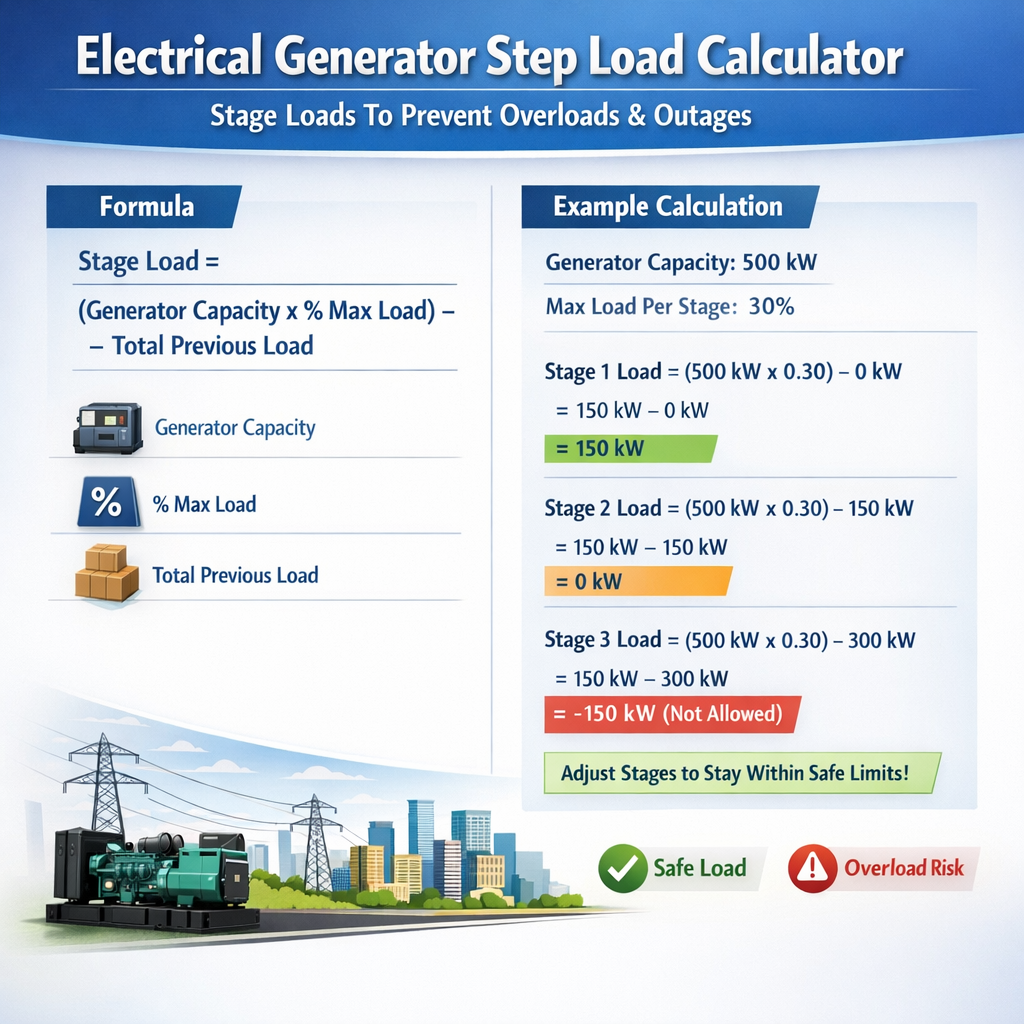
Fundamental Electrical Relationships and Formulas
The following formulas are expressed in plain HTML. Each formula is followed by a description of variables and typical values used in generator step load calculations.
1. Active Power (kW)
- V = Line-to-line voltage (volts, V). Typical values: 400 V, 480 V, 600 V, 13.8 kV.
- I = Line current (amperes, A). Typical values depend on load but often from 1 A (control circuits) to thousands of A (large gensets).
- PF = Power factor (dimensionless). Typical values: 0.8 (inductive) to 1.0 (resistive), often 0.85–0.95 for combined loads.
2. Apparent Power (kVA)
- V and I as above. kVA represents apparent power used for generator sizing because prime movers and alternators are rated in kVA.
3. Relationship between kW and kVA
- Helps convert required kW load into generator sizing kVA when PF is known or estimated.
4. Percent Load of Generator
- Used to determine staging thresholds and to avoid exceeding recommended continuous loading (usually 80–85% for standby gensets).
5. Motor Starting Inrush Approximation
Starting Current ≈ Locked Rotor Current (I_LR) ≈ k × Full Load Current
- k = locked-rotor multiple (typical 4–8 for small motors, 6–12 for large motors depending on type).
- Full Load Current (I_FL) determined by motor nameplate.
6. Simplified Thermal Accumulation Model (for step staging)
- t_i = duration of step i (seconds or minutes).
- Load_i = kVA applied during step i.
- Rated = generator rated kVA.
- n = thermal exponent (commonly between 1 and 2 depending on component thermal time constants; 1.6 used for conservative estimation).
- Used to approximate cumulative heating effect of successive steps on stator windings or cooling system.
Design Criteria and Practical Limits
Generator manufacturers and standards set guidance for continuous and standby loading. For standby systems, continuous loading to rated value is usually allowable for short durations, but manufacturers often recommend not exceeding 80–85% for prolonged operation to avoid overheating and accelerated wear.
Key design constraints for step load staging include:
- Transient voltage dip limits (typically ±5–10% allowable depending on critical loads).
- Frequency deviation limits (ISO and facility-specific tolerances, often ±0.5 Hz for sensitive equipment).
- Maximum allowable cumulative heating for rotor/stator per thermal model.
- Protection relay coordination thresholds (overcurrent, reverse-power, loss-of-field, over-speed).
Standards and Normative References
Design and verification of step load staging should reference international and national standards:
- NFPA 110, Standard for Emergency and Standby Power Systems — https://www.nfpa.org/
- NFPA 70 (National Electrical Code) — https://www.nfpa.org/
- IEEE 446, Recommended Practice for Emergency and Standby Power Systems for Industrial and Commercial Applications — https://standards.ieee.org/
- ISO 8528 series for generator set performance and testing — https://www.iso.org/
- IEC 60034 rotating electrical machines general specifications — https://www.iec.ch/
Key Parameters Required for a Step Load Calculator
To build an effective step load calculator, collect the following parameters:
- Generator rated kVA, rated voltage, rated speed (rpm), and rated power factor.
- Prime mover torque margin and governor response time.
- Load list with steady-state kW/kVA, inrush/starting currents, power factors, and duty cycles.
- Time constraints for staging (maximum allowed step duration, acceptable transfer delays).
- Protection relay setpoints and breaker interrupt ratings.
- Thermal characteristics: stator thermal time constant, cooling method, maximum winding temperature.
Tables of Typical Values and Lookup Data
| Load Type | Typical Power Factor | Starting Multiple (I_LR / I_FL) | Typical Duration of Inrush | Notes |
|---|---|---|---|---|
| Resistive Heaters | 1.00 | 1.0 | Instant | No inrush; simple staging |
| Incandescent Lighting | 0.95 | 1.2 | Instant | Low inrush; often grouped with small loads |
| Fluorescent Ballasts / LED Drivers | 0.90 | 1.5 | 100–500 ms | Some temporary flicker acceptable |
| Single-Phase Motors (small) | 0.85 | 4–6 | 0.5–2 s | High inrush; soft-start recommended |
| Three-Phase Induction Motors (medium) | 0.85 | 6–8 | 1–3 s | Management required to prevent voltage dip |
| Large Synchronous Motors | 0.85 | 6–12 | 2–10 s | Direct online may be unacceptable on small gensets |
| HVAC Compressors | 0.85 | 4–9 | 2–5 s | Staggered start advisable |
| Transformers Energization | — | 320% (inrush as % of nominal) | 50–200 ms | High instantaneous impulse; stage carefully |
| Generator Size (kVA) | Typical Continuous Load Recommendation | Typical Standby Peak Allowance | Common Application Examples |
|---|---|---|---|
| 50–150 kVA | ≤ 80% (40–120 kVA) | Up to 100% for short duration | Small commercial sites, small shops |
| 150–500 kVA | ≤ 80% (120–400 kVA) | Up to 100% momentary | Medium commercial, small hospitals, data closets |
| 500–1500 kVA | ≤ 85% (425–1275 kVA) | Transient support for motor starts | Large facilities, hospitals, industrial plants |
| 1500+ kVA | Site-specific engineering evaluation | Designed for peak including multiple motor starts | Utility backup, central plants |
Step Load Sequencing Algorithms — Practical Approaches
There are several algorithmic approaches to staging loads when utility fails and the generator(s) come online:
- Fixed Sequence Staging: Loads are grouped and turned on in a predetermined order with fixed delays.
- Adaptive Load Staging: Real-time measurement of frequency/voltage informs next load step, enabling dynamic adjustments.
- Priority-Based Shedding: Critical loads receive higher priority; non-essential loads only applied if capacity margin exists.
- Closed-Loop Thermal Staging: Uses thermal model to ensure cumulative heating stays within limits.
Example Sequencing Rules
- Measure generator rpm and bus voltage. If below threshold, delay further load application.
- Apply non-motor loads first (lighting, control loads, electronics) while generator recovers from transient.
- Introduce motor loads in staggered intervals based on their locked-rotor multiples and motor priorities.
- Monitor kVA loading; if approaching 80–85% continuously, pause staging and shed non-critical loads.
- For large motor starts, use soft starters or VFDs to reduce inrush current and allow simultaneous starting.
Detailed Example 1: Hospital Emergency Power Staging
Scenario: A hospital has a 1000 kVA standby generator, rated at 480 V, 0.8 PF. Essential loads include ICU, emergency lighting, HVAC (partial), and an elevator. Objective: Stage loads to prevent utility transfer failures and avoid generator overload during extended outage.
Step 1: Inventory loads (steady-state kW and motor inrush)
- ICU ventilators and monitors: 60 kW (non-motor, PF 0.98)
- Lighting and outlets (essential): 40 kW (PF 0.95)
- Partial HVAC (critical AHUs): 150 kW (PF 0.85; includes compressor motors)
- Elevator: 50 kW peak motor (starting multiple 6×, I_LR equivalent)
- Kitchen emergency systems: 30 kW (PF 0.92)
- Other critical systems: 20 kW
Step 2: Convert kW to kVA where needed
Total kW steady-state = 350 kW.
Assume average PF = 0.88 (weighted estimate). Then required kVA = kW / PF = 350 / 0.88 = 397.7 kVA.
Step 3: Evaluate generator percent load
Steady-state loading is below recommended continuous limits; however, motor starting and transformer inrush must be considered.
Step 4: Motor starting impact (elevator and HVAC compressors)
- Elevator starting apparent kVA = 50 kW / 0.85 ≈ 58.82 kVA steady; starting multiple 6× → instantaneous apparent kVA = 6 × 58.82 ≈ 352.9 kVA for the start duration (2–5 s).
- HVAC compressors combined starting apparent kVA: each compressor combined effect estimated as 4× their steady kVA. For 150 kW at PF 0.85 → steady kVA = 150/0.85 ≈ 176.47 kVA. Start inrush multiple 5× → 882.35 kVA instantaneous.
Step 5: Sequence design
- Stage A (immediate at transfer): ICU loads (60 kW), essential lighting (40 kW), control systems (20 kW) → total ≈ 120 kW → kVA ~ 136 kVA.
- Allow 15 s to stabilize generator speed and voltage.
- Stage B: Kitchen emergency systems (30 kW) and less-critical lighting (20 kW) → add 50 kW → cumulative ≈ 170 kW (~193 kVA).
- Allow 30 s; monitor %Load. If frequency drop >0.4 Hz or voltage drop >8%, pause further staging.
- Stage C: HVAC compressors introduced in soft-start mode or staged compressor starts with 60 s intervals to limit inrush to ≤25% additional generator capacity (~250 kVA margin). If soft-start not available, stagger starts so that peak starting kVA from compressors does not coincide with elevator start.
- Stage D: Elevator only after HVAC compressors stabilized; best to use elevator soft-start/drive or restrict to one car at a time.
Step 6: Verification calculation for worst-case concurrent start
Worst-case instantaneous kVA if elevator and one compressor start simultaneously (without soft-start): starting kVA ≈ 352.9 + (176.47 × 5) ≈ 352.9 + 882.35 = 1235.25 kVA, which exceeds generator rating (1000 kVA).
Mitigation: Introduce soft-start or ensure compressor and elevator starts are separated by at least the inrush duration plus stabilization window (e.g., 10–60 seconds depending on motor size). With staggering so only one large start occurs at a time, instantaneous kVA remains under ~1000 kVA.
Step 7: Thermal accumulation check (conservative)
Using n = 1.6, and durations of each stage, calculate T_accumulated to confirm long-term heating remains within acceptable bounds.
If sustained operation at steady-state 350 kW continues (397.7 kVA), %Load ≈ 40% — thermally safe. Short transient inrush events, if controlled, will not produce unacceptable heating.
Result: With the described staging and soft-starts/staggered start policy, the 1000 kVA generator supports essential hospital loads without overload or protective trips.
Detailed Example 2: Industrial Plant Motor Starting Management
Scenario: A manufacturing plant has a 750 kVA standby generator, 480 V, 0.8 PF. The plant must sequence three large motors and ancillary loads during a power outage.
Motor details:
- Motor A: 150 kW (PF 0.85), locked-rotor multiple 8×, start duration 3 s
- Motor B: 200 kW (PF 0.85), locked-rotor multiple 6×, start duration 4 s
- Motor C: 120 kW (PF 0.85), locked-rotor multiple 7×, start duration 3 s
- Lighting + controls: 50 kW (PF 0.95)
- Auxiliary heating: 80 kW (PF 1.0)
Step 1: Convert steady-state kW to kVA
Total steady kW = 150 + 200 + 120 + 50 + 80 = 600 kW.
Assume average PF = 0.88 → required kVA ≈ 600 / 0.88 = 681.8 kVA.
%Load = (681.8 / 750) × 100 ≈ 90.9% — high for standby continuous operation. Action required: stagger motor starts and possibly defer non-critical loads.
Step 2: Evaluate starting kVA for each motor
- Motor A steady kVA = 150 / 0.85 ≈ 176.47 kVA; starting kVA ≈ 8 × 176.47 ≈ 1411.8 kVA (instantaneous)
- Motor B steady kVA = 200 / 0.85 ≈ 235.29 kVA; starting kVA ≈ 6 × 235.29 ≈ 1411.8 kVA
- Motor C steady kVA = 120 / 0.85 ≈ 141.18 kVA; starting kVA ≈ 7 × 141.18 ≈ 988.26 kVA
Step 3: Staging plan
- Stage 1 (transfer immediate): Lighting + controls (50 kW), safety circuits (10 kW) → 60 kW (~63 kVA).
- Allow 10–15 s stabilize.
- Stage 2: Start Motor B first using soft starter or VFD. If soft starter available, reduce starting multiple to 1.5× → starting kVA reduced to ~353 kVA.
- Wait 30–60 s until Motor B reaches steady state and generator recovers.
- Stage 3: Start Motor A with soft start; if soft-start not available, postpone Motor A until Motor B is fully stabilized and generator loading remains <85%.
- Stage 4: Add Motor C last; because Motor C starting kVA is <1000 kVA, ensure it does not coincide with A or B starts.
- Defer auxiliary heating (80 kW) if simultaneous starts cause %Load > 85%.
Step 4: Verification if soft starters not present (worst-case)
Assume worst-case two motors start overlapping: Motor A start + Motor C start concurrently → instantaneous kVA ≈ 1411.8 + 988.26 ≈ 2399.96 kVA, far exceeding generator rating and triggering protective trips.
Mitigation: mandate hard sequencing via PLC/ATS ensuring no overlap; install soft starters or dynamic braking where possible; consider load shedding for auxiliary heating.
Step 5: Thermal accumulation verification
Sustained full steady-state loads at 600 kW produce 90.9% loading — unacceptable for continuous standby without derating or paralleling additional generator capacity. Recommended actions:
- Paralleling another generator to increase capacity and enable simultaneous starting.
- Implement soft starters to reduce instantaneous kVA during starts, allowing staged application without overload.
- Implement load shedding to reduce steady-state demand to ≤80% until utility restored.
Tool Implementation Considerations for a Step Load Calculator
A robust step load calculator application (spreadsheet or software) should include the following modules:
- Load inventory input with categories, steady kW/kVA, PF, starting multiple, start duration, priority level.
- Generator parameters: rated kVA, voltage, governor response times, permissible transient overloads.
- Sequencing engine that can apply both fixed and adaptive sequencing rules, simulate transient overlaps, and compute instantaneous and cumulative kVA and thermal accumulation.
- Real-time monitoring interface that ingests generator telemetry (frequency, voltage, current) to adapt staging under live conditions.
- Reporting and alarms for predicted overloads, excessive cumulative heating, and protective relay trip risk.
Algorithmic Pseudocode Outline
High-level logic to manage sequencing:
- Sort loads by priority and starting characteristics.
- Initialize stage = 1, currentLoad = baseline (essential non-motor loads).
- While unassigned loads exist:
- Attempt to add next highest-priority load.
- Calculate instantaneous kVA considering active starts and inrush durations.
- If instantaneous kVA ≤ generator emergency rating (and steady-state ≤ allowed continuous), commit load with specified delay.
- Else, try to apply mitigation (soft-start, longer delay, defer load) and re-evaluate.
Protective Devices, Relay Coordination, and Testing
Coordinate protective devices to avoid nuisance trips during staged starts. Key settings include:
- Overcurrent relays: account for locked-rotor currents; apply time delays to permit short inrush events.
- Under-frequency / over-frequency relays: set to trip only if sustained deviations exceed set thresholds to allow transient governor recovery.
- Voltage relays: implement supervision for sustained low-voltage conditions; transient dips during motor starts should be tolerated within limits.
- Reverse-power relays: when paralleling with utility or multiple gensets, set appropriately to prevent unintentional power flow into sources.
Testing: Conduct staged commissioning tests that sequentially add loads while logging generator metrics. Validate the step calculator predictions and refine thermal and transient models based on empirical data.
Common Pitfalls and Risk Mitigations
- Underestimating locked-rotor multiples: verify motor nameplates or manufacturer data rather than using generic multiples.
- Failing to account for transformer energization inrush: include transformer energization rules analogous to motor starts.
- Ignoring cumulative thermal effects: transient events can be safe individually but damaging in aggregation.
- Not including protection relay coordination margins, leading to nuisance trips during legitimate transients.
- Assuming nominal power factor: always measure or estimate weighted PF for mixed loads for accurate kVA conversion.
Performance Metrics and KPIs for Generator Staging Systems
Define metrics to evaluate system efficacy:
- Successful transfer rate without overload or protective trip (%)
- Average time-to-full-essential-load (seconds/minutes)
- Number of unintended generator trips per year
- Average generator loading during outage (%) and cumulative thermal index
- Mean time between forced derates or manual interventions
Advanced Techniques: Paralleling, Load Sharing and Active Controls
When a single generator cannot satisfy step-load objectives, paralleling multiple generators with proper load sharing controllers can provide smoother staging and redundancy.
Active controls include:
- Droop control optimization for stable load sharing.
- Fast digital governors to recover frequency quickly, enabling quicker subsequent steps.
- Model predictive control that anticipates upcoming load sequences and pre-positions governor and excitation to minimize transient effects.
Reference Links and Further Reading
- NFPA 110 — Standard for Emergency and Standby Power Systems: https://www.nfpa.org/ (search NFPA 110)
- NEC (NFPA 70) — National Electrical Code: https://www.nfpa.org/ (search NFPA 70)
- IEEE Std 446 — Recommended Practice for Emergency and Standby Power Systems: https://standards.ieee.org/
- ISO 8528 — Reciprocating internal combustion engine driven alternating current generating sets: https://www.iso.org/
- IEC 60034 — Rotating electrical machines: https://www.iec.ch/
- CIBSE and ASHRAE publications for HVAC motor starting and sequencing practices: https://www.ashrae.org/, https://www.cibse.org/
Operational Checklist for Implementing Step Load Staging
- Compile and verify detailed load inventory with nameplate data and manufacturer starting characteristics.
- Measure or estimate power factor for load groups; compute kVA requirements precisely.
- Model transient behavior using the step load calculator and run worst-case scenarios.
- Define staging sequences and timing with PLC/ATS logic, including fallback and manual override procedures.
- Coordinate protection relays with staged behavior in mind — perform relay coordination studies.
- Test staged sequences under controlled commissioning events and collect telemetry for model refinement.
- Document standard operating procedures and train operations staff in staged transfer and emergency responses.
Final Technical Considerations
Generator step load calculation is both an electrical and thermal engineering problem that requires conservative assumptions and iterative validation. Use manufacturer curves, real telemetry and on-site testing to validate model outputs.
Regular maintenance, firmware updates for controllers, and periodic re-validation of the step sequencing algorithm are essential to maintain reliability as site loads or equipment change.
Appendix: Common Calculation Examples (Quick Reference)
| Calculation | Expression | Example Values | Result |
|---|---|---|---|
| Convert 250 kW to kVA at PF 0.9 | kVA = 250 / 0.9 | PF = 0.9 | ≈ 277.78 kVA |
| % Load of 750 kVA gen with 400 kVA connected | %Load = (400 / 750) × 100 | 400 kVA connected | ≈ 53.33% |
| Instantaneous starting kVA for motor 100 kW PF 0.85, multiple 6× | Starting kVA = (100 / 0.85) × 6 | 100 kW, PF 0.85, 6× | ≈ 705.88 kVA |
| Thermal accumulation example | T_accumulated = Σ (t × (kVA / rated)^1.6) | 3 steps: 30 s at 0.4, 60 s at 0.6, 120 s at 0.5 (rated) | Compute per step and sum for thermal index |
Notes on Safety and Compliance
Always comply with local codes, and work with licensed electrical engineers for final designs. Safety practices must include lockout/tagout during commissioning, arc flash risk assessments, and testing under supervision to ensure personnel and equipment safety.
Contact Points for Further Technical Authority
- Generator manufacturers (for specific transient and thermal curves): e.g., Cummins, Caterpillar, MTU — consult product manuals and application engineers.
- Standards bodies for authoritative guidance: NFPA, IEEE, IEC, ISO.
- Independent testing labs for verification of thermal models and transient responses.