Fast, accurate available fault current calculations are critical for safe electrical panel labeling and compliance.
This guide explains methods, formulas, and examples for rapid AIC value determination and labeling accurately.
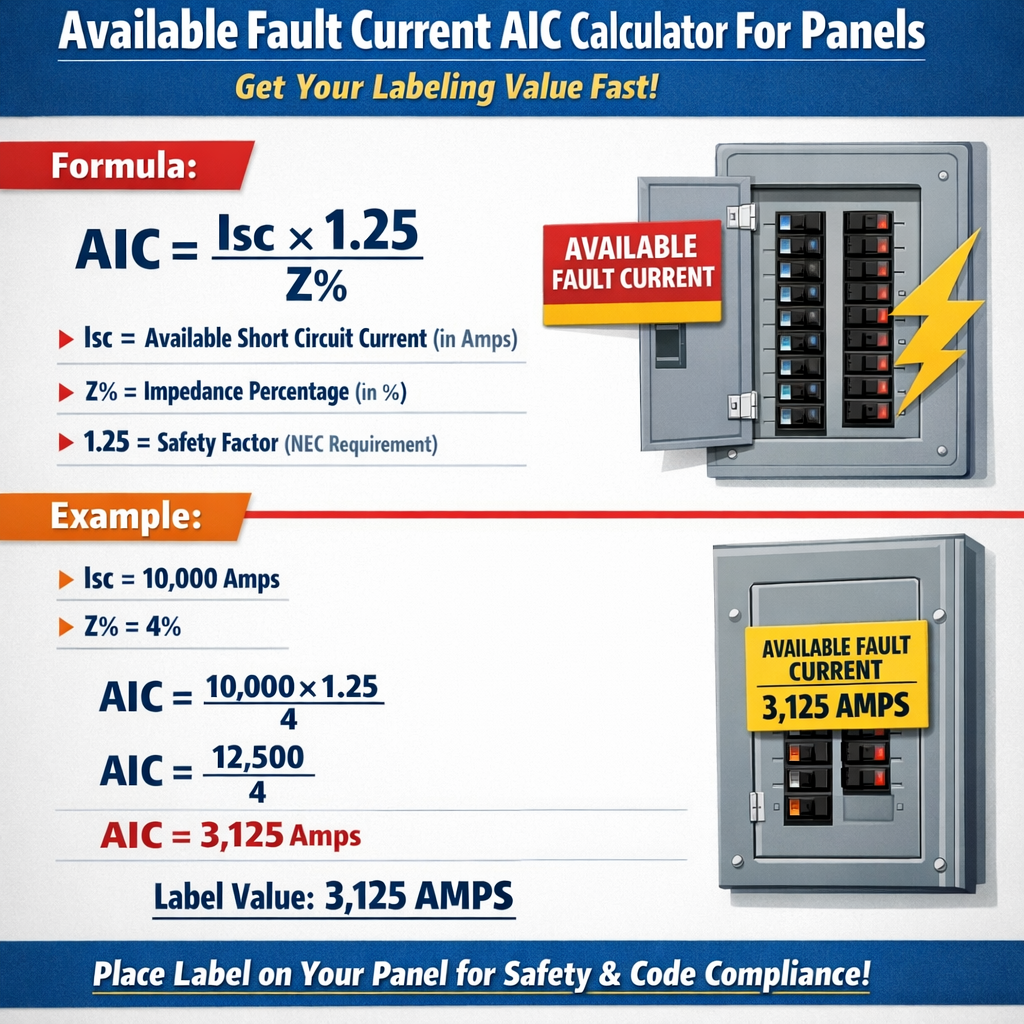
Available Fault Current (kA) Calculator for Panels – Fast AIC Labeling Value
Overview of Available Fault Current and AIC for Panels
Available fault current (AFC) — often expressed as symmetrical short-circuit current — is the prospective current a panel can see during a bolted fault condition. The Ampere Interrupting Capacity (AIC) rating (also called interrupting rating or I.R.) is the maximum fault current an overcurrent protective device (breaker/fuse) or enclosure assembly is tested to interrupt without catastrophic failure. Selecting equipment with an AIC at or above the available fault current at the point of installation is mandatory for safety and compliance.
Why Rapid Calculation Matters for Labeling and Field Work
Field technicians, designers, and inspectors require a fast, defensible method to determine the labeling value required by standards and by AHJs (Authorities Having Jurisdiction). A compact AIC calculator approach uses known source data (utility short-circuit MVA or impedance, transformer ratings and percent impedances, feeder conductor impedances) and Thevenin-equivalent combination of impedances to output available fault current at the panel.
Reference Standards and Regulatory Context
Several standards and test standards govern calculation methods and marking requirements. Key references include:
- NFPA 70 (National Electrical Code, NEC) — general requirements for electrical safety and equipment marking (see NFPA/NEC official resources).
- IEEE Std 1584 — Guide for Performing Arc-Flash Hazard Calculations (includes short-circuit current calculation guidance and uses for arc-flash hazard).
- IEC 60909 — Short-circuit currents in three-phase AC systems (widely used internationally for power system short-circuit calculations).
- UL 489 — Standard for Molded-Case Circuit Breakers, Interrupting Ratings and test evidence for AIC ratings.
Authoritative links:
- NEC (NFPA): https://www.nfpa.org/NEC
- IEEE 1584 info: https://standards.ieee.org/standard/1584-2018.html
- IEC 60909 info: https://www.iec.ch
- UL Standards catalog: https://standardscatalog.ul.com/
Basic Electrical Theory and Thevenin Equivalents
Short-circuit current at a point is computed by converting all sources and impedances in the network to a single Thevenin equivalent (voltage source and series impedance) as seen from the fault location. For three-phase systems, use line-to-line nominal voltages and symmetrical impedance. For single-line-to-ground faults and asymmetrical calculations, additional factors (DC offset, X/R ratio) are required; many labeling needs use initial symmetrical RMS values.
Key Concepts
- Per-unit (pu) impedance simplifies combining contributions from sources with different bases.
- Utility contribution is often provided as short-circuit MVA or X/R or as percent impedance at a bus.
- Transformer percent impedance (%Z) is given on the nameplate and is used to compute the transformer's Thevenin impedance at its rated voltage.
- Feeder/cable impedances (R + jX) reduce available fault current and should be included for accuracy — but field labeling can use conservative approximations if cable data is unknown.
Formulas and Variable Definitions
All formulas below use standard SI units: kVA or MVA, volts (V), amperes (A), percent impedance (%Z). Representations are three-phase balanced unless otherwise stated.
1) Rated line current (transformer):
Variables:
- I_rated — rated line current in amperes (A).
- kVA — transformer rated kVA (e.g., 500 kVA).
- V_LL — line-to-line secondary voltage in volts (e.g., 480 V).
- √3 — square root of three (approx. 1.732).
Typical values: for a 500 kVA, 480 V transformer, I_rated = (500 × 1000)/(1.732 × 480) ≈ 602 A.
2) Transformer short-circuit (three-phase bolted) initial symmetrical current at secondary terminals:
Or expanded:
Variables:
- I_sc_transformer — available symmetrical short-circuit current from transformer secondary terminal (A), ignoring upstream utility impedance.
- Z% — transformer percent impedance from nameplate (e.g., 5.75%).
Typical: for 500 kVA, 480 V, Z% = 5.75 → I_sc ≈ 602 / 0.0575 ≈ 10,470 A.
3) Utility short-circuit contribution from specified S_sc (MVA) at bus:
Variables:
- S_sc — short-circuit apparent power at the bus (MVA), often provided by utility or measured.
- V_LL — line-to-line voltage at the bus (V).
Typical: S_sc = 100 MVA at 480 V bus -> I_sc = 100e6/(1.732×480) ≈ 120,200 A (note: utility short-circuit MVA usually referenced on high-voltage bus before transformation; convert voltages appropriately).
4) Converting percent impedance to ohms at transformer's rating:
Variables:
- Z_transformer_ohm — transformer's series impedance in ohms on secondary base.
Typical: 500 kVA, 480 V, Z% = 5.75 → Z = (480^2)/(500000)×0.0575 ≈ 0.0266 Ω.
5) Combining series impedances (feeder + transformer + utility Thevenin):
Fault current (three-phase symmetrical):
Where V_th is nominal line-to-line (or per-unit adjusted) Thevenin voltage — for most calculations use nominal voltage (V_LL) prior to transformer when properly referenced.
6) For utility short-circuit represented as Thevenin impedance from S_sc:
When S_sc in VA and V_LL in volts, Z_utility in ohms. If S_sc is given in MVA, convert to VA by ×10^6.
Notes on X/R and asymmetry: X/R affects DC offset and peak currents. For AIC labeling, the RMS symmetrical short-circuit current is used to match interrupting ratings specified by UL/IEC test protocols. For protective device withstand/interruption testing, peak values and asymmetry may be relevant for mechanical stresses.
Tables: Typical System and Component Values
| Transformer kVA | Typical %Z (Std Distribution) | Typical %Z (Low Z - Generator-fed) | Typical Secondary I_rated @480V (A) |
|---|---|---|---|
| 50 | 4.0 | 2.5 | 60.2 |
| 75 | 4.5 | 3.0 | 90.3 |
| 150 | 4.75 | 3.5 | 180.6 |
| 225 | 5.0 | 4.0 | 270.9 |
| 500 | 5.5 | 4.75 | 601.9 |
| 1000 | 6.0 | 5.0 | 1203.8 |
| 2500 | 6.5 | 6.0 | 3009.6 |
| Common Utility Short-Circuit MVA at Primary | Converted Fault Current @13.8 kV (A) | Converted Fault Current @480 V (A) | Comment |
|---|---|---|---|
| 50 MVA | 2090 A (13.8kV) | 67470 A (480V equivalent after step-down) | Weak feeder utility |
| 100 MVA | 4180 A | 134940 A | Medium strength utility |
| 500 MVA | 20900 A | 674700 A | Very strong urban utility (rare to see full equivalent at low voltage due to transformer limits) |
| Overcurrent Device Typical AIC Ratings | Common Applications | Notes |
|---|---|---|
| 10 kAIC | Residential service panels, small breakers | Common for older equipment, now often inadequate |
| 22 kAIC | Commercial panels, standard MCCBs | Typical for many panelboards up to 480V |
| 42 kAIC | Commercial/industrial panels, higher-rated breakers | Often required in moderate fault current environments |
| 65 kAIC | Industrial with high available fault current | Used where utility or transformer produce high AFC |
| 100 kAIC + | Specialized systems and large switchboards | May require series rating or current-limiting devices |
Practical Calculation Workflow for an AIC Label Value
- Collect nameplate data: transformer kVA, primary and secondary voltages, percent impedance (%Z).
- Obtain utility short-circuit data if available: S_sc (MVA) or percent impedance at the utility primary bus. If utility data unavailable, use conservative assumptions (consult utility or AHJ).
- Determine feeder/cable length and size to compute conductor R + jX to the panel location; include bus and switchgear impedances if known.
- Convert all impedances to a common voltage base (secondary of transformer) using per-unit transformation if necessary.
- Sum series impedances to obtain Z_total.
- Compute three-phase available fault current: I_sc_total = V_LL / (√3 × |Z_total|).
- Round result up to a conservative AIC label (standard AIC nominal values) and annotate the panel with computed available fault current, method used, and date.
Labeling Best Practices
- Label should show the calculated Available Fault Current (AFC) value in amperes, the voltage level, and the date and name of the person/firm that performed the calculation.
- If the AFC exceeds the interrupting rating of installed protective devices, equipment must be replaced or upgraded, or series-rated assemblies used per manufacturer instructions and UL guidance.
- When performing calculations use conservative assumptions if any impedance data is missing and document the assumption clearly on the label or supporting documentation.
Example 1 — Single Transformer Fed Panel (Step-by-step)
Scenario: A distribution panel fed from a 500 kVA pad-mounted transformer, secondary 480 V, transformer percent impedance 5.75%. No additional feeder impedance is considered (panel at transformer secondary). Determine available fault current for labeling and select a minimum AIC rating.
Step 1: Compute I_rated:
Step 2: Compute three-phase transformer bolted fault current at secondary:
Step 3: Assess device selection. The panel main breaker installed is a common molded-case breaker. Choose AIC rating >= 10,472 A. Standard breaker AIC ratings available: 10 kAIC, 22 kAIC, 42 kAIC. The 10 kAIC (10,000 A) is below required. The next standard rating 22 kAIC is above the calculated value.
Field decision: Install or label the panel with Available Fault Current = 10,472 A at 480 V, date and engineer. Replace breaker or confirm breaker AIC ≥ 22 kAIC. Document assumption: no feeder impedance included.
Example 2 — Utility Source + Transformer + Feeder Impedance (Detailed)
Scenario: Utility provides a short-circuit power S_sc = 150 MVA at primary 13.8 kV. The facility uses a 13.8 kV/480 V transformer 1000 kVA with %Z = 6.0%. The feeder between transformer secondary and panel is 50 meters of 500 kcmil copper with approximate impedance R_feeder ≈ 0.051 Ω per 1000 ft — convert to ohms for 50 m and adjust. Determine available fault current at the panel and required AIC.
Step 1: Convert utility S_sc to Thevenin impedance at high-voltage side (13.8 kV):
Step 2: Reflect Z_utility to secondary (480 V) side via transformer turns ratio (a = V_HV / V_LV = 13800 / 480 = 28.75). Impedance reflected to LV:
Step 3: Compute transformer impedance in ohms on LV base:
Z_transformer_ohm = (480^2) / (1000 × 1000) × 0.06 = 230400 / 1e6 × 0.06 = 0.2304 × 0.06 = 0.013824 Ω
Alternatively using I_rated method: I_rated = (1000 × 1000)/(1.732 × 480) ≈ 1203.8 A; I_sc_transformer = 1203.8 / 0.06 ≈ 20,063 A. The corresponding Z = V_LL/(√3 × I_sc) ≈ 480/(1.732×20063) ≈ 0.0138 Ω — consistent.
Step 4: Convert feeder impedance. For 50 m of 500 kcmil copper (approx 164 ft). Typical 500 kcmil copper resistance ≈ 0.000321 Ω/ft at 75°C (approx); reactance negligible for short lengths but include X ≈ 0.0001 Ω/ft. For 164 ft, R ≈ 0.0526 Ω, X ≈ 0.0164 Ω -> magnitude ≈ sqrt(R^2+X^2) ≈ 0.0559 Ω.
Step 5: Sum series impedances on LV side:
Z_total ≈ 0.001536 + 0.013824 + 0.0559 ≈ 0.07126 Ω
Step 6: Compute available three-phase fault current at panel:
Step 7: Round and select device AIC. Calculated available fault current ≈ 3,888 A. Standard breaker AIC 10 kAIC is > 3,888 A and acceptable. However check upstream devices and series ratings. Label the panel: Available Fault Current = 3,888 A @ 480 V (date; engineer).
Discussion: Note how feeder impedance drastically reduced the available fault current compared with the transformer's theoretical bolted value (20,063 A). This demonstrates the importance of including real feeder impedances and the utility source impedance when available.
Examples of Conservative Assumptions and When to Escalate Calculations
- If utility short-circuit data is not available, request it. If the utility refuses, document the refusal and use conservative numbers that err on the side of higher available fault current to protect personnel and equipment.
- If older transformers may have different percent impedance under different tap settings, use the worst-case (lowest %Z) when determining maximum available fault current.
- For series-rated breaker assemblies, follow manufacturer instructions and listing — some breaker pairs are tested as assemblies and must be applied exactly as tested.
Handling Asymmetrical Peak Currents and X/R Considerations
For mechanical stress and peak let-through current considerations, X/R ratio and DC offset determine asymmetrical peak values. For labeling and AIC selection based on UL tests, the RMS symmetrical value is the principal comparator. For arc-flash hazard and equipment mechanical stress, refer to IEEE 1584 and incorporate X/R ratio and DC offset factors.
How X/R is Calculated and Used
X/R = |X| / R (both positive sequence magnitudes) where X and R are the total series reactance and resistance. A high X/R yields a larger potential DC offset and higher asymmetrical peak. For typical distribution systems, X/R ranges from 2 to 20 depending on length of cable and impedance mix. Use measured or tabulated conductor reactance values when accuracy is required.
Documentation and Label Content Recommendations
Regulatory bodies and AHJs expect clear labeling. An example label content:
- Available Fault Current: 3,888 A
- Voltage: 480 V three-phase
- Calculation basis: Utility S_sc = 150 MVA @ 13.8 kV; Transformer 1000 kVA, %Z = 6.0%; Feeder 500 kcmil, 50 m
- Date of calculation and responsible engineer/firm
- Note: If system changes (utility, transformer, or feeder), recalculate
Common Pitfalls and Field Tips
- Never assume breaker AIC is adequate without calculation. Many installed devices are only 10 kAIC and may be insufficient.
- Document all assumptions and calculation steps; AHJs may require evidence supporting the labeled value.
- When transformer nameplate percent impedance is missing, contact manufacturer or test. Using generic numbers can cause underestimates or overestimates.
- Series ratings and current-limiting protective devices can allow reduced equipment assembly ratings; use only manufacturer-approved combinations and documentation.
Automation and AIC Calculators: What to Look For
A robust AIC calculator should:
- Accept utility short-circuit MVA or impedance, transformer kVA and %Z, and feeder conductor R+jX.
- Perform per-unit base conversions automatically and show intermediate impedances.
- Output three-phase symmetrical RMS available fault current and suggested device AIC rating (rounded to standard rating values).
- Produce a printable report including assumptions, input data, calculation date, and responsible engineer for labeling and inspection.
When to Engage a Power Systems Engineer
Complex networks with generators, paralleling, multiple transformer banks, or where arc-flash hazard classification is required mandate professional engineering analysis using IEEE 1584, IEC 60909, or equivalent methodologies and software tools (ETAP, SKM PowerTools, EasyPower). Also consult a licensed engineer for stamping when required by jurisdiction.
Final Technical Notes and Best Practice Checklist
- Always verify the transformer's percent impedance and rated kVA from nameplate.
- Request and retain utility short-circuit data; treat changes in the utility network as triggers to re-evaluate AFC values.
- Include feeder/cable impedance for field panels near transformers — short feeder lengths may still significantly reduce fault current if conductor sizes are small.
- Round up the computed AFC to the next standard AIC rating and ensure documentation explains rounding logic.
- Label panels clearly and include the calculation date and contact details for traceability.
Normative References and Further Reading
- NFPA 70, National Electrical Code (NEC) — for general electrical safety and installation requirements. https://www.nfpa.org/NEC
- IEEE Std 1584-2018 — Guide for Performing Arc-Flash Hazard Calculations. https://standards.ieee.org/standard/1584-2018.html
- IEC 60909 — Short-circuit currents in three-phase AC systems (International electrotechnical standard). https://www.iec.ch
- UL 489 — Standard for Molded-Case Circuit Breakers, Interrupting Ratings. https://standardscatalog.ul.com/standards/en/standard_489
- Manufacturer application guides and series-rating instruction sheets (e.g., Schneider Electric, Siemens, Eaton) — for applying series-rated breakers.
Closing Professional Advice
Make available fault current calculations part of project deliverables and maintenance records. Quick calculators are invaluable for labeling but must be underpinned by rigorous data gathering and conservative assumptions where data is missing. When in doubt, involve a qualified power systems engineer and follow manufacturer and standards guidance to ensure personnel safety and regulatory compliance.