This article provides a precise method to determine transformer K-factor from harmonic spectra measurements reliably.
Engineers will calculate required transformer size in kVA using an instant K-factor transformer calculator accurately.Instant K‑Factor Transformer Calculator — determine transformer size from harmonic spectrum and load kVA
Fundamental concept: K-factor and harmonic heating
The K-factor quantifies additional winding heating caused by load harmonic currents. It is a normalized scalar used by transformer designers to express the relative heating effect of non-sinusoidal currents compared to purely sinusoidal (fundamental-only) loading. A K-factor of 1 corresponds to pure sinusoidal current. When harmonics are present, higher-order current components cause disproportionately more eddy-current and resistive heating in transformer windings and structural steel due to frequency-dependent losses; the K-factor captures that effect using a squared-harmonic-order weighting.
Transformer selection for nonlinear loads requires either selecting a K-rated transformer built for a required K or applying a derating multiplier to a conventional transformer rating. The following sections explain the instantaneous calculation method, practical measurement workflows, and how to derive the required kVA from the harmonic spectrum.
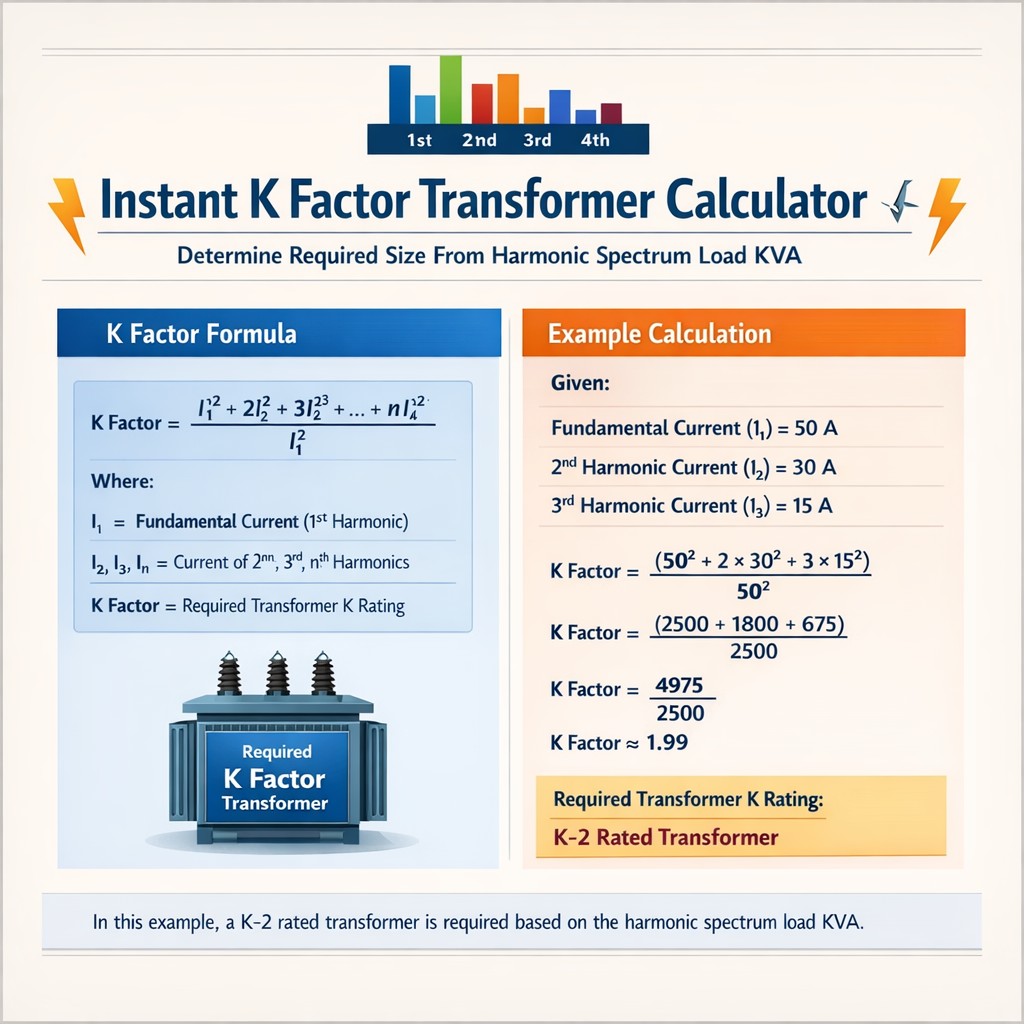
Instant K-factor: mathematical definition and formulas
Use the following working formula to compute the instantaneous K-factor from measured harmonic currents:
K = (Σh=1n Ih2 × h2) / I12
Explanation of variables and typical ranges
- Ih = RMS current at harmonic order h (A). Typical measured units: amps RMS per harmonic.
- I1 = RMS current of the fundamental frequency (h = 1) (A).
- h = harmonic order (integer). For mains 50/60 Hz systems, h = 1, 2, 3, … Typical measurement extends to h = 25–50 for power-quality consideration.
- n = highest harmonic order included in the calculation. Recommended n ≥ 25 for industrial VFD-heavy installations; n ≥ 50 for sensitive systems or when interharmonics are present.
Typical K-factor ranges by application (rounded): resistive/heating loads K≈1; office computing K≈1.5–4; 6-pulse VFD heavy loads K≈6–15; 12-pulse rectifiers K≈2–6. Exact values depend on measured harmonic amplitudes and order content.
Derating and required transformer size relations
For a conventional (non-K-rated) transformer, to keep the same internal heating when harmonic currents are present, the winding-rated current must satisfy:
Irated ≥ I1 × √K
Therefore, if the connected load draws fundamental current I1 and produces an instantaneous K, the required kVA for the non-K-rated transformer is approximated as:
Required kVA ≈ Load kVA × √K
Alternatively, specify a transformer designed and certified for the computed K (a “K-rated” transformer, e.g., K-13) to avoid simple kVA up-sizing. K-rated transformers are internally engineered to tolerate the harmonic heating at their nameplate rating.
Measurement inputs for an instant calculator
An instant K-factor calculator requires time-domain current samples or harmonic RMS values per order. Key measurement considerations:
- Sampling rate: at least 2× highest frequency considered (Nyquist), but in practice use ≥2–5 kHz sampling for up to the 50th harmonic at 60 Hz (50 × 60 = 3 kHz). Higher sampling improves spectral fidelity.
- Window length and update interval: use a window that captures an integer number of mains cycles (e.g., 10 cycles at 60 Hz = 167 ms) for stable harmonic resolution. Use overlapping windows for continuous update.
- Antialias filtering: ensure proper analog anti-alias filtering if using external ADCs.
- FFT/DFT or power analyzer: use spectral transform to obtain magnitude per harmonic order. Many power-quality instruments provide per-harmonic RMS directly.
- Include phase-aware summation for three-phase systems: harmonics may be phase-shifted; K-factor uses per-phase RMS magnitudes in the common practice of single-phase winding heating calculation.
Converting spectral magnitudes to harmonic RMS values
If the measurement system outputs complex DFT bins Xh, compute RMS per harmonic using the DFT amplitude conventions of your algorithm. For instruments that already return harmonic RMS values, use those directly. For many DFT normalizations (real-signal convention):
Ih,rms = (2 × |Xh|) / N × 1/√2 = √2 × |Xh| / N
Important: the DFT normalization may vary by implementation (some tools return amplitude directly). Validate the transform normalization by injecting a known sinusoid and verifying the computed RMS matches the test signal RMS.
Practical algorithm for an instant K-factor transformer calculator
An implementable sequence to compute an instant K-factor in software or embedded hardware:
- Acquire time-domain current samples from each phase over a defined window (e.g., 10 mains cycles).
- Apply a window function (Hann or Flat-top) to reduce spectral leakage if measuring precise harmonic amplitudes.
- Compute DFT/FFT of the windowed data and extract magnitudes for harmonic bins 1..n corresponding to 50/60 Hz multiples.
- Convert FFT bin magnitudes to harmonic RMS currents using instrument normalization (see previous formula or instrument docs).
- Compute K using K = (Σ Ih2 × h2) / I12, always including h=1 term so K ≥ 1.
- If system three-phase, compute K per phase and use the maximum per-phase K for transformer sizing; or compute a loss-weighted combined K if transformer design is unbalanced-specific.
- Output K and recommend transformer actions (specify K-rated designation or required kVA = Load kVA × √K for non-K-rated selection). Include safety margin (e.g., 10–25%) for ambient temperature and inrush currents.
Extensive tables of common values and selection guidance
| Load type | Typical K-range | Typical max harmonic order of concern | Practical recommendation |
|---|---|---|---|
| Resistive loads (heaters) | ~1.0 | 1 | Standard transformer acceptable |
| Office PCs & small electronics | 1.5–4.0 | 3–13 | Consider K-rated (K-4) or upsize by √K |
| 6-pulse VFDs (large) | 6–15 | 5–25 | Specify K-rated transformer (K-13 or higher) or upsize strongly |
| 12-pulse rectifiers / 12-pulse VFD | 2–6 | 5–25 | Often K-rated not required; verify spectrum |
| UPS rectifiers (nonlinear) | 5–12 | 3–25 | Specify K-rated transformer or derate |
| Lighting with electronic ballasts | 2–6 | 3–11 | Verify THD; consider K-rated only if concentrated |
| Harmonic order (h) | Example 6-pulse VFD rms% of I1 | Example office computing rms% of I1 | Example 12-pulse rectifier rms% of I1 |
|---|---|---|---|
| 1 (fundamental) | 100 | 100 | 100 |
| 3 | 1 | 2 | 0.5 |
| 5 | 35 | 6 | 8 |
| 7 | 25 | 4 | 3 |
| 9 | 8 | 3 | 1 |
| 11 | 6 | 2 | 0.8 |
| 13 | 3 | 1.5 | 0.6 |
| 15+ | 2–5 (spread) | 0–2 | 0–1 |
Worked examples with complete development and solutions
Example 1 — Industrial 6-pulse VFD bank, three-phase transformer sizing
Scenario: A three-phase motor drive installation draws a fundamental per-phase current of I1 = 100 A. A power analyzer measures the following per-phase harmonic RMS currents (A): I3 = 5 A, I5 = 35 A, I7 = 25 A, I9 = 10 A, I11 = 7 A, I13 = 4 A. Determine the instantaneous K-factor and the approximate required transformer kVA for a conventional transformer if the connected load is 200 kVA.
Step 1 — Compute numerator Σ Ih2 × h2 including h=1:
I12 × 12 = 1002 × 1 = 10,000
I32 × 32 = 52 × 9 = 225
I52 × 52 = 352 × 25 = 1,225 × 25 = 30,625
I72 × 72 = 252 × 49 = 625 × 49 = 30,625
I92 × 92 = 102 × 81 = 100 × 81 = 8,100
I112 × 112 = 72 × 121 = 49 × 121 = 5,929
I132 × 132 = 42 × 169 = 16 × 169 = 2,704
Step 2 — Divide by I12 = 1002 = 10,000:
Step 3 — Required kVA for a non-K-rated transformer (approx):
√8.8208 ≈ 2.9717
Required kVA ≈ 200 × 2.9717 ≈ 594.3 kVA
Interpretation: Using a conventional transformer, the installation would require approximately a 600 kVA unit to avoid excess heating. Alternatively, specify a transformer manufactured to handle K ≈ 8.8 (e.g., K-9 or K-13 depending on vendor rounding and temperature rise limits) at 200 kVA, which would be engineered internally to tolerate the harmonic heating without the same upsizing.
Example 2 — Commercial office building, concentrated computer loads
Scenario: A three-phase small commercial site has a per-phase fundamental current I1 = 50 A. Harmonic RMS currents measured: I3 = 2 A, I5 = 6 A, I7 = 4 A, I9 = 3 A, I11 = 2 A, I13 = 1.5 A. The connected transformer supports a 150 kVA load at present. Determine the K-factor and derive the required kVA for a standard transformer.
Step 1 — Compute numerator terms:
I12 × 12 = 502 = 2,500
I32 × 32 = 22 × 9 = 36
I52 × 52 = 62 × 25 = 36 × 25 = 900
I72 × 72 = 42 × 49 = 16 × 49 = 784
I92 × 92 = 32 × 81 = 9 × 81 = 729
I112 × 112 = 22 × 121 = 4 × 121 = 484
I132 × 132 = 1.52 × 169 = 2.25 × 169 = 380.25
Step 2 — Compute K:
I12 = 2,500 → K = 5,813.25 / 2,500 = 2.3253 → K ≈ 2.33
Step 3 — Required kVA with conventional transformer:
Required kVA ≈ 150 kVA × √2.3253
√2.3253 ≈ 1.525
Required kVA ≈ 150 × 1.525 ≈ 228.8 kVA → recommend 230–250 kVA in practice to allow margins.
Interpretation: For this office environment, the harmonic heating increases effective heating by ~2.33×. A standard transformer should be upsized to roughly 230–250 kVA rather than 150 kVA, or alternatively select a K-rated transformer (e.g., K-3 or K-4 rating) sized at the actual connected 150 kVA rating if vendor guarantees the K performance.
Implementation details and practical recommendations
When implementing an instant K-factor calculator in hardware or software, consider the following best practices:
- Calibration: validate instrument-level amplitude linearity with precision current sources or calibrated clamps across the expected amplitude range.
- Windowing and leakage: use a measurement window length that supports integer cycles to reduce spectral leakage; apply overlap-add and smoothing for continuous monitoring.
- Interharmonics: if interharmonics are present (non-integer multiples due to variable switching), sum their contributions explicitly or treat them conservatively by mapping to nearest integer orders with appropriate weighting.
- Three-phase handling: compute per-phase K and use the worst-case phase for sizing. Address neutral/triplen harmonics (e.g., 3rd, 9th, etc.) separately for tertiary or neutral conductor heating.
- Thermal modeling: where available, feed the instantaneous harmonic loss estimate into a thermal model for dynamic transformer temperature rise estimation; K alone estimates relative heating but not absolute temperature without thermal parameters.
- Use of K-rated transformers: where sustained harmonic-rich service exists, prefer K-rated transformers engineered to handle heating at the nameplate rating—this often reduces capital expenditure relative to large upsizing and improves operational reliability.
Standards, normative references, and further reading
Designers should consult authoritative standards and guides when specifying transformers or calculating harmonic-related derating. Key references include:
- IEEE C57.110 — Guide for Load Loss and Thermal Evaluation (transformer loading and harmonics guidance).
- IEEE Std 519 — Recommended Practices and Requirements for Harmonic Control (system-level harmonic limits and mitigation strategies).
- NEMA TP 1 and other NEMA publications describing transformer testing and performance in the presence of harmonics.
- IEC 60076 series — Power transformers (general requirements).
- Manufacturer K-rating datasheets (e.g., Eaton, Schneider, ABB) for specific K-rated transformer construction details and guaranteed performance curves.
Limitations, uncertainties and conservative practice
Important caveats when using instant K-factor values for equipment procurement:
- Measurement uncertainty: harmonic amplitude measurement errors propagate into K. Include instrument uncertainty and adopt conservative margins (10%–25%).
- Non-steady-state behavior: K computed from short windows may fluctuate with load; use averaged or percentile-based K (e.g., 95th percentile) for procurement decisions.
- Temperature and ambient effects: transformer thermal performance varies with ambient temperature and ventilation; derate further under high ambient conditions.
- Nonlinear load diversity: if multiple nonlinear loads are distributed over phases or time, calculate aggregate K considering coincidence factors.
Operational advice and mitigation options
If measured K is high and a K-rated transformer is impractical, consider these mitigation options:
- Install harmonic filters (passive tuned or active filters) to reduce key harmonic orders.
- Employ multi-pulse rectification (12-pulse, 18-pulse) upstream of major rectifiers/VFDs to reduce low-order harmonics.
- Distribute nonlinear loads across multiple transformers to reduce concentration and neutral heating.
- Specify transformers with higher design thermal capability, special materials, or forced-air cooling.
Summary of calculation steps for ready reference
- Measure harmonic RMS per order for each phase: Ih, h = 1..n.
- Compute K = (Σ Ih2 × h2) / I12.
- For non-K-rated transformer sizing: Required kVA ≈ Load kVA × √K; apply safety margin.
- Alternatively specify a K-rated transformer equal to the computed K (rounded to standard K designation) sized at the actual load kVA.
- Validate using standards (IEEE 519, IEEE C57.110) and manufacturer guidance.
Authoritative links and tools
- IEEE Standards Store — C57.110, IEEE 519 (searchable): https://standards.ieee.org/
- IEC Publications: https://www.iec.ch/
- NEMA Power Quality resources: https://www.nema.org/
- Transformer manufacturer technical papers and K-rating application notes (Eaton, ABB, Schneider Electric).
Using an instant K-factor transformer calculator with the formulas and procedures provided enables engineers to convert measured harmonic spectra into actionable transformer selection decisions. Always validate measurement methodology, account for uncertainty, and consult transformer vendors and applicable standards when specifying equipment for harmonic-rich installations.