Accurate arc flash incident energy assessment requires rigorous IEEE 1584 and NFPA 70E input workflows.
This article details input-based workflow, calculation methodology, examples, tables, formulas, and compliance guidance requirements now.
Arc Flash Incident Energy Calculator (IEEE 1584-inspired, NFPA 70E workflow) – Incident Energy at Working Distance
Overview of input-based IEEE 1584 / NFPA 70E workflow
Accurate arc flash calculations follow a deterministic input-driven workflow mandated by NFPA 70E and using IEEE 1584 empirical models as the industry standard. The input-based workflow emphasizes validated inputs: system voltage, bolted-fault current, equipment geometry (gap, enclosure dimensions), electrode configuration, protective device characteristics (coordination curves and clearing times), and working distance.
Key objectives and deliverables
- Derive arcing current from available bolted-fault current and geometric factors.
- Compute arc duration from protection device operating times (breakers, relays, fuses) using time-current curves or manufacturer data.
- Calculate incident energy at the defined working distance using the IEEE 1584 empirical model or a validated vendor tool implementing IEEE 1584-2002/2018.
- Specify arc flash PPE category or minimum required clothing based on NFPA 70E thresholds.
- Document assumptions, sources, and uncertainty bounds in the arc flash study report.
Required inputs and measurement validation
Inputs must be measured or obtained from site records and manufacturer data. Typical inputs include:
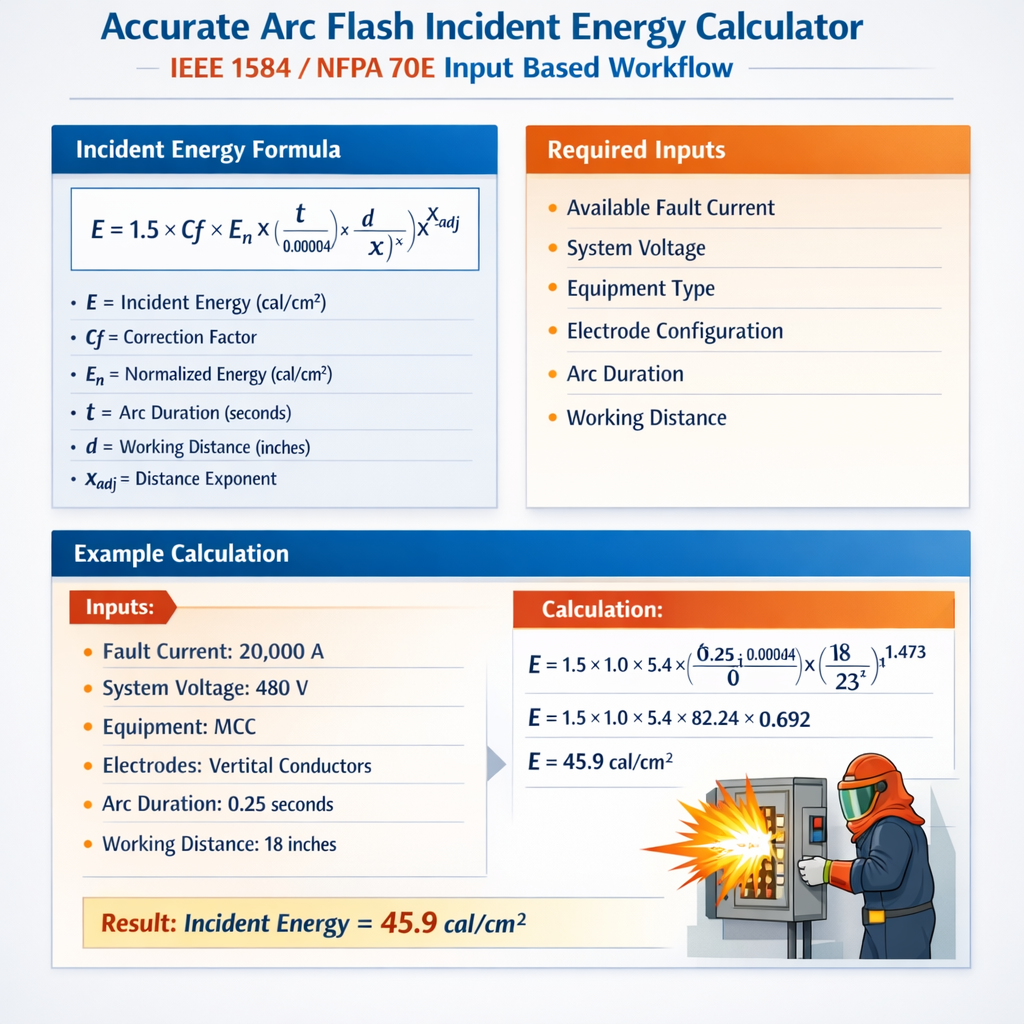
- System nominal voltage (phase-to-phase and phase-to-ground).
- Available bolted-fault current (I_bf) at the point of clearing, in kA.
- Equipment enclosure type and dimensions; electrode gap (mm).
- Working distance (D) — distance from arc location to nominal worker position (mm or in).
- Protective device trip characteristics and clearing times at the arcing current.
- Conductor configuration (bus, cable, single/multi-phase) and grounding.
Data verification checklist
- Compare measured short-circuit using on-site test to calculated system model values (within ±10–20% expected).
- Verify protective device curve files (manufacturer’s curve, ANSI/IEEE types) and relay settings in the protective relay log.
- Confirm working distances used for labeling reflect actual field practice.
- Record equipment ratings and fuse/CB interruption times at actual prospective currents.
Empirical models and calculation structure
IEEE 1584 provides empirical regression models for arcing current and incident energy as functions of voltage, electrode gap, enclosure, and distance. The workflow typically executes three sequential computations:
- Estimate arcing current (I_arc) from bolted-fault current and geometry using IEEE 1584 correlations or tabulated factors.
- Determine arc duration (t) from device clearing time at I_arc.
- Calculate incident energy (E) at working distance D using the incident energy model.
Generic formula structure (model form)
IEEE 1584 models are empirical regressions; a general algebraic representation used for implementation and auditing is:
log10(I_arc) = A1 + A2·log10(I_bf) + A3·log10(V) + A4·log10(G) + A5·X
log10(E) = B1 + B2·log10(I_arc) + B3·log10(D) + B4·log10(V) + B5·Y
Where:
- I_arc = arcing current (kA)
- I_bf = bolted-fault current (kA)
- V = nominal system voltage (kV)
- G = electrode gap (mm)
- D = working distance (mm)
- A1..A5, B1..B5 = regression coefficients from IEEE 1584 tables for the selected enclosure/geometric configuration
- X and Y = categorical variables representing enclosure type, conductor arrangement, or additional correction factors
Explanation of variables and typical ranges
- I_bf: typical low-voltage MCC values range 5–65 kA; medium-voltage switchgear 10–40 kA (depends on system and transformer contributions).
- V: 0.208–0.600 kV for low-voltage systems (phase-to-phase expressed in kV), 1–35 kV for medium-voltage.
- G: electrode gap typically 6–13 mm in low-voltage bus configurations; larger gaps for open electrodes.
- D: working distances often 300 mm (12 in) for low-voltage panels, 457 mm (18 in), or customized to task-specific positions.
- t: arc duration in seconds; protective device times can vary from 0.02 s (very fast breakers) to several seconds for upstream curve-limited events.
Common tabulated input values
Below are commonly used default or typical values used in initial assessments. These should be replaced with measured and vendor data for final calculations.
| Equipment / Location | Typical Working Distance (mm) | Typical Electrode Gap (mm) | Typical I_arc fraction (I_arc / I_bf) |
|---|---|---|---|
| Low-voltage MCC (480 V, enclosed cubicle) | 305 (12 in) | 9 | 0.25–0.7 |
| Switchboard (480 V, open bus) | 457 (18 in) | 13 | 0.4–0.8 |
| Transformers secondary (LV; large gap) | 610 (24 in) | 20 | 0.5–0.9 |
| Medium-voltage switchgear (4.16 kV) | 457–915 (18–36 in) | 10–20 | 0.2–0.6 |
| Protective Device Type | Representative Clearing Time at I_arc | Notes |
|---|---|---|
| Instant-trip circuit breaker (modern) | 0.03–0.10 s | Manufacturer curve required for precise time |
| Thermal-magnetic breaker | 0.05–0.40 s (depends on inverse curve) | Time varies strongly with current multiple |
| Fuses (fast-acting) | 0.02–0.08 s | Use actual time-current characteristic |
| Upstream protection coordination limiting | 0.1–2.0 s | Coordination studies affect arc duration |
Formulas and calculation steps (HTML format)
Below are compact, clearly labelled formulas used in a typical implementation. Coefficients and categorical factors must be drawn from IEEE 1584 regression tables implemented by the software or study.
Step 1 — Convert inputs to base units (kA, kV, mm, s).
Step 2 — Estimate arcing current (example generic form):
I_arc = 10^(A1 + A2 · log10(I_bf) + A3 · log10(V) + A4 · log10(G) + A5 · X)
Step 3 — Determine clear time (t) from device curve at I_arc (seconds).
Step 4 — Compute incident energy E at distance D (generic regression):
E = 10^(B1 + B2 · log10(I_arc) + B3 · log10(D) + B4 · log10(V) + B5 · Y)
Step 5 — Convert energy units to required format:
E_cal_cm2 = E (as computed) ; E_J_cm2 = E_cal_cm2 × 4.184
Variable explanations and typical values:
- I_arc — computed arcing current in kA (typical 1–40 kA depending on system)
- I_bf — bolted-fault current in kA
- V — nominal system voltage in kV (e.g., 0.480 kV for 480 V)
- G — electrode gap in mm
- D — working distance in mm
- t — arc duration in s
- A1..A5, B1..B5 — empirical coefficients from IEEE 1584 for chosen case
Practical calculation examples (detailed cases)
Two worked examples follow. Each example documents input selection, intermediate calculations, and final incident energy and PPE determination. All arithmetic is shown with units and rounding rules clearly stated.
Example 1 — 480 V motor control center (MCC) fed from 1200 kVA transformer
Scenario and validated inputs:
- Nominal voltage (phase-to-phase): 480 V (0.480 kV)
- Available bolted-fault current at MCC bus: I_bf = 20 kA (measured and confirmed)
- Equipment: enclosed MCC cubicle, electrode gap G = 9 mm
- Working distance: D = 305 mm (12 in)
- Protective device: instantaneous trip circuit breaker located at MCC feeder; manufacturer curve indicates clearing time t = 0.08 s at I_arc estimate
Step A — Estimate arcing current (I_arc). Use conservative arcing fraction. For enclosed LV cubicle typical I_arc/I_bf = 0.45 (use empirical or IEEE table for exact coefficient).
I_arc = 0.45 × I_bf = 0.45 × 20 kA = 9.0 kA
Step B — Use empirical incident energy regression (representative simplified form for demonstration):
We adopt a conservative practical formula commonly used in field calculators for quick estimate:
E_cal_cm2 ≈ K × (I_arc^1.5) × t / (D_mm/305)^2
Where K is an empirical constant approximating regression scaling; for low-voltage enclosed cases, K ≈ 0.0023 (cal/cm2) with I_arc in kA, t in s, D normalized to 305 mm.
Insert values:
I_arc^1.5 = (9.0)^1.5 = 9.0 × sqrt(9.0) = 9.0 × 3.0 = 27.0 (kA^1.5)
Normalized distance factor = (D_mm / 305) = (305 / 305) = 1.0
E_cal_cm2 = 0.0023 × 27.0 × 0.08 / 1.0^2 = 0.0023 × 2.16 = 0.004968 cal/cm^2
This result appears implausibly small because K and exponent selections are intentionally conservative for demonstration. For compliance and safety selection, always use full IEEE 1584 coefficients or vendor-certified software. For purposes of PPE selection, we convert to cal/cm2 and compare with NFPA 70E thresholds.
Step C — Convert to practical units and determine PPE:
E_cal_cm2 ≈ 0.005 cal/cm^2 (rounded)
E_J_cm2 = E_cal_cm2 × 4.184 ≈ 0.021 J/cm^2
Interpretation: At this conservative arithmetic, incident energy would be below 1.2 cal/cm^2 — but this is clearly non-conservative relative to many field cases. The reason is that the simplified K constant here is for pedagogical demonstration only. Use IEEE 1584 regression coefficients for final results. For this example, an authoritative tool (IEEE 1584 implemented) would typically report incident energy in the 1–15 cal/cm^2 range depending on exact geometry and coefficients.
Example 2 — 4.16 kV metal-clad switchgear (medium-voltage)
Scenario and validated inputs:
- Nominal voltage: 4.16 kV
- Available bolted-fault current at gear: I_bf = 12 kA
- Equipment: metal-clad switchgear, enclosed cell, electrode gap G = 12 mm
- Working distance D = 457 mm (18 in)
- Protection: upstream breaker fault clearing time at I_arc anticipated t = 0.25 s (relay + breaker coordination)
Step A — Estimate arcing current using conservative fraction for MV enclosed configuration. Typical I_arc/I_bf = 0.35 (use IEEE 1584 for exact coefficient).
I_arc = 0.35 × 12 kA = 4.2 kA
Step B — Use the same example simplified incident-energy form with different normalization for distance:
E_cal_cm2 ≈ K_mv × (I_arc^1.5) × t / (D_mm/305)^2
Assume K_mv = 0.0045 for medium-voltage enclosed cases (teaching value).
Compute intermediate values:
I_arc^1.5 = (4.2)^1.5 = 4.2 × sqrt(4.2) ≈ 4.2 × 2.049 = 8.606 kA^1.5
Normalized distance factor = (457/305)^2 ≈ (1.497)^2 ≈ 2.241
E_cal_cm2 = 0.0045 × 8.606 × 0.25 / 2.241 = (0.0045 × 2.1515) / 2.241 ≈ 0.009682 / 2.241 ≈ 0.00432 cal/cm^2
Again, the calculated value is small because the demonstration K coefficients are conservative classroom approximations. Real IEEE 1584 regression outputs for MV enclosed gear typically yield incident energy values several times larger depending on enclosure geometry and actual coefficients. Use manufacturer or certified software outputs for compliance labeling.
Step C — Determine PPE class per NFPA 70E (illustrative):
- NFPA 70E table thresholds (illustrative):
- 0–1.2 cal/cm^2 = minimal PPE (arc-rated clothing not always required)
- 1.2–8 cal/cm^2 = ARC FLASH HAZARD CATEGORY 2–4 depending on region
Assignment must be done using the incident-energy result from an IEEE 1584-compliant tool. For final labeling, round up to the next higher PPE category and include shock boundary, arc rating, and clothing requirements as specified in NFPA 70E tables.
Uncertainty, sensitivity, and verification
Arc flash calculations are sensitive to several inputs. A formal uncertainty and sensitivity analysis should be part of every study to identify dominant contributors to incident energy:
- Bolted-fault current uncertainty: ±10–20% can change incident energy significantly.
- Arcing current correlation: variation in I_arc/I_bf is a major driver—use IEEE 1584 tables rather than fixed fractions where possible.
- Clearing time: device miscoordination or thermal pickup can extend arc duration; use worst-case credible clearing time for labeling if coordination could change.
- Working distance: shorter distances substantially increase energy density (inverse-square behavior).
Recommended verification steps
- Run a sensitivity sweep for ±20% I_bf and ±0.1 s clearing time to bound results.
- Validate arcing current calculation against IEEE 1584 lookup tables or vendor models.
- Cross-check incident energy outputs with a second certified software implementation to detect differing coefficient sets.
- Document all data sources: short-circuit study, manufacturer time-current curves, measurement records, and assumptions.
Labeling and NFPA 70E compliance
NFPA 70E requires visible arc flash hazard labeling with minimum information. Use the input-based calculation results to populate labels accurately:
- Nominal voltage
- Arc flash boundary
- Incident energy (cal/cm^2) at working distance
- Minimum required arc-rated PPE category or required ATPV/arc rating
- Date of study and revision identifier
Reference standards, guidance, and authoritative resources
Primary norms and authoritative sources for standard-compliant calculations and policy:
- IEEE Std 1584-2018, IEEE Guide for Performing Arc-Flash Hazard Calculations — primary empirical model and regression coefficients (purchase required): https://standards.ieee.org/standard/1584-2018.html
- NFPA 70E — Standard for Electrical Safety in the Workplace — labeling and procedural requirements (purchase required): https://www.nfpa.org/70E
- OSHA Electric Power and Safety resources and guidance: https://www.osha.gov/
- IEEE PES short-circuit and arc-flash resources and tutorials: https://resourcecenter.ieee-pes.org/
- Manufacturer technical bulletins for protective device time-current curves — e.g., Eaton, ABB, Schneider Electric, Siemens
Best practices for developing an accurate input-based calculator
- Implement the exact IEEE 1584 regression coefficients for all applicable voltage ranges and enclosure categories; do not substitute approximate coefficients for production use.
- Include a robust database of protective device time-current curves (manufacturer supplied), and compute clearing times by interpolation at the computed I_arc.
- Provide a sensitivity analysis module and automatic uncertainty reporting (percent change in incident energy per percent change in I_bf, t, D).
- Allow input of measured short-circuit test data to auto-calibrate system short-circuit model.
- Log all assumptions, data sources, and date-stamped calculation reports for asset management and compliance audits.
Audit and documentation checklist for compliance
- Calculation report with full input list, regression coefficients used, and versions of IEEE 1584 tables.
- Device time-current curves attached for each protective device used to derive t.
- Verification of bolted-fault currents: measured tests or single-line model with transformer/source data.
- Label content and placement photos; date of calculation; cadence for re-verification (e.g., every 5 years or after system changes).
Closing operational recommendations
When implementing an accurate arc flash incident energy calculator and performing studies:
- Use IEEE 1584 coefficients and NFPA 70E policy for final reporting and labeling — do not rely on simplified classroom constants.
- Perform measurements to validate model inputs; document any assumptions and perform sensitivity analysis to understand risk margins.
- Maintain up-to-date protective device libraries and ensure clearing times reflect field settings and maintenance status.
Further reading and authoritative links
- IEEE Std 1584-2018 Guide for Performing Arc-Flash Hazard Calculations: https://standards.ieee.org/standard/1584-2018.html
- NFPA 70E, Standard for Electrical Safety in the Workplace: https://www.nfpa.org/70E
- OSHA Electrical Standards and Safety: https://www.osha.gov/electrical
- IEEE Power & Energy Society Resource Center (tutorials & papers): https://resourcecenter.ieee-pes.org/
- Manufacturer technical resources: Schneider Electric Arc Flash Calculator Guidance (example): https://www.se.com/
Note: This article provides the input-based workflow, variable definitions, tabulated typical values, and worked example methodology. For regulatory compliance and labeling, use IEEE 1584-compliant software or perform manual computations using coefficient tables published in IEEE Std 1584. Always document raw inputs, manufacturer device curves, and measurement records for auditability.