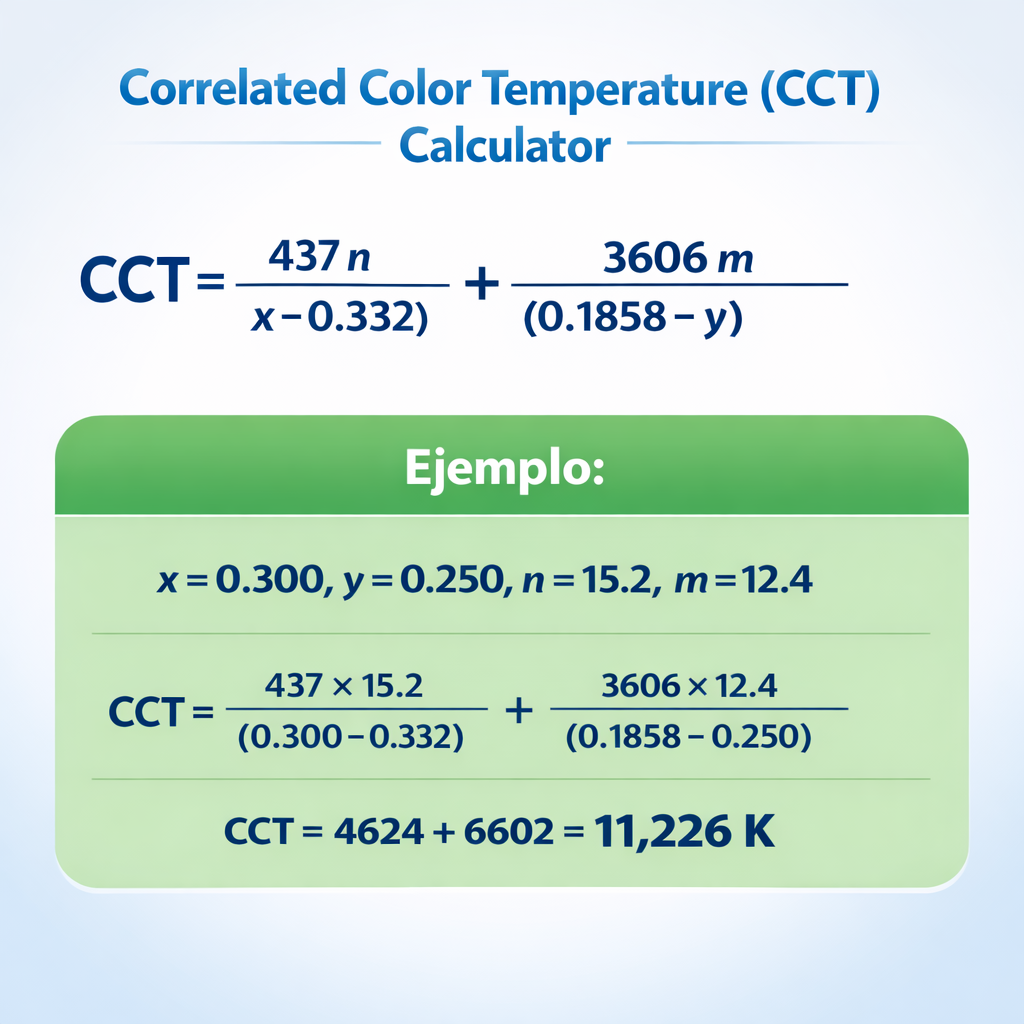
CCT = 449n³ + 3525n² + 6823.3n + 5520.33 where n = (x − 0.3320) / (0.1858 − y)📊 Common CCT Values
| CCT (K) | Light type |
|---|---|
| 1800 | Candle / flame |
| 2700 | Warm white (LED / incandescent) |
| 3000 | Warm white (halogen) |
| 4000 | Neutral white (office) |
| 5000 | Daylight (D50, graphic arts) |
| 6500 | Cool daylight (D65, monitors) |
Correlated Color Temperature (CCT) describes the color appearance of a white light source, expressed in Kelvin (K). A low value (2700 K) produces a warm, cozy light, while a high value (6500 K) emits a cool, bright light resembling an overcast sky. CCT is calculated from the CIE 1931 chromaticity coordinates (x, y) using McCamy’s approximation—the industry-standard method used by most colorimeters and spectrometers. This CCT calculator lets you get the result instantly: enter the x and y coordinates from your measurement instrument or manufacturer data sheet and see the color temperature with a live color swatch.
Whether you are specifying LEDs for an architectural project, calibrating a monitor, evaluating a fluorescent lamp, or verifying compliance with ANSI C78.377, this calculator gives you an accurate CCT value in real time. Read on for the full formula derivation, a reference table of common illuminants with their chromaticity coordinates, and six worked examples verified against CIE standard illuminants.
Common CCT Values — Light Sources, Coordinates & Applications
The table below shows the most frequently encountered CCT values in architectural, commercial, and industrial lighting. Each row includes the approximate CIE 1931 chromaticity coordinates on the Planckian locus, the typical light source, and the recommended application.
| CCT (K) | x | y | Typical Source | Application |
|---|---|---|---|---|
| 1800 | 0.5267 | 0.4133 | Candle, low-pressure sodium | Decorative ambiance, heritage lighting |
| 2400 | 0.4860 | 0.4210 | Vintage incandescent, dim-to-warm LED | Restaurants, living rooms |
| 2700 | 0.4578 | 0.4101 | Warm white LED / CFL | Residential standard, hospitality |
| 3000 | 0.4369 | 0.4041 | Halogen, warm white LED | Retail, museums, galleries |
| 3500 | 0.4091 | 0.3935 | Neutral white fluorescent | Corporate offices, clinics |
| 4000 | 0.3818 | 0.3797 | Neutral white LED | Commercial, classrooms, labs |
| 4500 | 0.3611 | 0.3658 | Cool white LED | Industrial, warehouses, parking |
| 5000 | 0.3457 | 0.3585 | Illuminant D50 | Graphic arts, color-viewing booths |
| 5500 | 0.3324 | 0.3474 | Direct noon sunlight | Photography, TV studios |
| 6500 | 0.3127 | 0.3290 | Illuminant D65, sRGB monitors | Display calibration, hospitals |
| 7500 | 0.2990 | 0.3149 | Overcast sky | Daylight compensation in interiors |
| 10000 | 0.2807 | 0.2884 | Blue sky / shade | Special effects, marine aquariums |
The x and y values are Planckian-locus approximations—the curve on the CIE chromaticity diagram representing the colors of a blackbody radiator at different temperatures. Real-world sources like LEDs and fluorescents may deviate slightly from this curve; that deviation is measured by the Duv parameter (see FAQ below).
McCamy’s Formula — Step by Step
McCamy’s approximation (1992) is the industry-standard method for calculating CCT from CIE 1931 chromaticity coordinates. It is accurate to within ±2 K across the range of 2,000 K to 12,000 K, covering virtually every artificial light source used in architectural and industrial lighting.
Step 1 — Calculate the parameter n
Where x and y are the CIE 1931 chromaticity coordinates measured with a spectrometer or colorimeter, or obtained from the luminaire manufacturer’s data sheet.
Step 2 — Calculate the CCT
This third-degree polynomial gives the CCT directly in Kelvin. It was derived by C. S. McCamy and published in Color Research & Application (1992). It is the most cited method in CIE (International Commission on Illumination) standards and is implemented in most commercial color-measurement instruments.
Quick example: For CIE Illuminant D65 (x = 0.3127, y = 0.3290):
n = (0.3127 − 0.3320) / (0.1858 − 0.3290) = −0.0193 / −0.1432 = 0.1348
CCT = 449(0.1348)³ + 3525(0.1348)² + 6823.3(0.1348) + 5520.33 = 1.10 + 64.05 + 919.82 + 5520.33 = 6,505 K
The theoretical value for D65 is ~6,504 K. The 1 K difference confirms the high accuracy of McCamy’s formula.
Range of validity
McCamy’s formula is valid for CCT between approximately 2,000 K and 12,000 K. Outside this range, accuracy degrades and the Robertson method or CIE 15:2018 standard should be used for exact calculations. For the vast majority of practical lighting applications (LEDs, fluorescents, halogens, daylight), McCamy’s range is more than adequate.
White Light Types — Comparison by CCT Group
ANSI/NEMA C78.377 classifies LEDs into nominal CCT groups. Each group has a tolerance ellipse defining the acceptable x,y coordinates for that commercial designation. The table below compares the main groups.
| CCT Group | Range (K) | Appearance | Psychological Effect | Typical CRI | Recommended Use |
|---|---|---|---|---|---|
| Very warm white | 2200–2700 | Yellow-orange | Relaxation, intimacy | 80–90 | Bedrooms, restaurants, lobbies |
| Warm white | 2700–3000 | Soft yellow | Comfort, warmth | 80–95 | Residential, luxury retail |
| Neutral white | 3000–4000 | Balanced white | Moderate alertness | 80–90 | Offices, shops, kitchens |
| Cool white | 4000–5000 | Bluish white | Productivity, focus | 70–85 | Industrial, classrooms, hospitals |
| Daylight | 5000–6500 | Blue-white | Energy, wakefulness | 90–98 | Graphic arts, photography, OR |
| Cool daylight | 6500–10000 | Deep blue | Cold, clinical | 85–95 | Monitors, aquariums, SFX |
CRI (Color Rendering Index) measures how faithfully the source reproduces object colors. A low CCT does not guarantee high CRI—both metrics are independent and must be specified together in any professional lighting project.
Inverse Conversion: CCT → Chromaticity Coordinates
Sometimes you need the reverse process: given a target CCT, find the approximate x, y coordinates on the Planckian locus. This is useful for programming RGB LEDs or verifying that a luminaire meets an ANSI specification.
These formulas (Hernandez-Andrés et al., 1999) provide coordinates on the Planckian locus with error less than 0.0001 in x and y. For practical use, the reference table above contains the most common values. For electrical power calculations in luminaire circuits, see our Amps to Watts calculator.
6 Solved Examples — CCT Calculation
Example 1 — CIE Illuminant A (incandescent, x=0.4476, y=0.4074)
Data: x = 0.4476, y = 0.4074
Step 1: n = (0.4476 − 0.3320) / (0.1858 − 0.4074) = 0.1156 / −0.2216 = −0.5217
Step 2: CCT = 449(−0.5217)³ + 3525(−0.5217)² + 6823.3(−0.5217) + 5520.33 = 2,856 K
CIE Illuminant A is defined as a Planckian radiator at 2,856 K, equivalent to a tungsten incandescent lamp. The result matches the theoretical value exactly, confirming McCamy’s formula accuracy.
Example 2 — CIE Illuminant D65 (standard daylight, x=0.3127, y=0.3290)
Data: x = 0.3127, y = 0.3290
n: (0.3127 − 0.3320) / (0.1858 − 0.3290) = −0.0193 / −0.1432 = 0.1348
CCT: 449(0.1348)³ + 3525(0.1348)² + 6823.3(0.1348) + 5520.33 = 6,505 K
D65 is the reference illuminant for sRGB and Adobe RGB monitor calibration, graphic arts (ISO 3664), and most color-evaluation workflows. Its nominal CCT is ~6,504 K—the 1 K difference is negligible.
Example 3 — Warm White LED 2700 K (x=0.4578, y=0.4101)
Data: x = 0.4578, y = 0.4101
n: (0.4578 − 0.3320) / (0.1858 − 0.4101) = 0.1258 / −0.2243 = −0.5610
CCT: 449(−0.5610)³ + 3525(−0.5610)² + 6823.3(−0.5610) + 5520.33 = 2,722 K
A nominal 2700 K LED measuring 2,722 K is well within the ANSI C78.377 tolerance ellipse (±100 K). This is the most popular CCT for residential lighting worldwide—the visual equivalent of a traditional 60 W incandescent bulb.
Example 4 — CIE Illuminant D50 (graphic arts, x=0.3457, y=0.3585)
Data: x = 0.3457, y = 0.3585
n: (0.3457 − 0.3320) / (0.1858 − 0.3585) = 0.0137 / −0.1727 = −0.0793
CCT: 449(−0.0793)³ + 3525(−0.0793)² + 6823.3(−0.0793) + 5520.33 = 5,001 K
D50 (~5,003 K theoretical) is the standard illuminant for color evaluation in the printing industry (ISO 3664) and automotive paint inspection. Certified color-viewing booths must maintain CCT within ±200 K of this value.
Example 5 — Cool White Fluorescent (x=0.3769, y=0.3903)
Data: x = 0.3769, y = 0.3903
n: (0.3769 − 0.3320) / (0.1858 − 0.3903) = 0.0449 / −0.2045 = −0.2196
CCT: 449(−0.2196)³ + 3525(−0.2196)² + 6823.3(−0.2196) + 5520.33 = 4,187 K
A typical T8 “cool white” fluorescent tube. At 4,187 K it falls on the boundary between neutral white and cool white—ideal for offices and commercial spaces where a balance between comfort and visual productivity is needed.
Example 6 — High-CCT LED for Marine Aquarium (x=0.2807, y=0.2884)
Data: x = 0.2807, y = 0.2884
n: (0.2807 − 0.3320) / (0.1858 − 0.2884) = −0.0513 / −0.1026 = 0.5000
CCT: 449(0.5000)³ + 3525(0.5000)² + 6823.3(0.5000) + 5520.33 = 9,869 K
Marine aquarium LEDs operate between 10,000 K and 20,000 K to simulate the bluish light of deep water. This ~10,000 K value is near the accuracy limit of McCamy’s formula; for higher CCTs, more sophisticated methods (CIE 15:2018) are recommended.
CCT in Lighting Design — Practical Applications
Correlated Color Temperature is one of three fundamental parameters every lighting designer must specify, alongside illuminance (lux) and CRI. Understanding CCT lets you make informed decisions about the visual atmosphere of any space.
Standards and selection: ANSI/NEMA C78.377 defines tolerance ellipses for LEDs in seven nominal groups (2700, 3000, 3500, 4000, 4500, 5000, 6500 K). Any LED falling within the ellipse can be sold under that designation. The standard also defines maximum deviation from the Planckian locus (Duv), which must be |Duv| ≤ 0.006 for professional-grade quality.
Circadian rhythm: Modern lighting research links CCT to biological effects. High-CCT light (≥ 5,000 K) suppresses melatonin production and promotes alertness, while low-CCT light (≤ 3,000 K) supports relaxation. “Tunable white” systems vary CCT throughout the day to align artificial lighting with the natural circadian cycle—an approach increasingly required in healthcare and education facilities.
Energy efficiency: In general, high-CCT LEDs (4000–6500 K) achieve higher luminous efficacy (lm/W) than low-CCT LEDs (2700 K) because the phosphor conversion is more efficient at shorter wavelengths. However, the gap has narrowed significantly in recent LED generations. For electrical circuit calculations in lighting installations, see our Amps to kW calculator and Amps to Watts calculator.
Color consistency: In a multi-luminaire installation, the CCT variation between fixtures (ΔCCTmax) should stay within a MacAdam “step.” A 3-step difference (~100 K at 3000 K) is imperceptible to most observers; 5-step (~200 K) is the maximum acceptable in quality projects. Premium LED manufacturers bin their products to 3-step or tighter consistency.
For related electrical calculations, see our Amperes to VA calculator and Motor Efficiency Calculator.
Quick Equivalencies — Common CCT Queries
2700 K
Warm white
Equivalent to a 60 W incandescent bulb. The most popular CCT for residential lighting worldwide.
4000 K
Neutral white
Balance between warmth and coolness. Ideal for offices, retail, and commercial spaces needing good visibility without eye fatigue.
5000 K (D50)
Daylight — graphic arts
Reference illuminant for color evaluation in printing, photography, and automotive paint inspection (ISO 3664).
6500 K (D65)
Cool daylight — monitors
Standard white point for sRGB, Adobe RGB, and most displays. Also used in laboratories and healthcare facilities.
McCamy’s Formula
CCT = 449n³ + 3525n² + 6823.3n + 5520.33
Where n = (x − 0.332) / (0.1858 − y). Valid 2,000–12,000 K with error < 2 K. Industry standard since 1992.
Duv (distance from locus)
|Duv| ≤ 0.006 for professional quality
Positive Duv = greenish tint; negative = pinkish tint. ANSI C78.377 defines acceptable limits.
CRI vs. CCT
Independent metrics
CCT describes light tone (warm/cool); CRI describes color-rendering fidelity. Both must be specified together.
MacAdam Steps
3-step ≈ imperceptible
Measure color consistency between fixtures. 3-step premium, 5-step standard, 7-step economy.
Kelvin vs. Mired
Mired = 1,000,000 / CCT
The mired (micro reciprocal degree) scale provides perceptually uniform intervals for color-temperature shifts.
CCT in Cameras
= White balance setting
A camera’s “white balance” is essentially the CCT selection for the scene, used to neutralize color casts.
Frequently Asked Questions — Correlated Color Temperature (CCT)
What is Correlated Color Temperature (CCT)?
CCT is the temperature in Kelvin of the blackbody radiator whose color appearance most closely matches a given light source. For example, a 3000 K LED has the same visual appearance as a blackbody heated to 3000 K—a warm white light with a yellowish tint.
What is the formula to calculate CCT?
McCamy’s formula: CCT = 449n³ + 3525n² + 6823.3n + 5520.33, where n = (x − 0.3320) / (0.1858 − y). The variables x and y are the CIE 1931 chromaticity coordinates of the light source.
What CCT should I use for residential lighting?
2700 K to 3000 K. These values produce a warm, cozy light similar to a traditional incandescent bulb. For kitchens and bathrooms, 3000–3500 K provides a bit more clarity without losing warmth.
What CCT is best for offices?
3500 K to 4000 K. Neutral white promotes concentration and document readability without causing visual fatigue. Standards like EN 12464-1 recommend this range for workspaces with moderate visual tasks.
What is the difference between CCT and CRI?
CCT describes the light’s tone (warm or cool). CRI describes how faithfully it reproduces object colors. A source can have CCT = 3000 K but CRI = 60 (poor) or CRI = 95 (excellent). Both metrics are independent and must be specified together.
What is D65 and why does it matter?
D65 is a CIE standard illuminant at ~6,504 K that simulates average northern-European daylight. It is the white-point reference for sRGB, Adobe RGB, and most displays. In industry, it serves as the reference for color evaluation.
How do I measure x,y chromaticity coordinates?
With a portable spectrometer or colorimeter (e.g., Sekonic, UPRtek, Asensetek). The instrument measures the emission spectrum and automatically calculates x, y, CCT, CRI, and Duv. You can also find these values on the LED manufacturer’s data sheet.
Does McCamy’s formula work for all light sources?
It works for sources whose coordinates are near the Planckian locus (|Duv| < 0.02), which includes the vast majority of LEDs, fluorescents, halogens, and natural daylight. It is not accurate for saturated-color sources like pure RGB LEDs or neon signs.
What is Duv and why does it matter?
Duv measures the distance from the x,y coordinates to the Planckian locus. Duv = 0 means the source is exactly on the blackbody curve. Positive values indicate a greenish tint; negative values indicate pinkish. For professional quality, |Duv| ≤ 0.006 per ANSI C78.377.
Can I convert CCT to RGB for programming LEDs?
Yes, approximately. Tanner Helland’s algorithm converts CCT to RGB values for on-screen visualization. Our calculator includes this conversion in the color swatch. However, for precise RGB LED control, you need the full spectral specification—not just the CCT.
What does “tunable white” mean?
Luminaires that combine LEDs of two or more CCTs (typically 2700 K and 6500 K) and allow real-time color-temperature adjustment via DALI, DMX, or Bluetooth. Used in circadian lighting (“human centric lighting”) to vary CCT throughout the day.
How many Kelvin is sunlight?
It depends on conditions. Direct noon sun: ~5,500 K. Sunrise/sunset: ~2,000–3,000 K. Overcast sky: ~6,500–7,500 K. Clear blue sky (no sun): ~10,000–15,000 K. The D65 illuminant (~6,504 K) represents the average of northern-hemisphere daylight.
Related Calculators
Explore more engineering tools on our site:
- Amps to kW Calculator — convert current to electrical power.
- Amps to Watts Calculator — single-phase and three-phase watt conversion.
- Amperes to VA Calculator — apparent power from current and voltage.
- Motor Efficiency Calculator — input vs. output power with loss breakdown.
- Amps to HP Calculator — relate motor current to horsepower.
- AWG to mm² Equivalences — wire-size cross-reference table.
- Balanced & Unbalanced Load Calculation — three-phase load distribution.