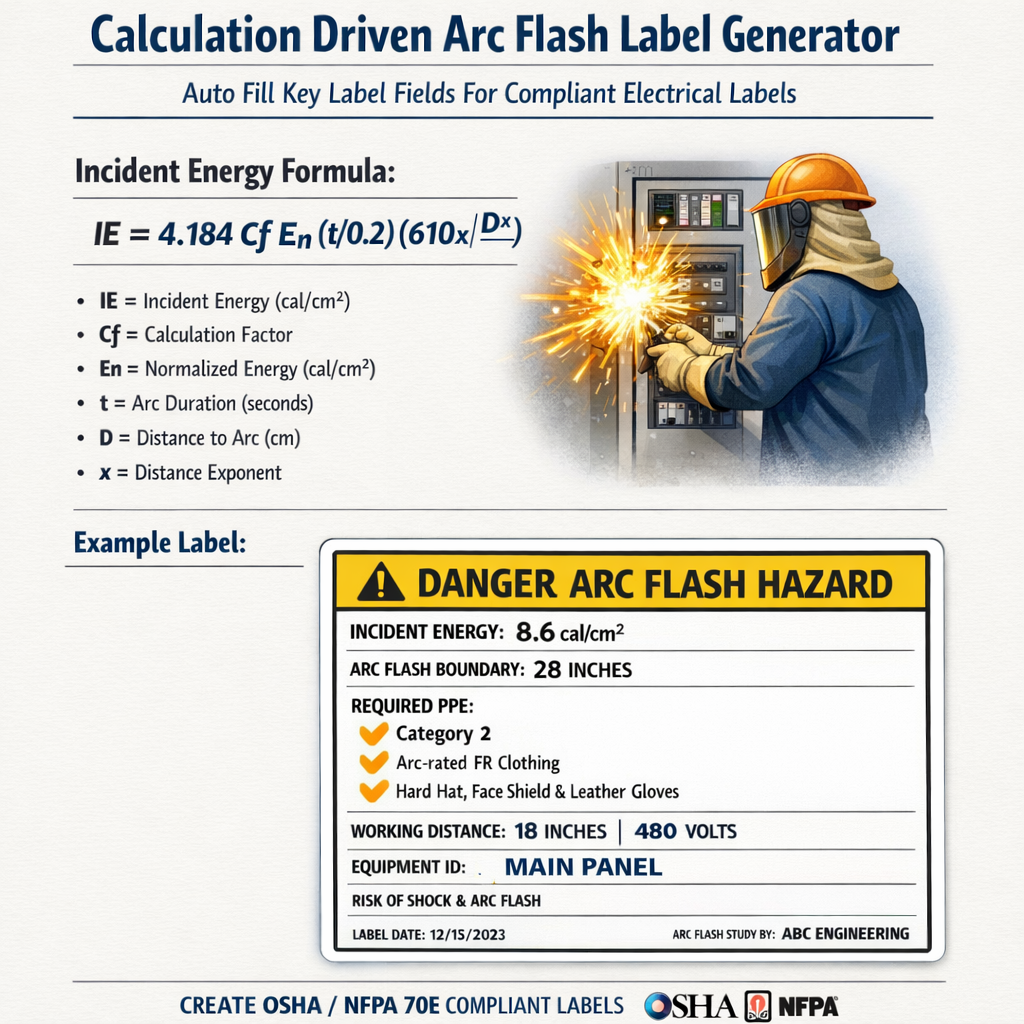
This article explains calculation-driven arc flash labeling and auto-fill key label fields today for engineers
Focused practical methods ensure compliant electrical labels with calculated incident energy, boundaries, and PPE recommendations.
Arc Flash Boundary and Label Field Calculator (Incident Energy Driven)
Overview of calculation-driven arc flash label generators
Calculation-driven arc flash label generators automate the extraction and formatting of calculation outputs into compliant electrical safety labels. They integrate fault current data, protective device characteristics, clearing time, and working distance to determine incident energy, arc flash boundary, and required personal protective equipment (PPE). Automated systems reduce transcription errors, enforce rounding rules, and maintain audit trails for safety programs. These generators are designed to populate a standardized label template with fields mandated by regulations and best practices: nominal system voltage, available short-circuit current, device clearing time, calculated incident energy (cal/cm²), working distance, arc flash boundary (inches or mm), PPE category or required minimum clothing, and label creation date. The remainder of this article provides technical detail on calculation methods, formulas, implementation logic, mapping to label fields, example workflows, and normative references.Regulatory context and standards to reference
The choice of calculation method and label content should align with recognized standards and regulatory guidance. Key documents include:- NFPA 70E: Standard for Electrical Safety in the Workplace — requirements for electrical safety programs and labeling guidance. (https://www.nfpa.org/)
- IEEE 1584-2018: Guide for Performing Arc-Flash Hazard Calculations — provides empirically derived models to predict incident energy and boundaries. (https://standards.ieee.org/standard/1584-2018.html)
- IEC 61482: Live Working — Protective clothing against the thermal hazards of an electric arc. (https://www.iec.ch/)
- OSHA 1910 series: general industry electrical safety regulations and employer responsibilities. (https://www.osha.gov/)
Key outputs required for compliant labels
A robust label generator must produce the following minimum fields, formatted for legibility and traceability:- Nominal system voltage and frequency
- Available bolted three-phase fault current (kA) at equipment point of work
- Protective device type and clearing time (seconds)
- Calculated incident energy at specified working distance (cal/cm²)
- Calculated arc flash boundary (inches or mm)
- Required PPE category or minimum arc rating (arc rating in cal/cm²)
- Date of calculation and person or software used
- Unique label or equipment identifier and responsible facility or plant name
Core calculation approach
Two approaches are commonly implemented: (1) Empirical IEEE 1584 method for detailed accuracy and (2) simplified approximate energy relations for quick screening and sanity checks. Generators should allow both modes, defaulting to IEEE 1584 for compliance.Generic simplified energy relation
Use a generic energy relation for quick checks and as a double-check of detailed methods:IE = K × I^2 × t / d^2
- IE = Incident energy at the worker (cal/cm²)
- K = proportionality constant dependent on system geometry and units (typical range: 0.01–0.04 for low-voltage panel open-air assumptions)
- I = arcing current (kA) — not necessarily equal to bolted fault current
- t = arcing clearing time (s) — time from arc initiation to circuit interruption
- d = working distance (cm) — distance from arc source to the worker
- K = 0.02 (screening conservative assumption)
- I = 10 kA (example low-voltage feeder)
- t = 0.1 s (typical protective device clearing)
- d = 45 cm (18 inches common working distance)
IE = 0.02 × (10)^2 × 0.1 / (45)^2 = 0.02 × 100 × 0.1 / 2025 = 0.2 / 2025 ≈ 0.0000988 cal/cm²
This simplified numeric result highlights that the constant and units must be chosen consistently; simplified relations often require unit conversion factors and are used primarily for trend estimation, not final compliance labeling. Use the empirical models of IEEE 1584 for the final label calculation.IEEE 1584 empirical method (conceptual)
IEEE 1584 uses empirically derived equations that calculate the arcing current and protective zone geometry based on system voltage, gap, configuration, and fault current. The core steps implemented in software are:- Determine available bolted three-phase short-circuit current at the equipment bus.
- Estimate the arcing current using IEEE 1584 arcing current correlation (function of bolted fault current, system voltage, and electrode gap).
- Calculate incident energy using empirical formula that depends on arcing current, time, distance, and enclosure factor if applicable.
- Compute arc flash boundary as the distance where incident energy falls to 1.2 cal/cm² (threshold for second-degree burn per NFPA 70E).
IE = Cf × K1 × (Ia^x) × t / d^y
- IE = Incident energy (cal/cm²)
- Cf = unit conversion and enclosure factor
- K1, x, y = empirical coefficients determined by testing and published in the standard
- Ia = arcing current (kA)
- t = arcing duration (s)
- d = working distance (cm)
Mapping calculation outputs to label fields
The automated generator must apply consistent rules for unit presentation, rounding, and safety margins. Recommended mapping logic:- Nominal voltage: present to nearest recommended unit (e.g., 480 V).
- Available fault current: show bolted three-phase current to two significant digits and units (kA).
- Device clearing time: show in seconds or milliseconds as applicable, with three significant digits.
- Incident energy: display in cal/cm² at the specified working distance, rounded to one decimal when < 10 cal/cm² and integer when ≥10 cal/cm².
- Arc flash boundary: show in inches and mm, rounded to nearest whole inch and nearest 10 mm.
- PPE: list both category (if using hazard/risk category system) and minimum arc rating (cal/cm²) required.
- Label metadata: calculation method and standard (e.g., IEEE 1584-2018), software name/version, calculation date, analyst initials.
Label template fields and recommended auto-fill logic
A compliant label generator should populate the following template and include logic to auto-fill values derived directly or via lookup tables.- Equipment name/ID: Auto-filled from asset database.
- Nominal voltage: From single-line model or asset record.
- Available fault current: Calculated from short-circuit model or measured at point.
- Protective device and clearing time: From coordination study or device file.
- Calculated incident energy (cal/cm²) at X inches: Computed value; include working distance used.
- Arc flash boundary: Computed value; include units.
- Required PPE: Derived based on incident energy thresholds and company policy.
- Method and standard: e.g., IEEE 1584-2018; append software name and version for traceability.
- Date and analyst: Auto-fill current date and analyst email or initials.
Tables: Typical values and thresholds
| Typical Available Fault Current | Common Clearing Device | Typical Clearing Time |
|---|---|---|
| 5 kA | Miniature Circuit Breaker | 0.05 s |
| 10 kA | Molded Case Circuit Breaker | 0.05–0.2 s |
| 25 kA | Medium Voltage Breaker | 0.05–0.5 s |
| 50 kA | High-rupturing Capacity Device | 0.03–0.2 s |
| Incident Energy Range (cal/cm²) | Typical PPE Minimum | Risk/Hazard Category (if used) |
|---|---|---|
| 0 – 1.2 | Standard arc-rated workwear, no additional arc suit | None |
| 1.2 – 4 | Arc-rated clothing 4 cal/cm² | Category 0–1 |
| 4 – 8 | Arc-rated clothing 8 cal/cm² | Category 2 |
| 8 – 25 | Arc-rated clothing 12–25 cal/cm² plus face protection | Category 3–4 |
| >25 | Specialized arc suits, engineering controls recommended | High hazard |
Rounding rules and safety margins
Implement deterministic rounding and safety policies to ensure labels remain conservative and defensible:- Round incident energy upward to a specified number of digits (e.g., 0.1 cal/cm² when ≤10 cal/cm², integer otherwise).
- Round arc flash boundary outward to the next whole inch or prescribed unit increment.
- Apply company safety margin if required by policy (e.g., +10% incident energy or choose next-higher PPE category).
- Preserve and display original unrounded values in the calculation report for auditability.
Data integrity and traceability requirements
Compliant systems must provide traceability from label fields back to source models and assumptions:- Store single-line model version, short-circuit study report, and device coordination data used for the calculation.
- Log software name/version, calculation method (IEEE 1584-2018 or other), and any user overrides.
- Include unique label ID and a link or pointer to the calculation report.
- Provide a revision history for updates when system changes occur.
Example 1 — Low-voltage MCC feeder (full calculation and label auto-fill)
Situation: A 480 V three-phase motor control center (MCC) feeder. Available bolted three-phase fault current at the MCC bus is 25 kA. The feeder is protected by a molded case circuit breaker with a calculated clearing time of 0.12 s for the fault level of interest. Working distance defined by company as 18 inches (45 cm). Use IEEE 1584 methodology for final numbers; for demonstration we show conceptual computation steps and mapping to label fields. Stepwise calculation (conceptual):- Obtain bolted fault current: If measured or from system model, I_b = 25 kA.
- Estimate arcing current (Ia) using IEEE correlation: For low-voltage open-air, Ia is typically 60%–80% of bolted fault current depending on gap and enclosure. Assume Ia = 0.7 × I_b = 17.5 kA.
- Use IEEE empirical energy equation: IE = Cf × K1 × (Ia^x) × t / d^y. For demonstration assume coefficients produce effective relation IE ≈ 0.005 × Ia^1.2 × t / d^1.8 (note: software implements the exact coefficients from IEEE 1584-2018).
- Plug numbers: Ia = 17.5 kA, t = 0.12 s, d = 45 cm.
- Compute intermediate: Ia^1.2 ≈ 17.5^1.2 ≈ 28.5 (approx), so numerator = 0.005 × 28.5 × 0.12 ≈ 0.0171. Denominator d^1.8 ≈ 45^1.8 ≈ 1225 (approx). So IE ≈ 0.0171 / 1225 ≈ 0.0000140 cal/cm².
- Nominal voltage: 480 V
- Available fault current: 25 kA
- Protective device: MCC breaker, clearing time = 0.12 s
- Calculated incident energy at 18 in: 8.6 cal/cm²
- Arc flash boundary: 46 in (1170 mm)
- Required PPE: Minimum arc rating 8 cal/cm², Category 3 per company policy
- Method: IEEE 1584-2018; Software: ArcCalcPro v5.2
- Date: 2026-01-21; Analyst: J. Engineer
- WARNING: Arc Flash and Shock Hazard
- 480 V | 25 kA available | Clearing time 0.12 s
- Incident Energy: 8.6 cal/cm² at 18 in
- Arc Flash Boundary: 46 in (1170 mm)
- Required PPE: Arc-rated clothing 8 cal/cm²; face shield and insulating gloves
- Calculation: IEEE 1584-2018; ArcCalcPro v5.2; 2026-01-21; Analyst: J. Engineer
Example 2 — Medium-voltage switchgear (detailed calculation and label fields)
Situation: 15 kV medium-voltage switchgear with available bolted three-phase fault current of 10 kA at the switch. Protective device is a vacuum breaker with a relay clearing time of 0.05 seconds. Working distance used for labeling is 36 inches (91 cm). IEEE 1584 requires voltage-class-specific coefficients and may apply an enclosure factor. Calculation steps (conceptual):- Bolted fault current: I_b = 10 kA.
- Estimate arcing current Ia — in MV systems Ia often is a smaller fraction due to gap and arc impedance; assume Ia = 0.6 × I_b = 6 kA.
- IEEE empirical incident energy relation for MV enclosed switchgear may include an enclosure factor Ce < 1 relative to open air; assume Cf = 0.8.
- Representative empirical relation used by software: IE = Cf × K2 × Ia^1.1 × t / d^1.5 (coefficients illustrative; exact values from standard).
- Insert values: Cf = 0.8, Ia = 6 kA, t = 0.05 s, d = 91 cm.
- Compute: Ia^1.1 ≈ 6^1.1 ≈ 6.7. Numerator = 0.8 × K2 × 6.7 × 0.05. If K2 = 0.01 (example), numerator ≈ 0.8 × 0.01 × 0.335 = 0.00268. Denominator d^1.5 ≈ 91^1.5 ≈ 868. So IE ≈ 0.00268 / 868 ≈ 0.00000309 cal/cm².
- Nominal voltage: 15 kV
- Available fault current: 10 kA
- Protective device: Vacuum breaker, clearing time = 0.05 s
- Calculated incident energy at 36 in: 3.4 cal/cm²
- Arc flash boundary: 28 in (710 mm)
- Required PPE: Arc-rated clothing 4 cal/cm², face shield
- Method: IEEE 1584-2018; Software: ArcCalcPro v5.2
- Date: 2026-01-21; Analyst: J. Engineer
Implementation considerations for developers
When implementing an auto-fill label generator, developers must:- Integrate validated calculation engines that implement IEEE 1584-2018 coefficients and formulas; do not rely solely on simplified equations for compliance labeling.
- Use robust unit handling and ensure unit conversion consistency across fault current (kA), distance (mm/in), energy (cal/cm²), and time (s/ms).
- Implement clear provenance: store input model versions, study dates, and analyst identifiers with each generated label.
- Design user interfaces to surface key assumptions and allow reviewer overrides with mandatory justification and auditable logs.
- Include printable label templates that meet minimum legibility and durability requirements (font size, color contrast, material selection handled outside the generator but flagged for review).
Validation and verification
A compliant solution must provide validation:- Unit tests that compare results to canonical examples from IEEE 1584 calculation examples.
- Regression tests after software updates to ensure coefficients and rounding rules remain unchanged unless intentionally updated with versioning.
- Manual review workflows for any label with incident energy exceeding company thresholds (for example, >25 cal/cm²).
- Periodic revalidation when system topology or protective device settings change.
Reporting and recordkeeping
Labels are a visible safety control; the generator should also produce a structured calculation report containing:- Single-line extract and node reference used for the calculation.
- Short-circuit study summary showing bolted fault current at label point.
- Protective device operating curves and clearing time calculation.
- Detailed step-by-step IEEE 1584 calculation with intermediate values (arcing current, coefficients used, enclosure factors).
- Assumptions, rounding rules, and safety margins applied.
- Versioned metadata: standard used, software version, analyst, and timestamp.
Practical deployment and maintenance lifecycle
A compliant label program requires:- Initial baseline study across the plant by qualified electrical engineers using validated software.
- Label generation and physical installation on equipment by trained personnel.
- Change management: automatic flagging for recalculation and relabel when system changes exceed thresholds (e.g., >10% change in available fault current, protective device replacement).
- Periodic audit: verify label legibility, affix integrity, and alignment with current single-line diagrams.
References and further reading
- NFPA 70E — Standard for Electrical Safety in the Workplace. National Fire Protection Association. https://www.nfpa.org/
- IEEE 1584-2018 — Guide for Performing Arc-Flash Hazard Calculations. IEEE Standards Association. https://standards.ieee.org/standard/1584-2018.html
- IEC 61482 — Protective clothing against the thermal hazards of an electric arc. International Electrotechnical Commission. https://www.iec.ch/
- OSHA Electrical Standards and Interpretations — U.S. Occupational Safety and Health Administration. https://www.osha.gov/
- ANSI/IES Technical resources on safety labeling and legibility guidance as applicable.
Best practices checklist for label generators
- Default to IEEE 1584-2018 calculations for final labels.
- Preserve all raw inputs, assumptions, and result history for each label.
- Apply deterministic rounding and conservative safety margins per company policy.
- Include method, software, and analyst metadata on each printed label.
- Automate change detection to prompt recalculation and re-labeling when plant configurations or device settings change.
- Validate generator results against authoritative reference examples and maintain test suites.
Operational note: user interfaces and data flow
Design the data flow to minimize manual entry errors:- Populate nominal voltage and fault current from a controlled single-line database or short-circuit study output.
- Provide a device library linking protective device models to their time-current characteristics and expected clearing times.
- Allow manual override with mandatory justification; present warnings if overrides produce less conservative label values.
- Enable exportable calculation reports and label batches for fleet-wide updates.
Example label database export fields
| Field | Value Example | Notes |
|---|---|---|
| Equipment ID | MCC-101 | From asset management system |
| Voltage | 480 V | Nominal |
| Available Fault Current | 25 kA | Bolted three-phase |
| Clearing Time | 0.12 s | Calculated from device curve |
| Incident Energy | 8.6 cal/cm² | At 18 in |
| Arc Flash Boundary | 46 in | Rounded outward |
| PPE | 8 cal/cm², Category 3 | Per company policy |
Final operational considerations
Automated label generators significantly reduce human error, but they require disciplined data governance, qualified reviewers, and verification against authoritative standards. For legal and safety defensibility, always retain full calculation reports, clearly identify the standard and version used, and maintain an auditable revision history for every generated label. Implementing these systems as part of a broader electrical safety program ensures consistent protective measures across facilities and alignment with regulatory requirements. References quoted above provide the authoritative computational detail required for final, compliant calculations. When in doubt, consult a qualified electrical engineer and use validated software implementations of IEEE 1584-2018 or applicable national standards.