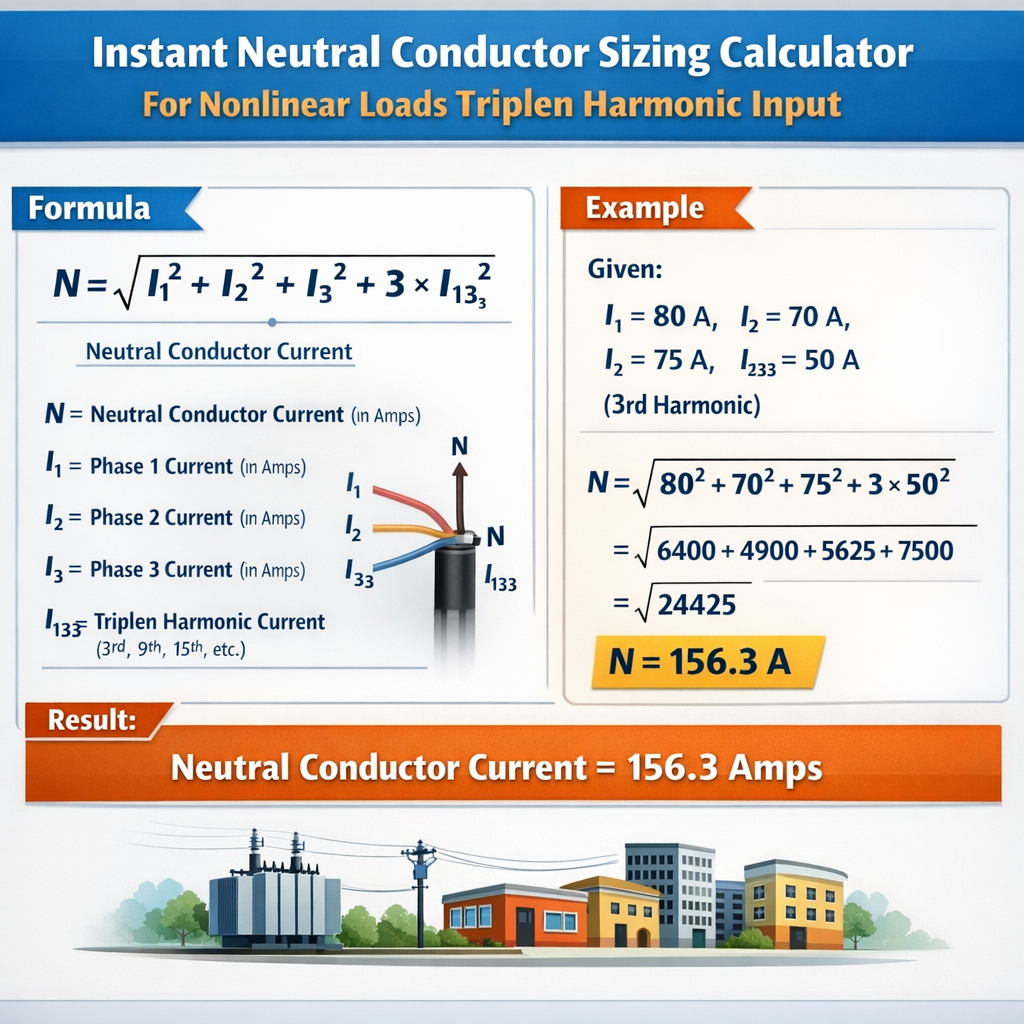
Tool for precise neutral conductor sizing in three-phase systems with triplen harmonic nonlinear load characteristics.
Calculated neutral currents, derating and ampacity ensure safety, minimizing overheating and nuisance tripping risks.Instant neutral conductor sizing for triplen-harmonic nonlinear loads (current-based)
Background and purpose of the sizing method
Triplen harmonics (orders 3, 9, 15, ...) are unique because their phase relationships cause them to add algebraically in the neutral of a three-phase four-wire wye system. In installations with high concentrations of single-phase nonlinear loads—UPS rectifiers, some types of lighting ballasts, and many computer/server loads—neutral currents can far exceed phase conductor currents. An instant neutral conductor sizing calculator must therefore treat triplen harmonics explicitly, provide conservative and realistic calculation modes, and return neutral RMS currents and recommended conductor ampacities for compliance with code and good engineering practice.This article documents the theoretical basis, provides practical formulas in plain HTML form, shows typical harmonic spectra for common equipment, gives extensive tabulated examples and conductor guidance, and walks through two fully worked real-world scenarios. It also cites authoritative standards and implementation references (IEEE/NFPA/IEC) so engineers can reconcile design outcomes with regulatory requirements and utility constraints.Fundamental theory: why triplen harmonics overload neutrals
Triplen harmonics are integer multiples of three (h = 3, 9, 15, ...). For a balanced three-phase wye system with identical per-phase triplen harmonic currents that are in-phase (zero sequence), the phasors from phases A, B and C do not cancel; instead they add in the neutral, producing a neutral harmonic current equal to the algebraic sum of the three phase contributions at that harmonic order. In contrast, non-triplen odd harmonics (5th, 7th, 11th, etc.) form positive or negative sequence sets that, when balanced, tend to cancel in the neutral.Key practical consequences:- Neutral conductor RMS current can exceed phase conductor RMS current, sometimes by multiples.
- Sizing the neutral conductor purely by phase ampacity (or with balanced load assumptions) can be unsafe when triplen harmonics are significant.
- Calculators must consider per-harmonic phasor sums or adopt conservative assumptions (worst-case in-phase addition) to guarantee safety.
The neutral RMS calculation methodology
The general, exact per-harmonic neutral contribution is computed by summing the three phase phasors of each harmonic order and taking the magnitude. The total neutral RMS current is the root-sum-square of all harmonic-order neutral contributions plus any DC or fundamental imbalance contribution. Expressed in plain HTML-friendly formulae:- I_N(h) = neutral current contribution from harmonic order h (RMS amplitude of the phasor-sum at that harmonic).
- I_A(h), I_B(h), I_C(h) = per-phase phasors (complex values) of harmonic order h for phases A, B, C respectively.
- I_N,rms = total neutral RMS current combining all harmonic orders (including DC or subharmonic content if present).
- Conservative linear-sum for triplen harmonics (worst-case in-phase): I_N(triplen_total) = 3 * sum_h |I_phase(h)| for h = 3, 9, 15, ...
- Root-sum-square (RSS) for triplen harmonics if phase-to-phase phase angles are statistically independent or known to be uncorrelated: I_N(triplen_total) = 3 * sqrt( sum_h (I_phase(h))^2 )
- Non-triplen harmonic contribution often cancels when loads and harmonics are balanced; conservative practice still permits including their RSS contribution if phase angles are unknown.
Variable definitions and typical values
Presenting the key variables used in formulas and calculators, with typical magnitudes engineers should expect:
- I_phase,1 — per-phase fundamental RMS current (A). Typical: small loads 1–20 A, VFD phases 20–200 A.
- I_phase,3 — per-phase 3rd harmonic RMS current (A). Typical ranges: 0–40% of fundamental for some single-phase nonlinear rectifiers; heavier for some legacy ballasts or saturable-reactor systems.
- I_phase,9 — per-phase 9th harmonic RMS current (A). Typical: often much smaller than 3rd, 0–10% of fundamental.
- THD_I — current total harmonic distortion (%). Typical: modern 6-pulse VFDs 30–60% without input mitigation; IT equipment and small single-phase rectifiers 60–150% depending on distribution.
- Conservative multiplier (M_trip) — choose 3 for worst-case in-phase triplen addition; choose 3 * sqrt(sum of squares) for RSS approach.
Common harmonic spectra for nonlinear loads (typical values)
Below is a compact but broad table of typical harmonic current magnitudes expressed as percentage of the per-phase fundamental current. These are approximate ranges; OEM data or harmonic scans should be used for precise design.| Load type | Typical THD_I (%) | Typical 3rd (%) | Typical 5th (%) | Typical 7th (%) | Notes |
|---|---|---|---|---|---|
| 6-pulse VFD (three-phase rectifier) | 30–80 | ~0–5 | 10–30 | 5–20 | Triplen components generally low; 5th/7th dominant |
| Single-phase UPS/rectifier (wye-fed banks) | 50–150 | 20–60 | 10–40 | 5–30 | Significant triplen content depending on rectifier and DC-link |
| Electronic fluorescent ballasts | 30–100 | 10–40 | 5–20 | 5–15 | Triplen may be present for single-phase ballasts on three-phase |
| IT server power supplies (many single-phase outlets) | 50–150 | 10–50 | 10–40 | 5–30 | Aggregate effect depends on phase distribution of outlets |
| HVDC converters, SCR drives | Variable | Variable | Variable | Variable | Manufacturer data required |
Neutral sizing strategy and recommended calculation modes
A robust calculator should present at least three sizing strategies:- Exact phasor-sum mode — uses measured or specified per-harmonic phasors (magnitudes and angles), computes exact I_N(h) for each harmonic and total I_N,rms using the formula above.
- Conservative worst-case mode — assumes triplen harmonic components are in-phase and add algebraically: I_N(triplen) = 3 * sum(|I_phase,h|). Use this for safety when harmonic phase relationships are unknown.
- Statistical/RSS mode — assumes uncorrelated triplen harmonics and computes I_N(triplen) = 3 * sqrt(sum(I_phase,h^2)). This is less conservative and may be used when phase angles are random or when field measurements show decorrelation.
- Phasor data available (power quality survey): use exact phasor-sum mode.
- No phasor data and many similar single-phase rectifiers served in-phase: use conservative worst-case mode.
- Many distributed single-phase loads with randomized phase connections: RSS mode may be acceptable with verification.
Formulas for the three modes (plain HTML)
Exact phasor-sum (per harmonic):
Total neutral RMS:
Conservative worst-case (triplen only):
I_N(triplen) = 3 * sum_h | I_phase(h) |, for h = 3, 9, 15, ...
I_N,rms ≈ I_N(triplen) (if triplen dominate and other harmonic contributions negligible)
RSS triplen approach:
- I_A(h) etc.: complex phasor values (RMS) of harmonic h on phase A, B, C.
- I_phase(h): per-phase RMS magnitude of harmonic h (if phases considered identical in magnitude).
Extensive conductor and neutral current example tables
Below are practical example lookup tables that map per-phase fundamental and triplen percentage content to neutral RMS using conservative and RSS modes. Values assume balanced per-phase fundamentals and identical per-phase harmonic magnitudes.| Per-phase I1 (A) | 3rd (% of I1) | 9th (% of I1) | Conservative neutral (A) = 3*(I3+I9) | RSS neutral (A) = 3*sqrt(I3^2+I9^2) |
|---|---|---|---|---|
| 50 | 16 (I3=8 A) | 4 (I9=2 A) | 30.0 | 24.74 |
| 100 | 20 (I3=20 A) | 5 (I9=5 A) | 75.0 | 64.95 |
| 200 | 25 (I3=50 A) | 5 (I9=10 A) | 180.0 | 162.46 |
| 30 | 10 (I3=3 A) | 2 (I9=0.6 A) | 11.0 | 9.97 |
Typical conductor ampacity reference (guideline)
Designers must comply with local code (NEC, IEC) and termination temperature ratings; however, the table below is a practical reference for common copper conductor sizes and typical ampacity values used in industrial practice. Verify with the applicable code edition and column for conductor insulation/termination temperature. These are typical rounded ampacities used for preliminary selection.| Copper conductor | Typical ampacity (A) | Common application |
|---|---|---|
| 14 AWG (2.08 mm2) | 15 | Lighting/branch circuits (small) |
| 12 AWG (3.31 mm2) | 20 | Branch circuits |
| 10 AWG (5.26 mm2) | 30 | Small branch circuits |
| 8 AWG (8.36 mm2) | 50 | Feeder/trunk (small) |
| 6 AWG (13.3 mm2) | 65 | Feeder |
| 4 AWG (21.2 mm2) | 85 | Feeder |
| 3 AWG (26.7 mm2) | 100 | Large feeder |
| 1/0 AWG (53.5 mm2) | 150 | Service feeder |
Real-case Example 1 — commercial office with many single-phase UPS loads
Scenario:- 208Y/120 V three-phase wye distribution.
- Per-phase connected IT loads produce per-phase fundamental current I1 = 50 A.
- Measured per-phase harmonic content: 3rd harmonic = 8 A, 9th harmonic = 2 A. Assume 5th and 7th are present but negligible for neutral calculation because they form 3-phase sequence cancellation when balanced.
- Goal: calculate neutral RMS current under conservative and RSS assumptions and select neutral conductor size accordingly.
- Under conservative mode, neutral sees 30 A (sizing must select conductor ampacity >30 A). Typical copper #10 AWG has ampacity ≈30 A (NEC 60°C table) — this would be marginal. Use at least #10 in 75°C column (35 A) or better #8 (40–50 A based on termination rating) to provide margin and account for derating, ambient, and future load growth.
- Under RSS mode, neutral current ≈24.7 A — #12 AWG (20 A) would be undersized; #10 AWG (30 A) would be acceptable but still close to the limit once derating is applied.
- Recommendation: adopt conservative neutral equal to or greater than phase conductor rating and consider sizing neutral equal to phase conductor or next larger size when triplen harmonics present. In this example select #8 AWG copper to provide margin, reduce temperature rise and allow 75°C termination rating operation.
Real-case Example 2 — data center with concentrated single-phase rectifiers producing heavy triplen currents
Scenario:- Three-phase 480Y/277 V wye distribution serving many single-phase rectifiers and battery-charger circuits.
- Aggregate per-phase fundamental currents (I1) vary by phase due to unbalanced number of single-phase loads; measured per-phase 3rd harmonics (RMS) are: Phase A I3A = 22 A, Phase B I3B = 25 A, Phase C I3C = 18 A.
- Other triplen harmonics (9th, 15th) are present but small: I9 per phase assumed 3 A on each phase for simplicity. Phases are roughly in-phase for triplen components (single-phase rectifiers are referenced to neutral), so worst-case addition is a prudent design assumption.
- Goal: compute neutral RMS current and recommend neutral conductor.
Compute per-harmonic neutral contributions:
3rd harmonic neutral: I_N(3) = |I3A + I3B + I3C| = |22 + 25 + 18| = 65 A (they are in-phase)
I_N,rms = sqrt( I_N(3)^2 + I_N(9)^2 ) = sqrt( 65^2 + 9^2 ) = sqrt(4225 + 81) = sqrt(4306) ≈ 65.62 A
Interpretation:- The dominant neutral content is the summed 3rd harmonic: 65 A. Even with small 9th content, the total neutral RMS is ≈ 65.6 A.
- If phase fundamentals are smaller (per-phase fundamental maybe 80–100 A), the neutral can still exceed the rated phase conductor (depending on phase conductor sizing).
- Recommendation: size neutral to at least 75–100 A to allow margin and account for ambient/derating. Typical practical conductor choices would be 4 AWG copper (≈85 A) or 3 AWG (≈100 A) depending on exact ampacity tables and termination temperature ratings. Where neutral may exceed phase conductor rating, provide a neutral conductor with equal or larger ampacity than phase conductors and document reasoning.
- Install harmonic filters (passive or active) at the source to reduce triplen component amplitudes.
- Redistribute single-phase loads across phases to reduce aggregate in-phase triplen summation.
- Convert some single-phase loads to three-phase or use three-phase rectifiers which can reduce triplen generation.
- Provide a dedicated oversize neutral conductor (or paralleling) and use thermal monitoring on neutral busbars to detect elevated temperatures.
Practical engineering recommendations and code alignment
Best practices derived from field experience and normative guidance:- Always obtain or measure per-harmonic phasor data if possible; exact phasor-sum calculation is the most defensible approach.
- When phasor information is unavailable and triplen harmonics are expected, use the conservative worst-case addition (linear sum) for triplen orders for neutral sizing and protection selection.
- Size the neutral conductor equal to or greater than the phase conductors when triplen harmonic currents exceed a small fraction (e.g., >10%) of per-phase RMS current or when many single-phase nonlinear loads are connected to neutral.
- When installing protective devices, ensure neutral protection devices (if present) and current sensing account for harmonic content and do not misoperate due to harmonic distortion (use true-RMS sensing for metering and protection where available).
- Document assumptions (conservative vs RSS), measurement data, and margins for future audits and utility coordination.
Standards, normative guidance and authoritative references
For design validation and regulatory compliance consult these recognized references:- IEEE Std 519-2014 — IEEE Recommended Practice and Requirements for Harmonic Control in Electric Power Systems. Source: https://standards.ieee.org/standard/519-2014.html
- NFPA 70 (NEC) — National Electrical Code, for conductor ampacity, termination limits and derating rules. Source: https://www.nfpa.org/NEC
- IEC 61000 series — Electromagnetic compatibility (EMC) standards including harmonic immunity and emissions. Source: https://www.iec.ch
- IEEE Std 141 (Green Book) — grounding and neutral practice guidance. Source: https://standards.ieee.org/standard/141-1993.html
- Manufacturer whitepapers on harmonic mitigation and UPS/VFD harmonics (examples): Schneider Electric application notes, Eaton technical bulletins, ABB harmonic filter guidelines. Example: Schneider Electric technical note on harmonics: https://www.se.com
Implementation checklist for an instant neutral sizing calculator
When building or using an "Instant Neutral Conductor Sizing Calculator" include these features:- Input fields for per-phase fundamental current and per-harmonic magnitudes and phases (phasor inputs optional).
- Choice of calculation mode: exact phasor, conservative linear-sum, RSS.
- Automatic per-harmonic neutral contribution computation (I_N(h) = |I_A(h)+I_B(h)+I_C(h)|).
- Total neutral RMS computation and comparison to selected conductor ampacities with code-based derating factors.
- Warnings when neutral RMS > phase conductor ampacity and suggestion to upsize or mitigate harmonics.
- Exportable report including assumptions, calculation mode, and reference standards for job documentation.
Summary of technical takeaways
Triplen harmonics can produce neutral currents far exceeding phase conductor currents in three-phase four-wire systems. An instant neutral sizing tool must therefore:- Compute per-harmonic neutral contributions using phasor sums.
- Offer conservative and RSS calculation modes when phasor angles are unknown.
- Compare neutral RMS to conductor ampacity consistent with code and termination ratings and provide sizing recommendations with appropriate margins.
- IEEE Std 519-2014: IEEE Recommended Practice and Requirements for Harmonic Control in Electric Power Systems. https://standards.ieee.org/standard/519-2014.html
- NFPA 70, National Electrical Code (NEC). https://www.nfpa.org/NEC
- IEC 61000 series for electromagnetic compatibility and harmonics. https://www.iec.ch
- Schneider Electric: Application notes and whitepapers on harmonics (search term "harmonics Schneider Electric white paper"). https://www.se.com
- Eaton: Technical papers on harmonic mitigation and neutral sizing. https://www.eaton.com