I = (kVA × 1000) / V (single-phase) · I = (kVA × 1000) / (√3 × V) (three-phase)Quick Reference Table
| kVA | 1φ 240V | 3φ 480V |
|---|---|---|
| 10 | 41.67 A | 12.03 A |
| 25 | 104.17 A | 30.07 A |
| 50 | 208.33 A | 60.14 A |
| 75 | 312.50 A | 90.21 A |
| 100 | 416.67 A | 120.28 A |
| 125 | 520.83 A | 150.35 A |
| 200 | 833.33 A | 240.56 A |
| 300 | 1250.00 A | 360.84 A |
FAQ
How to convert kVA to Amps (3φ)?
I = (kVA × 1000) ÷ (√3 × V) with line-to-line voltage.
kVA vs kW?
kVA = apparent power (no PF needed). kW = active power (kW = kVA × PF).
Whether you are sizing a transformer, selecting a breaker, or checking that your generator can handle the load, you need to convert kVA to amps. The formula is simple — divide apparent power by voltage (and by √3 for three-phase) — but picking the wrong voltage or forgetting the phase factor is one of the most common mistakes on job sites. This kVA to Amps calculator eliminates that risk: enter kVA, choose single-phase or three-phase, select your voltage, and get the exact current in seconds.
Below you will find complete conversion tables for every standard voltage, the formulas explained step by step, six real-world solved examples, and direct answers to the most-searched kVA-to-Amps queries — from 1 kVA all the way up to 380 kVA.
kVA to Amps Conversion Table — Single-Phase & Three-Phase
These tables cover the transformer and generator sizes you will actually encounter in commercial and industrial work. All values assume unity power factor (PF = 1). For real loads, divide the amps by your actual PF to get the true current draw.
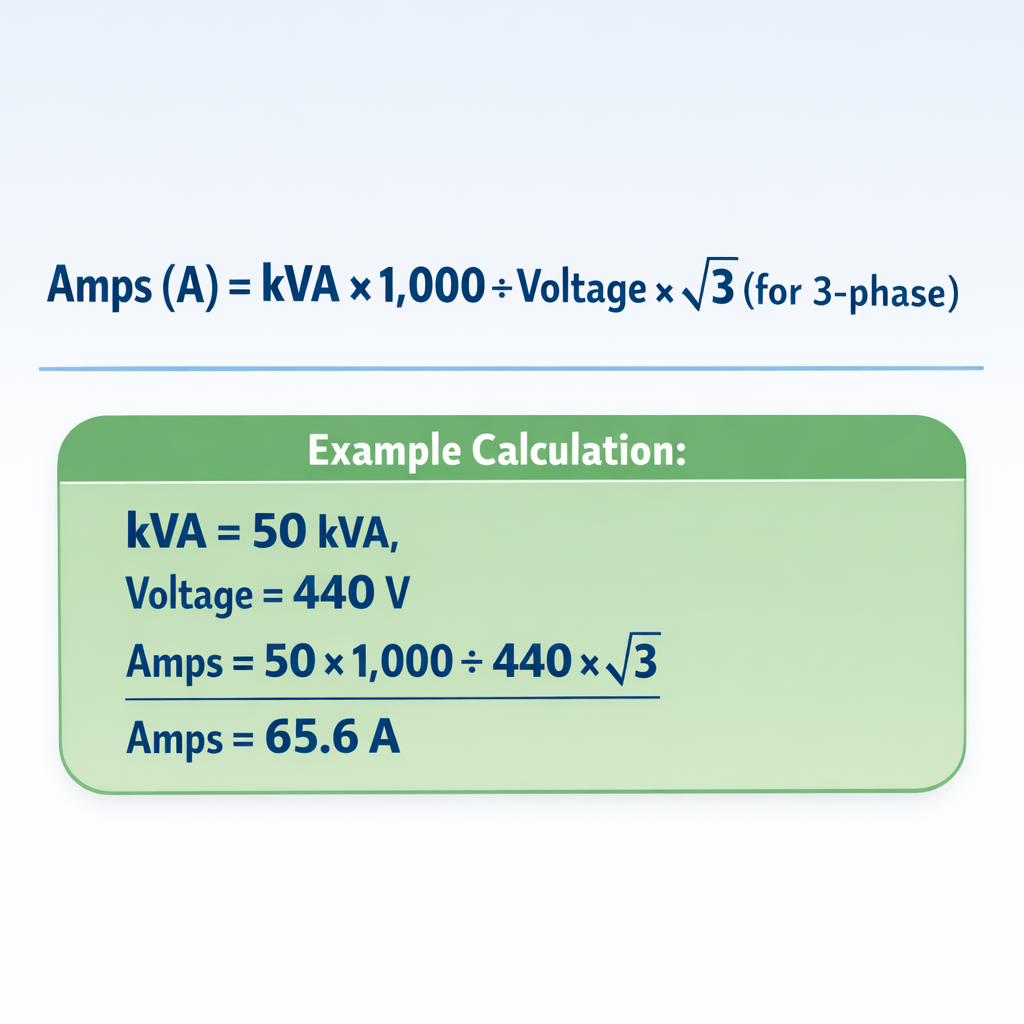
Table 1 — Single-Phase kVA to Amps
| kVA | 120 V | 208 V | 220 V | 240 V | Typical Application |
|---|---|---|---|---|---|
| 1 | 8.33 | 4.81 | 4.55 | 4.17 | Small UPS, POS terminal |
| 2 | 16.67 | 9.62 | 9.09 | 8.33 | Office UPS, point-of-sale |
| 3 | 25.00 | 14.42 | 13.64 | 12.50 | Server rack UPS |
| 5 | 41.67 | 24.04 | 22.73 | 20.83 | Residential sub-panel |
| 7.5 | 62.50 | 36.06 | 34.09 | 31.25 | Small workshop transformer |
| 10 | 83.33 | 48.08 | 45.45 | 41.67 | Residential backup generator |
| 15 | 125.00 | 72.12 | 68.18 | 62.50 | Standby generator |
| 25 | 208.33 | 120.19 | 113.64 | 104.17 | Small commercial transformer |
| 37.5 | 312.50 | 180.29 | 170.45 | 156.25 | Pole-mount transformer |
| 50 | 416.67 | 240.38 | 227.27 | 208.33 | Pad-mount transformer |
| 75 | 625.00 | 360.58 | 340.91 | 312.50 | Large commercial service |
| 100 | 833.33 | 480.77 | 454.55 | 416.67 | Industrial single-phase feeder |
Table 2 — Three-Phase kVA to Amps (Line-to-Line Voltage)
| kVA | 208 V | 240 V | 380 V | 480 V | 600 V | Typical Application |
|---|---|---|---|---|---|---|
| 5 | 13.88 | 12.03 | 7.60 | 6.01 | 4.81 | Small 3φ panel |
| 10 | 27.76 | 24.06 | 15.19 | 12.03 | 9.62 | CNC machine supply |
| 15 | 41.63 | 36.08 | 22.79 | 18.04 | 14.43 | Small elevator |
| 25 | 69.39 | 60.14 | 37.98 | 30.07 | 24.06 | Restaurant kitchen panel |
| 30 | 83.27 | 72.17 | 45.58 | 36.08 | 28.87 | HVAC rooftop unit |
| 40 | 111.03 | 96.23 | 60.77 | 48.11 | 38.49 | Data room PDU |
| 45 | 124.90 | 108.25 | 68.37 | 54.13 | 43.30 | Commercial chiller |
| 50 | 138.78 | 120.28 | 75.97 | 60.14 | 48.11 | Welding shop supply |
| 75 | 208.17 | 180.42 | 113.95 | 90.21 | 72.17 | Building main transformer |
| 100 | 277.55 | 240.56 | 151.93 | 120.28 | 96.23 | Industrial MCC feeder |
| 112.5 | 312.25 | 270.63 | 170.92 | 135.32 | 108.25 | Medium commercial bldg |
| 125 | 346.94 | 300.70 | 189.91 | 150.35 | 120.28 | School, office building |
| 150 | 416.33 | 360.84 | 227.90 | 180.42 | 144.34 | Shopping center feeder |
| 200 | 555.11 | 481.13 | 303.86 | 240.56 | 192.45 | Factory main transformer |
| 225 | 624.50 | 541.27 | 341.84 | 270.63 | 216.51 | Hospital wing |
| 300 | 832.66 | 721.69 | 455.79 | 360.84 | 288.68 | Large industrial plant |
| 380 | 1054.71 | 914.14 | 577.33 | 457.07 | 365.66 | Substation feeder |
| 500 | 1387.79 | 1202.81 | 759.67 | 601.41 | 481.13 | Campus distribution |
How to read: Find your kVA in the left column, then look across to your system voltage. The cell gives you full-load amps. For example, a 75 kVA transformer at 480 V three-phase delivers 90.21 A.
Step-by-Step Formulas: How to Convert kVA to Amps
The conversion from kVA to amps depends on whether you have a single-phase or three-phase system. Both formulas come from the same principle: apparent power (S) equals voltage times current. The only twist is the √3 factor in three-phase circuits, which accounts for the 120° phase offset between the three line conductors.
Formula 1 — Single-Phase kVA to Amps
Where V is the line-to-neutral voltage for single-phase systems (e.g., 120 V, 220 V, 240 V). The factor 1000 converts kilovolt-amperes to volt-amperes.
Example: A 10 kVA single-phase generator at 240 V.
I = (10 × 1000) ÷ 240 = 10000 ÷ 240 = 41.67 A.
Formula 2 — Three-Phase kVA to Amps
Where VLL is the line-to-line voltage (e.g., 208 V, 380 V, 480 V) and √3 ≈ 1.7321. This formula applies to balanced three-phase loads. For an unbalanced system, calculate each phase individually using the single-phase formula with line-to-neutral voltage.
Example: A 75 kVA three-phase transformer at 480 V.
I = (75 × 1000) ÷ (1.7321 × 480) = 75000 ÷ 831.38 = 90.21 A.
Formula 3 — With Power Factor (Real-World Loads)
I (A) = (kVA × 1000) ÷ (V × PF) — single-phase
When the source gives you kW instead of kVA, remember that kVA = kW ÷ PF. A motor rated 22 kW at PF 0.85 draws 22 ÷ 0.85 = 25.88 kVA. Then apply the standard formula. Per NEMA MG1, typical motor power factors range from 0.80 to 0.92 depending on load percentage.
Why the formulas work
Apparent power in volt-amperes is V × I for single-phase and √3 × VLL × I for three-phase. Dividing both sides by voltage (and √3 for three-phase) isolates the current. The 1000 multiplier simply converts kVA to VA. These relationships are defined in IEC 60076 for transformer ratings and IEEE C57.12 for distribution transformers.
kVA vs kW vs kVAR — What Is the Difference?
These three quantities describe different aspects of AC power. Confusing them leads to undersized equipment, tripped breakers, and utility penalties. Here is a clear comparison.
| Quantity | Symbol | Unit | What It Measures | Depends on PF? |
|---|---|---|---|---|
| Apparent Power | S | kVA | Total power the source must deliver (voltage × current) | No — it includes both real and reactive |
| Active (Real) Power | P | kW | Power that does useful work (heat, motion, light) | Yes — kW = kVA × PF |
| Reactive Power | Q | kVAR | Power stored and returned by inductors/capacitors | Yes — kVAR = kVA × sin(φ) |
The power triangle ties them together: kVA² = kW² + kVAR². Transformers and generators are rated in kVA because they must handle total current regardless of how much is reactive. Motors and heaters are rated in kW because you care about actual output. When converting kVA to amps, you do not need PF — the formula uses apparent power directly. But when sizing cables and protection per NEC Article 430, you work with kW and PF to find actual current draw.
Common PF values: Resistive loads (heaters, incandescent): PF ≈ 1.0. Induction motors at full load: PF ≈ 0.85–0.90. Motors at light load: PF ≈ 0.50–0.70. LED drivers: PF ≈ 0.90–0.98. UPS systems: PF ≈ 0.80–0.95.
Inverse Conversion: Amps to kVA
To go from amps back to kVA, multiply instead of dividing.
kVA = (I × VLL × √3) ÷ 1000 — three-phase
| Amps | 1φ @ 240 V (kVA) | 3φ @ 480 V (kVA) | 3φ @ 208 V (kVA) |
|---|---|---|---|
| 20 | 4.80 | 16.63 | 7.21 |
| 30 | 7.20 | 24.94 | 10.81 |
| 50 | 12.00 | 41.57 | 18.02 |
| 60 | 14.40 | 49.88 | 21.63 |
| 100 | 24.00 | 83.14 | 36.04 |
| 150 | 36.00 | 124.71 | 54.07 |
| 200 | 48.00 | 166.28 | 72.09 |
| 400 | 96.00 | 332.55 | 144.17 |
You can also use our calculator above — switch to “Amps → kVA” mode. For a deeper look at the amp-to-kVA direction, see our Amperes to VA calculator.
6 Solved Examples — Real-World kVA to Amps Conversions
Example 1 — 1 kVA UPS at 120 V (Single-Phase)
Data: UPS rated 1 kVA, 120 V single-phase.
Formula: I = (1 × 1000) ÷ 120
Result: 8.33 A
A 1 kVA desktop UPS draws only 8.33 A. It fits on a standard 15 A circuit with room for other devices. Check that the combined load does not exceed 80% of the breaker rating (12 A on a 15 A circuit) per NEC 210.20.
Example 2 — 30 kVA Transformer at 208 V (Three-Phase)
Data: Dry-type transformer, 30 kVA, 208 V three-phase secondary.
Formula: I = (30 × 1000) ÷ (1.7321 × 208)
Result: 83.27 A
This is a very common setup for HVAC rooftop units in commercial buildings. A 100 A breaker provides the NEC 125% overcurrent margin (83.27 × 1.25 = 104 A, so a 110 A trip is ideal). Size conductors for at least 104 A — typically 1 AWG copper or 1/0 AWG aluminum THHN.
Example 3 — 50 kVA Generator at 240 V (Single-Phase)
Data: Standby generator, 50 kVA, 240 V single-phase output.
Formula: I = (50 × 1000) ÷ 240
Result: 208.33 A
A 50 kVA single-phase generator delivers over 208 A. You need a 250 A rated ATS and 4/0 AWG copper service entrance cables. Verify your ATS continuous rating matches or exceeds this value.
Example 4 — 125 kVA Transformer at 480 V (Three-Phase)
Data: Pad-mount transformer, 125 kVA, 480 V three-phase.
Formula: I = (125 × 1000) ÷ (1.7321 × 480)
Result: 150.35 A
A 125 kVA, 480 V transformer is the standard choice for small commercial buildings — schools, branch offices, retail stores. The secondary breaker is typically 175 A or 200 A. Conductors: 2/0 AWG copper THHN in conduit.
Example 5 — 200 kVA at 380 V (Three-Phase, EU/Asia)
Data: Factory transformer, 200 kVA, 380 V three-phase (IEC system).
Formula: I = (200 × 1000) ÷ (1.7321 × 380)
Result: 303.86 A
In IEC countries (380/400 V systems), a 200 kVA transformer delivers about 304 A. Size cables per IEC 60364 — typically 185 mm² copper single-core. The MCCB should be rated at 400 A to allow for motor inrush and future load growth.
Example 6 — 300 kVA at 600 V (Three-Phase, Canada)
Data: Industrial transformer, 300 kVA, 600 V three-phase (Canadian system).
Formula: I = (300 × 1000) ÷ (1.7321 × 600)
Result: 288.68 A
Canada’s 600 V distribution delivers noticeably lower current than 480 V for the same kVA — about 20% less. That means smaller cables and smaller bus bars, which is one reason 600 V is popular in Canadian plants. Size a 400 A fused disconnect for this application per CEC Section 26.
kVA to Amps in Electric Motors & Transformers
Motors and transformers are the two pieces of equipment where you will use kVA-to-amps conversions most often. Here is what you need to know for each.
Transformer Nameplates
Every transformer nameplate lists kVA, primary voltage, and secondary voltage. To find the full-load current on either side, apply the three-phase (or single-phase) formula to that side’s voltage. For example, a 75 kVA transformer with a 480 V secondary delivers 90.21 A on the secondary side. On the 4160 V primary side, it draws only 10.41 A — same kVA, higher voltage, lower current.
Always size protection on the secondary current. Per NEC 450.3, the secondary OCPD for a transformer ≤ 600 V can be set at up to 125% of the secondary FLA for transformers with primary protection.
Motor kVA vs Motor kW
Motor nameplates show kW (or HP) output, not kVA input. To find the kVA input, divide kW by PF and efficiency:
Example: A 22 kW motor, PF = 0.86, η = 0.91.
kVA input = 22 ÷ (0.86 × 0.91) = 22 ÷ 0.7826 = 28.12 kVA.
At 480 V three-phase: I = (28.12 × 1000) ÷ (1.7321 × 480) = 33.82 A.
This is the current you need for cable and breaker sizing — not the kW-based current. See our Amp to kW calculator for the reverse direction, and our motor efficiency calculator for IE class lookup.
Generator Sizing
Generators are rated in kVA (or kW at a stated PF). To find the maximum current a generator can deliver, use the kVA-to-amps formula at the generator’s rated voltage. Then verify that the total connected load — including motor starting kVA — does not exceed that current. Use our generator load-list calculator for a thorough sizing check.
Quick Equivalences — Most-Searched kVA to Amps Values
These are the specific conversions people search for most often. Every result is calculated at the most common voltage for that size; alternative voltages are noted.
1 kVA to Amps
8.33 A at 120 V (1φ) · 2.78 A at 208 V (3φ)
Small UPS or control transformer. Fits on a standard 15 A branch circuit at 120 V.
10 kVA to Amps
41.67 A at 240 V (1φ) · 12.03 A at 480 V (3φ)
Residential backup generator or small dry-type transformer.
25 kVA to Amps
104.17 A at 240 V (1φ) · 30.07 A at 480 V (3φ)
Pole-mount distribution transformer for a small commercial customer.
30 kVA to Amps
83.27 A at 208 V (3φ) · 36.08 A at 480 V (3φ)
Common HVAC and rooftop unit transformer size.
40 kVA to Amps
111.03 A at 208 V (3φ) · 48.11 A at 480 V (3φ)
Data room PDU or small manufacturing cell supply.
50 kVA to Amps
60.14 A at 480 V (3φ) · 75.97 A at 380 V (3φ)
Welding shop or medium commercial service entrance.
100 kVA to Amps
120.28 A at 480 V (3φ) · 151.93 A at 380 V (3φ)
Industrial MCC feeder. Size a 150 A or 175 A breaker with 125% margin.
125 kVA to Amps
150.35 A at 480 V (3φ) · 189.91 A at 380 V (3φ)
Standard school or office building transformer. Secondary breaker: 175–200 A.
150 kVA to Amps
180.42 A at 480 V (3φ) · 227.90 A at 380 V (3φ)
Shopping center feeder or medium factory. Cable: 3/0 AWG copper typical.
200 kVA to Amps
240.56 A at 480 V (3φ) · 303.86 A at 380 V (3φ)
Factory main transformer. Size a 300 A or 400 A disconnect depending on your system.
300 kVA to Amps
360.84 A at 480 V (3φ) · 455.79 A at 380 V (3φ)
Large industrial plant. Consider 500 A bus duct for the secondary side.
380 kVA to Amps
457.07 A at 480 V (3φ) · 577.33 A at 380 V (3φ)
Substation feeder class. Requires bus-bar or parallel cable runs for secondary distribution.
Frequently Asked Questions
How do I convert kVA to Amps?
Divide kVA × 1000 by your voltage. For three-phase, also divide by √3 (1.7321). Formula: I = (kVA × 1000) ÷ V for single-phase, I = (kVA × 1000) ÷ (√3 × V) for three-phase. Example: 50 kVA at 480 V 3φ = 60.14 A.
Can I convert kVA to Amps without knowing voltage?
No. Voltage is essential because amps = power ÷ voltage. Without voltage, you cannot determine current. If the voltage is unknown, check the equipment nameplate, the utility service entrance, or the transformer secondary rating.
What is the difference between kVA and kW?
kVA is apparent power (voltage × current, no PF). kW is real (active) power, which accounts for power factor: kW = kVA × PF. Transformers and generators are rated in kVA; motors and heaters are rated in kW. When converting kVA to amps, PF is not needed.
How many amps is 1 kVA at 120 V?
8.33 A. Calculation: (1 × 1000) ÷ 120 = 8.33 A. This is a single-phase result. At 240 V single-phase, 1 kVA = 4.17 A.
How many amps is 125 kVA at 480 V three-phase?
150.35 A. Calculation: (125 × 1000) ÷ (1.7321 × 480) = 150.35 A. This is one of the most common commercial transformer sizes in North America.
How many amps is 200 kVA at 380 V three-phase?
303.86 A. Calculation: (200 × 1000) ÷ (1.7321 × 380) = 303.86 A. Standard factory transformer size for IEC 380/400 V systems in Europe and Asia.
Why does my calculated current differ from the nameplate?
The nameplate may list kW instead of kVA, it may show current at a different voltage tap, or it may include a service factor. Also, the nameplate FLA is measured at rated load; actual current varies with load percentage and power factor.
Do I need power factor to convert kVA to amps?
No. kVA already includes both real and reactive power, so the formula I = kVA × 1000 ÷ V gives total current directly. You only need PF if your starting value is kW (then convert to kVA first: kVA = kW ÷ PF).
How do I convert amps to kVA?
Multiply: kVA = (I × V) ÷ 1000 for single-phase, or kVA = (I × V × √3) ÷ 1000 for three-phase. Example: 100 A at 480 V 3φ = (100 × 480 × 1.7321) ÷ 1000 = 83.14 kVA.
What voltage should I use — line-to-line or line-to-neutral?
For three-phase, always use line-to-line voltage (e.g., 208, 380, 480 V) with the √3 formula. For single-phase loads fed from line to neutral, use the L-N voltage (e.g., 120 V). For single-phase loads fed line to line (e.g., 240 V dryer circuit), use the L-L voltage without √3.
How do I size a transformer from amps?
Use the inverse formula: kVA = (I × V × √3) ÷ 1000 for three-phase. Then round up to the next standard transformer size (15, 25, 30, 45, 75, 112.5, 150, 225, 300, 500 kVA). Our transformer kVA sizing calculator automates this with a growth margin.
Is the kVA-to-amps conversion the same for AC and DC?
No. kVA is an AC concept (it accounts for phase angle). In DC circuits, power is simply P = V × I (watts). There is no reactive component and no √3 factor. Do not apply AC kVA formulas to DC systems.
Related Conversions
- Amperes to VA Calculator — inverse of this page (amps → VA/kVA)
- Amps to kW Calculator — when you need real power from current
- Amps to Watts Calculator — single-phase and three-phase watt conversions
- Amps to HP Calculator — from current directly to horsepower
- Transformer kVA Sizing Calculator — size your transformer from demand load
- Balanced and Unbalanced Load Calculation — handle phase imbalance properly
- UPS Sizing Calculator (kVA/kW) — exact UPS size for IT loads