DC: A = W ÷ V · 1Φ AC: A = W ÷ (V × PF) · 3Φ AC: A = W ÷ (V × √3 × PF)
📊 Quick Reference Table (120 V, PF 1.0)
| Watts | Amps @120 V | Amps @240 V | Amps @480 V 3Φ |
|---|---|---|---|
| 100 | 0.83 | 0.42 | 0.12 |
| 500 | 4.17 | 2.08 | 0.60 |
| 1000 | 8.33 | 4.17 | 1.20 |
| 1500 | 12.50 | 6.25 | 1.80 |
| 2000 | 16.67 | 8.33 | 2.41 |
| 4500 | 37.50 | 18.75 | 5.41 |
❓ Quick FAQ
How many amps is 1500 watts at 120 V?
12.50 amps. Formula: 1500 ÷ 120 = 12.50 A.
Why do I need the voltage?
Watts alone don’t tell you the current — amps depend on both watts and volts (A = W ÷ V).
🔄 Need the reverse calculation? If you need to convert from AMP to WATTS (the opposite direction of this page), use our dedicated AMP to WATTS calculator with full conversion tables, step-by-step examples, and engineering formulas.
A watts to amps conversion calculator solves one of the most frequent questions in electrical work: “how much current does this appliance draw?” You need the answer every time you size a breaker, select wire gauge, or check if a circuit is overloaded. The calculation itself is simple — divide watts by volts — but it changes slightly depending on whether you have a DC circuit, a single-phase AC supply, or a three-phase system. This page gives you an instant calculator that handles all three, plus complete formulas, conversion tables for everyday wattages, and six worked examples from real installations.
Watts to Amps Conversion Table — Common Appliance Wattages
The table below converts the most searched wattage values to amps at standard North American and international voltages. All values assume power factor = 1.0 (resistive loads like heaters, kettles, and incandescent lights). For motor-driven loads, divide the amps shown by the actual PF (typically 0.80–0.85) to get the true current draw.
| Watts | Amps @ 120 V | Amps @ 220 V | Amps @ 240 V | Typical Appliance |
|---|---|---|---|---|
| 60 | 0.50 | 0.27 | 0.25 | Incandescent light bulb |
| 100 | 0.83 | 0.45 | 0.42 | LED TV / monitor |
| 300 | 2.50 | 1.36 | 1.25 | Blender / small appliance |
| 500 | 4.17 | 2.27 | 2.08 | Window fan |
| 700 | 5.83 | 3.18 | 2.92 | Microwave (small) |
| 1000 | 8.33 | 4.55 | 4.17 | Toaster / space heater (small) |
| 1200 | 10.00 | 5.45 | 5.00 | Hair dryer (low setting) |
| 1500 | 12.50 | 6.82 | 6.25 | Space heater / electric kettle |
| 1800 | 15.00 | 8.18 | 7.50 | Hair dryer (high) / iron |
| 2000 | 16.67 | 9.09 | 8.33 | Countertop oven |
| 3000 | 25.00 | 13.64 | 12.50 | Tankless mini water heater |
| 3600 | 30.00 | 16.36 | 15.00 | EV Level 1 charger |
| 4500 | 37.50 | 20.45 | 18.75 | Electric water heater element |
| 4800 | 40.00 | 21.82 | 20.00 | Large water heater / dryer element |
| 5000 | 41.67 | 22.73 | 20.83 | Electric range burner |
| 7200 | 60.00 | 32.73 | 30.00 | EV Level 2 charger (30 A) |
| 10000 | 83.33 | 45.45 | 41.67 | Electric furnace / range |
How to Convert Watts to Amps — Formulas Step by Step
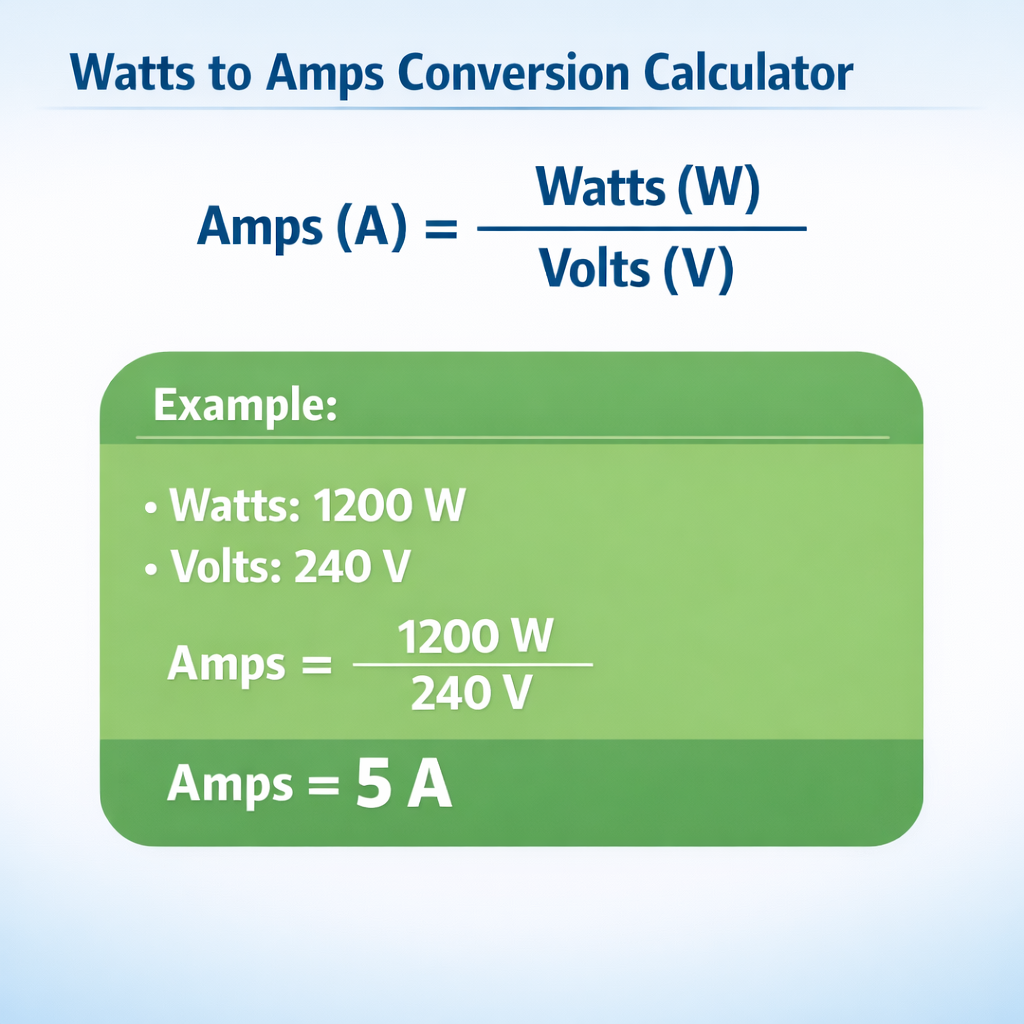
The core idea is always the same: current equals power divided by voltage. The formula changes slightly depending on the electrical system because AC circuits involve power factor and three-phase circuits distribute power across three conductors.
DC Circuits
Direct current has no power factor — watts and volt-amps are the same thing. If a 12 V DC LED strip draws 60 W, the current is 60 ÷ 12 = 5.00 A. This is the formula you use for batteries, solar panels, automotive circuits, and any DC power supply.
Single-Phase AC
In single-phase AC, the power factor reduces the useful power relative to the apparent power. A 1500 W heater at 120 V with PF = 1.0 draws 1500 ÷ (120 × 1.0) = 12.50 A. But a 1500 W motor at 120 V with PF = 0.80 draws 1500 ÷ (120 × 0.80) = 15.63 A — over 3 amps more for the same useful output. This is why motor circuits need larger wires and breakers than resistive loads of the same wattage.
Three-Phase AC
For three-phase, the voltage in the formula is the line-to-line voltage (e.g., 480 V, 400 V, 208 V). The √3 factor (≈ 1.732) accounts for the phase angle between the three conductors. A 10,000 W three-phase heater bank at 480 V (PF = 1.0) draws 10,000 ÷ (480 × 1.732 × 1.0) = 12.03 A per phase. As a reference, IEEE and IEC 60038 define these standard voltages for global installations.
Key point — why voltage matters
Watts alone never tell you the amps. A 1500 W load draws 12.50 A at 120 V but only 6.25 A at 240 V. That is why most countries use 220–240 V for homes — it halves the current for the same power, allowing thinner and cheaper wiring. Always enter the actual system voltage in the calculator above for an accurate result.
What Are Amperes? Understanding Watts, Volts and Amps
This section answers the high-volume query “what’s a amperes” that brings significant traffic. An ampere (symbol A) is the SI base unit of electric current. It measures the rate of electron flow through a conductor — think of it as the “volume” of electricity moving through a wire per second.
| Unit | Symbol | What It Measures | Water Analogy |
|---|---|---|---|
| Volt | V | Electrical pressure (potential difference) | Water pressure in the pipe |
| Ampere | A | Electrical current (electron flow rate) | Volume of water flowing per second |
| Watt | W | Power (rate of energy use) | Total work the water can do |
| Ohm | Ω | Resistance to current flow | Pipe diameter (narrow = more resistance) |
The three are linked by Ohm’s law and the power formula: W = V × A. A 120 V outlet delivering 15 A supplies up to 1,800 W of power. Exceeding the ampere rating of a wire or breaker causes overheating — which is exactly why converting watts to amps matters for safety. The National Electrical Code (NEC) sizes conductors and overcurrent protection based on amps, not watts.
Amps to Watts — Inverse Conversion
To go from amps back to watts, multiply instead of dividing:
| Amps | Watts @ 120 V | Watts @ 240 V | Watts @ 480 V 3Φ |
|---|---|---|---|
| 5 | 600 | 1,200 | 4,157 |
| 10 | 1,200 | 2,400 | 8,314 |
| 15 | 1,800 | 3,600 | 12,470 |
| 20 | 2,400 | 4,800 | 16,627 |
| 30 | 3,600 | 7,200 | 24,941 |
| 40 | 4,800 | 9,600 | 33,255 |
| 50 | 6,000 | 12,000 | 41,569 |
Need the full amps-to-watts calculator? Check our dedicated Amps to Watts Calculator — or simply switch the approach: enter your amps into the formula above and multiply by voltage.
Solved Examples — 6 Real-World Cases
Example 1 — 1500 W Space Heater (120 V)
Data: 1500 W portable heater, 120 V, PF = 1.0 (resistive).
Formula: A = W ÷ V = 1500 ÷ 120 = 12.50 A
This fits a standard 15 A circuit but leaves only 2.50 A of headroom. NEC 210.23 limits continuous loads to 80% of the breaker rating (15 × 0.80 = 12 A), so technically a 20 A circuit is recommended for a heater running more than 3 hours.
Example 2 — 4500 W Water Heater Element (240 V)
Data: Standard residential water heater element, 4500 W, 240 V, PF = 1.0.
Formula: A = 4500 ÷ 240 = 18.75 A
Water heaters are continuous loads. At 80% breaker utilization, you need a 30 A breaker (30 × 0.80 = 24 A ≥ 18.75 A) and 10 AWG copper wire — which is exactly what NEC 422.13 specifies.
Example 3 — 4800 W Clothes Dryer Element (240 V)
Data: Electric dryer heating element, 4800 W, 240 V, PF = 1.0.
Formula: A = 4800 ÷ 240 = 20.00 A
The heating element alone draws 20 A, but the dryer motor adds another 3–5 A. That is why dryers require a 30 A circuit with 10 AWG wire and a NEMA 14-30 outlet.
Example 4 — 1800 W Hair Dryer (120 V)
Data: Professional hair dryer on high setting, 1800 W, 120 V, PF = 1.0.
Formula: A = 1800 ÷ 120 = 15.00 A
This maxes out a 15 A circuit by itself. Plugging anything else into the same circuit will trip the breaker. Use a bathroom outlet on a dedicated 20 A circuit per NEC 210.11(C)(3).
Example 5 — 1000 W Three-Phase Motor (480 V)
Data: Small three-phase pump motor, 1000 W output, 480 V, PF = 0.82, efficiency = 0.88.
Formula: Input W = 1000 ÷ 0.88 = 1136 W → A = 1136 ÷ (480 × 1.732 × 0.82) = 1.67 A
At 480 V three-phase, even a 1 kW motor draws under 2 A — this is why industrial plants prefer higher voltages to reduce conductor size and costs.
Example 6 — 2000 W Window AC (220 V)
Data: Window air conditioner, 2000 W, 220 V, PF = 0.85 (compressor motor).
Formula: A = 2000 ÷ (220 × 0.85) = 10.70 A
At 220 V the current is manageable on a 15 A circuit. At 120 V the same unit would draw 19.61 A — requiring a dedicated 20 A outlet. This illustrates why 220 V is standard for air conditioners in most countries.
Watts to Amps in Electric Motors — Nameplate and Real-World Current
Electric motors are the trickiest loads to convert because the nameplate wattage (or HP) represents mechanical output, not electrical input. The input current is always higher due to motor efficiency losses and power factor. Here is how to get the real amps:
For a typical 5 HP (3,730 W) single-phase motor at 240 V with PF = 0.82 and efficiency = 0.86: A = 3730 ÷ (240 × 0.82 × 0.86) = 3730 ÷ 169.25 = 22.04 A. Compare this to the simple calculation of 3730 ÷ 240 = 15.54 A — you would undersize the breaker by over 40% if you forgot efficiency and PF.
Always check the motor nameplate for the Full Load Amps (FLA) rating. The NEC requires you to use the FLA from Table 430.248 (single-phase) or Table 430.250 (three-phase) when the nameplate is not available. These tables build in typical efficiency and PF values so you don’t have to calculate them separately.
During startup, induction motors pull 6–8 times their running amps (locked-rotor amps / LRA). This short surge doesn’t change wire sizing but does affect the breaker type — use an inverse-time breaker rated per NEC 430.52 to avoid nuisance trips.
Quick Equivalences — Watts to Amps
Direct answers for the most searched watts-to-amps conversions. Values below use PF = 1.0 (resistive) unless noted. For motors, multiply the amps shown by approximately 1.20–1.25 to account for power factor and efficiency losses.
1000 Watts to Amps
8.33 A at 120 V
4.17 A at 240 V. A 1 kW heater fits comfortably on a 15 A / 120 V circuit.
1500 Watts to Amps
12.50 A at 120 V
6.25 A at 240 V. The standard wattage for portable heaters and electric kettles in the US.
1800 Watts to Amps
15.00 A at 120 V
7.50 A at 240 V. Maxes out a 15 A circuit — use a dedicated 20 A branch for this load.
2000 Watts to Amps
16.67 A at 120 V
8.33 A at 240 V. Requires a 20 A circuit at 120 V. Common wattage for countertop ovens and AC units.
4500 Watts to Amps
18.75 A at 240 V
Standard water heater element. Uses a 30 A breaker and 10 AWG wire per NEC.
4800 Watts to Amps
20.00 A at 240 V
Common dryer element wattage. With the motor, total draw reaches 23–25 A on a 30 A circuit.
500 Watts to Amps
4.17 A at 120 V
2.08 A at 240 V. Light loads like fans and small appliances — easily shared on a general circuit.
3000 Watts to Amps
25.00 A at 120 V
12.50 A at 240 V. Too much for any single 120 V branch — must be wired at 240 V on a 20 A circuit minimum.
5000 Watts to Amps
20.83 A at 240 V
Typical electric range burner. Uses a 30 or 40 A circuit depending on total range wattage.
10000 Watts to Amps
41.67 A at 240 V
Electric range or furnace. Requires a 50 A breaker and 6 AWG copper conductor.
Frequently Asked Questions
How do you convert watts to amps?
Divide watts by volts: Amps = Watts ÷ Volts. For AC circuits with power factor less than 1, use Amps = Watts ÷ (Volts × PF). For three-phase, include the √3 factor: Amps = Watts ÷ (Volts × 1.732 × PF).
How many amps is 1500 watts at 120 volts?
12.50 amps. Calculation: 1500 ÷ 120 = 12.50 A. This is a typical space heater or electric kettle — it fits on a 15 A circuit but leaves very little room for other loads on the same breaker.
How many amps is 4500 watts at 240 volts?
18.75 amps. Calculation: 4500 ÷ 240 = 18.75 A. This is the standard wattage for a residential electric water heater element. NEC requires a 30 A breaker and 10 AWG wiring for this load.
What’s an ampere?
An ampere (amp) is the SI unit of electrical current. It measures how much electric charge flows past a point per second. One ampere equals one coulomb of charge per second. In practical terms, amps tell you how much “flow” a wire is carrying — higher amps means more electrons moving, more heat generated in the conductor, and a thicker wire required.
How many amps is 1000 watts?
8.33 amps at 120 V, or 4.17 amps at 240 V. Formula: 1000 ÷ 120 = 8.33 A. A 1 kW load is well within a standard 15 A household circuit.
Can I convert watts to amps without knowing the voltage?
No. Watts and amps are related through voltage — without it, the conversion is impossible. If you don’t know the exact voltage, use the standard for your country: 120 V in the US/Canada/Japan, 220–240 V in Europe/Asia/South America, 100 V in Japan. The calculator above has a dropdown with common voltages.
Why does a motor draw more amps than the watts formula suggests?
Because motor watts on the nameplate represent shaft output, not electrical input. Efficiency losses (typically 10–15%) and reactive power (PF 0.75–0.90) both increase the input current. Use A = W ÷ (V × PF × Efficiency) for motors, or look up the NEC FLA tables for the correct value.
Is 4800 watts a lot for a 240 V circuit?
20 amps — moderate for 240 V. A 30 A circuit handles 4800 W at 66% capacity, well within NEC limits. At 120 V, though, 4800 W would draw 40 amps, which exceeds most residential breaker ratings.
How many amps is 1800 watts at 120 V?
15.00 amps exactly. This is the maximum a 15 A circuit can deliver. High-wattage hair dryers and irons at this rating should be on a dedicated 20 A circuit, especially in bathrooms where NEC requires a separate branch circuit.
What is the difference between watts and amps?
Watts measure power — the rate of energy consumption. Amps measure current — the rate of electron flow. They are related by voltage: W = V × A. A 60 W light bulb on a 120 V circuit draws only 0.50 A, while a 1500 W heater on the same voltage draws 12.50 A.
How do I convert watts to amps for a three-phase motor?
Use A = W ÷ (V × √3 × PF × Efficiency). For a 5000 W three-phase motor at 480 V, PF = 0.85, efficiency = 0.90: A = 5000 ÷ (480 × 1.732 × 0.85 × 0.90) = 5000 ÷ 635.5 = 7.87 A per phase.
How many amps does a 2000-watt appliance draw?
16.67 amps at 120 V, or 8.33 amps at 240 V. At 120 V this exceeds a 15 A circuit and requires a 20 A breaker. At 240 V it’s well within a 15 A branch — another reason higher-voltage systems are more economical for large loads.
Related Conversions
Explore more electrical conversion calculators on our site:
- Amps to Watts Calculator — the inverse conversion with formula and table.
- Amps to kW Calculator — convert current to kilowatts for larger loads.
- Amperes to VA Calculator — amps to volt-amperes for UPS and transformer sizing.
- Amperes to Resistance (Ohm’s Law) Calculator — find resistance from current and voltage.
- Amps to HP Calculator — convert amperage to horsepower for motors.
- AWG to mm² Equivalences — wire gauge cross-reference for conductor sizing.