This article explains a rapid harmonic load screening method for generators with nonlinear electrical loads.
It provides technical formulas, tables, step-by-step calculator logic, and practical worked examples, effectively for engineers.
Generator Harmonic Load Screening — Quick Estimate of Voltage Distortion from Nonlinear Load
Purpose and scope of the generator harmonic load screening calculator
The purpose of a rapid harmonic load screening calculator is to estimate generator terminal voltage distortion caused by nonlinear loads, enabling engineers to screen whether a proposed load mix will produce unacceptable harmonic voltages and require mitigation. This tool is not a replacement for detailed time-domain simulation or field measurements, but it provides a deterministic, transparent, and quick engineering check used in early design, procurement, and operational planning.
Scope covers three-phase rotating synchronous or asynchronous generators, common nonlinear loads (VFDs, UPSs, diode/thyristor rectifiers), and screening using frequency-by-frequency impedance interaction. The method supports both single-load and aggregated-multiple-load cases and maps results to normative limits such as IEEE 519 voltage distortion guidance.
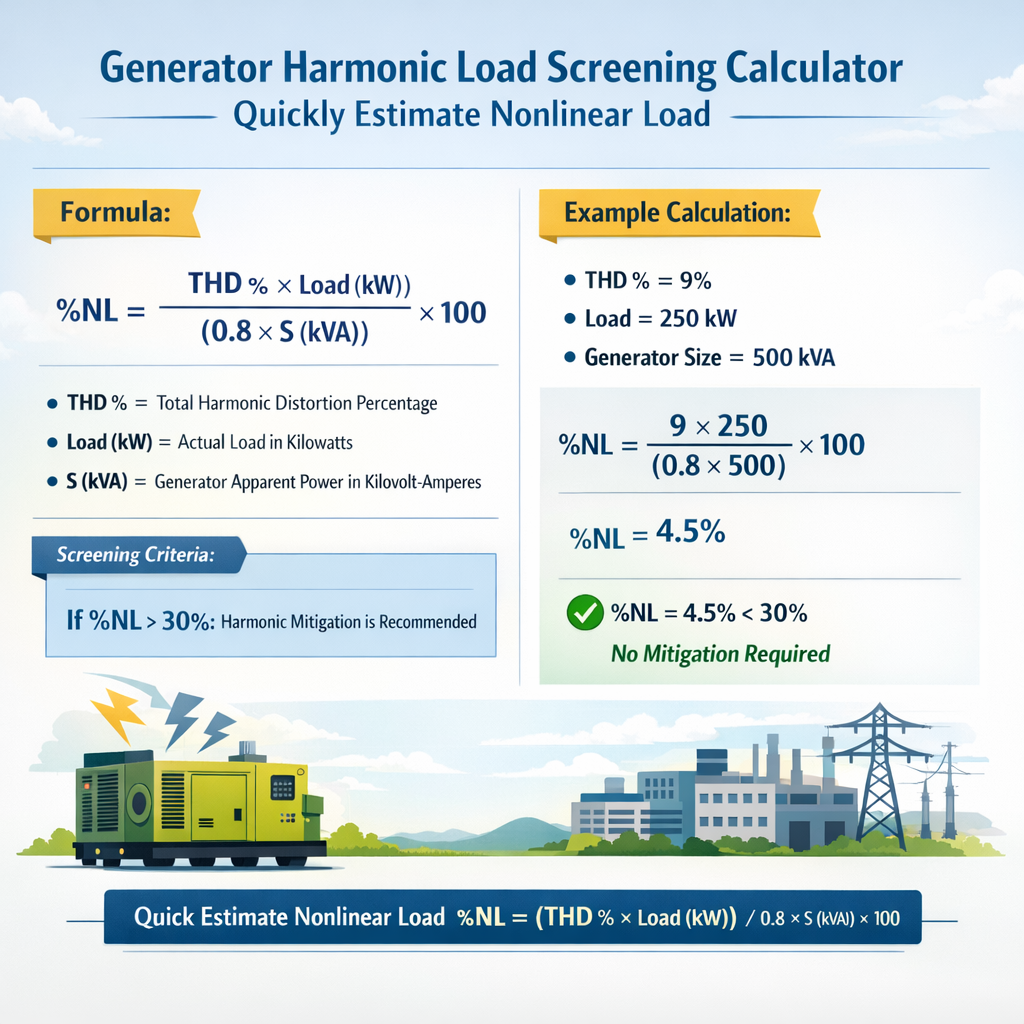
Fundamental screening concept and workflow
At each harmonic order k, the voltage harmonic amplitude at the generator terminals is the product of the load harmonic current and the generator/thevenin impedance seen by that harmonic. Aggregate harmonic distortion is computed by root-sum-square of harmonic voltages and compared to limits.
- Determine generator short-circuit impedance at fundamental (Z_base and per-unit reactances).
- Estimate harmonic current spectrum from nonlinear loads (Ih_k for each k).
- Compute harmonic source impedance magnitude at order k (|Z_k|), accounting for scaling of reactance with frequency.
- Compute harmonic voltage Vh_k = Ih_k * |Z_k| and convert to percent of nominal voltage.
- Compute voltage THD (VTHD) = sqrt(sum_k Vh_k^2) / V1 and compare with limits (e.g., IEEE 519 guidance).
- If limits are exceeded, evaluate mitigation: filters, phase-shifted rectifiers (12/18/24-pulse), generator sizing, or active cancellation.
Key assumptions and limitations
- Harmonic currents are assumed independent sources; phase-angle interaction is conservatively assumed to be worst-case (vector sum as RMS or in-phase sum depending on methodology).
- Generator harmonic impedance model is simplified: fundamental per-unit reactances converted to ohms, while harmonic reactance is scaled with harmonic order using a practical approximation.
- Triplen (3rd, 9th, 15th...) sequence behavior depends on grounding connection; triplen currents may circulate in neutrals and cause different voltage appearance—this calculator assumes balanced three-phase loads unless explicitly modeling neutral paths.
- Detailed resonant interactions between generator, transformer and external network require network frequency-domain analysis not covered here.
Core formulas and variable explanations
All formulas below use plain HTML text. Each formula is followed by definitions and typical values for quick engineering use.
Base impedance (phase) for three-phase system on base apparent power S_base and line-to-line voltage V_LL:
- Z_base: base impedance in ohms (phase basis). Typical: for 480 V, 300 kVA => Z_base ≈ 0.768 Ω.
- V_LL: line-to-line voltage in volts (e.g., 480).
- S_base: generator rated apparent power in VA (e.g., 300000 VA).
Generator subtransient reactance converted to ohms (X_sub_ohm):
- X''_pu: subtransient reactance in per unit (typical synchronous generator X'' = 0.12 to 0.35 pu depending on size and construction).
- X_sub_ohm: reactance at fundamental in ohms.
Harmonic frequency reactance approximation (simplified linear scaling):
- X_k: approximate reactance at k-th harmonic order. Rationale: for higher harmonics the machine reactance typically increases with frequency; linear scaling is conservative and practical for screening.
- k: harmonic order (3, 5, 7, 11, 13, ...).
Harmonic source impedance magnitude for order k (single-phase equivalent):
- R_ohm: equivalent resistance seen by harmonics. Typical small value for modern machines: 0.005–0.02 pu converted to ohms.
- |Z_k|: magnitude in ohms.
Harmonic voltage amplitude at the generator terminal for harmonic k:
- I_hk: magnitude of k-th harmonic current in amperes (phase basis). For three-phase line currents, convert to phase current where necessary.
- V_hk: line-to-neutral harmonic amplitude in volts (if phase basis used).
Convert to percent of nominal line-to-neutral voltage:
- V_ph_nominal = V_LL / sqrt(3) (e.g., for 480 V system, V_ph_nominal = 277 V).
Total voltage THD (percentage) from harmonic orders considered:
Aggregate harmonic current when multiple nonlinear loads exist (conservative RMS approach):
- I_hk_i: k-th harmonic current contribution of load i. Use vector summation if phase relationships known for accuracy; otherwise use RMS summation for conservative estimate.
Tables: typical generator and load harmonic parameters
| Generator parameter | Typical value range | Notes |
|---|---|---|
| Subtransient reactance X'' (pu) | 0.12 – 0.35 | Smaller industrial gensets often 0.12–0.20; larger alternators 0.20–0.35 |
| Transient reactance X' (pu) | 0.20 – 0.80 | Used for lower frequency harmonics when available |
| Equivalent machine resistance R (pu) | 0.002 – 0.02 | Very small; include stator winding resistance and grounding |
| Neutral grounding | Solid / Impedance / Ungrounded | Triplen harmonics behavior differs; account for neutral path |
| Nonlinear load type | Typical THDi (%) | Typical harmonic distribution (approx % of I1) |
|---|---|---|
| 6-pulse VFD / diode rectifier | 30 – 75 | 5th 18–25%, 7th 10–18%, 11th 6–12%, 13th 3–8% (others present) |
| 12-pulse VFD | 10 – 25 | 5th/7th reduced, dominant order 11th/13th smaller; 12-pulse reduces characteristic harmonics |
| UPS (double-conversion, PWM) | 3 – 8 | Lower harmonics; some broadband switching noise; modern AFE UPS <5% |
| Phase-controlled rectifier (thyristor) | 40 – 100+ | High low-order harmonics; 3rd, 5th significant depending on firing angle |
| Single-phase rectifier | 50 – 200 | High odd harmonics, including 3rd and 5th; triplen harmonics may accumulate in neutral |
| IEEE 519 voltage distortion recommendation (typical) | Limit (%) | Applicability |
|---|---|---|
| Voltage THD at point of common coupling (PCC) | ≤ 5% | General guidance for distribution feeders serving sensitive equipment |
| Individual voltage harmonic components | Varies by order and system voltage | Refer to IEEE 519 table for system voltage-dependent limits |
Step-by-step calculator algorithm (deterministic frequency-by-frequency)
- Enter generator nameplate: S_rated (kVA), V_LL (V), X''_pu, R_pu (if available).
- Convert to base impedances: Z_base = V_LL^2 / S_base; X_sub_ohm = X''_pu * Z_base; R_ohm = R_pu * Z_base.
- Enter each nonlinear load: rated power (kW or kVA), load fundamental current I1 (compute using power, PF), and harmonic spectrum percentages for orders k of interest.
- Compute each load's I_hk = percentage_k * I1. Aggregate across multiple loads: I_hk_total = sqrt(sum_i I_hk_i^2) for conservative RMS combination.
- Compute X_k = k * X_sub_ohm, |Z_k| = sqrt(R_ohm^2 + X_k^2), then V_hk = I_hk_total * |Z_k|.
- Compute V_THD = (sqrt(sum_k V_hk^2) / V_ph_nominal) * 100. Compare to limits (e.g., 5%).
- If V_THD is unacceptable, iterate mitigation options and recalc: change converter pulse number, add filters, increase generator base MVA (reduces X_sub_ohm), or change grounding.
Real example 1 — Single generator, single large 6-pulse VFD
Scenario: A 300 kVA, 480 V, three-phase generator (X'' = 0.18 pu, R = 0.01 pu) supplies a 250 kW motor load through a 6-pulse VFD. VFD THDi = 45% with characteristic harmonic distribution approximated as 5th 20%, 7th 12%, 11th 6%, 13th 3%, other harmonics summing to remainder. Determine the expected generator terminal voltage THD and whether it exceeds a 5% IEEE guidance limit.
Step A: Base calculations
S_base = 300 kVA = 300000 VA; V_LL = 480 V.
Z_base = (480 * 480) / 300000 = 230400 / 300000 = 0.768 Ω.
X_sub_ohm = X''_pu * Z_base = 0.18 * 0.768 = 0.13824 Ω.
R_ohm = R_pu * Z_base = 0.01 * 0.768 = 0.00768 Ω.
Step B: Load fundamental current
I1 = P / (sqrt(3) * V_LL * PF) = 250000 / (1.732 * 480 * 0.9) ≈ 333.9 A (line current).
Phase current for phase calculations: I1_ph = I1 / sqrt(3) if converting to phase? For three-phase symmetrical analysis using phase-neutral basis, using line currents is sufficient provided consistent conversions for V_ph_nominal below. We will compute V_ph_nominal = 480 / sqrt(3) = 277.13 V.
Step C: Harmonic currents (approx)
Using distribution percentages of fundamental I1 (line current basis):
- I5 = 0.20 * 333.9 = 66.78 A
- I7 = 0.12 * 333.9 = 40.07 A
- I11 = 0.06 * 333.9 = 20.03 A
- I13 = 0.03 * 333.9 = 10.02 A
- Other orders assume RMS remainder, combine later if needed.
Step D: Harmonic impedances and voltage contributions
Compute X_k and |Z_k| per harmonic.
For k = 5: X_5 = 5 * X_sub_ohm = 5 * 0.13824 = 0.6912 Ω.
|Z_5| = sqrt(0.00768^2 + 0.6912^2) ≈ 0.6912 Ω (R negligible).
V_5 = I5 * |Z_5| = 66.78 * 0.6912 ≈ 46.17 V.
For k = 7: X_7 = 7 * 0.13824 = 0.96768 Ω.
|Z_7| ≈ 0.9677 Ω.
V_7 = 40.07 * 0.9677 ≈ 38.80 V.
For k = 11: X_11 = 11 * 0.13824 = 1.52064 Ω.
|Z_11| ≈ 1.5207 Ω.
V_11 = 20.03 * 1.5207 ≈ 30.45 V.
For k = 13: X_13 = 13 * 0.13824 = 1.79712 Ω.
|Z_13| ≈ 1.7971 Ω.
V_13 = 10.02 * 1.7971 ≈ 18.01 V.
Step E: Total voltage THD
Compute RMS of harmonic voltages (line-to-neutral basis). Sum squares of V_k:
Sum_sq = 46.17^2 + 38.80^2 + 30.45^2 + 18.01^2 = 2131.7 + 1505.4 + 927.3 + 324.4 ≈ 4890.8 V^2.
V_h_rms_total = sqrt(4890.8) ≈ 69.95 V.
V_ph_nominal = 277.13 V.
V_THD = (69.95 / 277.13) * 100 ≈ 25.3%.
Interpretation and mitigation
Result: V_THD ≈ 25.3%, far exceeding a 5% recommended voltage THD limit. The generator is at significant risk of voltage distortion, control malfunction, overheating, and protection misoperation. Mitigations include:
- Replace 6-pulse with 12/18/24-pulse front end to reduce characteristic harmonic levels.
- Add tuned or detuned passive filters targeting dominant harmonics (5th/7th), designed to avoid resonance with generator reactance.
- Use active harmonic filters or active front-end (AFE) converters to reduce THDi to <10%.
- Increase generator MVA (larger machine reduces X''_pu on same base or changes per-unit basis) or use separate alternators for major nonlinear loads.
Real example 2 — Aggregated loads and neutral considerations
Scenario: A 1000 kVA, 4160 V generator (X'' = 0.22 pu, R = 0.008 pu) feeds the following loads at the same switchboard: two identical 500 HP VFD-driven pumps (6-pulse) each consuming 350 A line at 0.9 PF and a 250 kVA UPS with AFE (THDi ≈ 5%). The VFDs produce harmonic families with per-drive THDi ≈ 45% distributed as 5th 22%, 7th 13%, 11th 7%, 13th 3%. Determine whether generator terminal voltage THD might exceed 5% and consider neutral/triplen effects if the system neutral is grounded solidly.
Step A: Base impedances
S_base = 1000 kVA = 1,000,000 VA; V_LL = 4160 V.
Z_base = (4160 * 4160) / 1,000,000 = 17,305,600 / 1,000,000 = 17.3056 Ω.
X_sub_ohm = 0.22 * 17.3056 ≈ 3.8072 Ω.
R_ohm = 0.008 * 17.3056 ≈ 0.13845 Ω.
Step B: Individual load fundamental currents
Two VFD pumps: each 350 A line current (has I1 = 350 A). UPS: assume I1_ups ≈ 35 A (250 kVA at 4160 V three-phase is ≈ 34.7 A assuming PF ≈ 1 and VA/kVA approx). For more conservative estimate, take I1_ups = 40 A.
Step C: Harmonic currents per load
Per VFD drive (use percentages applied to each drive's fundamental):
- Per drive I5 = 0.22 * 350 = 77.0 A
- I7 = 0.13 * 350 = 45.5 A
- I11 = 0.07 * 350 = 24.5 A
- I13 = 0.03 * 350 = 10.5 A
Two drives: aggregate per-harmonic RMS combination (conservative assuming uncorrelated phases):
I5_total_vfds = sqrt(77.0^2 + 77.0^2) = 108.9 A.
I7_total_vfds = sqrt(45.5^2 + 45.5^2) = 64.3 A.
I11_total_vfds = sqrt(24.5^2 + 24.5^2) = 34.6 A.
I13_total_vfds = sqrt(10.5^2 + 10.5^2) = 14.85 A.
UPS AFE: I_hk small; assume AFE reduces harmonics below 5% overall. For conservatism, include I5_ups = 0.01 * 40 = 0.4 A, etc. These are negligible against VFD contributions.
Aggregate total harmonic currents (dominant from VFDs):
- I5_total ≈ 109 A
- I7_total ≈ 64.3 A
- I11_total ≈ 34.6 A
- I13_total ≈ 14.85 A
Step D: Harmonic impedances and voltage contributions
Compute X_k and |Z_k|:
k=5: X_5 = 5 * 3.8072 = 19.036 Ω; |Z_5| = sqrt(0.13845^2 + 19.036^2) ≈ 19.037 Ω.
V_5 = I5_total * |Z_5| = 109 * 19.037 ≈ 2076.9 V (line-to-neutral harmonic amplitude).
k=7: X_7 = 26.6504 Ω; V_7 = 64.3 * 26.6504 ≈ 1714.0 V.
k=11: X_11 = 41.8792 Ω; V_11 = 34.6 * 41.8792 ≈ 1449.5 V.
k=13: X_13 = 49.4936 Ω; V_13 = 14.85 * 49.4936 ≈ 734.5 V.
Step E: Voltage THD assessment
V_ph_nominal = 4160 / sqrt(3) = 2401.6 V.
Sum squares: 2076.9^2 + 1714.0^2 + 1449.5^2 + 734.5^2 ≈ 4,312,427 + 2,937,796 + 2,101,436 + 539,531 ≈ 9,891,190 V^2.
V_h_rms_total = sqrt(9,891,190) ≈ 3146.6 V.
V_THD = (3146.6 / 2401.6) * 100 ≈ 131% (unrealistically high).
Interpretation and realism check
The screening result shows huge voltage distortion because the simplified linear-scaling of X_k leads to very high harmonic impedances at high orders multiplied by substantial harmonic currents, producing harmonic voltages larger than nominal. In practice, several factors reduce this extreme result:
- Generator harmonic impedance does not scale strictly linearly with harmonic order; it often becomes more complex with saturation, winding distribution, eddy currents, and electromagnetic damping—leading to different effective impedances at different orders.
- Series system impedance (transformers, feeder, external grid) often provides lower overall harmonic voltage than the generator-only model predicts.
- Triplen harmonic currents (3rd, 9th…) are zero-sequence and may circulate in neutral or delta windings rather than appear as phase-to-neutral voltage distortion.
Nevertheless, the screening indicates that with two large 6-pulse drives on a standalone generator of 1000 kVA, significant distortion is likely and mitigation is required: use 12-pulse drives, detuned filters, oversized alternator, or separation of nonlinear loads to separate generators.
Practical guidance for applying the calculator and interpreting results
- Use conservative harmonic current spectra for initial screening (e.g., 6-pulse THDi = 45% unless vendor provides measured spectra).
- If the screening shows values near or above limits, escalate to detailed network harmonic analysis with frequency-dependent machine models and field measurements.
- Include transformer reactance and system source (utility) short-circuit MVA in the impedance seen by harmonics; often the utility provides lower impedance at harmonic frequencies reducing generator terminal distortion.
- Explicitly model neutral path for triplen harmonics if loads include single-phase rectifiers or unbalanced loads.
- Document assumptions: pulse number, PF, harmonic distribution, X'' value, grounding method—this is critical for later validation.
Mitigation options and implementation considerations
- Phase-shifting (12/18/24-pulse) rectifier front ends: reduces characteristic harmonic orders proportionally to pulse number and is cost-effective at larger ratings.
- Passive tuned filters: tuned to dominant harmonic orders (e.g., 5th/7th), but must be designed to avoid resonance with generator reactance; detuned filters (slightly off resonance) often preferred when generator impedance unknown.
- Active harmonic filters: provide dynamic mitigation across orders and load variations but have capital/operational cost and control interactions with generator controls.
- Generator sizing and paralleling: larger generators (higher MVA) reduce per-unit reactance and therefore reduce voltage distortion for a given harmonic current.
- Distribution of nonlinear loads across multiple machines or phases to avoid local concentration of harmonics.
Normative references and authoritative resources
- IEEE Std 519-2014 — IEEE Recommended Practice and Requirements for Harmonic Control in Electrical Power Systems: https://standards.ieee.org/standard/519-2014.html
- IEC 61000 series — Electromagnetic compatibility (EMC) standards for control of harmonic emissions: https://www.iec.ch
- NEMA MG 1 — Motors and generators (guidelines and characteristics): https://www.nema.org/standards
- Technical papers on generator harmonic impedance and modeling: IEEE Transactions on Power Delivery and industry application notes from major alternator manufacturers (e.g., Caterpillar, Cummins, ABB).
Implementation notes for an actual calculator tool
An implementation of this screening calculator (spreadsheet, web tool, or embedded engineering tool) should provide:
- Input fields for generator nameplate and per-unit reactances with default typical values.
- Load database of common nonlinear equipment with selectable harmonic spectra templates.
- Ability to sum harmonic currents by RMS or vectorially when phase angles are known.
- Option to include upstream utility short-circuit MVA and transformer impedances to obtain net source impedance at each harmonic.
- Automated reporting to show V_hk per order, V_THD, pass/fail relative to selected standard limits, and recommend mitigation measures.
Best practices for field validation and measurement
- Measure both current and voltage harmonic spectra at generator terminals under representative loading using a power quality meter capable of IEC/IEEE compliance measurements.
- Compare measured V_hk and I_hk with calculator predictions; adjust generator impedance model to match measurements (calibration).
- If possible, measure machine short-circuit current (SCC) or source impedance to refine X''_pu used in the model.
- Use spectral analysis to identify dominant orders and check for resonance peaks indicative of filter or system resonance.
Summary of actionable engineering steps
- Use the frequency-by-frequency screening method to rapidly assess whether harmonic voltages are likely to exceed acceptable thresholds.
- If screening indicates high risk, request vendor harmonic spectrum data or measure load harmonics and perform frequency-domain network analysis.
- Prioritize mitigation: change converter topology, install filters, or increase generator capacity; verify with measurements post-installation.
The deterministic screening formulas and examples above provide transparent calculations for engineers to make informed decisions early in design and procurement, and to determine whether further detailed harmonic studies are required. Always record assumptions and confirm with field measurements when possible.