Accurate OD600 measurement is essential for growth monitoring, calibration, and in quantitative microbial physiology applications.
This article provides calculators, algorithms, examples, and best practices to ensure reliable OD600 conversions globally.
Optical Density (OD600) → Cells/mL and Total Cells Calculator (pathlength-corrected)
Fundamentals of OD600 and spectrophotometric measurement
Optical Density at 600 nm (OD600) is the most common proxy for microbial turbidity measurement. OD600 is fundamentally a measure of light attenuation through a cell suspension due to scattering and, to a lesser extent, absorption at 600 nanometers.
Spectrophotometers and microplate readers report unitless optical density values that depend on instrument geometry, path length, cell physiology, and media composition.
Physical basis and limitations
- OD600 is primarily light scattering; it does not directly measure cell number or biomass unless calibrated.
- Measurements are accurate within a linear range; above that range, multiple scattering and detector saturation bias results.
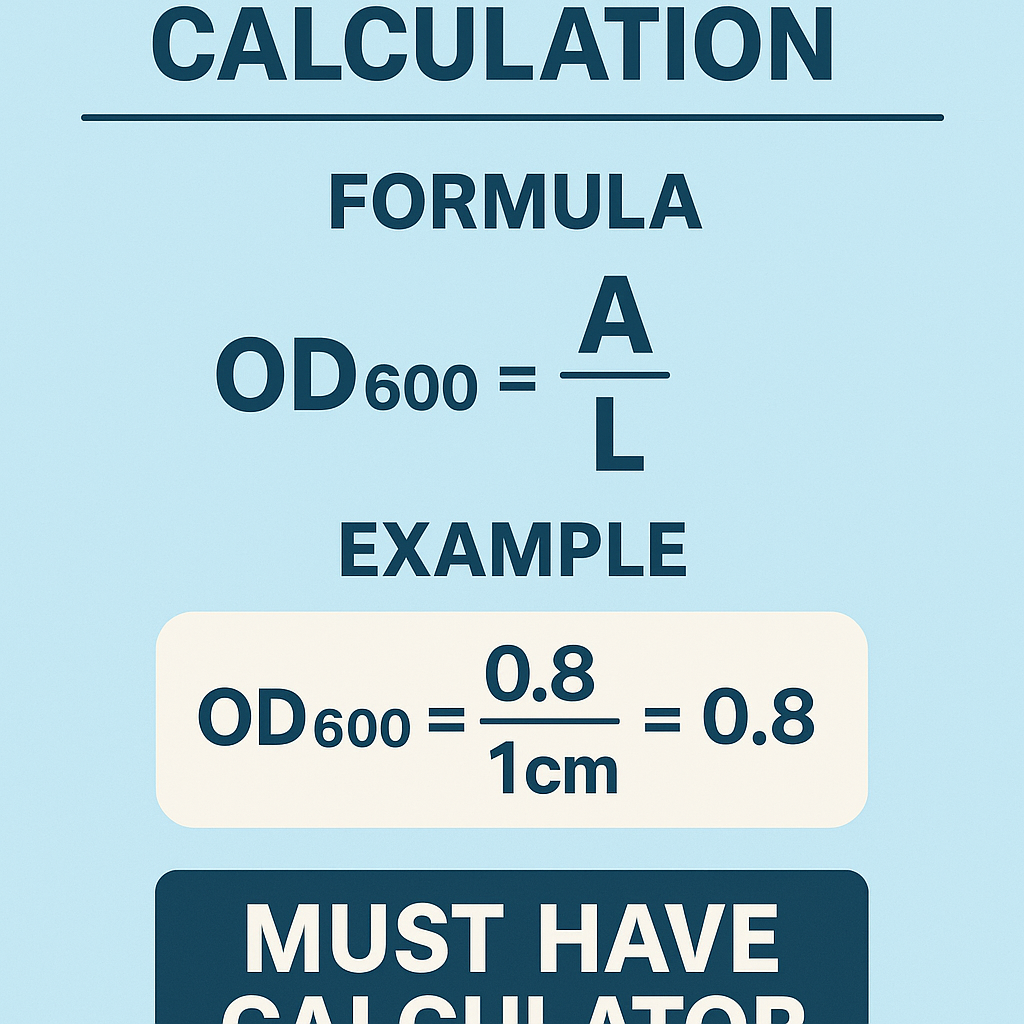
- Path length is critical: OD value scales linearly with path length within the linear range.
- Media background (turbidity, color) must be blanked; residual absorbance biases OD readings.
Key formulas and variable definitions
Presenting formulas in plain HTML for calculator implementation and documentation.
1) Path length correction (standardizing to 1 cm):
- OD_standard: corrected OD normalized to the standard path length (commonly 1 cm).
- OD_measured: raw instrument reading.
- standard_path_length: typically 1 (for 1 cm cuvette).
- measured_path_length: path length of the device measurement (cm). Typical microplate path lengths are 0.3–0.8 cm.
2) Dilution correction:
- dilution_factor: reciprocal of the fraction of original sample present (for 1:10 dilution, factor = 10).
3) Conversion from OD600 to cells per milliliter (species-specific):
- CF_cells: conversion factor (cells per mL per OD unit at 1 cm path length). Typical values vary by organism and physiology.
4) Conversion from OD600 to biomass (dry weight):
- CF_biomass: conversion factor (g dry weight per L per OD unit at 1 cm). Species and growth-condition-specific.
5) Conversion from OD600 to colony forming units (CFU/mL) using empirical calibration:
- CF_CFU: empirically derived CFU conversion factor (CFU per mL per OD unit), measured by plating.
Typical values and guidance for conversion factors
Conversion factors vary; the following table lists commonly used approximate values for log-phase cultures in rich media at 37°C with 1 cm path length.
| Organism | Approx. cells per mL per OD600 (1 cm) | Approx. CFU per mL per OD600 (1 cm) | Approx. biomass (g dry weight per L per OD600) | Notes |
|---|---|---|---|---|
| Escherichia coli (K-12, rod-shaped) | 8.0 × 10^8 cells/mL | 4.0 × 10^8 – 8.0 × 10^8 CFU/mL* | 0.30 – 0.35 g/L | Typical log-phase in LB, dependent on strain and growth phase |
| Escherichia coli (dense cultures) | 5.0 × 10^8 – 1.0 × 10^9 cells/mL | variable | 0.30 – 0.40 g/L | Physiology alters CF and biomass |
| Saccharomyces cerevisiae (yeast) | 2.5 × 10^7 – 3.5 × 10^7 cells/mL | ~3.0 × 10^7 CFU/mL | 0.40 – 0.60 g/L | Cell size significantly larger than bacteria |
| Bacillus subtilis | 8.0 × 10^8 cells/mL | ~5.0 × 10^8 CFU/mL | 0.30 – 0.40 g/L | Similar to E. coli for approximate calculations |
| Lactobacillus spp. | 1.0 × 10^9 cells/mL | 0.5 × 10^9 – 1.0 × 10^9 CFU/mL | 0.30 – 0.50 g/L | Smaller rod-shaped bacteria, depend on growth medium |
*CFU may be lower than total cell counts due to non-viable cells or clumping; plating-derived CFU should be measured per-experiment.
Instrument types and path length considerations
Understanding the instrument geometry is essential for accurate OD600 standardization and calculator design.
1 cm cuvettes (bench spectrophotometer)
- Standard laboratory reference; path length = 1.00 cm.
- Most conversion factors are referenced to 1 cm.
- Minimal correction required when using 1 cm cuvettes.
Microplate readers and variable path lengths
- Microplate wells have shorter path lengths (typical 0.3–0.7 cm depending on volume and plate geometry).
- Many plate readers offer "path length correction" using water absorbance at 900 nm or manufacturer-supplied algorithms.
- When path length correction is not present, measure a standard (e.g., 1 cm cuvette reading) to derive conversion factor between devices.
Optical configuration effects
- Front-facing vs. top optical geometry, detector linearity, and stray light all influence OD readings.
- Ensure linear range checks and instrument-specific calibration curves.
Designing an OD600 calculator: necessary parameters and options
A high-quality OD600 calculator should allow input for instrument, blank, dilution, path length, organism, and conversion factors. The calculator should also warn when OD values are outside the linear range.
- Inputs to include:
- Raw OD reading (OD_measured)
- Blank OD
- Measured path length (cm) or device selection that implies path length
- Dilution factor
- Species/strain or custom CF values for cells/mL and biomass
- Desired output units (cells/mL, CFU/mL, g/L biomass)
- Outputs to compute:
- Blank-corrected OD
- Path-length corrected OD standardized to 1 cm
- Undiluted OD after dilution correction
- cells/mL, CFU/mL, biomass_g_per_L with uncertainty estimates
- Quality control and warnings:
- Indicate linear range (e.g., OD < 0.8 for many spectrophotometers). Suggest dilution if needed.
- Warn when blank correction yields negative or near-zero values.
- Provide confidence interval based on variability in conversion factor if known.
Practical workflows and best practices
- Always measure and subtract a blank prepared in the same medium and conditions.
- Check instrument linearity with serial dilutions of a dense culture.
- Calibrate conversion factors for each organism and growth condition by pairing OD600 with independent cell counts (microscopy, Coulter counter, plate counts) and biomass dry weight measurements.
- Use path length correction for microplates or small-volume cuvettes to standardize to 1 cm.
- Report method: instrument model, path length, blank, dilution, culture conditions, and calibration data alongside reported conversions.
Detailed worked examples
Two real-case examples below show full calculation steps including blank subtraction, path length correction, dilution correction, and conversion to cells/mL and biomass.
Example 1 — Escherichia coli culture measured in a microplate reader
Scenario: You measure a culture of E. coli in a 96-well plate containing 200 µL per well. The microplate reader reports OD600 = 0.225 for the well, blank (medium) OD600 = 0.015. The reader does not perform path length correction, and the effective path length for 200 µL in the well is measured separately as 0.64 cm. You want cells per mL and biomass g/L using common conversion factors for E. coli.
- Blank subtraction:OD_blank_corrected = OD_measured − OD_blankOD_blank_corrected = 0.225 − 0.015 = 0.210
- Path length correction to 1 cm:OD_standard = OD_blank_corrected × (1.00 cm / path_length)OD_standard = 0.210 × (1.00 / 0.64) = 0.210 × 1.5625 = 0.3281
- Dilution factor: none performed, so dilution_factor = 1.
- Convert to cells/mL using CF_cells = 8.0 × 10^8 cells/mL per OD600 (typical E. coli):cells_per_mL = OD_standard × CF_cellscells_per_mL = 0.3281 × 8.0 × 10^8 = 2.6248 × 10^8 cells/mL ≈ 2.62 × 10^8 cells/mL
- Convert to biomass using CF_biomass = 0.33 g/L per OD600:biomass_g_per_L = OD_standard × CF_biomassbiomass_g_per_L = 0.3281 × 0.33 = 0.108 = 0.108 g/L
- Report with context and uncertainty:
- OD600 (blank-corrected, 1 cm): 0.328 ± instrument noise
- cells/mL ≈ 2.6 × 10^8 (using literature CF; variation ±30% typical)
- biomass ≈ 0.108 g/L (species and condition dependent)
Example 2 — Saccharomyces cerevisiae measured in a 1 cm cuvette after dilution
Scenario: Yeast culture sample diluted 1:5 in fresh medium. OD600 measured in a 1 cm cuvette: 0.160. Blank medium OD600 = 0.005. Goal: compute undiluted OD, cells/mL, and estimate CFU/mL assuming a CFU conversion factor.
- Blank subtraction:OD_blank_corrected = 0.160 − 0.005 = 0.155
- Dilution correction (1:5 dilution; dilution_factor = 5):OD_undiluted = OD_blank_corrected × dilution_factorOD_undiluted = 0.155 × 5 = 0.775
- Path length: cuvette 1 cm, so OD_standard = OD_undiluted = 0.775
- Convert to cells/mL using CF_cells = 3.0 × 10^7 cells/mL per OD600 for S. cerevisiae:cells_per_mL = 0.775 × 3.0 × 10^7 = 2.325 × 10^7 cells/mL ≈ 2.33 × 10^7 cells/mL
- Convert to CFU/mL: if plating calibration gives CF_CFU ≈ 2.8 × 10^7 CFU/mL per OD600 (strain-dependent):CFU_per_mL = 0.775 × 2.8 × 10^7 = 2.17 × 10^7 CFU/mL
- Biomass estimation with CF_biomass ≈ 0.50 g/L per OD600:biomass_g_per_L = 0.775 × 0.50 = 0.3875 g/L ≈ 0.388 g/L
- Report:
- OD600 (undiluted, 1 cm): 0.775
- cells/mL ≈ 2.33 × 10^7 (expected variability ±20–40%)
- CFU/mL ≈ 2.17 × 10^7 (requires plating calibration for accuracy)
Troubleshooting and edge cases
Nonlinear responses and high OD
- If OD_standard > instrument linear limit (often OD ≈ 0.8–1.0 for bench spectrophotometers), dilute sample and re-measure.
- Correct final result by multiplying back by the dilution factor.
Clumping, biofilms, and heterogeneity
- Clumping skews OD-to-cells relationship; perform sonication or vortexing if needed, and verify with microscopy.
Colored media or pigmentation
- If media have significant absorbance at 600 nm, use a matched blank and consider measuring at an alternate wavelength less affected by pigment; however OD conversions are wavelength-specific.
Viability vs. total cell count
- OD600 measures total particles (viable + non-viable). Use plating or viability staining when viable cell count is required.
Calibration procedures and producing accurate conversion factors
To generate accurate conversion factors for your organism and experimental conditions, follow a standardized calibration workflow:
- Grow culture to representative physiological state (e.g., mid-exponential phase) under target conditions.
- Prepare serial dilutions and measure OD600 for each dilution in the same instrument and format used for experimental measurements.
- For each dilution, determine:
- Cell count by independent method (hemocytometer, Coulter counter, flow cytometry).
- Viable counts by plating (CFU/mL).
- Dry weight biomass by filtering and drying aliquots.
- Plot measured OD600 (standardized to 1 cm) vs. cells/mL and biomass; fit linear regression within the linear OD range.
- Extract slope as CF_cells and CF_biomass; report R^2 and confidence intervals.
Reporting recommendations for reproducibility
When reporting OD600-derived values in publications, SOPs, or calculators, include the following details:
- Instrument model, manufacturer, and any path length correction used.
- Blank composition and blank value.
- Dilution factor and how measured.
- Calibration methods and conversion factors (cells/mL per OD, biomass per OD) with measurement uncertainty.
- Culture conditions: medium, temperature, growth phase, strain.
Regulatory and normative references
Standards and authoritative resources relevant to spectrophotometry, microbiology, and calibration:
- International Organization for Standardization (ISO): General microbiology methods and guidance. Example: ISO 7218 — Microbiology of food and animal feeding stuffs — General requirements and guidance for microbiological examinations. (https://www.iso.org)
- Clinical and Laboratory Standards Institute (CLSI): Guidelines for susceptibility testing and microbiological procedures. (https://clsi.org)
- National Institute of Standards and Technology (NIST): Guidance on spectrophotometer calibration and measurement uncertainty. (https://www.nist.gov)
- ATCC (American Type Culture Collection): Strain information and culture maintenance recommendations. (https://www.atcc.org)
- BioNumbers: curated database for biological numeric values including cells per OD data. (https://bionumbers.hms.harvard.edu)
- Peer-reviewed reference on OD measurements and conversion: Stevenson et al., "A practical guide to optical density measurements for microorganisms," Journal of Microbiological Methods (example; search on PubMed). (https://pubmed.ncbi.nlm.nih.gov)
Recommended authoritative reading and online resources
- PubMed / NCBI for method and calibration literature: https://pubmed.ncbi.nlm.nih.gov
- Manufacturer application notes for specific microplate readers and spectrophotometers (e.g., Tecan, BioTek/Agilent, Thermo Fisher Scientific).
- BioNumbers entries for specific organism conversion factors: https://bionumbers.hms.harvard.edu
- NIST guidance for uncertainty and traceability in spectrophotometry: https://www.nist.gov
UX considerations for calculator implementation
To make an OD600 calculator practical and reliable, incorporate these UX elements:
- Predefined instrument profiles (with path length) and option for custom path length input.
- Species selection with built-in recommended CFs and the option to enter custom CF values.
- Automatic blank subtraction and display of individual calculation steps for traceability.
- Warnings for values outside linear range and suggested dilution steps to return to linearity.
- Exportable report including inputs, intermediate steps, final values, uncertainties, and calibration references.
Summary of best practices (quick checklist)
- Always blank with matched medium; subtract blank prior to any correction.
- Standardize to 1 cm path length via measurement or instrument path length correction.
- Verify linear range; dilute dense samples and correct by the dilution factor.
- Calibrate conversion factors for organism, media, and growth condition using independent cell counts and biomass measurements.
- Document instrument, method, calibration, and uncertainty when reporting converted values.
Final notes on uncertainty and reporting
OD600-to-cell or biomass conversion inherently carries uncertainty due to biological heterogeneity, instrument variance, and measurement protocol differences. A robust calculator will provide not only point estimates but also estimated uncertainty bands based on calibration data. For critical quantitative work (bioprocessing, regulatory reporting, mathematical modeling), always supply empirical calibration data linked to the reported conversions.
Selected references and further reading
- Stevenson, A., et al., Practical guidelines for optical density measurements of microbial cultures. Journal of Microbiological Methods. [Search via PubMed: https://pubmed.ncbi.nlm.nih.gov]
- NIST: Guidelines for calibration and uncertainty in spectrophotometry. https://www.nist.gov
- BioNumbers: searchable database of biological measurements. https://bionumbers.hms.harvard.edu
- ATCC strain data and culture protocols. https://www.atcc.org
- ISO 7218 — Microbiology of food and animal feeding stuffs — General requirements and guidance for microbiological examinations. https://www.iso.org/standard/56114.html
- CLSI guidelines for laboratory method standardization and validation. https://clsi.org