This technical guide explains essential calculator selections for lightning arrester surge protection evaluation device criteria.
Engineers and procurement specialists require precise surge tool calculators for compliance testing and performance verification.Lightning Arrester / Surge Protective Device (SPD) Recommendation Calculator
Why a calculator is indispensable for lightning arrester selection
A calculator converts site variables and standards parameters into quantifiable requirements for arrester selection. Manual estimation risks undersizing or overspecifying equipment, increasing cost or exposing systems to failure.
Accurate calculators model waveforms, line impedance, clamp characteristics, energy dissipation, and coordination with downstream protection. They translate normative test currents into field-rated energy and voltage limits.
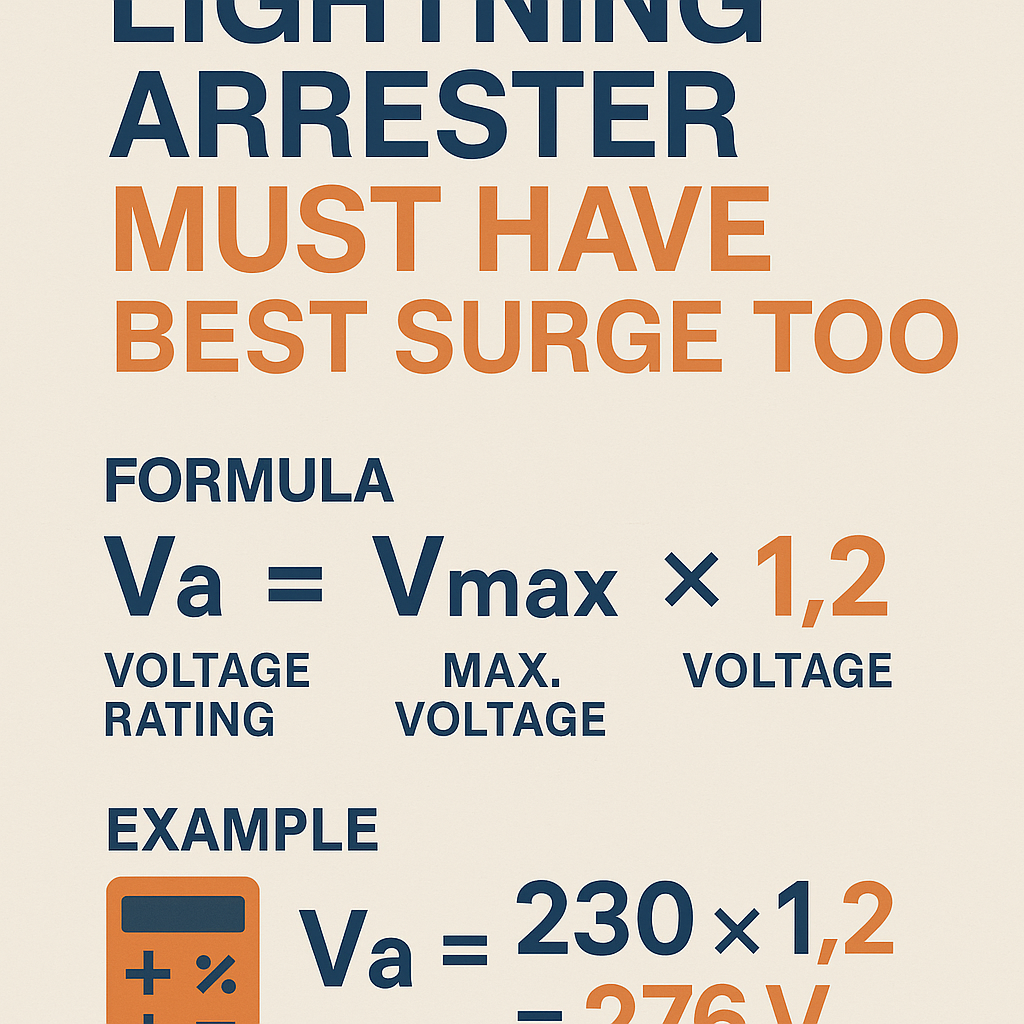
Essential inputs for a lightning arrester calculator
- Site lightning exposure (direct strike probability, location lightning parameters).
- Waveform type (10/350 for direct lightning, 8/20 for switching/transferred lightning, 1.2/50 for impulse).
- Peak current estimates (Ipeak) and repeated surge currents (In).
- Source and line series impedance (Zline), conductor length, and earthing resistance (Rg).
- System nominal voltage and nominal discharge current rating requirements (per IEC/UL).
- Protective device V-I curve or clamping voltage as a function of current.
- Load withstand voltage and coordination margins (clearance to equipment rated insulation).
Key outputs a professional calculator must produce
- Required nominal discharge current (kA) rating for SPD (In / Iimp depending on waveform).
- Expected clamping voltage at specified currents (Vclamp @ Itest).
- Energy dissipation estimate (J) for given waveform and device resistance.
- Residual voltage at protected equipment (Vresid) including series impedance effects.
- Number of arrester modules and parallel arrangements for energy sharing.
- Coordination recommendations with downstream protection (coordination voltage levels).
- Compliance flags relative to IEC 61643-11, UL 1449, IEC 62305, IEEE C62 family.
Core electrical relationships and calculator formulas
All formulas presented use plain HTML for clarity. Each formula is followed by a variable explanation and typical values.
Clamped/residual voltage (simplified series model)
- V_resid: Residual voltage at equipment terminals (V).
- V_oc: Open-circuit lightning induced voltage or transferred surge (V). Typical range: 1 kV–1 MV depending on scenario and grounding.
- I_peak: Peak surge current (A). Typical: 1 kA (switching) to 200 kA (direct lightning peaks).
- Z_line: Series impedance between surge entry and protected equipment (Ω). Typical: 0.01–1 Ω depending on conductor length and cross-section.
- V_clamp_device: Clamping voltage of lightning arrester at I_peak (V). Typical: hundreds to thousands of volts depending on SPD class and system voltage.
Voltage drop across series impedance
- Used to estimate how much surge current contributes to protective device stress.
- Example typical values: I_peak = 10,000 A, Z_line = 0.05 Ω ⇒ V_drop = 500 V.
Energy dissipated in arrester (Joules), simplified
For calculator implementation use an energy-equivalent constant K for each waveform: E ≈ R_arrestor × I_peak^2 × τ_eq
- E: Energy dissipated in arrester (J).
- R_arrestor: Dynamic resistance of arrester during surge (Ω). Typical dynamic resistances vary; calculators should use manufacturer V-I data.
- I_peak: Peak current (A).
- τ_eq: Energy equivalent time constant for waveform (s). Typical approximate values: for 8/20 waveform τ_eq ≈ 5e-5 s; for 10/350 τ_eq ≈ 2e-4 s (illustrative — consult manufacturer/test data).
Module sharing for parallel arresters
- I_each: Current per module (A).
- I_total: Total expected surge current (A).
- N_modules: Number of identical modules in parallel.
- Note: Real current sharing depends on V-I dispersion among modules; calculators must include derating for tolerances.
Tables of common values for calculator reference
| Waveform | Standard | Typical Peak Currents (kA) | Rise / Fall (µs / µs or µs / ms) | Notes |
|---|---|---|---|---|
| 10/350 | IEC/EN (lightning current Iimp) | 30, 50, 100, 200 | 10 µs rise / 350 µs tail | Represents direct lightning strokes to structures (high energy). |
| 8/20 | IEC/EN (surge), IEEE C62.41 equivalent | 1, 5, 10, 20, 40 | 8 µs rise / 20 µs fall | Common test waveform for surge protective devices (switching/transferred). |
| 1.2/50 | IEC impulse (open-circuit) | 0.5–20 (as induced voltages) | 1.2 µs rise / 50 µs fall | Represents lightning open-circuit voltages used for insulation coordination. |
| 2/10 | Switching impulse in some practices | 0.5–10 | 2 µs rise / 10 µs fall | Rare, but used in some component tests. |
| SPD Type (IEC) | Typical Application | Nominal Discharge Current | Typical Clamping Voltage Range (for 230 V system) |
|---|---|---|---|
| Class I (Type 1) | Service entrance, direct lightning exposure | Iimp: 10–100 kA (per device/assembly) | 1–3 kV (site dependent) |
| Class II (Type 2) | Distribution panels, secondary protection | In: 1–20 kA (8/20) | 500 V–2 kV |
| Class III (Type 3) | Downstream, point-of-use devices | low energy, coordinated with upstream | 100 V–1 kV depending on coordination |
| Common design values | Typical numeric | Units | Usage |
|---|---|---|---|
| Earth resistance target (for sensitive sites) | 1–10 | Ω | Lower resistances reduce transferred voltage to equipment. |
| Series line impedance (short runs) | 0.01–0.1 | Ω | Industrial short conductors; used to evaluate V_drop. |
| Series line impedance (long runs) | 0.1–1.0 | Ω | Long lines, small cross-section cables. |
| Energy-equivalent time constant (approx) | 5e-5 – 2e-4 | s | Used in E ≈ R I^2 τ approximation (illustrative). |
How to implement accurate V-I coordination in the calculator
Calculators must use manufacturer V-I curves or parametric Vclamp(I) functions rather than single-point clamping numbers. Typical approach:
- Interpolate the manufacturer V-I curve to obtain Vclamp at expected I_peak and I_th (test currents).
- Compute Vdrop = I_peak × Z_line to estimate series contribution.
- Compute Vresid = Vclamp + Vdrop and check against equipment withstand voltage.
- If Vresid exceeds equipment limits, increase arrester rated capacity (higher V-I slope or additional modules in parallel) or reduce series impedance (shorten leads, reduce Rg).
Practical example 1 — Service entrance direct lightning protection
Problem statement: A substation entrance on an exposed rural site must be protected against direct lightning. Site lightning statistics lead to a design impulse Iimp = 50 kA (10/350). The incoming conductor from the pole to the SPD location is 20 meters of 35 mm2 copper. The equipment to be protected has insulation withstand 6 kV. Use a simplified calculator approach to size SPD and compute residual voltage.
Assumptions and manufacturer data
- I_peak (Iimp) = 50,000 A (10/350 waveform).
- Cable DC resistance for 20 m of 35 mm2 copper ≈ 0.005 Ω (round trip considered) — assume Z_line ≈ 0.02 Ω including contact/inductive effects.
- Selected Type 1 arrester manufacturer curve gives Vclamp ≈ 1.2 kV at 50 kA (manufacturer spec used for 10/350 test equivalence when available).
- Arrester dynamic resistance during event approximated to support energy calculation R_arrestor ≈ 0.02 Ω for the surge duration (illustrative; use vendor data).
- Energy-equivalent time constant τ_eq for 10/350 approximated as 2e-4 s (illustrative).
Step-by-step calculations
1) Voltage drop across series impedance:
2) Residual voltage at equipment terminals (simplified):
3) Compare to equipment withstand 6,000 V: V_resid = 2,200 V < 6,000 V ⇒ acceptable margin.
4) Energy dissipated (approx):
E ≈ 10,000 J (10 kJ) — the SPD modules must be capable of absorbing or diverting this energy; use manufacturer 10/350 energy rating or multi-module assemblies. Note: This approximate method must be validated with manufacturer test data for 10/350 currents.
Design decision and notes
- Selected Type 1 SPD with Vclamp ≤ 1.2 kV at 50 kA and specified 10/350 energy rating ≥ 10 kJ per protection event (or multiple modules to share energy) meets the simplified requirement.
- Ensure mechanical separation and direct bonding to earth, with short low-impedance leads to minimize Z_line and V_drop.
- Follow IEC 62305 recommendations for earthing and bonding for buildings with direct lightning exposure.
Practical example 2 — Industrial control panel transient from switching surge
Problem statement: An industrial plant experiences frequent switching transients. Use an arrester calculator to determine SPD rating for protection at a distribution panel. Waveform selected: 8/20, expected switching peak current 10 kA. Panel equipment maximum acceptable residual voltage 1,000 V.
Assumptions and vendor curves
- I_peak = 10,000 A (8/20).
- Series impedance between SPD and panel equipment Z_line = 0.05 Ω (short run but including connectors).
- Manufacturer Type 2 SPD Vclamp @ 10 kA = 700 V (from datasheet plotting V-I curve).
- Dynamic resistance R_arrestor during event approximated 0.03 Ω.
- τ_eq for 8/20 approximated 5e-5 s (illustrative).
Calculations
1) Voltage drop across series impedance:
2) Residual voltage:
- Specify SPD with lower Vclamp at 10 kA (e.g., Vclamp ≤ 500 V) if available — then V_resid ≤ 1,000 V.
- Reduce Z_line (shorter connections, larger cross-section) to reduce V_drop. Example: reduce Z_line to 0.03 Ω: V_drop = 10,000 × 0.03 = 300 V ⇒ V_resid = 700 + 300 = 1,000 V acceptable.
- Install additional downstream coordination (Type 3/panel mounted point-of-use SPD) to clamp residual further.
4) Energy check (approx):
E ≈ 150 J — this is relatively low; choose SPD rated for multiple pulses at this energy or design parallel modules if events repeat.
Calculator accuracy considerations and validation
- Use manufacturer V-I curves and dynamic resistance, not only single-point clamping numbers.
- Model waveform energy using manufacturer test waveforms when available (some vendors provide 10/350 equivalence tables for MOV stacks).
- Include tolerance bands and safety factors: recommended 10–30% margin on residual voltage targets to account for aging and temperature dependence.
- Simulate parallel module current sharing with realistic V-I dispersion; assume imperfect sharing and derate per manufacturer guidance.
- Validate calculator outputs with sample device test certificates and third-party lab test reports where possible.
Standards, normative references and authoritative links
Designers must reference international and national standards when using calculators and specifying SPDs. Key normative references:
- IEC 61643-11: Surge protective devices connected to low-voltage power distribution systems — Requirements and tests. (commercial standard)
- IEC 62305: Protection against lightning — four-part series (risk management, physical damage, power systems, installations). (commercial standard)
- UL 1449: Standard for Surge Protective Devices (USA) — performance and classification. See UL Solutions information: https://www.ul.com
- IEEE C62.41 and C62.45: Surge environment and test procedures (useful for networking and building surge descriptions). See IEEE Xplore: https://standards.ieee.org
- NFPA 780: Standard for the Installation of Lightning Protection Systems — installation guidance (USA). https://www.nfpa.org
- NIST publications and technical notes on surge protection best practices and coordination. https://www.nist.gov
Where possible consult manufacturer datasheets and independent test reports in addition to these standards. Standards bodies often provide purchase links; check the latest edition for compliance dates.
Best-practice calculator features to include (UX and functionality)
- Preloaded waveform libraries (8/20, 10/350, 1.2/50) with editable τ_eq and I2t constants.
- Input masks for conductor geometry, length, and cross-section to compute realistic Z_line including inductive reactance for high-frequency components.
- Database of manufacturer V-I curves and SPDs with interpolation and curve-fitting functions.
- Energy-sharing module calculators for parallel arrangements, including derating factors for manufacturing tolerances.
- Automated compliance checks against IEC/UL categories and flags for required test levels.
- Exportable reports with assumptions, input values, calculated margins, and recommended products for procurement documentation.
Procurement checklist derived from calculator outputs
- Specified SPD class (Type 1/2/3) and applicable waveform rating (10/350 or 8/20).
- Peak current rating and energy rating per module; number of modules if paralleling.
- Manufacturer V-I curve(s) and test certificates for the rated waveform(s).
- Physical mounting and connection requirements to achieve low Z_line (short leads, large cross-sections).
- Required accessories: remote status indication, disconnecting device (fuse), and short-circuit withstand ratings.
- Warranty and performance degradation data (MOV lifetime curves versus number of impulses/energy).
Maintenance and field verification
Calculators can predict expected residual voltage and energy absorption; field verification should include periodic inspection and test to ensure installed SPDs operate as predicted:
- Visual inspections for thermal damage, discoloration, or component failure.
- Periodic measurement of series impedance and earthing resistance to ensure Z_line and Rg remain within design tolerances.
- Functional checks: remote status indicators, continuity of SPD fusing/disconnects.
- Record keeping: event logs and energy history when devices provide event counters.
Limitations, uncertainties and recommended safety margins
All calculator outputs are subject to uncertainties in site parameters and manufacturer tolerances. Key limitations:
- Open-circuit lightning voltages (1.2/50) and direct stroke currents have broad statistical distributions; design must consider risk and cost trade-offs.
- Manufacturer V-I curves may vary with temperature and age; include derating for high ambient temperatures and end-of-life scenarios.
- Parallel module current sharing is rarely ideal; include conservative sharing factors (e.g., 10–30% derating per module).
- Regulatory or insurance requirements may mandate higher test levels than minimal calculator outputs; always confirm procurement requirements.
Operational checklist for engineers using the calculator
- Collect site data: cable lengths, cross-sections, earthing values, equipment insulation ratings.
- Select appropriate waveform(s) for threat model: 10/350 for direct lightning, 8/20 for switching.
- Input manufacturer V-I curves or select representative device libraries.
- Run initial sizing and verify residual voltage vs equipment withstand limits.
- Iterate: adjust Z_line (installation improvements), select different SPDs, or add coordination stages until requirements met.
- Produce verifiable output report with clear assumptions for procurement and compliance checks.
Further reading and authoritative resources
- IEC 61643-11 information page — search for latest edition at https://www.iec.ch
- IEC 62305 series overview — visit https://www.iec.ch/ for normative content and guidance.
- UL Solutions guidance on Surge Protective Devices and UL 1449 — https://www.ul.com
- NFPA 780 summary and purchasing information — https://www.nfpa.org
- IEEE Standards Association for surge-related standards (C62.x family) — https://standards.ieee.org
- NIST publications related to power quality and surge protection — https://www.nist.gov
Final recommendations for engineers and technical procurement
Implement a calculator that combines waveform libraries, manufacturer V-I curves, series impedance modeling, and energy computations. Validate calculator outputs against actual test certificates and adopt conservative margins for parallel sharing and aging. Match SPD class and clamping performance to site risk per IEC 62305 and IEC 61643-11. Maintain documentation and perform periodic verification testing to ensure long-term protection performance.