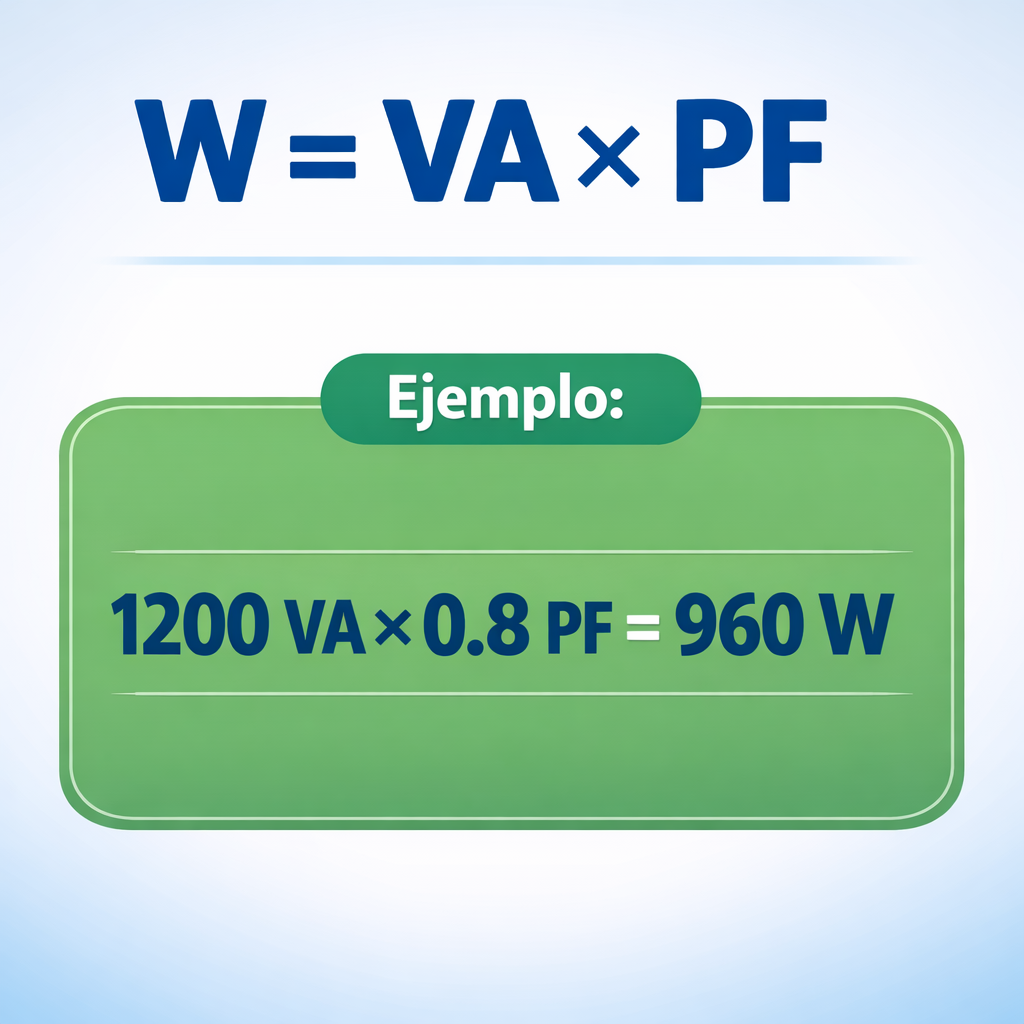
W = VA × PF · W = kVA × 1000 × PF · VA = W ÷ PF · Default PF if unknown: 0.8How do I convert VA to Watts?
Use W = VA × PF. If your input is in kVA, use W = kVA × 1000 × PF. For DC loads, PF = 1 so W = VA.
What PF should I use?
Use the load PF from measurement or manufacturer data. 0.80 is an illustrative preset, not a universal safe value. For UPS selection, check the separate watts and VA ratings as well as load demand.
Formulas used
P(W) = S(VA) × PF
P(W) = S(kVA) × 1000 × PF
For DC: PF ≈ 1 → W ≈ VA
Converting VA to Watts is one of the most practical calculations in electrical engineering. VA (volt-amperes) represents apparent power — the total power supplied to a circuit — while Watts represent real power, the portion that actually performs useful work. The difference between them depends entirely on the power factor (PF), a dimensionless ratio between 0 and 1 that reflects how efficiently your load uses the supplied energy. This VA to Watts calculator gives you instant, verified results for single-phase, three-phase, and DC circuits — just enter the VA rating and power factor to get Watts.
VA to watts for 1,100, 1,125 and 1,200 VA
At an illustrative PF of 0.80: 1,100 VA = 880 W; 1,125 VA = 900 W; 1,200 VA = 960 W. At PF 0.60, the same inputs give 660 W, 675 W and 720 W. Enter the actual load PF in the calculator.
For a UPS, compare the load against both the VA limit and the manufacturer’s rated output watts. A UPS described only as 1,200 VA does not establish a 960 W output rating or a battery runtime.
Continue your calculation:
1. VA to Watts Conversion Table (Common Commercial Values)
The table below covers the VA ratings you will find most often on UPS systems, transformers, generators, and industrial equipment nameplates. Each row shows the real power in Watts at four standard power factors. Use this VA to Watts table as a quick reference before pulling out the calculator.
| VA Rating | PF = 1.0 (W) | PF = 0.9 (W) | PF = 0.8 (W) | PF = 0.7 (W) | Typical Application |
|---|---|---|---|---|---|
| 100 VA | 100 W | 90 W | 80 W | 70 W | Small desktop UPS |
| 150 VA | 150 W | 135 W | 120 W | 105 W | LED driver, control transformer |
| 200 VA | 200 W | 180 W | 160 W | 140 W | Small appliance transformer |
| 250 VA | 250 W | 225 W | 200 W | 175 W | Control panel transformer |
| 500 VA | 500 W | 450 W | 400 W | 350 W | Home UPS, small inverter |
| 750 VA | 750 W | 675 W | 600 W | 525 W | Office UPS, networking gear |
| 800 VA | 800 W | 720 W | 640 W | 560 W | Desktop computer UPS |
| 1000 VA | 1000 W | 900 W | 800 W | 700 W | Server room UPS, 1 kVA transformer |
| 1050 VA | 1050 W | 945 W | 840 W | 735 W | Mid-range rack UPS |
| 1200 VA | 1200 W | 1080 W | 960 W | 840 W | Workstation + monitor UPS |
| 1250 VA | 1250 W | 1125 W | 1000 W | 875 W | Point-of-sale system backup |
| 1400 VA | 1400 W | 1260 W | 1120 W | 980 W | High-capacity workstation UPS |
| 1500 VA | 1500 W | 1350 W | 1200 W | 1050 W | Multi-device UPS, small generator |
| 2000 VA | 2000 W | 1800 W | 1600 W | 1400 W | Rack-mount server UPS |
| 3000 VA | 3000 W | 2700 W | 2400 W | 2100 W | Data center UPS, 3 kVA transformer |
| 5000 VA | 5000 W | 4500 W | 4000 W | 3500 W | Industrial UPS, distribution transformer |
| 7500 VA | 7500 W | 6750 W | 6000 W | 5250 W | Large motor starter, panel feeder |
| 10000 VA | 10000 W | 9000 W | 8000 W | 7000 W | Industrial drive, large transformer |
Note: These values are mathematically exact (W = VA × PF). In practice, the actual wattage may vary slightly depending on operating temperature, load conditions, and equipment age. Always cross-check with the equipment nameplate or datasheet.
2. Step-by-Step VA to Watts Formulas
The VA to Watts conversion formula is straightforward once you understand what each variable represents. Below you have every formula you need, broken down by circuit type, so you can convert VA to Watts in any scenario.
Single-Phase Formula (Most Common)
Where W is real power in Watts, VA is apparent power in volt-amperes, and PF is the power factor (0 to 1). This is the primary VA to Watts calculator formula that covers roughly 90% of residential and commercial applications.
When Input Is in kVA
Industrial transformers and generators are often rated in kVA rather than VA. Simply multiply by 1000 first, then apply the power factor. For example, a 5 kVA transformer at PF 0.85 delivers: 5 × 1000 × 0.85 = 4250 W.
Three-Phase Formula
In three-phase systems, the apparent power is S = √3 × V × I, so the conversion to Watts still follows the same principle: multiply apparent power by the power factor. If you already have the total VA for the three-phase system, use W = VA × PF directly.
DC Circuits
In a DC circuit there is no phase angle between voltage and current, so the power factor is always 1.0. That means VA equals Watts — no conversion needed. This applies to batteries, solar panels at the DC side, and DC motor drives.
Variable Reference
| Variable | Unit | Description |
|---|---|---|
| VA | Volt-Amperes | Apparent power — total power the source must deliver to the circuit |
| W | Watts | Real power — the portion that performs actual work (heat, motion, light) |
| PF | Dimensionless (0–1) | Power factor — ratio of real power to apparent power |
| kVA | Kilovolt-Amperes | Apparent power in thousands (1 kVA = 1000 VA) |
| VL-L | Volts | Line-to-line voltage in three-phase systems |
| VAR | Volt-Amperes Reactive | Reactive power — the non-working component of apparent power |
3. Types of Loads & Power Factor Differences
The power factor is the single most important variable in any VA to Watts conversion. It depends on the type of electrical load connected to the circuit. Understanding the differences helps you pick the right PF for your VA to Watts calculator input.
| Load Type | Typical PF Range | Why | Common Equipment |
|---|---|---|---|
| Purely Resistive | 1.0 | Voltage and current are perfectly in phase | Heaters, incandescent bulbs, toasters |
| Slightly Inductive | 0.85 – 0.95 | Small inductive component from windings or coils | HVAC systems, fluorescent ballasts |
| Moderately Inductive | 0.70 – 0.90 | Significant lagging current due to motor windings | Induction motors, pumps, compressors |
| Highly Non-Linear | 0.60 – 0.95 | Switching power supplies distort the current waveform | Computers, servers, LED drivers (without PFC) |
| Capacitive (Rare) | 0.90 – 0.99 leading | Current leads voltage due to capacitor banks | PF correction banks, synchronous motors |
Rule of thumb: if you don’t know the power factor and you need a safe estimate for a VA to Watts conversion, use PF = 0.8. This is the value most UPS manufacturers use to derate their equipment, and it gives a conservative (slightly lower) Watts figure that won’t oversize your installation.
4. Reverse Conversion: Watts to VA
Sometimes you know the real power (Watts) your load consumes and you need to find the VA rating required for a UPS, transformer, or generator. The reverse formula is:
This is critical for equipment sizing. If you size a UPS by Watts alone and ignore the VA rating, you risk overloading the unit because the apparent power demand will always be higher than the real power when PF < 1. Our Amperes to VA calculator can help you with current-based conversions for this scenario.
| Real Power (W) | PF = 0.7 → VA | PF = 0.8 → VA | PF = 0.9 → VA | PF = 1.0 → VA |
|---|---|---|---|---|
| 500 W | 714 VA | 625 VA | 556 VA | 500 VA |
| 750 W | 1071 VA | 938 VA | 833 VA | 750 VA |
| 1000 W | 1429 VA | 1250 VA | 1111 VA | 1000 VA |
| 1500 W | 2143 VA | 1875 VA | 1667 VA | 1500 VA |
| 2000 W | 2857 VA | 2500 VA | 2222 VA | 2000 VA |
| 3000 W | 4286 VA | 3750 VA | 3333 VA | 3000 VA |
| 5000 W | 7143 VA | 6250 VA | 5556 VA | 5000 VA |
5. Solved Examples — Real-World VA to Watts Conversions
Theory is good, but practice is better. Here are six real-world VA to Watts conversion examples, each with a different scenario you might encounter on the job or at home.
Example 1 — Home Office UPS Sizing
Data: UPS rated at 1500 VA. Connected load: desktop PC + monitor + router. Combined PF = 0.65 (switched-mode power supplies).
Formula: W = VA × PF = 1500 × 0.65 = 975 W
Your 1500 VA UPS can deliver up to 975 W of real power at this power factor. If your total load draws 800 W, you have roughly 22% headroom — a comfortable margin for startup surges.
Example 2 — Industrial Motor Power Audit
Data: Three induction motors totaling 5000 VA of apparent load. Measured average PF = 0.85.
Formula: W = VA × PF = 5000 × 0.85 = 4250 W
The 750 VA difference (5000 − 4250 = 750 VA of reactive power) doesn’t perform useful work but still loads your cables, transformers, and breakers. Installing capacitor banks to raise PF toward 0.95 would reduce that reactive burden and your utility penalty charges.
Example 3 — Data Center Rack PDU
Data: PDU rated at 3000 VA. Servers with active PFC have PF = 0.99.
Formula: W = VA × PF = 3000 × 0.99 = 2970 W
Modern server power supplies with active power factor correction achieve PF near unity. In this case, the VA and Watts values are almost identical, so the PDU can deliver nearly its full VA rating as real power.
Example 4 — Residential Transformer for LED Lighting
Data: Transformer rated at 200 VA. LED drivers without PFC, combined PF = 0.60.
Formula: W = VA × PF = 200 × 0.60 = 120 W
Budget LED drivers without power factor correction can have PF as low as 0.5. A 200 VA transformer only delivers 120 W of usable power — 40% of its VA rating goes to reactive power. Consider LED drivers with PFC (PF ≥ 0.9) to maximize the transformer’s capacity.
Example 5 — Portable Generator for Construction Site
Data: Generator rated at 7500 VA (7.5 kVA). Mix of power tools and lighting, estimated PF = 0.80.
Formula: W = kVA × 1000 × PF = 7.5 × 1000 × 0.80 = 6000 W
You can safely run up to 6000 W of real load on this generator. Keep a 10–15% margin for motor start-up surges from tools like circular saws, so plan for about 5100–5400 W of continuous connected load. Use our generator sizing calculator for precise load-list analysis.
Example 6 — HVAC System Backup
Data: HVAC unit rated at 10000 VA. Nameplate PF = 0.92.
Formula: W = VA × PF = 10000 × 0.92 = 9200 W
When sizing a backup generator for this HVAC unit, you need at least 9200 W of continuous capacity — plus the locked-rotor starting current, which can be 3–6× the running current for the first 0.5–2 seconds. A 15 kW generator would handle this comfortably.
6. VA to Watts in Electric Motors
Electric motors are one of the most common applications for VA to Watts conversion. The nameplate on a motor tells a story — but you have to read it correctly to convert VA to Watts accurately.
Reading the Motor Nameplate
A typical motor nameplate shows: rated voltage (V), rated current (A or FLA), horsepower or kW output, efficiency (η), power factor (PF), and service factor (SF). The VA rating is not listed directly — you calculate it from voltage and current:
Once you have the input VA, convert to Watts with: Winput = VAinput × PF.
Input Power vs. Output Power
Here is a critical distinction many people miss: the Watts you calculate from the VA to Watts formula represent electrical input power. The mechanical output power (what the shaft actually delivers) is lower because of motor losses:
Where η (eta) is the motor efficiency, typically 0.85–0.96 for modern NEMA Premium motors.
| Motor (HP) | Typical VA Input | PF | W Input | η | W Output (Shaft) |
|---|---|---|---|---|---|
| 1 HP | 1100 VA | 0.82 | 902 W | 0.828 | 747 W |
| 5 HP | 4800 VA | 0.84 | 4032 W | 0.926 | 3734 W |
| 10 HP | 9200 VA | 0.86 | 7912 W | 0.943 | 7461 W |
| 25 HP | 22000 VA | 0.87 | 19140 W | 0.975 | 18662 W |
| 50 HP | 45100 VA | 0.88 | 39688 W | 0.940 | 37307 W |
Note: The HP-to-W relationship is 1 HP = 746 W of mechanical output. The electrical input (VA and W) is always higher due to losses. For a deeper dive, use our electric motor efficiency calculator.
7. Quick Equivalences — Common VA to Watts Values
These common VA-to-watts conversions assume PF = 0.80 unless stated otherwise. This is an illustrative assumption, not an equipment rating or a guarantee that a particular UPS can supply the calculated watts.
100 VA to Watts
80 W (at PF 0.8)
Typical for a small desktop UPS or a doorbell transformer. At PF 1.0 (resistive): 100 W.
150 VA to Watts
120 W (at PF 0.8)
Common rating for control transformers in industrial panels and low-voltage lighting circuits.
200 VA to Watts
160 W (at PF 0.8)
Used in small appliance transformers and landscape lighting systems.
250 VA to Watts
200 W (at PF 0.8)
Standard control transformer size for HVAC control circuits and building automation panels.
750 VA to Watts
600 W (at PF 0.8)
A common home/office UPS size. Enough for a desktop PC, monitor, and router with margin to spare.
800 VA to Watts
640 W (at PF 0.8)
Popular UPS rating for gaming PCs. At PF 0.9 (modern PSU with active PFC): 720 W.
1000 VA to Watts
800 W (at PF 0.8)
The classic 1 kVA UPS or transformer. Covers most single-workstation setups with peripherals.
1050 VA to Watts
840 W (at PF 0.8)
Mid-range rack UPS found in small server closets and telecom cabinets.
1200 VA to Watts
960 W (at PF 0.8)
Often used for workstation + dual-monitor setups. At PF 0.65 (older PSUs): only 780 W.
1250 VA to Watts
1000 W (at PF 0.8)
Commonly found in point-of-sale and retail UPS systems. Clean 1 kW output at PF 0.8.
1400 VA to Watts
1120 W (at PF 0.8)
High-capacity UPS for workstations with multiple peripherals and external drives.
1500 VA to Watts
1200 W (at PF 0.8)
The largest common consumer UPS. Also a standard portable generator rating (1.5 kVA).
2000 VA to Watts
1600 W (at PF 0.8)
Rack-mount UPS for server rooms. Can support 2–3 servers depending on their PSU ratings.
3000 VA to Watts
2400 W (at PF 0.8)
Standard data center UPS (3 kVA). Supports a full server rack with networking equipment.
8. FAQ — VA to Watts Conversion
What is the formula to convert VA to Watts?
W = VA × PF. Multiply the apparent power in volt-amperes by the power factor to get real power in Watts. For example, 1000 VA × 0.8 PF = 800 W. If the input is in kVA, multiply by 1000 first: W = kVA × 1000 × PF.
How many Watts is 1 VA?
1 VA = 1 Watt only when PF = 1.0 (purely resistive load). For any other power factor, 1 VA delivers fewer Watts: at PF 0.8, 1 VA = 0.8 W. At PF 0.6, 1 VA = 0.6 W.
What power factor should I use if I don’t know it?
Use the actual load PF at the operating point. For 1,000 VA, PF 0.60 gives 600 W and PF 0.95 gives 950 W. Neither result changes a UPS’s rated watts limit. If PF is unknown, state the assumption and compare alternatives; do not infer safe capacity from the conversion alone.
What is the difference between VA and Watts?
VA measures apparent power; Watts measure real power. Apparent power is the total power the source delivers. Real power is the portion that does useful work. The difference is reactive power (VAR), caused by inductive or capacitive loads that shift current out of phase with voltage. VA is always greater than or equal to Watts.
Why do UPS systems list both VA and Watts?
Because a UPS has two independent limits. The VA rating limits its inverter/transformer capacity, while the Watts rating limits its battery discharge rate. A UPS rated 1500 VA / 900 W can supply up to 1500 VA of apparent power, but no more than 900 W of real power — whichever limit is reached first constrains your load. For accurate UPS sizing, try our UPS sizing calculator.
Can power factor change over time?
Yes. PF varies with load level, equipment age, and operating conditions. Motors running at partial load have lower PF than at full load. Capacitors degrade over years, reducing PF correction effectiveness. Measure PF periodically — annually for industrial plants, per IEEE recommended practices.
How do I convert VA to Watts for three-phase systems?
W = VA × PF — the same formula applies. If you have line voltage and current instead of total VA, use W = √3 × VL-L × I × PF to get total three-phase real power in Watts.
Is the VA to Watts conversion the same for AC and DC?
For DC, PF is always 1.0, so VA = Watts. The conversion only matters for AC circuits where inductive or capacitive loads create a phase difference between voltage and current. In any DC circuit — batteries, solar panels, DC drives — no VA to Watts conversion is needed.
What happens if I ignore power factor and assume VA equals Watts?
You will overestimate the real power available. A 1500 VA UPS at PF 0.8 delivers only 1200 W, not 1500 W. If you connect 1400 W of load thinking the UPS can handle it, you risk overload, shutdown, and potential equipment damage.
How do I measure the power factor of my equipment?
Use a power quality meter or clamp meter with PF measurement. Brands like Fluke, Hioki, and Dranetz offer portable meters. Connect the meter, run equipment at normal load, and read PF directly. For large installations, a full power quality audit per NEMA guidelines is recommended.
What is reactive power and how does it relate to VA and Watts?
Reactive power (VAR) is the non-working component of apparent power. It relates to VA and Watts through the power triangle: VA² = W² + VAR². When PF = 1, VAR = 0 and VA = W. When PF < 1, some of the VA capacity is "consumed" by reactive power, reducing the usable Watts.
What standards govern VA and Watts ratings on electrical equipment?
The main standards are IEC 61000-3-2 for harmonic limits and power factor, IEEE C57.12 for transformer ratings, and NEMA MG 1 for motor nameplate data. UPS ratings follow IEC 62040 which requires manufacturers to state both VA and Watts capacity on the label.
9. Related Conversions
If you found this VA to Watts calculator useful, these related tools might help with your next project:
- Amps to Watts Calculator — convert current (A) to real power (W) for any voltage and power factor.
- Amps to kW Calculator — convert current to kilowatts for single-phase and three-phase systems.
- Amperes to VA Calculator — find the apparent power from current and voltage.
- Amps to HP Calculator — convert current to mechanical horsepower for motor sizing.
- Electric Motor Efficiency Calculator — calculate motor input vs. output power and losses.
- Balanced and Unbalanced Load Calculation — distribute loads evenly across phases in panels.