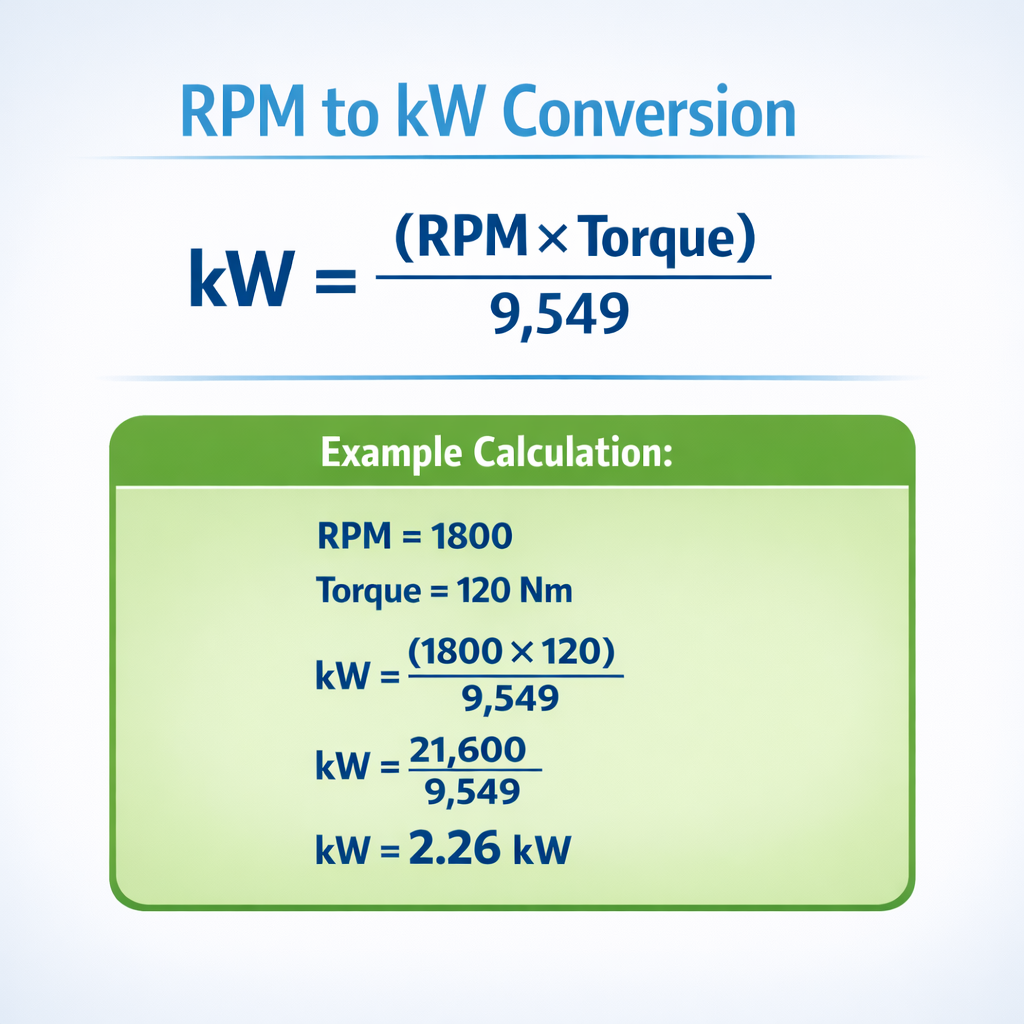
kW = T (N·m) × RPM ÷ 9,549 · T = kW × 9,549 ÷ RPM📊 Quick Reference Table
| RPM | 50 N·m | 100 N·m | 200 N·m |
|---|---|---|---|
| 750 | 3.93 | 7.85 | 15.71 |
| 1,500 | 7.85 | 15.71 | 31.42 |
| 1,800 | 9.42 | 18.85 | 37.70 |
| 3,000 | 15.71 | 31.42 | 62.83 |
| 3,600 | 18.85 | 37.70 | 75.40 |
❓ Common Questions
Can I convert RPM to kW without torque?
No. RPM is speed; power requires both speed and torque.
What is the 9,549 constant?
It equals 60,000 ÷ (2π) and converts N·m × RPM directly to kW.
The RPM to kW conversion determines how much mechanical power a rotating shaft delivers when you know its speed and torque. Unlike simple unit-prefix conversions, you always need two inputs—rotational speed in RPM and torque, usually in N·m—because power is the product of both. The master formula is kW = T × RPM ÷ 9,549, derived from the physics relationship P = T × ω. Every motor selection, gearbox specification, and drive-sizing decision in industrial practice relies on this calculation.
Getting the RPM to kW conversion right matters because motor undersizing causes overheating and premature winding failure, while oversizing wastes capital and energy. Use the calculator above for an instant answer, or read on for the complete breakdown with formulas, reference tables at multiple torque levels, and six fully worked examples drawn from real installations—conveyors, pumps, fans, CNC spindles, wind turbines, and oilfield equipment.
RPM to kW Conversion Table — Common Torque Values
The table below gives mechanical shaft power in kW for a range of speeds at three fixed torque values: 50 N·m (small conveyor drives and auxiliary motors), 100 N·m (mainstream industrial motors), and 200 N·m (heavy-duty pumps, crushers, and fans). Every value is calculated using kW = T × RPM ÷ 9,549.
| RPM | kW at 50 N·m | kW at 100 N·m | kW at 200 N·m | Typical Application |
|---|---|---|---|---|
| 100 | 0.52 | 1.05 | 2.09 | Low-speed gear motors, agitators |
| 250 | 1.31 | 2.62 | 5.24 | Winding machines, screw conveyors |
| 500 | 2.62 | 5.24 | 10.47 | Mixers, low-speed centrifugal fans |
| 750 | 3.93 | 7.85 | 15.71 | 8-pole induction motors (50 Hz) |
| 1,000 | 5.24 | 10.47 | 20.94 | 6-pole induction motors (50 Hz) |
| 1,200 | 6.28 | 12.57 | 25.13 | 6-pole induction motors (60 Hz) |
| 1,500 | 7.85 | 15.71 | 31.42 | 4-pole motors (50 Hz) — most common worldwide |
| 1,800 | 9.42 | 18.85 | 37.70 | 4-pole motors (60 Hz) — most common in Americas |
| 3,000 | 15.71 | 31.42 | 62.83 | 2-pole motors (50 Hz), centrifugal pumps |
| 3,600 | 18.85 | 37.70 | 75.40 | 2-pole motors (60 Hz), turbo blowers |
| 6,000 | 31.42 | 62.83 | 125.66 | High-speed spindle drives, turbochargers |
| 10,000 | 52.36 | 104.72 | 209.44 | CNC spindles, centrifugal compressors |
All figures represent shaft power (mechanical output). To find the electrical input power the motor draws from the supply, divide by efficiency: Input kW = Shaft kW ÷ η. A premium IE3-class motor at 15 kW typically achieves η ≈ 0.916 per IEC 60034-30-1.
RPM to kW Formulas — Step by Step
The fundamental relationship between rotational speed, torque, and power comes from Newtonian mechanics: power equals torque multiplied by angular velocity. The formulas below translate that principle into the units you actually encounter on nameplates, data sheets, and in design software.
1. SI Formula (Torque in N·m)
The constant 9,549 originates from the full derivation: P (W) = T × 2π × RPM ÷ 60. Dividing both sides by 1,000 to convert watts to kilowatts gives the denominator 60,000 ÷ (2π) ≈ 9,549.3. Rounding to 9,549 introduces less than 0.003 % error—negligible for any engineering purpose.
Quick example: A pump coupling reads 100 N·m at 1,500 RPM. Power = 100 × 1,500 ÷ 9,549 = 15.71 kW.
2. Imperial Formula (Torque in lb·ft)
Use this when torque is measured in pound-feet, which is standard in North American oilfield, automotive, and legacy HVAC applications. The constant 5,252 equals 33,000 ÷ (2π), where 33,000 ft·lbf/min is James Watt’s original definition of one horsepower.
3. Rearranged — Find Torque from kW and RPM
This form is essential when reverse-engineering a gearbox, verifying coupling capacity, or checking whether a shaft can handle the transmitted torque. Example: a 22 kW motor at 1,450 RPM produces T = 22 × 9,549 ÷ 1,450 = 144.9 N·m at the coupling flange.
4. Including Motor Efficiency
Where η is motor efficiency as a decimal (e.g., 0.95 for 95 %). This tells you how much electrical power the motor draws from the supply to produce a given shaft output—the number you need for cable sizing per IEEE and IEC standards, breaker coordination, and energy-cost estimation.
Torque Units — Types & Differences
One of the most common mistakes in the RPM to kW conversion is mixing torque units. The formula constant changes depending on the unit system, so you must verify which unit you are working with before plugging numbers in. The table below compares the three torque units you will encounter most often in industrial practice.
| Torque Unit | Symbol | SI Equivalent | RPM-to-kW Constant | Where Used |
|---|---|---|---|---|
| Newton-meter | N·m | 1 N·m | ÷ 9,549 | IEC countries — global standard |
| Pound-foot | lb·ft | 1.3558 N·m | ÷ 7,043 (gives kW directly) | US, Canada, UK automotive & oilfield |
| Kilogram-force meter | kgf·m | 9.8067 N·m | ÷ 974.0 | Older European, Japanese & Korean machinery |
If you work with legacy equipment from Japan, Germany, or Italy, you may find torque stamped in kgf·m. The safest approach: convert to N·m first (multiply by 9.8067) and then apply the standard ÷ 9,549 formula. Per NEMA MG-1 and IEC 60034, N·m is the only recommended torque unit for new engineering documentation.
kW to RPM — Inverse Conversion
When you already know the shaft power in kW and the torque, you can solve for speed. This is useful when selecting a gearbox reduction ratio, programming a VFD setpoint, or verifying the output speed of a motor at a given load.
| Shaft kW | Torque (N·m) | RPM | Application |
|---|---|---|---|
| 1.5 | 10 | 1,432 | Small VFD-driven exhaust fan |
| 7.5 | 50 | 1,432 | Belt conveyor drive |
| 15 | 100 | 1,432 | Centrifugal process pump |
| 22 | 150 | 1,401 | Cooling-tower fan motor |
| 37 | 200 | 1,767 | Screw compressor drive |
| 75 | 500 | 1,432 | Ball-mill main drive |
| 160 | 1,000 | 1,528 | Mine-hoist motor |
For the frequent search query “kW to RPM”, remember that you always need the torque as well—power alone does not determine speed. If you only have the motor nameplate (e.g., “15 kW, 4-pole, 50 Hz”), the synchronous speed is 1,500 RPM and typical full-load slip gives roughly 1,450 RPM. See our Amps to kW calculator for related electrical-power conversions.
6 Solved Examples — RPM to kW in Real Scenarios
Example 1 — Industrial Conveyor Motor (1,200 RPM, 100 N·m)
Data: RPM = 1,200 · T = 100 N·m
Formula: kW = T × RPM ÷ 9,549
Calculation: kW = 100 × 1,200 ÷ 9,549 = 12.57 kW
Standard warehouse conveyor belt drive. Engineers typically apply a 1.15 service factor per NEMA MG-1, so the closest standard motor is 15 kW. This covers peak loads, starting transients, and a 10 % ambient-temperature margin.
Example 2 — Centrifugal Pump (1,450 RPM, 70 N·m)
Data: RPM = 1,450 · T = 70 N·m
Formula: kW = T × RPM ÷ 9,549
Calculation: kW = 70 × 1,450 ÷ 9,549 = 10.63 kW
A 4-pole, 50 Hz pump motor running slightly below synchronous speed due to rotor slip. An 11 kW frame is the closest IEC standard size and provides adequate margin. At reduced flow (throttled valve), torque drops and so does shaft kW.
Example 3 — Wind Turbine Rotor (15 RPM, 8,000 N·m)
Data: RPM = 15 · T = 8,000 N·m
Formula: kW = T × RPM ÷ 9,549
Calculation: kW = 8,000 × 15 ÷ 9,549 = 12.57 kW
A small wind turbine rotor turning slowly but developing high torque. The gearbox steps speed up to match the generator’s rated RPM while proportionally reducing torque—power remains constant minus gearbox losses of 2–4 %. This example proves that the same kW can come from vastly different RPM/torque combinations.
Example 4 — CNC Spindle Motor (6,000 RPM, 12 N·m)
Data: RPM = 6,000 · T = 12 N·m
Formula: kW = T × RPM ÷ 9,549
Calculation: kW = 12 × 6,000 ÷ 9,549 = 7.54 kW
High-speed spindle in a CNC milling center. At this speed, bearing selection, rotor balancing, and cooling design become critical because centrifugal forces scale with RPM². The motor is typically a permanent-magnet servo rated for constant-power operation above base speed.
Example 5 — Cooling Tower Fan (720 RPM, 300 N·m)
Data: RPM = 720 · T = 300 N·m
Formula: kW = T × RPM ÷ 9,549
Calculation: kW = 300 × 720 ÷ 9,549 = 22.62 kW
An 8-pole motor direct-coupled to a large cooling tower fan. Fan loads follow the affinity (cube) law, so power scales with RPM³. Running at 80 % speed via VFD reduces power to roughly 51 % of rated—a massive energy saving that typically pays back the VFD cost within 18 months.
Example 6 — Imperial Units: Oilfield Pump (1,750 RPM, 35 lb·ft)
Data: RPM = 1,750 · T = 35 lb·ft
Formula: HP = T × RPM ÷ 5,252 → kW = HP × 0.7457
Calculation: HP = 35 × 1,750 ÷ 5,252 = 11.66 HP → kW = 11.66 × 0.7457 = 8.69 kW
A rod pump on a North American oil well where imperial torque is standard. A 10 HP (7.46 kW) motor would be undersized; a 15 HP (11.19 kW) NEMA frame is the correct selection, covering service factor and variable downhole load conditions.
RPM to kW in Electric Motors — Nameplate & Operating Point
Every electric motor nameplate shows rated power (kW or HP) and rated speed (RPM). Those two numbers define one point on the motor’s torque-speed curve. In practice, the motor rarely operates at exactly that point: variable-frequency drives, changing loads, and temperature shifts all move the operating point along the curve. Understanding the RPM-to-kW relationship helps you verify whether the motor is running safely within its thermal envelope or being pushed beyond design limits.
Shaft power vs. input power: The nameplate “kW” on an IEC motor is the mechanical output at the shaft. The electrical power drawn from the supply is higher because some energy is lost as heat in the stator windings, rotor bars, iron core, and bearings.
For a 15 kW, IE3 motor at full load with η = 0.916, the electrical input is 15 ÷ 0.916 = 16.38 kW. This is the number you use for cable sizing (per IEC 60364 or NEC Article 430), breaker coordination, and energy-cost estimation. For a detailed motor-efficiency walkthrough, check our Motor Efficiency Calculator.
Speed and pole count: The synchronous speed of an AC induction motor is n_sync = 120 × f ÷ poles. A 4-pole motor on 50 Hz has a synchronous speed of 1,500 RPM; on 60 Hz, 1,800 RPM. Under load, the rotor “slips” behind by 2–5 %, producing actual speeds of roughly 1,425–1,470 RPM (50 Hz) or 1,725–1,770 RPM (60 Hz). The slip speed multiplied by torque equals rotor copper losses—a practical diagnostic check during motor commissioning.
VFD operation: Below base speed in constant-torque mode, shaft power scales linearly with RPM: half speed gives half power. For fan and pump loads (variable torque), power follows the cube law: half speed yields roughly one-eighth power. In both regimes, the formula kW = T × RPM ÷ 9,549 holds—only the torque profile differs. For related electrical calculations, see our Amps to HP calculator and Amps to Watts calculator.
Quick Equivalencies — Common RPM to kW Queries
1500 RPM to kW
Depends on torque
At 100 N·m → 15.71 kW. At 50 N·m → 7.85 kW. 1,500 RPM is the synchronous speed of a 4-pole, 50 Hz motor—the most common motor type worldwide.
RPM to kW Converter
kW = T × RPM ÷ 9,549
Enter speed and torque in the calculator at the top of this page for an instant result with optional efficiency derating.
kW to RPM
RPM = kW × 9,549 ÷ T
The inverse formula. You always need the torque value—power alone does not determine speed.
RPM to Watts
W = T (N·m) × RPM ÷ 9.549
Same formula, result in watts instead of kilowatts. Divide the denominator by 1,000 (use 9.549), or compute kW and multiply by 1,000.
RPM N·m to kW
kW = N·m × RPM ÷ 9,549
Exactly the standard SI formula. N·m is the globally recommended torque unit per IEC 60034; no extra conversion factor needed.
110,000 RPM in Watts
Depends on torque
Ultra-high-speed dental or spindle drive. At 0.01 N·m: W = 0.01 × 110,000 ÷ 9.549 = 115.2 W. Tiny torque, huge speed, modest power.
kW / RPM Ratio
= Torque ÷ 9,549
A 15 kW motor at 1,500 RPM has a ratio of 0.01, corresponding to approximately 95.5 N·m of shaft torque.
RPM to N·m (Find Torque)
T = kW × 9,549 ÷ RPM
Rearranged formula. A 22 kW motor at 1,450 RPM delivers 144.9 N·m at the coupling.
RPM to kW Calculator
Free tool at the top of this page
Supports N·m, lb·ft, and kgf·m torque units with adjustable efficiency from 90 % to 100 %.
kW to RPM Converter
RPM = kW × 9,549 ÷ T
Enter shaft kW and known torque to solve for speed. Useful for gearbox ratio selection and VFD speed-setpoint programming.
Frequently Asked Questions — RPM to kW
How do I convert RPM to kW?
Use the formula kW = T (N·m) × RPM ÷ 9,549. You need both rotational speed in RPM and torque in newton-meters. For example, 1,500 RPM at 100 N·m gives 100 × 1,500 ÷ 9,549 = 15.71 kW of shaft power.
Can I convert RPM to kW without knowing the torque?
No. RPM alone is a speed, not a power. Power depends on both speed and torque simultaneously. If you only have a motor nameplate, the rated kW is already printed on it; the RPM-to-kW formula is for verifying operating points or sizing components at off-design conditions.
What is the constant 9,549 in the formula?
9,549 ≈ 60,000 ÷ (2π). It converts revolutions per minute and newton-meters into kilowatts in a single step. Full derivation: P (W) = T × 2π × RPM ÷ 60; divide by 1,000 for kW and the denominator becomes 60,000 ÷ (2π) = 9,549.3.
What is the difference between shaft kW and input kW?
Shaft kW is the mechanical power delivered at the coupling. Input kW is the electrical power the motor draws from the supply, which is always higher. The relationship: Input kW = Shaft kW ÷ η, where η is motor efficiency (typically 0.90–0.96 for industrial motors).
How do I convert RPM to watts instead of kW?
Use W = T (N·m) × RPM ÷ 9.549 (note the decimal, not a comma). Alternatively, compute kW first and multiply by 1,000. Example: 50 N·m at 3,000 RPM = 50 × 3,000 ÷ 9.549 = 15,708 W = 15.71 kW.
What if torque is in lb·ft instead of N·m?
Use the imperial path: HP = T (lb·ft) × RPM ÷ 5,252, then kW = HP × 0.7457. Example: 50 lb·ft at 1,750 RPM → HP = 50 × 1,750 ÷ 5,252 = 16.66 HP → kW = 16.66 × 0.7457 = 12.43 kW.
How do I find torque if I know kW and RPM?
Rearrange to T (N·m) = kW × 9,549 ÷ RPM. A 37 kW motor at 1,475 RPM produces 37 × 9,549 ÷ 1,475 = 239.5 N·m at the shaft—use this to check coupling and gearbox ratings.
Does motor efficiency affect the RPM-to-kW formula?
The basic formula gives shaft (mechanical) power, which is independent of motor type or losses. To find electrical input power, divide by efficiency: Input kW = Shaft kW ÷ η. A premium IE3 motor at 15 kW with η = 0.916 draws approximately 16.4 kW from the supply.
Why does a 4-pole, 50 Hz motor run at 1,450 RPM instead of 1,500?
The 50 RPM difference is rotor slip. An induction motor’s rotor must turn slightly slower than the synchronous field to induce current in the rotor bars and produce torque. Typical full-load slip ranges from 2 % to 5 %, giving actual speeds of 1,425–1,470 RPM for a 4-pole, 50 Hz machine.
What happens to power when a VFD changes the motor speed?
Below base speed in constant-torque mode, power scales linearly with RPM (half speed = half power). For fan and pump loads (variable torque), power follows the cube law (half speed ≈ 1/8 power). Both regimes obey kW = T × RPM ÷ 9,549; only the torque-versus-speed profile changes.
Is the formula the same for DC motors?
Yes. The formula kW = T × RPM ÷ 9,549 is a physics equation that applies to any rotating shaft—AC induction, permanent magnet, DC brushed, or even hydraulic motors. It relates mechanical torque and speed to mechanical power, regardless of the energy source.
How accurate is the RPM-to-kW formula for real motors?
Extremely accurate for shaft power when torque and speed are measured correctly (e.g., with an inline torque transducer and encoder). The main source of error is the torque measurement itself, not the formula. For electrical input power, add the efficiency term and use the manufacturer’s certified data per IEC 60034-2-1.
Related Conversions
Explore more engineering calculators on our site:
- Amps to kW Calculator — convert motor current to electrical power.
- Amps to Watts Calculator — single-phase and three-phase conversions.
- Amps to HP Calculator — relate motor current to horsepower rating.
- Amperes to VA Calculator — apparent power from current and voltage.
- Motor Efficiency Calculator — input vs. output power with loss breakdown.
- AWG to mm² Equivalences — wire-size cross-reference table.
- Balanced & Unbalanced Load Calculation — three-phase load distribution.