I = (kW × 1000) ÷ V (DC) · I = (kW × 1000) ÷ (V × PF) (1Φ) · I = (kW × 1000) ÷ (√3 × V × PF) (3Φ)Formulas used
DC: I = (kW × 1000) ÷ V
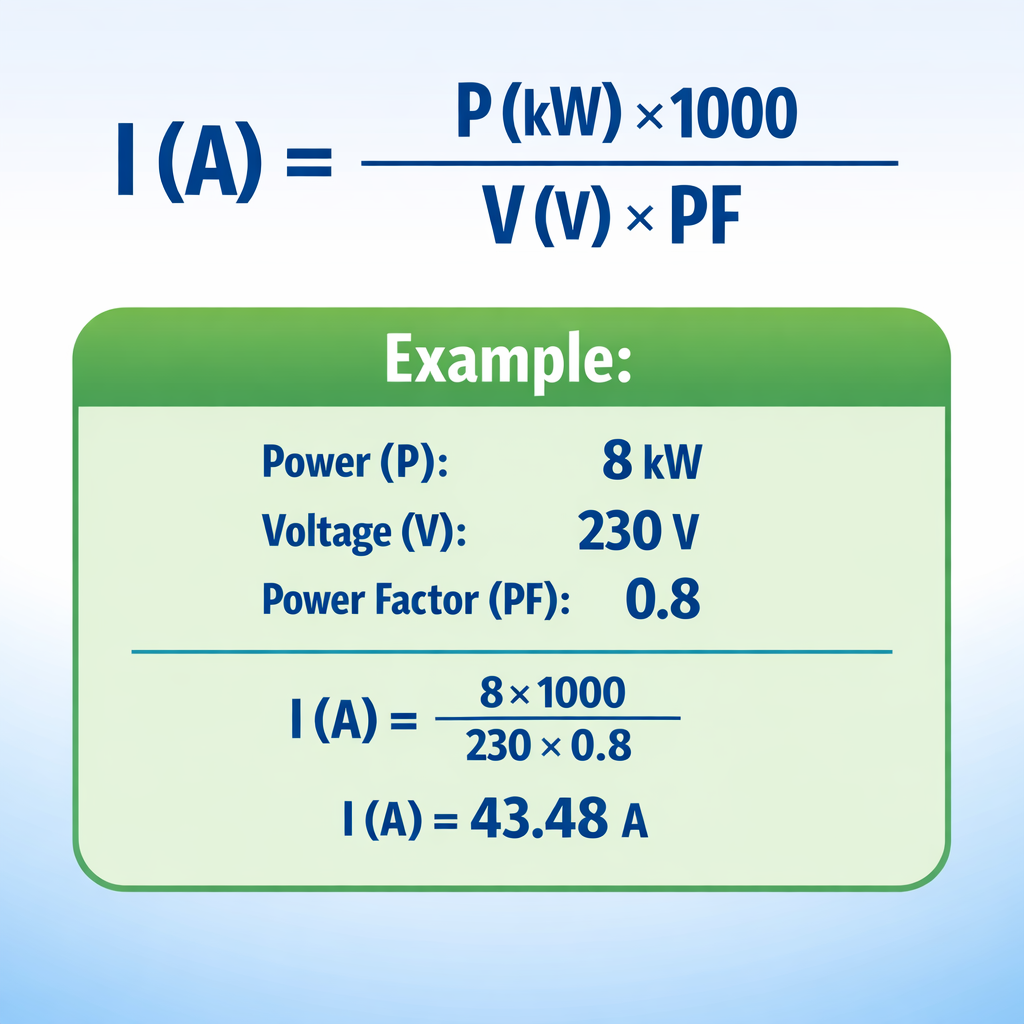
1Φ AC: I = (kW × 1000) ÷ (V × PF)
3Φ AC: I = (kW × 1000) ÷ (√3 × V × PF)
What PF should I use?
If unknown, use 0.85 for mixed loads. Resistive loads (heaters): PF = 1.0. Motors: 0.75–0.90. Computers: 0.60–0.95.
Converting kW to Amps is one of the most frequent calculations in electrical work — from sizing breakers and cables to verifying motor nameplate data. The formula changes depending on whether you have a DC, single-phase AC, or three-phase AC circuit, and for AC you also need the power factor (PF). This kW to Amps calculator handles all three circuit types instantly, so you can determine the exact current draw for any load. Whether you are selecting wire gauge per NEMA standards, sizing a breaker, or auditing a panel, the formulas and tables below cover every scenario.
After converting kW to amps: check the cable
A 10 kW electrical input at 400 V, three-phase and PF 0.85 gives approximately 16.98 A of line current. That is a load estimate, not a breaker rating or a completed conductor selection.
- Take the current to the wire size and ampacity calculator and compare conductor material and temperature ratings. Apply any load multipliers, terminal limits and installation corrections required for the actual circuit.
- Check the candidate conductor with the voltage drop calculator, using the circuit voltage, load current and one-way cable length. A long run may need a larger conductor even when its current-carrying capacity is adequate.
If the kW value is motor shaft output, account for motor efficiency before treating it as electrical input.
1. kW to Amps Conversion Table (Common Voltages)
The table below shows current in Amps for standard kW values at the most common voltages. All AC values assume PF = 0.85 (typical mixed commercial load). For DC circuits, PF is not applicable (effectively 1.0). Use the kW to Amps calculator above if your voltage or PF is different.
| kW | 120V 1Φ (A) | 220V 1Φ (A) | 240V 1Φ (A) | 208V 3Φ (A) | 480V 3Φ (A) |
|---|---|---|---|---|---|
| 0.75 kW | 7.35 A | 4.01 A | 3.68 A | 2.45 A | 1.06 A |
| 1 kW | 9.80 A | 5.35 A | 4.90 A | 3.27 A | 1.42 A |
| 1.5 kW | 14.71 A | 8.02 A | 7.35 A | 4.90 A | 2.13 A |
| 2.2 kW | 21.57 A | 11.76 A | 10.78 A | 7.19 A | 3.12 A |
| 3 kW | 29.41 A | 16.04 A | 14.71 A | 9.81 A | 4.26 A |
| 5 kW | 49.02 A | 26.74 A | 24.51 A | 16.35 A | 7.10 A |
| 7.5 kW | 73.53 A | 40.11 A | 36.76 A | 24.52 A | 10.64 A |
| 10 kW | 98.04 A | 53.48 A | 49.02 A | 32.66 A | 14.15 A |
| 12 kW | 117.65 A | 64.17 A | 58.82 A | 39.23 A | 17.03 A |
| 15 kW | 147.06 A | 80.21 A | 73.53 A | 48.98 A | 21.23 A |
| 20 kW | 196.08 A | 106.95 A | 98.04 A | 65.31 A | 28.30 A |
| 25 kW | 245.10 A | 133.69 A | 122.55 A | 81.64 A | 35.38 A |
| 30 kW | 294.12 A | 160.43 A | 147.06 A | 97.97 A | 42.45 A |
| 50 kW | — | 267.38 A | 245.10 A | 163.28 A | 70.75 A |
| 75 kW | — | — | 367.65 A | 244.92 A | 106.13 A |
| 100 kW | — | — | 490.20 A | 326.56 A | 141.51 A |
Note: Values calculated with I = (kW × 1000) ÷ (V × PF) for single-phase and I = (kW × 1000) ÷ (√3 × V × PF) for three-phase, at PF = 0.85. Dashes indicate impractical current levels for that voltage. Always verify with actual measurements and applicable IEEE or NEC standards before sizing conductors.
2. Step-by-Step kW to Amps Formulas
The kW to Amps formula depends on the circuit type. All three formulas derive from the basic power equation P = V × I, adjusted for AC power factor and three-phase geometry. Here is each one broken down step by step.
DC Circuit Formula
For DC circuits, there is no power factor — voltage and current are always in phase. Multiply kW by 1000 to get Watts, then divide by voltage. For example, a 5 kW solar array at 48 V DC draws: (5 × 1000) ÷ 48 = 104.17 A.
Single-Phase AC Formula
For single-phase AC, you divide by both voltage and power factor. The PF accounts for the phase difference between voltage and current caused by inductive or capacitive loads. A 3 kW load at 240 V and PF 0.85: (3 × 1000) ÷ (240 × 0.85) = 14.71 A.
Three-Phase AC Formula
For three-phase, the √3 factor (1.732) accounts for the 120° phase shift between the three lines. V is always the line-to-line voltage. A 15 kW motor at 480 V and PF 0.85: (15 × 1000) ÷ (1.732 × 480 × 0.85) = 21.23 A.
Variable Reference
| Variable | Unit | Description |
|---|---|---|
| I | Amperes (A) | Current — the flow of electric charge through the conductor |
| kW | Kilowatts | Real power — the power that does useful work (1 kW = 1000 W) |
| V | Volts | Voltage — electrical pressure. Use line-to-line for 3Φ systems |
| PF | Dimensionless (0–1) | Power factor — ratio of real to apparent power. Not used for DC |
| √3 | ≈ 1.732 | Square root of 3 — three-phase geometry constant |
3. DC vs. Single-Phase vs. Three-Phase — How Circuit Type Affects Current
The same kW load draws very different current depending on the circuit type and voltage. Understanding this is essential for selecting the right wire gauge, breaker size, and panel capacity. Here is a direct comparison for a 10 kW load at PF = 0.85:
| Circuit Type | Voltage | Formula | Current (A) | Wire Impact |
|---|---|---|---|---|
| DC | 48 V | (10 × 1000) ÷ 48 | 208.33 A | Very heavy conductors — typical for battery banks |
| DC | 120 V | (10 × 1000) ÷ 120 | 83.33 A | Large wire, dedicated circuit |
| Single-phase AC | 240 V | (10 × 1000) ÷ (240 × 0.85) | 49.02 A | #6 AWG copper minimum (NEC) |
| Three-phase AC | 208 V | (10 × 1000) ÷ (1.732 × 208 × 0.85) | 32.66 A | #8 AWG copper — per conductor |
| Three-phase AC | 480 V | (10 × 1000) ÷ (1.732 × 480 × 0.85) | 14.15 A | #14 AWG copper — small, cost-effective |
Key takeaway: Higher voltage = lower current for the same kW. This is why industrial facilities use 480 V or higher — it dramatically reduces conductor size, voltage drop, and installation cost. Three-phase further reduces per-conductor current by distributing the load across three wires. For wire sizing, check our AWG to mm² equivalence guide.
4. Reverse Conversion: Amps to kW
When you have a measured current and need to find the real power in kW, use the reverse formulas:
For a detailed Amps to kW tool, use our Amps to kW calculator.
| Current (A) | 120V 1Φ PF 0.85 → kW | 240V 1Φ PF 0.85 → kW | 480V 3Φ PF 0.85 → kW |
|---|---|---|---|
| 10 A | 1.02 kW | 2.04 kW | 7.07 kW |
| 15 A | 1.53 kW | 3.06 kW | 10.60 kW |
| 20 A | 2.04 kW | 4.08 kW | 14.12 kW |
| 30 A | 3.06 kW | 6.12 kW | 21.20 kW |
| 50 A | 5.10 kW | 10.20 kW | 35.33 kW |
| 100 A | 10.20 kW | 20.40 kW | 70.67 kW |
| 200 A | 20.40 kW | 40.80 kW | 141.34 kW |
5. Solved Examples — Real-World kW to Amps Conversions
Here are six practical kW to Amps examples covering residential, commercial, and industrial scenarios.
Example 1 — Residential Water Heater
Data: Electric water heater rated at 4.5 kW, single-phase 240 V. PF = 1.0 (resistive load).
Formula: I = (kW × 1000) ÷ (V × PF) = (4.5 × 1000) ÷ (240 × 1.0) = 18.75 A
A 20 A breaker on a dedicated 240 V circuit handles this load. NEC requires the breaker to be rated at 125% of continuous load: 18.75 × 1.25 = 23.44 A, so a 25 A or 30 A breaker is the correct choice.
Example 2 — Commercial Kitchen Oven
Data: Commercial oven rated at 12 kW, single-phase 220 V. PF = 1.0 (resistive).
Formula: I = (12 × 1000) ÷ (220 × 1.0) = 54.55 A
This requires a 60 A or 70 A breaker and #6 AWG copper conductors minimum. In a commercial kitchen, verify the panel has capacity for this circuit before installation.
Example 3 — Industrial Motor (3-Phase)
Data: 15 kW motor, three-phase 480 V. PF = 0.85.
Formula: I = (15 × 1000) ÷ (1.732 × 480 × 0.85) = 21.23 A
A 15 kW motor at 480 V draws only about 21 A per phase. This is manageable on #10 AWG copper conductors with a 30 A breaker. Compare this to the same motor at 208 V, which would draw 48.98 A — requiring much heavier wiring.
Example 4 — Solar Panel Array (DC)
Data: 10 kW solar array, 48 V DC bus.
Formula: I = (10 × 1000) ÷ 48 = 208.33 A
At low DC voltages, current is extremely high. This is why solar installations use string configurations to raise voltage (e.g., 400 V DC) before reaching the inverter, reducing current to about 25 A for the same 10 kW.
Example 5 — Office HVAC Compressor
Data: 7.5 kW compressor, three-phase 208 V. PF = 0.80.
Formula: I = (7.5 × 1000) ÷ (1.732 × 208 × 0.80) = 26.02 A
The compressor draws about 26 A at rated load. The starting (locked-rotor) current can be 5–6× higher for 0.5–2 seconds. A motor-rated breaker with appropriate trip curve handles the inrush without nuisance tripping.
Example 6 — EV Charger Installation
Data: Level 2 EV charger rated at 7.2 kW, single-phase 240 V. PF = 0.99 (active PFC).
Formula: I = (7.2 × 1000) ÷ (240 × 0.99) = 30.30 A
NEC requires 125% sizing for continuous loads: 30.30 × 1.25 = 37.88 A. A 40 A breaker and #8 AWG copper are the standard install. Most Level 2 chargers run as continuous loads (charging for 3+ hours).
6. kW to Amps in Electric Motors
Electric motors are the most common reason engineers convert kW to Amps. The nameplate kW rating is usually the mechanical output, not the electrical input. To find the actual current draw, you must account for motor efficiency.
Input kW vs. Output kW
Then use the kW to Amps formula with kWinput to get the actual current the motor draws from the supply. For example, a motor rated 15 kW output with η = 0.92 actually consumes 15 ÷ 0.92 = 16.30 kW of electrical input.
| Motor Output (kW) | η | kW Input | PF | 480V 3Φ (A) | 208V 3Φ (A) |
|---|---|---|---|---|---|
| 0.75 kW | 0.82 | 0.91 kW | 0.78 | 1.41 A | 3.24 A |
| 1.5 kW | 0.85 | 1.76 kW | 0.80 | 2.65 A | 6.11 A |
| 5 kW | 0.89 | 5.62 kW | 0.83 | 8.14 A | 18.80 A |
| 7.5 kW | 0.91 | 8.24 kW | 0.84 | 11.81 A | 27.25 A |
| 15 kW | 0.92 | 16.30 kW | 0.86 | 22.82 A | 52.66 A |
| 30 kW | 0.93 | 32.26 kW | 0.87 | 44.63 A | 102.99 A |
| 75 kW | 0.95 | 78.95 kW | 0.88 | 107.96 A | 249.16 A |
For complete motor efficiency analysis, see our electric motor efficiency calculator.
7. Quick Equivalences — Common kW to Amps Values
Instant answers for the most searched kW to Amps conversions. Unless noted, single-phase values use 240 V, PF 0.85, and three-phase values use 480 V, PF 0.85.
0.75 kW to Amps
3.68 A (240V 1Φ, PF 0.85)
Small fractional motor or LED driver. At 120V 1Φ: 7.35 A. At 480V 3Φ: 1.06 A.
1 kW to Amps
4.90 A (240V 1Φ, PF 0.85)
Space heater, small pump. At 120V: 9.80 A. At 480V 3Φ: 1.42 A.
1 kW to Amps (3-Phase)
1.42 A (480V 3Φ, PF 0.85)
Small three-phase motor. At 208V 3Φ: 3.27 A. Very low current at industrial voltages.
5 kW to Amps
24.51 A (240V 1Φ, PF 0.85)
Electric tankless water heater or workshop compressor. Needs a dedicated 30 A circuit at 240V.
12 kW to Amps
58.82 A (240V 1Φ, PF 0.85)
Commercial oven, large tankless heater. Requires #6 AWG copper and 60+ A breaker.
15 kW to Amps
73.53 A (240V 1Φ, PF 0.85)
Large electric heater or AC unit. At 480V 3Φ: only 21.23 A — much more manageable.
15 kW to Amps (3-Phase)
21.23 A (480V 3Φ, PF 0.85)
Industrial motor or HVAC compressor. Standard #10 AWG wire with a 30 A breaker handles it.
20 kW to Amps
98.04 A (240V 1Φ, PF 0.85)
Large commercial load. At 480V 3Φ: 28.30 A. Three-phase is almost always used at this power level.
25 kW to Amps
35.38 A (480V 3Φ, PF 0.85)
Medium industrial motor. Requires #8 AWG copper per phase at 480V.
30 kW to Amps
42.45 A (480V 3Φ, PF 0.85)
Large pump or compressor drive. A 50 A breaker and #6 AWG copper are standard.
50 kW to Amps
70.75 A (480V 3Φ, PF 0.85)
Large industrial motor or generator feed. Needs #4 AWG copper minimum at 480V.
100 kW to Amps
141.51 A (480V 3Φ, PF 0.85)
Major industrial drive or plant feeder. Requires 2/0 AWG copper conductors and a 200 A breaker.
8. FAQ — kW to Amps Conversion
What is the formula to convert kW to Amps?
For single-phase AC: I = (kW × 1000) ÷ (V × PF). For three-phase AC: I = (kW × 1000) ÷ (√3 × V × PF). For DC: I = (kW × 1000) ÷ V. Example: 10 kW at 240V single-phase, PF 0.85: (10 × 1000) ÷ (240 × 0.85) = 49.02 A.
How many Amps is 1 kW?
It depends on voltage and circuit type. At 120V single-phase PF 0.85: 1 kW = 9.80 A. At 240V: 4.90 A. At 480V three-phase: 1.42 A. Higher voltage means lower current for the same power.
Why do I need power factor to convert kW to Amps?
Because kW is real power but Amps carry apparent power (VA). The power factor is the ratio between them. Without PF, you would underestimate the current by the factor 1/PF. For a purely resistive load (PF = 1.0), kW and kVA are the same, so PF drops out of the formula.
What power factor should I use if I don’t know it?
Use 0.85 for mixed commercial loads. For resistive loads (heaters, ovens): PF = 1.0. For motors: 0.75–0.90. For computers/servers with active PFC: 0.95–0.99. For motors without PF data, 0.80 is a safe default.
Does voltage affect kW to Amps conversion?
Yes — it’s the biggest factor. Doubling the voltage halves the current for the same kW. A 10 kW load draws 49.02 A at 240V but only 14.19 A at 480V (three-phase). This is why industrial plants prefer higher voltages.
How do I size a breaker using kW to Amps?
First convert kW to Amps, then multiply by 1.25 for continuous loads. Per NEC 210.20, a breaker must be rated at 125% of continuous current. Example: 5 kW at 240V = 24.51 A × 1.25 = 30.64 A → use a 35 A breaker. Then select wire gauge per NEC Table 310.16.
Is the kW to Amps formula different for single-phase and three-phase?
Yes. Single-phase uses I = (kW × 1000) ÷ (V × PF). Three-phase adds the √3 factor (1.732) in the denominator because power is distributed across three conductors. The three-phase formula gives lower per-conductor current for the same total kW.
How do I convert kW to Amps for a motor?
First divide the nameplate kW by motor efficiency (η) to get input kW. Then apply the kW to Amps formula. Example: 15 kW motor, η = 0.92, PF = 0.86, 480V 3Φ: Input = 15 ÷ 0.92 = 16.30 kW. I = (16.30 × 1000) ÷ (1.732 × 480 × 0.86) = 22.82 A.
What is the difference between kW and kVA in current calculations?
kW is real power; kVA is apparent power. Amps carry apparent power, so if you use kVA instead of kW, you don’t need PF in the formula: I = kVA × 1000 ÷ V (single-phase) or I = kVA × 1000 ÷ (√3 × V) (three-phase). Use our Amperes to VA calculator for kVA-based conversions.
Can I convert kW to Amps without knowing the voltage?
No. Voltage is essential — there is no fixed ratio between kW and Amps. You must know (or assume) the system voltage to perform the conversion. Common assumptions: 120V or 240V for residential, 208V or 480V for commercial/industrial.
How does temperature affect kW to Amps?
Temperature doesn’t change the kW-to-Amps calculation itself, but it affects conductor ampacity (how much current a wire can safely carry). At higher ambient temperatures, you must derate the conductor per IEC 60364 or NEC Table 310.16. The kW to Amps formula gives you the current; temperature adjustment gives you the wire size.
Why do I get a different answer than the motor nameplate FLA?
Because the kW to Amps formula uses average or assumed PF and η. The nameplate FLA (Full Load Amps) is measured under specific test conditions per NEMA MG 1. Your calculation may differ if you use a different PF, efficiency, or voltage. Always trust the nameplate FLA for conductor and breaker sizing — use the kW to Amps calculator for estimation and verification.
9. Related Conversions
If you found this kW to Amps calculator useful, these related tools can help with your next electrical project:
- Amps to kW Calculator — the reverse conversion, from current to kilowatts.
- Amps to Watts Calculator — convert current to Watts for any voltage.
- Amperes to VA Calculator — find apparent power from current and voltage.
- Amps to HP Calculator — convert current to horsepower for motors.
- Electric Motor Efficiency Calculator — motor input vs. output power analysis.
- Balanced and Unbalanced Load Calculation — distribute loads across three-phase panels.