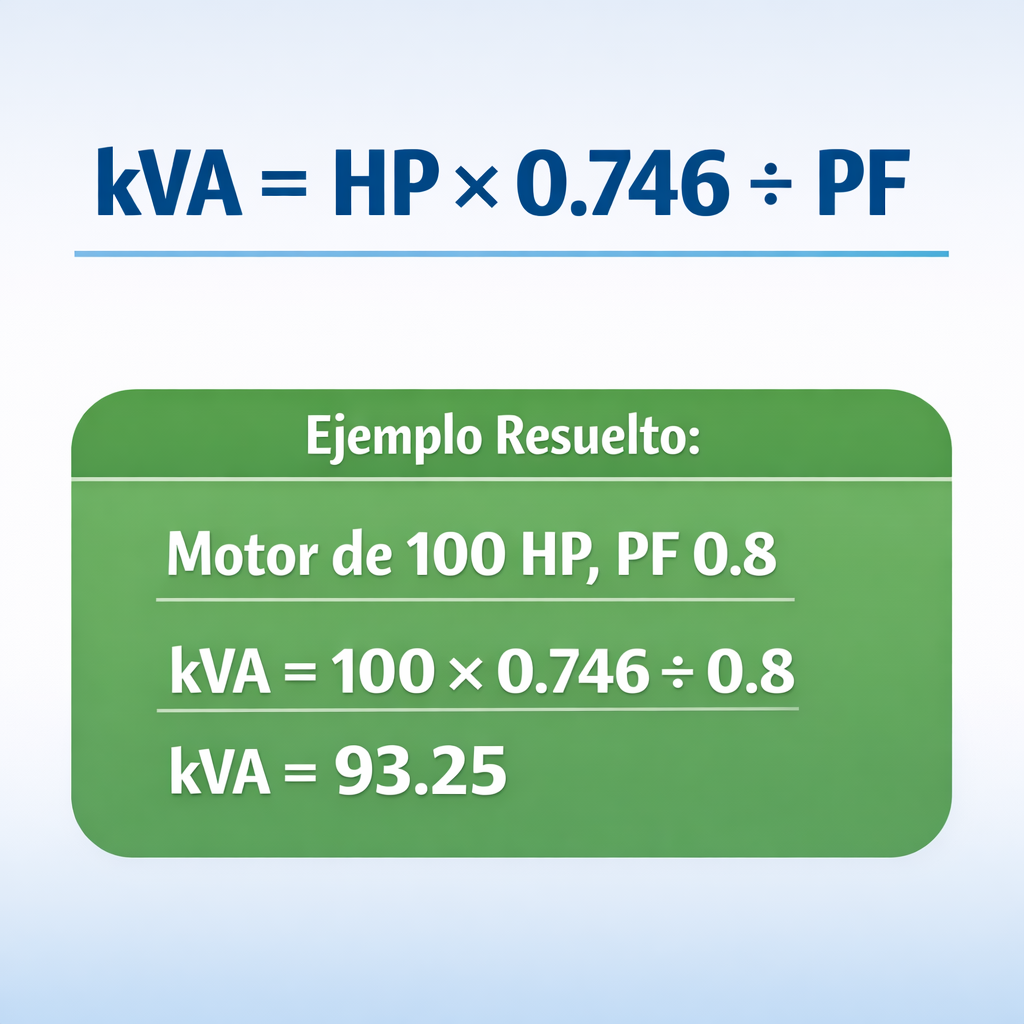
kVA = (HP × 0.746) ÷ (PF × η) — works for both single-phase and three-phase systems. Reverse: HP = (kVA × PF × η) ÷ 0.746📊 Quick Reference Table (PF=0.8, η=0.9)
| HP | kVA | HP | kVA |
|---|---|---|---|
| 1 | 1.04 | 50 | 51.81 |
| 5 | 5.18 | 75 | 77.71 |
| 10 | 10.36 | 100 | 103.61 |
| 20 | 20.72 | 150 | 155.42 |
| 30 | 31.08 | 200 | 207.22 |
❓ Common Questions
1 HP = ? 1.04 kVA (at PF=0.8, η=0.9).
Why does voltage not appear? kVA already accounts for voltage and current. The formula only needs PF and η.
Single vs 3-phase difference? The HP-to-kVA formula is the same. Phase type affects current, not kVA.
Converting HP to kVA is one of the most frequent calculations you’ll face when sizing generators, transformers, or motor feeders. Horsepower (HP) measures mechanical output power, while kilovolt-amperes (kVA) measures apparent electrical power — the total power the supply must deliver including reactive losses. The bridge between them depends on two critical variables: the power factor (PF) and the efficiency (η) of the equipment. This guide gives you the formula, verified tables, six worked examples, and a free instant calculator to convert HP to kVA accurately for any single-phase or three-phase system.
HP to kVA Conversion Table (PF = 0.8, η = 0.9)
This table uses the standard industrial assumptions of power factor 0.8 and motor efficiency 90%. These are conservative values suitable for preliminary sizing of generators and transformers per IEEE 141 guidelines. Multiply HP × 1.0361 to get kVA under these conditions.
| HP | kVA | Typical Application |
|---|---|---|
| 1 | 1.04 | Small fans, bench tools |
| 2 | 2.07 | Residential well pumps |
| 3 | 3.11 | Conveyor drives |
| 5 | 5.18 | Air compressors, mixers |
| 7.5 | 7.77 | Small HVAC units |
| 10 | 10.36 | Centrifugal pumps |
| 15 | 15.54 | Workshop machinery |
| 20 | 20.72 | Grain elevators, blowers |
| 25 | 25.90 | Medium HVAC chillers |
| 30 | 31.08 | Irrigation pumps |
| 40 | 41.44 | Industrial crushers |
| 50 | 51.81 | Large compressors |
| 75 | 77.71 | Water treatment plants |
| 100 | 103.61 | Mining hoists |
| 125 | 129.51 | Paper mill drives |
| 150 | 155.42 | Production line motors |
| 200 | 207.22 | Steel rolling mills |
| 250 | 259.03 | Large centrifugal compressors |
| 300 | 310.83 | Oil refinery pumps |
Important: These are steady-state running values. Motor starting inrush can multiply apparent power by 3–6×, so always add a 15–25% safety margin when selecting generators or transformers. If your power factor or efficiency differs, use the calculator above for an exact result.
Step-by-Step Formulas to Convert HP to kVA
The HP to kVA conversion formula is the same for both single-phase and three-phase systems because kVA already combines voltage and current into a single apparent-power figure. The phase type affects the current calculation (where you’d need voltage and √3 for three-phase), but not the total kVA demand.
Where:
- HP = mechanical horsepower (motor nameplate output).
- 0.746 = conversion constant (1 HP = 0.746 kW).
- PF = power factor (cosφ). Typical: 0.80 for standard induction motors, 0.85–0.95 for high-efficiency or corrected loads.
- η = overall efficiency (motor + driven equipment). Typical: 0.85–0.95 for modern motors per IEC 60034.
Step-by-step example (quick)
Convert 50 HP to kVA at PF = 0.8 and η = 0.9:
- Multiply: 50 × 0.746 = 37.30 kW (electrical input equivalent).
- Divide by PF × η: 37.30 ÷ (0.8 × 0.9) = 37.30 ÷ 0.72 = 51.81 kVA.
That’s the minimum apparent power the supply must deliver. For a transformer, you’d select a standard 60 or 75 kVA unit to allow for starting surges.
Why voltage doesn’t appear in the formula
A common question: shouldn’t voltage affect the kVA? No. kVA = V × I ÷ 1000 (single-phase) or V × I × √3 ÷ 1000 (three-phase). When you convert from HP (which is mechanical output), you’re calculating total apparent power. Voltage determines the current at that kVA — a higher voltage means lower current for the same kVA — but the kVA demand itself depends only on the mechanical load, PF, and efficiency.
Single-Phase vs Three-Phase — Key Differences
| Parameter | Single-Phase | Three-Phase |
|---|---|---|
| HP to kVA formula | kVA = (HP × 0.746) ÷ (PF × η) | kVA = (HP × 0.746) ÷ (PF × η) |
| Current from kVA | I = kVA × 1000 ÷ V | I = kVA × 1000 ÷ (V × √3) |
| Typical voltages | 120 V, 230 V, 240 V | 208 V, 400 V, 480 V |
| Max practical HP | Up to ~10 HP (residential) | Up to 10,000+ HP (industrial) |
| Common PF range | 0.75–0.90 | 0.80–0.95 |
| Typical efficiency | 0.80–0.90 | 0.88–0.96 |
| Starting inrush multiplier | 4–6× running kVA | 3–5× running kVA |
In practice, the HP-to-kVA number is identical regardless of phase configuration. The difference matters when you calculate wire size, breaker rating, or current — because three-phase distributes the current across three conductors, resulting in lower amps per wire for the same kVA.
Reverse Conversion: kVA to HP
To go from kVA back to horsepower, invert the formula:
| kVA | HP (PF=0.8, η=0.9) | HP (PF=0.9, η=0.95) |
|---|---|---|
| 5 | 4.83 | 5.73 |
| 10 | 9.65 | 11.46 |
| 25 | 24.13 | 28.65 |
| 50 | 48.26 | 57.30 |
| 100 | 96.51 | 114.61 |
| 150 | 144.77 | 171.91 |
| 200 | 193.03 | 229.22 |
| 250 | 241.29 | 286.52 |
For more details and a dedicated tool, see our Amp to kW calculator, which covers related electrical conversions.
Solved Examples — 6 Real-World HP to kVA Conversions
Example 1 — Sizing a Standby Generator for a 150 HP Production Motor
Data: 150 HP, three-phase induction motor, PF = 0.80, η = 0.92.
Formula: kVA = (150 × 0.746) ÷ (0.80 × 0.92) = 111.90 ÷ 0.736 = 152.04 kVA
A 175 kVA generator is the closest standard rating. Since this motor has an inrush multiplier of ~4×, confirm the generator’s surge rating covers 600+ kVA momentarily. Always request the generator manufacturer’s motor-starting capability curve.
Example 2 — Selecting a Transformer for a 75 HP Water Pump
Data: 75 HP, single-phase supply, PF = 0.85, η = 0.90.
Formula: kVA = (75 × 0.746) ÷ (0.85 × 0.90) = 55.95 ÷ 0.765 = 73.14 kVA
Select an 80 kVA or 100 kVA dry-type transformer. For a pump this size on single-phase, verify with the utility that service capacity is available — most utilities require three-phase for loads above 10–15 HP.
Example 3 — 10 HP Air Compressor for a Workshop
Data: 10 HP, three-phase, PF = 0.80, η = 0.88.
Formula: kVA = (10 × 0.746) ÷ (0.80 × 0.88) = 7.46 ÷ 0.704 = 10.60 kVA
A 15 kVA transformer or a 12 kW generator (at 0.8 PF → 15 kVA) handles this comfortably. Make sure the panel breaker is rated for the compressor’s locked-rotor amps, typically printed on the motor nameplate.
Example 4 — 50 HP HVAC Chiller Motor
Data: 50 HP, three-phase, PF = 0.85, η = 0.91.
Formula: kVA = (50 × 0.746) ÷ (0.85 × 0.91) = 37.30 ÷ 0.7735 = 48.22 kVA
HVAC chillers often run alongside other building loads. Add this kVA to the total connected load when sizing the building transformer. Most commercial buildings use 500 kVA or 750 kVA pad-mount transformers.
Example 5 — 200 HP Industrial Motor on an Emergency Generator
Data: 200 HP, three-phase, PF = 0.80, η = 0.93.
Formula: kVA = (200 × 0.746) ÷ (0.80 × 0.93) = 149.20 ÷ 0.744 = 200.54 kVA
Select a 250 kVA generator minimum. For motors this size, reduced-voltage starters (VFDs, soft starters, or autotransformer starters) are essential to keep inrush within the generator’s transient capability per NEMA MG 1.
Example 6 — 30 HP Agricultural Irrigation Pump
Data: 30 HP, single-phase, PF = 0.82, η = 0.88.
Formula: kVA = (30 × 0.746) ÷ (0.82 × 0.88) = 22.38 ÷ 0.7216 = 31.01 kVA
For agricultural installations, a 37.5 kVA or 50 kVA pole-mounted transformer is standard. Run the pump through a soft starter to avoid voltage sags on rural distribution lines, which can affect neighboring properties.
HP to kVA in Electric Motors — Reading the Nameplate
A motor nameplate gives you output horsepower — the shaft power delivered to the load. The electrical input is always higher because of losses. Here’s how to interpret the nameplate data for an accurate HP-to-kVA conversion:
Nameplate HP = mechanical output. This is the number you plug into the formula.
Nameplate FLA (Full Load Amps) = the current drawn at rated HP. You can verify your kVA calculation: kVA = V × FLA × √3 ÷ 1000 (three-phase). If the result differs significantly from your formula-based kVA, the motor’s actual PF or η differs from your assumptions.
Efficiency (η) = sometimes printed as “NOM EFF” or “NEMA NOM.” Values range from 0.855 (older standard motors) to 0.965 (premium-efficiency IE4 motors per IEC 60034-30-1).
Power factor = rarely printed on the nameplate. Use 0.80–0.85 for standard induction motors below 50 HP, and 0.85–0.92 for larger or premium motors. If the motor has a capacitor (capacitor-start/run), PF can be higher.
Service factor (SF) = if SF = 1.15, the motor can continuously deliver 115% of nameplate HP. Factor this into your kVA calculation for worst-case sizing: use HP × SF in the formula.
High-Efficiency Motors — Conversion Table (PF = 0.9, η = 0.95)
Premium-efficiency motors (IE3/IE4) have higher PF and η, so they draw less kVA per HP. This table is useful when sizing for modern, energy-efficient installations.
| HP | kVA | HP | kVA |
|---|---|---|---|
| 1 | 0.87 | 50 | 43.63 |
| 5 | 4.36 | 75 | 65.44 |
| 10 | 8.73 | 100 | 87.25 |
| 15 | 13.09 | 150 | 130.88 |
| 20 | 17.45 | 200 | 174.50 |
| 30 | 26.18 | 250 | 218.13 |
| 40 | 34.90 | 300 | 261.75 |
Compare with the standard table above — a high-efficiency motor rated at 100 HP needs only 87.25 kVA versus 103.61 kVA for a standard motor. That’s a 16% reduction in apparent power demand, which directly translates to smaller transformers and lower utility demand charges.
Quick Equivalences — HP to kVA
These direct answers cover the most-searched specific HP values. All calculated at PF = 0.8, η = 0.9 (standard industrial conditions). For other conditions, use the calculator above.
1 HP to kVA
1.04 kVA
Enough for a small workshop fan or a fractional-HP bench grinder. A 2 kVA UPS covers it with margin.
3 HP to kVA
3.11 kVA
Common for pool pumps and small conveyor belts. A 5 kVA stabilizer handles running + modest starting surge.
10 HP to kVA
10.36 kVA
Typical for centrifugal pumps and workshop compressors. Size a 15 kVA transformer to allow headroom.
15 HP to kVA
15.54 kVA
Medium-duty machinery. A 20 kVA or 25 kVA generator is the correct range.
20 HP to kVA
20.72 kVA
Grain dryers, industrial blowers. A 25 kVA transformer is the closest standard size.
30 HP to kVA
31.08 kVA
Irrigation and fire pumps. Use a 37.5 kVA or 50 kVA transformer for rural installations.
50 HP to kVA
51.81 kVA
Large HVAC systems and industrial compressors. A 75 kVA generator covers steady-state plus margin.
100 HP to kVA
103.61 kVA
Mining hoists, large pumping stations. Requires a 125 kVA or 150 kVA transformer minimum.
150 HP to kVA
155.42 kVA
Production-line motors in manufacturing. Size generator at 200 kVA and include a soft starter.
200 HP to kVA
207.22 kVA
Heavy industry — steel mills, cement plants. A 250 kVA generator is the standard pairing.
1 HP berapa kVA
1.04 kVA
1 HP sama dengan sekitar 1.04 kVA pada PF 0.8 dan efisiensi 0.9. For Indonesian readers: this is the same formula worldwide.
HP to kVA formula 3 phase
kVA = (HP × 0.746) ÷ (PF × η)
Same formula as single-phase. Phase type only matters when calculating amps from kVA: I = kVA × 1000 ÷ (V × 1.732).
Frequently Asked Questions — HP to kVA Conversion
How many kVA is 1 HP?
1 HP equals approximately 1.04 kVA at a power factor of 0.8 and efficiency of 0.9. The exact value depends on your equipment’s actual PF and η. Use the formula kVA = (1 × 0.746) ÷ (PF × η) with your specific values.
Is the HP to kVA formula different for single-phase and three-phase?
No, the HP-to-kVA formula is identical: kVA = (HP × 0.746) ÷ (PF × η). Phase type only affects the current calculation. For three-phase, amps = kVA × 1000 ÷ (V × 1.732). For single-phase, amps = kVA × 1000 ÷ V.
Does voltage affect the HP to kVA conversion?
No. Voltage does not appear in the HP-to-kVA formula because kVA already represents total apparent power. A 50 HP motor needs 51.81 kVA whether it runs on 230 V or 480 V — only the current changes.
What power factor should I use for a motor?
0.80 is the standard assumption for induction motors below 50 HP. Larger or premium-efficiency motors typically have PF between 0.85 and 0.92. If the nameplate doesn’t list PF, measure it with a power quality analyzer or use 0.80 as a safe estimate.
Why is the kVA always higher than the kW for the same HP?
kVA includes reactive power (magnetizing current in the motor), while kW only counts real (working) power. Since kVA = kW ÷ PF and PF is always ≤ 1, kVA is always ≥ kW. For example, 50 HP ≈ 37.3 kW input but 51.81 kVA at PF = 0.8.
How do I convert HP to kVA for a generator?
Use kVA = (HP × 0.746) ÷ (PF × η), where HP is the total connected motor load, PF is the load power factor, and η is motor efficiency. Then add 15–25% margin for starting surges. For multiple motors, calculate each one separately and sum the kVA values.
What is the difference between HP to kVA and HP to kW?
HP to kW gives you real power: kW = HP × 0.746 ÷ η. HP to kVA gives you apparent power: kVA = kW ÷ PF. You need kVA to size transformers, generators, and UPS systems, because they are rated in apparent power. You need kW to calculate energy consumption and utility bills.
Can I use HP to kVA for DC motors?
DC motors don’t have a power factor because DC circuits have no reactive component. For DC, simply use kW = HP × 0.746 ÷ η. The concept of kVA doesn’t apply to pure DC systems. However, if the DC motor is fed through a rectifier from an AC supply, size the AC side in kVA normally.
How does motor starting affect the kVA calculation?
Motor starting inrush is 3–6× the running kVA, lasting 5–15 seconds depending on the motor type. When sizing a generator, you must ensure its transient kVA rating covers the inrush. A 100 HP motor needing 103.61 kVA running may demand 400–600 kVA during startup.
What if I only know amps and voltage, not HP?
Calculate kVA directly: kVA = V × I × √3 ÷ 1000 (three-phase) or kVA = V × I ÷ 1000 (single-phase). If you then need HP, use HP = kVA × PF × η ÷ 0.746. For help with this conversion, try our Amps to HP calculator.
1 HP berapa kVA? (Indonesian search query)
1 HP sama dengan kira-kira 1.04 kVA pada faktor daya 0.8 dan efisiensi 0.9. Rumus: kVA = (HP × 0.746) ÷ (PF × η). Untuk motor standar industri, gunakan PF = 0.8 dan η = 0.9 sebagai acuan.
How accurate are online HP to kVA calculators?
Online calculators, including the one on this page, use the exact engineering formula and are mathematically accurate. The accuracy of your result depends on how well the PF and η values you enter match your actual equipment. Use nameplate data whenever possible. For critical sizing, always verify with a licensed electrical engineer.