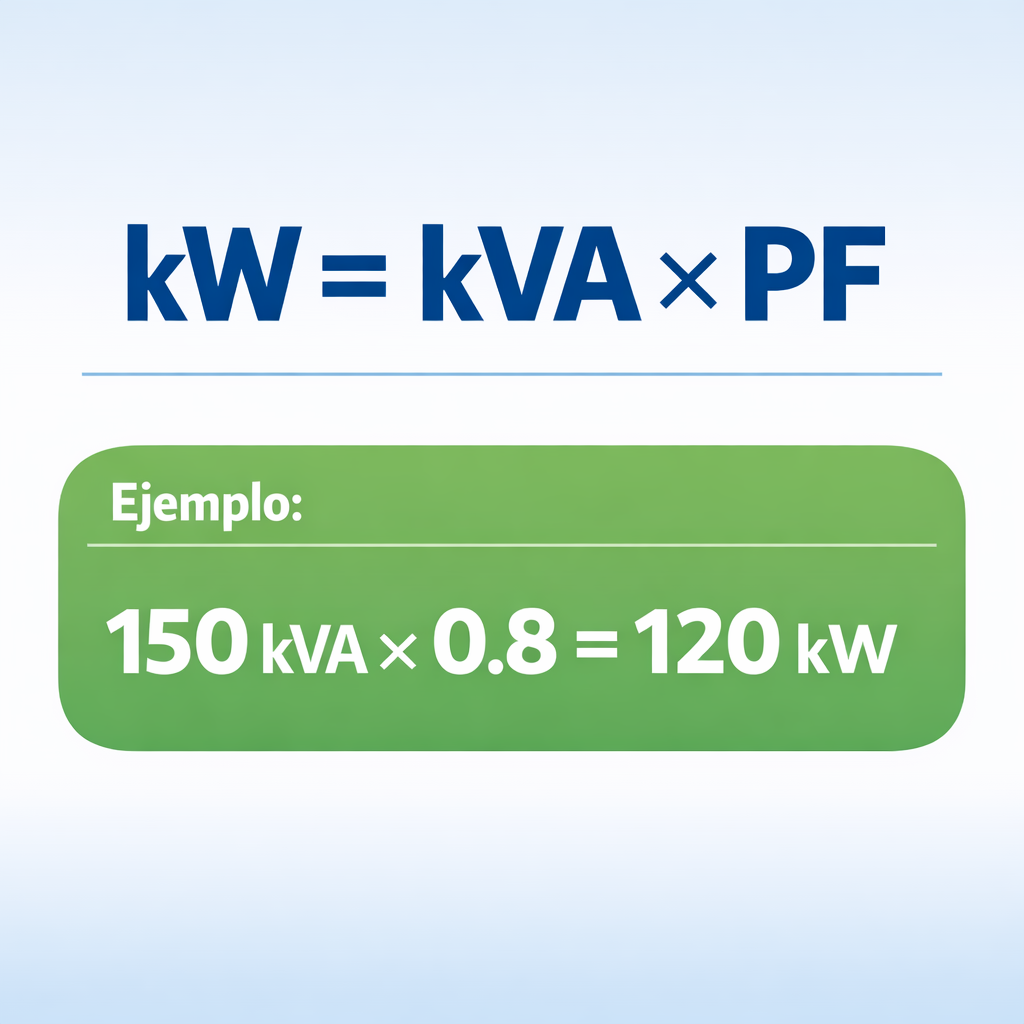
kW = kVA × PF · kVA = kW ÷ PF · Example PF: 0.8 — use the actual load power factor; an unknown PF does not give a unique result.Formulas used
kVA → kW: kW = kVA × PF
kW → kVA: kVA = kW ÷ PF
For DC or PF = 1: kW = kVA
What PF should I use?
Use the load power factor at the relevant operating point. 0.80 is an illustrative preset, not a universal derating rule. A source’s rated kW/kVA ratio does not establish the actual load PF.
Converting kVA to kW is essential for determining the real power output of any electrical source — generators, transformers, and UPS systems are all rated in kVA, but your loads consume kW. The formula is simple: kW = kVA × PF (power factor). This kVA to kW calculator handles both directions instantly and shows results across multiple power factors, so you can size equipment confidently. Whether you are specifying a standby generator, auditing a transformer’s capacity, or comparing UPS units, this page gives you the formulas, tables, and examples you need.
kVA to kW for 150, 200 and 1,000 kVA
At PF 0.80: 150 kVA = 120 kW; 200 kVA = 160 kW; 1,000 kVA = 800 kW. At PF 0.90, the corresponding values are 135, 180 and 900 kW. Use kW = kVA × PF with a PF appropriate to the operating point.
These are power conversions. Calculating energy in kWh also requires operating time and the load over that time. A generator or UPS can have a separate kW limit that remains applicable.
Continue your calculation:
1. kVA to kW Conversion Table (Standard Equipment Ratings)
This kVA to kW table covers the ratings found on generators, transformers, and UPS systems. All values use the formula kW = kVA × PF at four standard power factors.
| kVA | PF = 1.0 (kW) | PF = 0.9 (kW) | PF = 0.8 (kW) | PF = 0.7 (kW) | Typical Equipment |
|---|---|---|---|---|---|
| 1 kVA | 1.00 kW | 0.90 kW | 0.80 kW | 0.70 kW | Desktop UPS, home inverter |
| 5 kVA | 5.00 kW | 4.50 kW | 4.00 kW | 3.50 kW | Workshop generator |
| 10 kVA | 10.00 kW | 9.00 kW | 8.00 kW | 7.00 kW | Industrial UPS |
| 15 kVA | 15.00 kW | 13.50 kW | 12.00 kW | 10.50 kW | Commercial generator |
| 20 kVA | 20.00 kW | 18.00 kW | 16.00 kW | 14.00 kW | Data center UPS module |
| 25 kVA | 25.00 kW | 22.50 kW | 20.00 kW | 17.50 kW | Distribution transformer |
| 30 kVA | 30.00 kW | 27.00 kW | 24.00 kW | 21.00 kW | Standby generator |
| 50 kVA | 50.00 kW | 45.00 kW | 40.00 kW | 35.00 kW | Industrial generator |
| 70 kVA | 70.00 kW | 63.00 kW | 56.00 kW | 49.00 kW | Medium industrial drive |
| 75 kVA | 75.00 kW | 67.50 kW | 60.00 kW | 52.50 kW | Large distribution transformer |
| 100 kVA | 100.00 kW | 90.00 kW | 80.00 kW | 70.00 kW | Plant feeder, large generator |
| 150 kVA | 150.00 kW | 135.00 kW | 120.00 kW | 105.00 kW | Commercial building transformer |
| 200 kVA | 200.00 kW | 180.00 kW | 160.00 kW | 140.00 kW | Primary substation transformer |
| 250 kVA | 250.00 kW | 225.00 kW | 200.00 kW | 175.00 kW | Industrial plant feeder |
| 450 kVA | 450.00 kW | 405.00 kW | 360.00 kW | 315.00 kW | Large standby generator |
| 500 kVA | 500.00 kW | 450.00 kW | 400.00 kW | 350.00 kW | Utility distribution transformer |
| 1000 kVA | 1000.00 kW | 900.00 kW | 800.00 kW | 700.00 kW | Large industrial substation (1 MVA) |
Note: All values are mathematically exact (kW = kVA × PF). Most generators are rated at PF = 0.80 by default, meaning a 100 kVA generator delivers 80 kW of real power. Always check the nameplate for the manufacturer’s rated PF.
2. Step-by-Step kVA to kW Formulas
The kVA to kW conversion strips away reactive power to reveal the real, usable power. Here are all the formulas you need.
Primary Formula
Multiply kilovolt-amperes (apparent power) by the power factor to get kilowatts (real power). For example, a 150 kVA generator at PF 0.80: 150 × 0.80 = 120 kW. This formula works identically for single-phase and three-phase — the kVA rating already accounts for the circuit type.
To Watts
If you need the result in Watts instead of kW, multiply by an additional 1000. For 5 kVA at PF 0.85: 5 × 1000 × 0.85 = 4,250 W.
When PF = 1.0 (Resistive Loads)
For purely resistive loads — heaters, ovens, incandescent bulbs — there is no reactive power. kVA and kW are identical. A 10 kVA heater bank draws exactly 10 kW.
Finding Reactive Power (kVAR)
Reactive power is the “wasted” capacity that circulates between source and load but does no useful work. For 100 kVA at PF 0.80: kW = 80, kVAR = √(100² − 80²) = √(3600) = 60 kVAR. This 60 kVAR loads cables and transformers without producing work.
Variable Reference
| Variable | Unit | Description |
|---|---|---|
| kVA | Kilovolt-Amperes | Apparent power — total power delivered (includes reactive component) |
| kW | Kilowatts | Real power — power that performs useful work |
| PF | Dimensionless (0–1) | Power factor — ratio of real power to apparent power |
| kVAR | Kilovolt-Amperes Reactive | Reactive power — non-working power component |
3. kVA vs. kW — Apparent Power vs. Real Power
Understanding the difference between kVA and kW is critical for anyone sizing electrical equipment. Here is a direct comparison.
| Attribute | kVA (Apparent Power) | kW (Real Power) |
|---|---|---|
| What it measures | Total power the source delivers | Power that does useful work |
| Includes reactive power? | Yes | No |
| Used to size | Cables, transformers, generators, breakers | Loads, fuel consumption, utility billing |
| Affected by PF? | No — it IS the total | Yes — kW = kVA × PF |
| Equal when | PF = 1.0 (purely resistive loads). Otherwise kVA > kW | |
| Typical use | Equipment nameplates (gen, xfmr, UPS) | Utility bills, load calculations, engine sizing |
Practical rule: Generators, transformers, and UPS units are rated in kVA because they must handle apparent power (including reactive current) in their windings and conductors. Your loads consume kW. The kVA to kW calculator bridges this gap by applying the power factor to show exactly how much real power you get from a given kVA source.
4. Reverse Conversion: kW to kVA
When you know the real power demand (kW) and need to select a generator or transformer (rated in kVA), use the reverse formula:
This is critical for equipment sizing. A 100 kW load at PF 0.80 requires: 100 ÷ 0.80 = 125 kVA of supply capacity. If you bought a 100 kVA generator, you would only have 80 kW available — a 20 kW shortfall. For detailed transformer sizing, use our transformer kVA sizing calculator.
| Load (kW) | PF 0.70 → kVA | PF 0.80 → kVA | PF 0.90 → kVA | PF 1.0 → kVA |
|---|---|---|---|---|
| 10 kW | 14.29 kVA | 12.50 kVA | 11.11 kVA | 10.00 kVA |
| 25 kW | 35.71 kVA | 31.25 kVA | 27.78 kVA | 25.00 kVA |
| 50 kW | 71.43 kVA | 62.50 kVA | 55.56 kVA | 50.00 kVA |
| 100 kW | 142.86 kVA | 125.00 kVA | 111.11 kVA | 100.00 kVA |
| 200 kW | 285.71 kVA | 250.00 kVA | 222.22 kVA | 200.00 kVA |
| 500 kW | 714.29 kVA | 625.00 kVA | 555.56 kVA | 500.00 kVA |
5. Solved Examples — Real-World kVA to kW Conversions
Six practical kVA to kW conversion examples covering generators, transformers, UPS systems, and industrial equipment.
Example 1 — Standby Generator
Data: Generator rated at 200 kVA standby. PF = 0.80 (manufacturer default).
Formula: kW = kVA × PF = 200 × 0.80 = 160 kW
Your 200 kVA generator delivers 160 kW of real power. If your building load is 145 kW, you have about 10% headroom — adequate for standby, but consider motor starting surges. Use our generator sizing calculator for load-list analysis.
Example 2 — Distribution Transformer
Data: Transformer rated at 150 kVA. Connected motor loads with PF = 0.78.
Formula: kW = 150 × 0.78 = 117 kW
At PF 0.78, the 150 kVA transformer delivers only 117 kW. Installing capacitor banks to raise PF to 0.95 would increase usable capacity to 142.5 kW — a 22% improvement without changing the transformer.
Example 3 — Data Center UPS
Data: UPS module rated at 20 kVA. Server load with active PFC, PF = 0.98.
Formula: kW = 20 × 0.98 = 19.6 kW
Modern servers with active power factor correction let you use nearly the full kVA rating as kW. This 20 kVA UPS delivers 19.6 kW — only 0.4 kW lost to reactive power. For UPS sizing, try our UPS sizing calculator.
Example 4 — Industrial Welding Load
Data: Welding transformer rated 50 kVA. Welding arc PF = 0.65.
Formula: kW = 50 × 0.65 = 32.5 kW
Welding equipment has very low PF. This 50 kVA transformer delivers only 32.5 kW at the arc. The remaining 17.5 kVA is reactive power that heats conductors without producing useful work.
Example 5 — kW to kVA (Generator Sizing)
Data: Total building load: 360 kW. Average PF = 0.82.
Formula: kVA = kW ÷ PF = 360 ÷ 0.82 = 439.02 kVA
You need at least a 450 kVA generator (next standard size per IEEE standards). This provides about 2.5% margin at rated PF — tight but acceptable if the load is well characterized and motor starting is managed with soft starters.
Example 6 — Large Industrial Transformer
Data: Transformer rated at 1010 kVA. Plant PF = 0.85.
Formula: kW = 1010 × 0.85 = 858.5 kW
The 1010 kVA transformer delivers 858.5 kW of real power. This is a non-standard size — likely a custom-spec unit. The closest standard size below is 1000 kVA per NEMA standard transformer ratings.
6. kVA to kW in Generators & Transformers
Generators and transformers are the two equipment types where the kVA to kW conversion matters most. Here is what you need to know about each.
Generator kVA vs. kW Ratings
Most generator manufacturers rate their units in both kVA and kW. The kW rating is typically 80% of the kVA rating (PF = 0.80). For example, a generator labeled “200 kVA / 160 kW” tells you it supplies 200 kVA of apparent power and 160 kW of real power — the relationship is kW = kVA × 0.80.
Some generator brands (especially for the US market) list only kW. Others (especially European and Asian) list only kVA. The kVA to kW calculator lets you convert between them instantly. Just remember: the engine is sized in kW (it must produce enough mechanical power to generate the real electrical power), while the alternator is sized in kVA (it must handle the total current including reactive component).
Transformer kVA Ratings
Transformers are always rated in kVA because their core and winding losses depend on total current (apparent power), not just real power. A transformer doesn’t “know” the power factor of the connected load — it simply handles whatever current flows. Standard transformer sizes per IEC 60076 and IEEE C57.12 include: 15, 25, 37.5, 50, 75, 100, 167, 250, 333, 500, 750, and 1000 kVA.
To determine the real power capacity of a transformer, you must know the load’s PF: kW = kVA × PF. A 500 kVA transformer feeding motors at PF 0.80 delivers 400 kW. The same transformer feeding resistive heaters at PF 1.0 delivers 500 kW. Use our Amps to kW calculator for current-based power calculations.
7. Quick Equivalences — Common kVA to kW Values
Instant answers for the most searched kVA to kW conversions. Each assumes PF = 0.80 unless noted.
1 kVA to kW
0.80 kW (PF 0.8)
Desktop UPS or home inverter. At PF 1.0: 1.00 kW exactly.
5 kVA to kW
4.00 kW (PF 0.8)
Workshop generator or portable genset. At PF 0.9: 4.50 kW.
10 kVA to kW
8.00 kW (PF 0.8)
Industrial UPS or panel transformer. Standard small commercial building size.
15 kVA to kW
12.00 kW (PF 0.8)
Commercial generator. Powers an office floor with HVAC and lighting.
30 kVA to kW
24.00 kW (PF 0.8)
Standby generator for mid-size retail store or restaurant.
50 kVA to kW
40.00 kW (PF 0.8)
Industrial generator or substation transformer. Supports heavy motor loads.
70 kVA to kW
56.00 kW (PF 0.8)
Medium industrial drive or commercial HVAC chiller supply.
100 kVA to kW
80.00 kW (PF 0.8)
Large generator or plant feeder. At PF 0.85: 85 kW. At PF 0.9: 90 kW.
150 kVA to kW
120.00 kW (PF 0.8)
Commercial building transformer. Common size for multi-story offices.
200 kVA to kW
160.00 kW (PF 0.8)
Standby generator for small industrial plant or large commercial building.
450 kVA to kW
360.00 kW (PF 0.8)
Large standby generator. Common in hospitals, data centers, and manufacturing.
1000 kVA to kW
800.00 kW (PF 0.8)
1 MVA substation transformer. Powers a full manufacturing facility or campus.
8. FAQ — kVA to kW Conversion
What is the formula to convert kVA to kW?
kW = kVA × PF. Multiply the apparent power (kVA) by the power factor to get real power (kW). Example: 100 kVA × 0.80 = 80 kW.
How many kW is 1 kVA?
At PF = 0.80, 1 kVA = 0.80 kW. At PF = 1.0 (resistive load), 1 kVA = 1.00 kW. The exact answer always depends on the power factor.
Is kVA equal to kW?
Only when PF = 1.0. In all other cases, kVA > kW because kVA includes reactive power. A 100 kVA generator at PF 0.80 delivers only 80 kW. The 20 kVA difference is reactive power (kVAR).
What power factor should I use for kVA to kW conversion?
Use measured load PF or manufacturer operating data. If unavailable, compare assumptions and label the result as an estimate. For 100 kVA, PF 0.70 gives 70 kW and PF 0.90 gives 90 kW. These conversions do not override a generator or UPS’s independent kW rating.
How do I convert kW to kVA?
kVA = kW ÷ PF. Example: 100 kW ÷ 0.80 = 125 kVA. You always need more kVA than kW because of reactive power.
Is the kVA to kW formula the same for 3-phase?
Yes. kW = kVA × PF works for all circuit types — DC, single-phase, and three-phase. The kVA rating already accounts for the circuit configuration, so PF is the only variable you need.
Why do generators list both kVA and kW?
Because they have two independent limits. The alternator handles kVA (total current through its windings), while the engine handles kW (mechanical power output). The relationship is kW = kVA × PF, and most generators assume PF = 0.80.
What is kVAR and how does it relate to kVA and kW?
kVAR is reactive power. It relates through the power triangle: kVA² = kW² + kVAR². For 100 kVA at PF 0.80: kW = 80, kVAR = √(100² − 80²) = 60. The 60 kVAR loads conductors but does no useful work.
Can improving power factor increase kW from the same kVA source?
Yes. Raising PF from 0.70 to 0.95 on a 100 kVA transformer increases kW from 70 to 95 — a 36% increase in usable capacity. This is typically done with capacitor banks or synchronous motors.
Is kVA to kW conversion the same as kVA to kWh?
No. kW is instantaneous power; kWh is energy (power × time). To convert kVA to kWh: first convert to kW (kW = kVA × PF), then multiply by hours of operation (kWh = kW × h). Example: 50 kVA × 0.80 = 40 kW; running 8 hours = 320 kWh.
What standards govern kVA ratings?
IEEE C57.12 governs transformer kVA ratings. IEC 60034 covers rotating machine ratings. NEMA MG 1 defines motor nameplate data. Generator kVA ratings follow ISO 8528 and NFPA 110 for standby applications.
How does temperature affect kVA to kW conversion?
Temperature doesn’t change the formula (kW = kVA × PF stays the same). However, at higher ambient temperatures, generators and transformers must be derated — meaning their maximum kVA capacity decreases. A 100 kVA generator at 50°C ambient may only deliver 90 kVA (and thus 72 kW at PF 0.80) instead of the full rated 80 kW.
For the meaning behind the calculation, read kW vs kVA: power factor and equipment limits.
9. Related Conversions
If you found this kVA to kW calculator useful, these related tools can help:
- Amps to kW Calculator — convert current to kilowatts for any voltage.
- Amps to Watts Calculator — convert current to real power in Watts.
- Amperes to VA Calculator — find apparent power from current and voltage.
- Amps to HP Calculator — convert current to horsepower for motors.
- Electric Motor Efficiency Calculator — motor input vs. output power analysis.
- Balanced and Unbalanced Load Calculation — distribute loads across three-phase panels.