V = mV ÷ 1000 · 1 mV = 0.001 V
📊 Quick Reference Table
| mV | Volts | Use case |
|---|---|---|
| 1 | 0.001 | Thermocouple signal |
| 10 | 0.010 | Strain gauge output |
| 25 | 0.025 | Current shunt (50 A) |
| 100 | 0.100 | Low-level sensor signal |
| 250 | 0.250 | 4–20 mA across 12.5 Ω |
| 500 | 0.500 | Precision voltage reference |
| 1000 | 1.000 | 1 mV = 0.001 V exactly |
❓ Quick FAQ
How many volts is 1 millivolt?
0.001 V. One millivolt is one-thousandth of a volt.
Is the formula the same for AC and DC?
Yes — mV to V is a pure unit prefix conversion (÷ 1000), independent of AC or DC.
Converting millivolts to volts is one of the simplest electrical conversions — divide by 1,000 — yet it is also one of the most searched because engineers and technicians work with millivolt signals every day. Thermocouples, current shunts, strain gauges, pH probes, and precision voltage references all output in millivolts. Getting the decimal point wrong by even one place can cause a calibration error, a misread temperature, or a failed measurement loop. This page gives you an instant bidirectional calculator, the formula with step-by-step math, a comprehensive conversion table, and six real-world examples from industrial instrumentation.
Millivolts to Volts Conversion Table
The table below covers the millivolt values most commonly encountered in electrical and electronic work — from thermocouple outputs in the single-digit range to full-scale sensor signals at 500 mV and above. Every value is simply mV ÷ 1000.
| Millivolts (mV) | Volts (V) | Typical Application |
|---|---|---|
| 0.1 | 0.0001 | Nanovoltmeter threshold |
| 1 | 0.001 | Thermocouple at near-ambient temp |
| 5 | 0.005 | RTD bridge imbalance signal |
| 10 | 0.010 | Strain gauge full-scale output |
| 20 | 0.020 | Current shunt (4 mA × 5 Ω) |
| 25 | 0.025 | Standard 50 A/50 mV shunt at half load |
| 50 | 0.050 | Full-scale current shunt (50 mV class) |
| 100 | 0.100 | Low-level analog signal |
| 150 | 0.150 | Mid-range thermocouple reading |
| 200 | 0.200 | pH electrode offset |
| 250 | 0.250 | 4–20 mA across 12.5 Ω sense resistor |
| 300 | 0.300 | Type K thermocouple at ~73 °C |
| 350 | 0.350 | Load cell amplifier output (mid-range) |
| 500 | 0.500 | Precision 0.5 V reference (500 mV) |
| 750 | 0.750 | Silicon diode forward drop (approx.) |
| 1000 | 1.000 | 1 V exactly — benchmark value |
| 1200 | 1.200 | Bandgap voltage reference (1.2 V) |
| 1500 | 1.500 | AA battery nominal voltage |
| 2500 | 2.500 | Precision 2.5 V ADC reference |
| 5000 | 5.000 | Standard logic level / USB voltage |
How to Convert Millivolts to Volts — Formula Step by Step
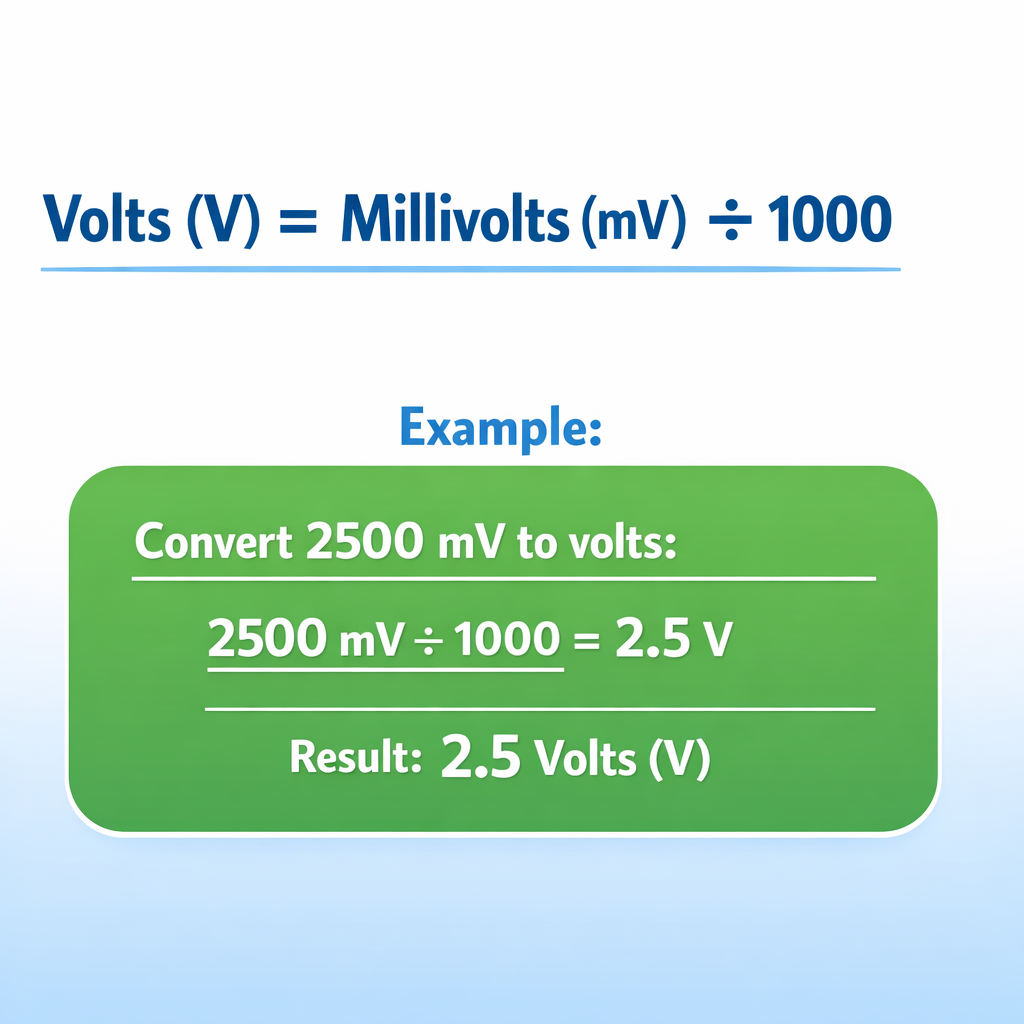
The conversion from millivolts to volts is a simple metric prefix shift. “Milli” means one-thousandth (10⁻³), so 1 millivolt is exactly 0.001 volts. The formula is:
Or equivalently:
Both are identical mathematically — dividing by 1,000 is the same as multiplying by 0.001. Most engineers prefer ÷ 1000 because it is easier to visualize: just move the decimal point three places to the left.
Step-by-step example: Convert 350 mV to volts.
1. Start with the value: 350 mV.
2. Divide by 1,000: 350 ÷ 1000 = 0.350.
3. Result: 350 mV = 0.350 V.
That’s it — one step, one operation. The formula works for any number, whether it is 0.5 mV (a thermocouple micro-signal) or 5,000 mV (a standard 5 V logic rail).
This relationship is defined by the International System of Units (SI prefixes, BIPM). The “milli-” prefix always means × 10⁻³, regardless of the base unit — milliamps, millimeters, millivolts all follow the same rule.
Millivolts vs Volts — Understanding the Units
Both millivolts and volts measure electrical potential difference (voltage), but they are used in very different contexts. Here is a comparison:
| Characteristic | Millivolt (mV) | Volt (V) |
|---|---|---|
| SI relationship | 1 mV = 0.001 V = 10⁻³ V | Base unit of voltage (derived SI) |
| Typical range | 0.01 mV – 999 mV | 1 V – 600 V (common electrical) |
| Where used | Sensors, thermocouples, shunts, DAQ | Power systems, batteries, outlets |
| Measurement tool | Multimeter (mV range), data logger | Multimeter (V range), voltmeter |
| Accuracy concern | Very high — noise and offset matter | Moderate — easier to measure reliably |
| Shielding needed? | Often yes — millivolt signals pick up noise | Usually no for normal wiring |
| Decimal places | Typically shown as whole numbers (250 mV) | Typically shown as decimals (0.250 V) |
In practice, engineers prefer to express signals below 1 V in millivolts because it avoids leading zeros and reduces the chance of decimal-point errors. Saying “350 mV” is clearer and less error-prone than “0.350 V” when communicating verbally or writing calibration sheets. But when the value enters a calculation — Ohm’s law, power formulas, or PLC scaling — you must convert to volts first, because standard formulas use volts, amps, and ohms in their base SI units.
Volts to Millivolts — Inverse Conversion
To convert in the other direction, multiply by 1,000:
| Volts (V) | Millivolts (mV) |
|---|---|
| 0.001 | 1 |
| 0.005 | 5 |
| 0.010 | 10 |
| 0.025 | 25 |
| 0.050 | 50 |
| 0.100 | 100 |
| 0.250 | 250 |
| 0.500 | 500 |
| 1.000 | 1,000 |
| 1.500 | 1,500 |
| 2.500 | 2,500 |
| 5.000 | 5,000 |
You can use the calculator above in reverse — just switch the direction to “V → mV” and enter your value in volts.
Solved Examples — 6 Real-World Cases
Example 1 — Type K Thermocouple Reading (10 mV)
Data: A Type K thermocouple reads 10.00 mV at the terminal block (cold junction compensated).
Formula: V = 10.00 ÷ 1000 = 0.0100 V
Per the IEEE and NIST ITS-90 thermocouple tables, 10.00 mV for Type K corresponds to approximately 246 °C. The PLC analog input needs the value in volts to scale properly.
Example 2 — 50 mV Current Shunt (Full Scale)
Data: A 100 A / 50 mV DC ammeter shunt reads exactly 50 mV at rated current.
Formula: V = 50 ÷ 1000 = 0.050 V
At 0.050 V across the shunt, Ohm’s law gives R = 0.050 ÷ 100 = 0.0005 Ω (0.5 mΩ). If the meter reads 25 mV (0.025 V), the current is 50 A — half scale.
Example 3 — 250 mV Signal from 4–20 mA Loop
Data: A 4–20 mA transmitter drives 20 mA through a 12.5 Ω sense resistor. Voltage drop = 20 × 12.5 = 250 mV.
Formula: V = 250 ÷ 1000 = 0.250 V
The PLC analog input reads 0.250 V at full scale (20 mA). At 4 mA (zero scale), the voltage is 4 × 12.5 = 50 mV = 0.050 V. The 0.050–0.250 V range maps to 0–100% of the process variable.
Example 4 — 150 mV Thermocouple Mid-Range
Data: Temperature controller displays 150 mV from a Type J thermocouple.
Formula: V = 150 ÷ 1000 = 0.150 V
150 mV on a Type J thermocouple corresponds to roughly 277 °C — a typical setpoint for a plastic injection mold heater zone. The signal transmits over shielded twisted-pair to reject electromagnetic noise.
Example 5 — 350 mV Load Cell Output
Data: A 500 kg load cell with 2 mV/V sensitivity, excited at 10 V, produces 2 × 10 × (350/500) = 14 mV at 350 kg. But the question asks to convert 350 mV (amplified signal) to volts.
Formula: V = 350 ÷ 1000 = 0.350 V
After the signal conditioner amplifies the raw load cell output to the 0–500 mV range, the DAQ system reads 0.350 V and scales it to 350 kg.
Example 6 — 1500 mV AA Battery
Data: A fresh alkaline AA battery measures 1,500 mV on a millivolt-range digital multimeter.
Formula: V = 1500 ÷ 1000 = 1.500 V
The nominal voltage of an AA cell is 1.5 V. When measured in millivolts, you get extra resolution — for example, a depleted cell might read 1,050 mV (1.050 V), which a voltmeter rounding to one decimal would show as just “1.1 V.”
Millivolts in Instrumentation & Sensors
Millivolt signals are the foundation of industrial measurement. Nearly every analog sensor in a process plant — temperature, pressure, flow, weight, strain — outputs in the millivolt range before amplification. Understanding how to convert these signals correctly to volts is critical for calibration, troubleshooting, and PLC/DCS configuration.
Thermocouples
Thermocouples generate a voltage proportional to the temperature difference between the measuring junction and the reference junction. A Type K thermocouple produces about 41 µV per degree Celsius (0.041 mV/°C). At 500 °C the output is approximately 20.6 mV = 0.0206 V. Thermocouple tables published by NIST (ITS-90) list values in millivolts — you must divide by 1,000 before plugging into any Ohm’s law or power calculation.
Current shunts
DC ammeters use precision shunt resistors rated in millivolts at full-scale current — commonly 50 mV, 75 mV, or 100 mV class. A 500 A / 50 mV shunt has a resistance of 0.050 ÷ 500 = 0.0001 Ω (100 µΩ). Reading 37.5 mV on this shunt means 37.5 ÷ 50 × 500 = 375 A flowing. The millivolt reading is first converted to volts (0.0375 V) for the Ohm’s law verification: 0.0375 ÷ 0.0001 = 375 A — confirming the measurement.
Strain gauges and load cells
Load cells output in mV/V — typically 2 mV per volt of excitation at full scale. With a 10 V excitation, full-scale output is only 20 mV (0.020 V). This tiny signal requires instrumentation amplifiers with high common-mode rejection and shielded cabling to avoid measurement errors from electromagnetic interference.
PLC and DAQ analog inputs
Most PLC analog input modules accept 0–10 V, 0–5 V, or 4–20 mA signals. When you have a millivolt-level sensor, you need a signal conditioner or transmitter to amplify the signal to the PLC’s input range. For example, converting a 0–50 mV shunt signal to 0–10 V requires a gain of 200. If the PLC reads 5.000 V, the original shunt signal was 5000 ÷ 200 = 25 mV = 0.025 V, corresponding to half the shunt’s rated current.
Quick Equivalences — Millivolts to Volts
Direct answers for the most searched mV-to-V conversions. Every result is simply the mV value divided by 1,000.
1 mV to V
0.001 V
One millivolt. Typical thermocouple output at a few degrees above ambient temperature.
10 mV to V
0.010 V
Common strain gauge full-scale reading or small current-shunt drop.
20 mV to V
0.020 V
Load cell full-scale output at 2 mV/V with 10 V excitation.
25 mV to V
0.025 V
50 A / 50 mV current shunt at half rated current (25 A).
150 mV to V
0.150 V
Mid-range thermocouple reading. Type J at ~277 °C or Type K at ~367 °C.
250 mV to V
0.250 V
4–20 mA signal across a 12.5 Ω sense resistor at full scale (20 mA).
300 mV to V
0.300 V
Type K thermocouple at approximately 73 °C — useful for HVAC monitoring.
350 mV to V
0.350 V
Amplified load cell signal at about 70% of full scale in a weighing system.
500 mV to V
0.500 V
Half-volt precision reference. Also a 100 mV class shunt at full scale on some systems.
1000 mV to V
1.000 V
By definition, 1000 millivolts equals exactly 1 volt. The benchmark crossover point.
1500 mV to V
1.500 V
Nominal voltage of a single AA or AAA alkaline battery cell.
2500 mV to V
2.500 V
Standard precision ADC reference voltage used in data acquisition systems.
Frequently Asked Questions
How do you convert millivolts to volts?
Divide by 1,000. The formula is V = mV ÷ 1000. For example, 250 mV ÷ 1000 = 0.250 V. This works because “milli-” means one-thousandth (10⁻³).
How many volts is 1 millivolt?
0.001 volts. One millivolt is exactly one-thousandth of a volt. This is the SI-defined relationship between the milli- prefix and the base unit.
What is 1 millivolt equal to?
0.001 V, or equivalently 1,000 microvolts (µV). In other unit systems: 1 mV = 10⁻³ V. It is the voltage level generated by a thermocouple at near-ambient temperature differences.
Is 500 mV the same as 0.5 V?
Yes, exactly. 500 mV ÷ 1000 = 0.500 V = 0.5 V. Both expressions represent the same voltage; millivolts are simply more convenient for small signals to avoid leading zeros.
How do you convert volts to millivolts?
Multiply by 1,000. Formula: mV = V × 1000. For example, 0.150 V × 1000 = 150 mV. Use the calculator above in “V → mV” mode for instant results.
What instruments measure in millivolts?
Digital multimeters (on the mV range), thermocouple readers, data loggers, oscilloscopes, precision voltmeters, and nanovoltmeters. For industrial work, a good DMM with 0.01 mV resolution on the 200 mV range is essential for thermocouple and shunt troubleshooting.
Why do thermocouples output in millivolts?
Because the Seebeck effect (the thermoelectric principle behind thermocouples) produces very small voltages — about 40 µV per degree Celsius for Type K. At 500 °C, this is still only about 20 mV (0.020 V). The signal is too small for direct use, so it must be amplified or read by a specialized thermocouple input module.
Is the mV to V formula different for AC signals?
No. The conversion mV ÷ 1000 = V is a pure mathematical unit prefix change. It applies identically to DC voltages, AC RMS voltages, AC peak voltages, or any other voltage measurement — the division by 1,000 is universal.
How many millivolts in a volt?
1,000 millivolts. By definition, 1 V = 1000 mV, just as 1 meter = 1000 millimeters or 1 gram = 1000 milligrams.
What is 150 mV in volts?
0.150 V. Calculation: 150 ÷ 1000 = 0.150. This is a typical mid-range thermocouple reading — for Type K, it corresponds to approximately 367 °C.
What is 350 mV in volts?
0.350 V. Calculation: 350 ÷ 1000 = 0.350. This value appears commonly in load cell signal conditioning, where the amplified output ranges from 0 to 500 mV.
What is the difference between mV and V?
Only magnitude — both measure voltage. The millivolt (mV) is one-thousandth of a volt (V). Engineers use mV for small signals (sensors, shunts) and V for power-level voltages (batteries, mains). There is no physical or conceptual difference; it is purely a scale convention for readability.
Related Conversions
Explore more electrical conversion calculators on our site:
- Amp to kW Calculator — convert amperes to kilowatts with voltage and PF.
- Amps to Watts Calculator — convert current to watts with formula and table.
- Amperes to Resistance (Ohm’s Law) Calculator — find ohms from current and voltage.
- Amperes to VA Calculator — amps to volt-amperes for transformer sizing.
- AWG to mm² Equivalences — wire gauge cross-reference for conductor sizing.