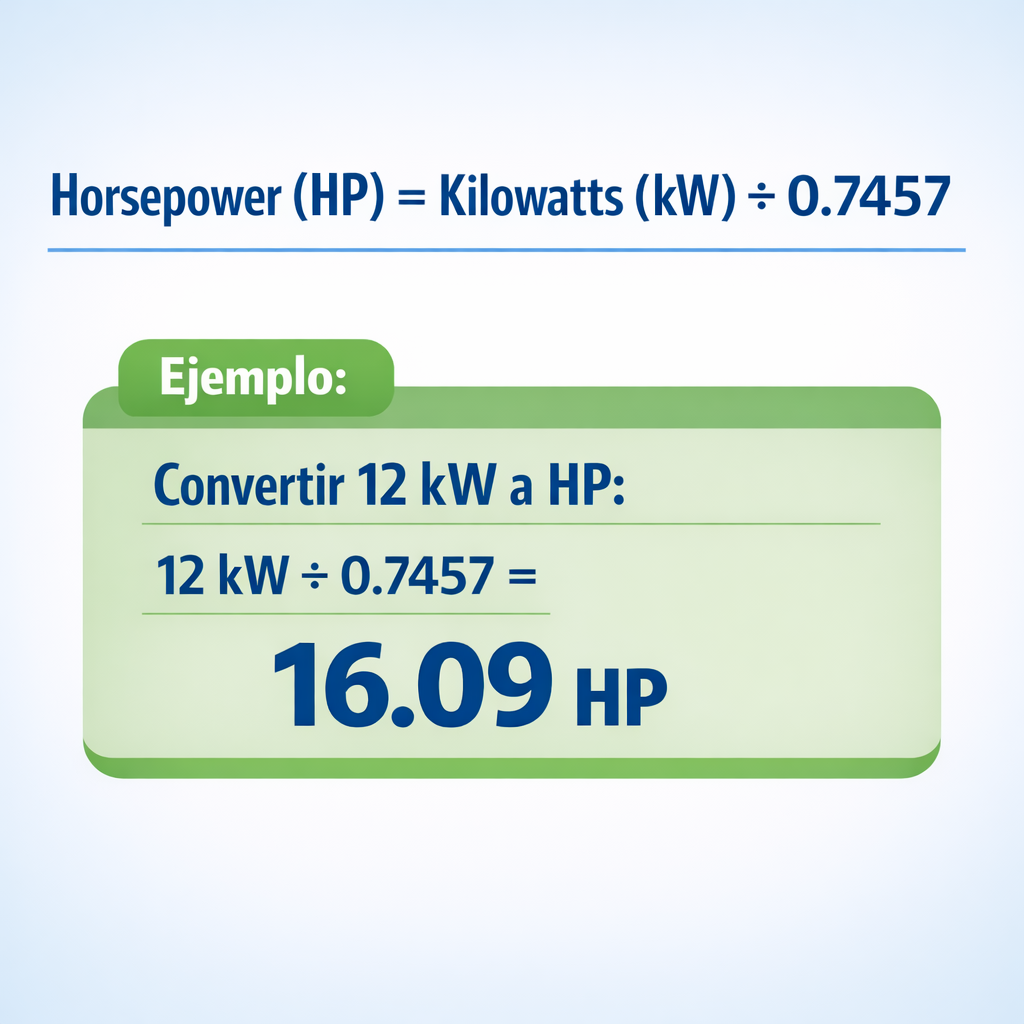
HP(mech) = kW ÷ 0.7457 · HP(metric) = kW ÷ 0.7355 · kW = HP × 0.7457Quick Reference Table
| kW | Mech HP | Metric HP |
|---|---|---|
| 0.25 | 0.335 | 0.340 |
| 0.37 | 0.496 | 0.503 |
| 0.55 | 0.738 | 0.748 |
| 0.75 | 1.006 | 1.020 |
| 1.5 | 2.012 | 2.039 |
| 2.2 | 2.951 | 2.993 |
| 5.5 | 7.376 | 7.479 |
| 22 | 29.515 | 29.912 |
| 75 | 100.587 | 101.939 |
| 125 | 167.645 | 169.899 |
Frequently Asked Questions
What is 1 kW in HP?
1 kW = 1.341 mechanical HP or 1.3596 metric HP.
Mechanical or metric?
Use mechanical HP (745.7 W) for U.S./NEMA equipment, metric HP (735.5 W) for EU/Asia.
If you work with motors, drives, or any power-rated equipment, you will run into the kW-to-HP conversion constantly. The problem is that “horsepower” is not one number — there are mechanical, metric, and electric variants, each with a different watt-equivalent. This kW to HP converter gives you all three results instantly and explains exactly when to use each one, with formulas, tables, and real engineering examples you can apply on the job today.
The conversion is straightforward: divide kilowatts by the appropriate factor (0.7457 for mechanical HP, 0.7355 for metric HP). But choosing the wrong type can lead to undersized motors, failed inspections, or equipment that does not match the nameplate. Below you will find everything you need to convert confidently, whether you are sizing a 0.25 kW fractional motor or specifying a 250 kW industrial drive.
kW to HP Conversion Table — Commercial Motor Sizes
This table covers the motor sizes you will actually encounter in industrial and commercial catalogs. Values are rounded to three decimal places. The “Typical Application” column helps you pick the right row for your project without guessing.
| kW | Mech HP (÷ 0.7457) | Metric HP (÷ 0.7355) | Typical Application |
|---|---|---|---|
| 0.18 | 0.241 | 0.245 | Small fans, lab stirrers |
| 0.25 | 0.335 | 0.340 | Fractional pumps, HVAC dampers |
| 0.37 | 0.496 | 0.503 | ½ HP class — bench grinders, small compressors |
| 0.55 | 0.738 | 0.748 | ¾ HP class — sump pumps, sewing machines |
| 0.75 | 1.006 | 1.020 | 1 HP class — residential pool pumps |
| 1.1 | 1.475 | 1.496 | 1.5 HP class — small conveyors |
| 1.5 | 2.012 | 2.039 | 2 HP class — garage door openers, augers |
| 2.2 | 2.951 | 2.993 | 3 HP class — large drill presses |
| 3.0 | 4.023 | 4.079 | Dust collectors, large fans |
| 4.0 | 5.364 | 5.438 | 5 HP class — air compressors |
| 5.5 | 7.376 | 7.479 | 7.5 HP — centrifugal pumps |
| 7.5 | 10.059 | 10.197 | 10 HP — elevator hoists |
| 11 | 14.749 | 14.955 | 15 HP — large HVAC chillers |
| 15 | 20.117 | 20.394 | 20 HP — industrial blowers |
| 22 | 29.505 | 29.912 | 30 HP — conveyor systems |
| 30 | 40.234 | 40.789 | 40 HP — crushers, grinders |
| 37 | 49.622 | 50.306 | 50 HP — large screw compressors |
| 45 | 60.352 | 61.183 | 60 HP — cooling towers |
| 55 | 73.764 | 74.779 | 75 HP — mine ventilation |
| 75 | 100.587 | 101.939 | 100 HP — water treatment pumps |
| 90 | 120.704 | 122.327 | Large mixers, centrifuges |
| 110 | 147.527 | 149.558 | 150 HP — paper mills |
| 125 | 167.645 | 169.953 | Rock crushers |
| 160 | 214.586 | 217.540 | Cement kilns |
| 200 | 268.232 | 271.925 | Large extruders, rolling mills |
| 250 | 335.290 | 339.906 | Oil platform pumps |
| 315 | 422.466 | 428.282 | Steel mill drives |
Tip: In the U.S. and Canada, NEMA standard motor sizes follow the mechanical HP column. In Europe and Asia, catalogs list metric HP (PS) or kW directly. Always confirm which standard applies before ordering.
Step-by-Step Formulas: How to Convert kW to HP
There are three conversion formulas because “horsepower” has three standardized definitions. Each one ties back to a different watt-equivalent, so the divisor changes. Here is every formula you need, with a worked example for each.
Formula 1 — kW to Mechanical Horsepower (Imperial)
One mechanical horsepower equals exactly 745.69987 W. This is the standard in the United States, defined by James Watt in the 18th century and codified by NEMA for motor ratings.
Example: Convert 22 kW to mechanical HP.
HP = 22 ÷ 0.7457 = 29.505 HP. The nearest NEMA frame is 30 HP.
Formula 2 — kW to Metric Horsepower (PS / CV)
One metric horsepower (PS in German, CV in French and Spanish) equals 735.49875 W. This variant is used across the EU, Latin America, Japan, and most of Asia. Automotive spec sheets outside North America almost always use metric HP. The standard is documented in ISO 1000.
Example: Convert 22 kW to metric HP.
HP(metric) = 22 ÷ 0.7355 = 29.912 PS.
Formula 3 — kW to Electric Horsepower
Electric horsepower is defined as exactly 746 W. It is used specifically for electric motor output ratings in some North American contexts, per IEC 60034.
Example: Convert 22 kW to electric HP.
HP(elec) = 22 ÷ 0.746 = 29.491 HP.
Why the difference matters
The gap between mechanical and metric HP is only about 1.4%, but on a 200 kW motor that is nearly 4 HP — enough to push you into the next frame size or trip a protection relay set at the wrong rating. Always check whether your nameplate, VFD, or PLC configuration expects mechanical or metric HP before entering values.
Mechanical vs Metric vs Electric HP — Comparison Table
Here is a side-by-side comparison so you can pick the right variant instantly. The conversion factor is the value you divide kW by to get HP.
| Type | Watts per HP | Conversion Factor | Where Used | Standard |
|---|---|---|---|---|
| Mechanical (Imperial) | 745.6999 | 0.7457 | USA, Canada, UK (legacy) | NEMA MG1 |
| Metric (PS / CV) | 735.4988 | 0.7355 | EU, Asia, Latin America, automotive worldwide | ISO 1000, DIN 66036 |
| Electric | 746.0000 | 0.7460 | Electric motor ratings (some N. American contexts) | IEC 60034 |
Rule of thumb: If the motor catalog is from a NEMA manufacturer (Baldor, WEG-US, Marathon), use mechanical. If the catalog is IEC-frame (Siemens, ABB, Schneider), the nameplate probably already says kW and metric HP is the correct equivalent.
Inverse Conversion: HP to kW
To convert in the opposite direction, just multiply HP by the factor instead of dividing.
| HP (mech) | kW | HP (mech) | kW |
|---|---|---|---|
| 0.5 | 0.373 | 25 | 18.643 |
| 1 | 0.746 | 30 | 22.371 |
| 1.5 | 1.119 | 40 | 29.828 |
| 2 | 1.491 | 50 | 37.285 |
| 3 | 2.237 | 60 | 44.742 |
| 5 | 3.729 | 75 | 55.928 |
| 7.5 | 5.593 | 100 | 74.570 |
| 10 | 7.457 | 125 | 93.213 |
| 15 | 11.186 | 150 | 111.855 |
| 20 | 14.914 | 200 | 149.140 |
You can also use the calculator above — just switch the direction to “HP → kW.”
6 Solved Examples — Real-World kW to HP Conversions
Example 1 — 0.25 kW Fractional Motor for HVAC Damper
Data: Motor rated 0.25 kW. Type: mechanical HP.
Formula: HP = 0.25 ÷ 0.7457
Result: 0.335 HP (⅓ HP standard frame)
Fractional HP motors for HVAC actuators and dampers are sold in ⅓ HP frames in the U.S. A 0.25 kW motor slots perfectly into this size.
Example 2 — 0.37 kW Bench Grinder
Data: Motor rated 0.37 kW. Type: mechanical HP.
Formula: HP = 0.37 ÷ 0.7457
Result: 0.496 HP (½ HP standard frame)
A 0.37 kW grinder motor matches the ½ HP NEMA frame. If you see “0.37 kW” on an import label, order ½ HP replacement parts.
Example 3 — 2.2 kW Industrial Drill Press
Data: Motor rated 2.2 kW. Type: mechanical HP.
Formula: HP = 2.2 ÷ 0.7457
Result: 2.951 HP (3 HP standard frame)
2.2 kW is one of the most common IEC motor ratings. It maps to a 3 HP NEMA frame — the go-to size for large drill presses and small compressors.
Example 4 — 22 kW Conveyor Motor
Data: Conveyor drive rated 22 kW, facility uses NEMA 30 HP frames, 480 V, 3-phase.
Formula: HP = 22 ÷ 0.7457
Result: 29.505 HP → select 30 HP motor
The 22 kW → 30 HP match is extremely common in U.S. material-handling plants. At 480 V the full-load current is approximately 28 A, so a 30 A breaker with 125% sizing (37.5 A) covers startup inrush per NEC 430.
Example 5 — 75 kW Water Treatment Pump
Data: Pump rated 75 kW, metric environment (EU plant).
Formula: HP(metric) = 75 ÷ 0.7355
Result: 101.939 PS ≈ 102 PS
In European water treatment plants, pump datasheets list kW and PS. A 75 kW pump is roughly 102 PS — useful when comparing against older EU catalogs that still use metric HP.
Example 6 — 125 kW Crusher Drive
Data: Rock crusher drive, 125 kW, U.S. mine site.
Formula: HP = 125 ÷ 0.7457
Result: 167.645 HP → select 175 HP or 200 HP motor
Crushers have high starting torque, so engineers typically oversize one frame. Here, a 200 HP motor provides the margin for locked-rotor startup without tripping the MCC.
kW to HP on Electric Motor Nameplates
Every electric motor nameplate lists rated power, but what it means depends on the standard. Understanding the difference prevents costly mis-sizing.
Input Power vs Output Power
The kW on an IEC nameplate is the shaft output (mechanical power delivered). The HP on a NEMA nameplate is also the shaft output. Electrical input is always higher because no motor is 100% efficient. For a typical 90% efficient motor:
So a motor labeled 22 kW output actually draws about 24.4 kW from the supply. This matters for sizing cables, breakers, and VFDs — always size protection on input current, not nameplate HP.
Reading the Nameplate
A typical IEC motor nameplate shows kW, voltage, frequency, full-load amps (FLA), efficiency (IE class), and power factor. A NEMA nameplate shows HP, voltage, FLA, service factor (SF), and NEMA design letter. When cross-referencing, convert kW to HP using the mechanical formula and verify the FLA matches — if it does not, the efficiency ratings differ and you need to recalculate protection settings.
Efficiency Classes Matter
IEC efficiency classes (IE1 through IE5) and NEMA premium efficiency have different minimum thresholds. A NEMA premium motor at 10 HP may draw slightly less current than an IE3 motor at 7.5 kW even though the output power is similar (7.5 kW ≈ 10.06 HP). Always check the actual FLA when replacing across standards.
Quick Equivalences — Common kW to HP Lookups
These are the most-searched specific conversions. Each one gives you the direct answer, the formula, and a practical note.
0.25 kW to HP
0.335 HP (mechanical) · 0.340 PS (metric)
Standard ⅓ HP frame. Common in HVAC actuators and small domestic pumps.
0.37 kW to HP
0.496 HP (mechanical) · 0.503 PS (metric)
Matches the ½ HP NEMA frame exactly. Bench grinders and small workshop tools.
0.55 kW to HP
0.738 HP (mechanical) · 0.748 PS (metric)
¾ HP class. Residential sump pumps and light-duty circulation fans.
1 kW to HP
1.341 HP (mechanical) · 1.360 PS (metric)
Slightly above a 1 HP frame. Usually rounded to 1.5 HP in catalogs.
1.5 kW to HP
2.012 HP (mechanical) · 2.039 PS (metric)
Maps to the 2 HP NEMA frame. Garage door openers, grain augers.
2.2 kW to HP
2.951 HP (mechanical) · 2.993 PS (metric)
One of the most common IEC sizes worldwide. Equivalent to the 3 HP NEMA frame.
77 kW to HP
103.269 HP (mechanical) · 104.689 PS (metric)
Uncommon size — typically a custom or automotive application. Closest NEMA frame is 125 HP.
125 kW to HP
167.645 HP (mechanical) · 169.953 PS (metric)
Heavy industry: crushers, extruders, large compressors. Usually paired with a VFD for soft start.
610 kW to HP
818.084 HP (mechanical) · 829.369 PS (metric)
Very large drive — marine propulsion, mining excavators, or power plant auxiliaries.
kW ke HP (general)
1 kW = 1.341 HP (mech) = 1.360 PS (metric)
Quick mental shortcut: multiply kW by 1.34 for a fast mechanical HP estimate.
Frequently Asked Questions
How many HP is 1 kW?
1 kW equals 1.341 mechanical HP or 1.3596 metric HP. Use HP = kW ÷ 0.7457 for mechanical, or HP = kW ÷ 0.7355 for metric. Example: 1 ÷ 0.7457 = 1.341 HP.
What is the difference between mechanical and metric horsepower?
Mechanical HP equals 745.7 W; metric HP (PS) equals 735.5 W — a 1.4% gap. Mechanical HP is the U.S. NEMA standard; metric HP is used in the EU, Asia, and automotive specs worldwide. On a 100 kW motor, the difference is about 1.8 HP.
Is the kW to HP conversion exact?
Yes, the mathematical conversion is exact because both units have fixed watt-equivalents. However, real-world motor output differs from nameplate due to efficiency losses, voltage variation, and load type. Always verify with actual measured current.
How do I convert HP to kW?
Multiply HP by 0.7457 (mechanical) or 0.7355 (metric). Example: 100 HP × 0.7457 = 74.57 kW. You can also use the calculator above — switch direction to HP → kW.
What is electric horsepower?
Electric HP is defined as exactly 746 W per IEC 60034. It is used in some North American electric motor contexts. The conversion is HP(elec) = kW ÷ 0.746. The difference versus mechanical HP (745.7 W) is negligible — only 0.04%.
How many kW is a 5 HP motor?
A 5 HP mechanical motor equals 3.729 kW (5 × 0.7457). A 5 PS metric motor equals 3.678 kW (5 × 0.7355). If you see “5 HP” on a U.S. motor, use 3.729 kW for electrical calculations.
Why do European and U.S. motor ratings differ?
European motors follow IEC frame sizes rated in kW (0.75, 1.1, 1.5, 2.2 …). U.S. motors follow NEMA frame sizes rated in HP (1, 1.5, 2, 3 …). The physical power is nearly identical; only the labeling standard changes. A 2.2 kW IEC motor and a 3 HP NEMA motor produce almost the same shaft output.
Can I replace a 3 HP NEMA motor with a 2.2 kW IEC motor?
Yes, in most cases. 2.2 kW = 2.951 HP, which is within 2% of 3 HP. Confirm that voltage, frequency, shaft dimensions, and mounting match. Also verify the IEC motor’s efficiency class meets your local energy code (e.g., IE3 or NEMA Premium).
What HP type do cars use?
Most automotive manufacturers outside North America use metric HP (PS/CV). SAE J1349 (U.S.) uses mechanical HP measured at the crankshaft. When comparing car specs internationally, check which HP type the brochure lists — a 200 PS car is actually 197.3 mechanical HP.
How do I calculate motor current from kW?
For a 3-phase motor: FLA = (kW × 1000) ÷ (√3 × V × PF × η). Example for a 22 kW motor at 480 V, PF 0.85, efficiency 0.91: FLA = 22000 ÷ (1.732 × 480 × 0.85 × 0.91) ≈ 35.2 A. This is essential for sizing breakers and cables per our Amp to kW calculator.
Do VFDs change the kW to HP ratio?
No. A variable frequency drive does not change the mathematical conversion between kW and HP. However, a VFD controls the motor’s actual operating point, so the motor may run at partial load (e.g., 15 kW on a 22 kW motor), which affects the effective HP output.
Where can I find the official definition of horsepower?
Mechanical HP is defined in NEMA MG1 and traces back to the British gravitational system. Metric HP is standardized in DIN 66036 and ISO 1000. Electric HP is defined in IEC 60034. All three are derived from the watt, the SI unit of power.
Related Conversions
- Amps to kW Calculator — convert current and voltage to kilowatts
- Amps to HP Calculator — go from amperes directly to horsepower
- Amps to Watts Calculator — single-phase and three-phase conversions
- Motor Efficiency Calculator — calculate input vs output and IE class
- Amperes to VA Calculator — apparent power conversions