This article provides precise transformer grounding guidance for calculators and small services under NEC requirements.
Engineers will find formulas, tables, examples, and NEC tips for safe, compliant grounding solutions applications.
Transformer Grounding Conductor Sizing — Adiabatic NEC-based Estimation
Transformer Grounding Fundamentals per NEC
Transformer grounding ensures personnel safety, equipment protection, and proper operation of overcurrent protective devices. NEC Article 250 and 450 contain the primary prescriptions for grounding transformers, with 250.30 governing separately derived systems and neutral bonding. The grounding system must provide a low-impedance path for fault current, stabilize neutral potential, and allow overcurrent devices to clear faults within designed timeframes.
Key objectives when designing transformer grounding include limiting touch and step voltages, managing ground-fault currents, sizing grounding conductors, and selecting electrode systems to meet resistance and fault-energy constraints. Practical designs balance NEC minimums, site soil conditions, and available short-circuit current to select resistors, electrodes, and conductor sizes.
Core Principles and Terminology
- Separately derived system — transformer secondary isolated from primary except by a solidly grounded neutral when required (NEC 250.30).
- Grounded conductor — the neutral point that is intentionally connected to the grounding electrode system.
- Equipment grounding conductor (EGC) — a conductor that provides a low impedance path for fault current back to the source enclosure and neutral bonding point.
- Grounding electrode conductor (GEC) — conductor used to connect the equipment grounding system to the grounding electrode(s).
- Grounding electrode system (GES) — electrodes (rods, plates, building steel, Ufer) bonded together to establish earth reference.
- Ground fault current — current that flows through the earth or grounded paths during a fault to ground; must be high enough to trip overcurrent devices unless a neutral grounding resistor limits it.
Essential Calculation Formulas
Below are the essential, HTML-only formulas used in transformer grounding calculations. Each formula is followed by a variable explanation and typical values.
- S_kVA: Transformer rated kVA (e.g., 75 kVA, 500 kVA)
- V_LL: Line-to-line secondary voltage (e.g., 480 V)
- Typical: √3 ≈ 1.732
- V: single-phase voltage (e.g., 240 V)
I_sc ≈ I_rated × (100 / Z_percent)
- I_sc: Approximate short-circuit current at transformer terminals (A)
- Z_percent: Transformer percent impedance (from nameplate, e.g., 5.75%)
- Note: This is a simplified transformer-limited fault calculation commonly used for initial grounding design.
- R_limit: Desired neutral grounding resistor value (Ω)
- V_LL_phase_to_ground: Phase-to-ground voltage (for line-to-neutral) e.g., 277 V for 480Y/277 V
- I_desired_fault: Desired limited ground-fault current in amperes
Resistance of a single ground rod (approx) R_rod = (ρ / (2 × π × L)) × (ln(8 × L / d) - 1)
- ρ: soil resistivity (Ω·m)
- L: length of rod (m)
- d: rod diameter (m)
- Typical: for longer rods in moderate soils this gives first-order estimates; use computer methods for networks.
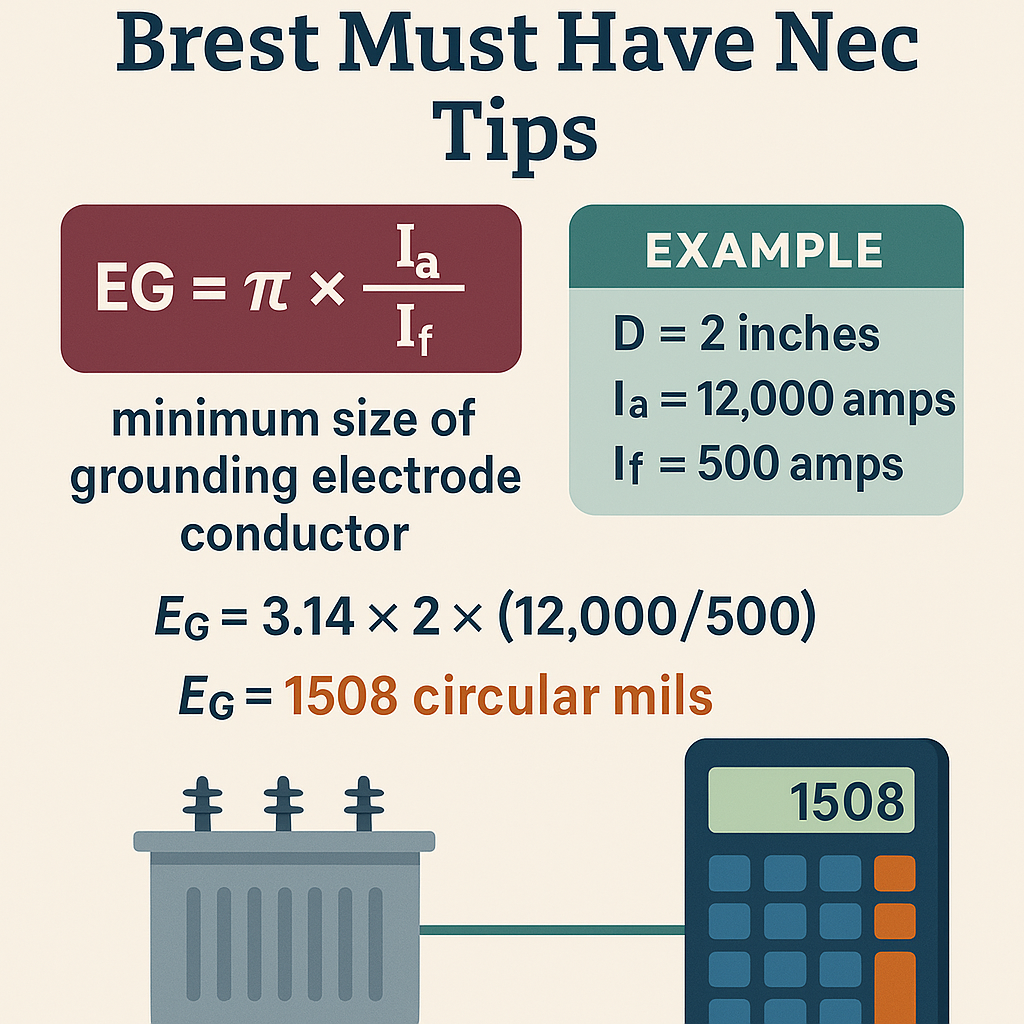
NEC Must-Have Tips and Articles to Consider
- Verify whether the transformer is a separately derived system (NEC 250.30) — bond the neutral at the transformer if it is derived and requires grounding.
- Bonding conductor continuity — ensure bonding jumpers are sized and installed per NEC and manufacturer instructions.
- Use NEC Table 250.102 and Table 250.66 guidance (or the currently adopted equivalents) to size grounding conductors; confirm local amendments and latest code edition.
- Where intentional ground current limiting is used, install neutral grounding resistors or reactors with proper ratings and protective schemes to prevent hazardous voltages and overvoltages (NEC 250.30 and transformer manufacturer guidance).
- Provide visible and accessible bonding jumpers to maintain continuity during maintenance and to allow disconnection only where permitted by NEC.
- For outdoor pad-mounted transformers, bond secondary enclosures and provide a robust grounding electrode system tied to structural grounding and building GES.
Common Parameter Tables for Quick Design Reference
| Transformer kVA | Secondary Voltage (V) | Rated Current I_rated (A) | Typical %Z | Approx Short-Circuit Current I_sc (A) |
|---|---|---|---|---|
| 15 kVA | 240 V (1Ø) | 62.5 | 4.0% | 1562 |
| 75 kVA | 480Y/277 V (3Ø) | 90 | 5.75% | 1565 |
| 150 kVA | 480Y/277 V (3Ø) | 180 | 5.0% | 3600 |
| 500 kVA | 480Y/277 V (3Ø) | 601 | 7.5% | 8013 |
| 2000 kVA | 13.8 kV / 480 V (3Ø) | 2404 | 8.0% | 30050 |
| Soil Type | Resistivity ρ (Ω·m) | Typical Ground Rod Resistance (single 3m rod) (Ω) | Practical Note |
|---|---|---|---|
| Dry rock | >1000 | >150 | Requires multiple rods, conductive backfill, or driven systems. |
| Sand / Gravel | 200–1000 | 20–150 | Rods may need to be spaced and paralleled. |
| Sandy loam | 100–300 | 8–50 | Multiple electrodes often required to achieve <25 Ω. |
| Clay / Moist soil | 20–100 | 3–20 | Favorable for grounding; fewer rods required. |
| Saltwater / Conductive | < 20 | < 1–5 | Excellent electrode performance; watch corrosion. |
Sizing Grounding Conductors — Practical Approach
NEC Table 250.122 specifies equipment grounding conductor sizing based on the rating of the overcurrent protective device protecting the circuit. For transformer neutrals and conductor sizing to electrodes, follow NEC 250.30 and manufacturer directions. Use the following workflow:
- Calculate available fault current at the transformer secondary using the I_sc formula above.
- Decide whether to intentionally limit ground-fault current (neutral grounding resistor) to reduce damage and transient effects.
- Select bonding conductors and GEC sized per NEC tables or by ampacity and mechanical strength, with copper often preferred for its conductivity and corrosion resistance.
- Design the electrode system (rods, Ufer, plate) to get target resistance, often ≤ 25 Ω for general practice, aiming lower (≤ 5 Ω) for sensitive installations.
Typical EGC and GEC Practices
- Minimum conductor size: Many jurisdictions require at least 6 AWG copper bonding conductor for transformer neutrals, but confirm with current NEC tables and local amendments.
- Where parallel conductors are used for GECs, they must be of the same material and mechanically continuous.
- Protect exposed conductors from mechanical damage; bury GECs at uniform depths and encase in conduit where required.
Neutral Grounding Resistors (NGRs) and Reactors
Neutral grounding resistors and reactors control ground-fault current and transient overvoltages. Use of NGRs is common on medium-voltage transformers or when limiting ground-fault current is required to protect equipment and minimize arc flash energy.
Design steps:
- Determine maximum allowable ground-fault current that still allows overcurrent protective device operation where required, or to limit thermal/arc flash energy.
- Compute resistor value using: R_limit = V_phase_to_ground / I_desired_fault.
- Select resistor rated for continuous and peak energy dissipation and provide monitoring/protection for resistor failure.
Example 1 — Small Commercial 75 kVA Transformer Grounding Design
Problem statement: A 75 kVA transformer, 480Y/277 V secondary, has nameplate %Z = 5.75%. The designer wants to determine available short-circuit current at the secondary, and select a neutral grounding resistor to limit line-to-ground fault current to 500 A. Also determine a recommended EGC size to the transformer enclosure.
Step 1 — Compute rated secondary current I_rated (three-phase):
Step 2 — Compute transformer-limited short-circuit current I_sc:
I_sc ≈ I_rated × (100 / Z_percent)
Interpretation: If the neutral were solidly grounded, a ground fault could produce roughly 1.57 kA returning through the ground/EGC path.
Step 3 — Compute desired neutral grounding resistor value to limit ground-fault current to I_desired = 500 A. Use phase-to-neutral voltage V_phase = 277 V.
Therefore, install a neutral grounding resistor of approximately 0.55 Ω rated to dissipate continuous/peak energy during fault clearing. Energy ratings must be checked with available clearing time and prospective short-circuit current.
Step 4 — Select equipment grounding conductor (EGC). With an available prospective fault current without NGR of 1568 A but with NGR limiting to 500 A, size the EGC to handle the 500 A prospective current for the clearing time. Practically, use NEC Table 250.122 to select an EGC sized for the overcurrent protective device protecting the secondary. If the secondary is protected, for example, by a 225 A fuse, Table 250.122 would recommend 2 AWG copper EGC (confirm with current NEC).
Notes: The EGC must be insulated where required, protected against mechanical damage, and the NGR must be provided with monitoring and a means to bypass or short for testing if permitted. Verify local code for maximum allowed neutral grounding resistor operation and proper signage.
Example 2 — Pad-Mounted 500 kVA Transformer with Grounding Electrode Design
Problem statement: A pad-mounted transformer, 13.8 kV delta primary to 480Y/277 V secondary, rated 500 kVA, %Z = 7.5%. The site soil is sandy loam with estimated ρ = 150 Ω·m. Determine the transformer's secondary-rated current, approximate short-circuit current, design a multi-rod electrode system to reach ≤ 25 Ω, and recommend GEC sizing.
Step 1 — Rated secondary current:
Step 2 — Approximate short-circuit current at transformer secondary:
Interpretation: If solidly grounded, prospective fault currents up to approximately 8 kA are possible at the transformer secondary. Grounding electrode and EGC must be sized and installed to carry fault currents long enough for overcurrent devices to operate.
Step 3 — Ground rod sizing and parallel rods estimate.
Estimate single 3 m rod resistance R_rod using approximate soil formula (note: professional soil resistivity testing recommended):
R_rod ≈ (ρ / (2 × π × L)) × (ln(8 × L / d) - 1)
R_rod ≈ (150 / (2 × 3.1416 × 3)) × (7.313 - 1) = (150 / 18.85) × 6.313 ≈ 7.96 × 6.313 ≈ 50.3 Ω
One rod yields ~50 Ω — not acceptable. Parallel rods reduce resistance but spacing must be >= rod length for near-optimal reduction. Use approximate parallel formula:
R_total ≈ R_rod / N_effective
If rods spaced properly, N_effective ~ N × factor (but conservative estimate: R_total ≈ R_rod / N)
To achieve ≤25 Ω, need N ≈ 50.3 / 25 ≈ 2.0 rods — but because rods are imperfect in parallel, use at least 3 rods spaced 3 m apart. Practical selection: install 3–4 rods with supplemental horizontal conductors or use concrete-encased electrode (Ufer) to reach target. If soil resistivity is higher at depth, consider chemical backfill or driven/plate electrodes.
Step 4 — GEC sizing: Bond the transformer neutral to the building GES with a suitably sized grounding electrode conductor. Because the anticipated available fault current is 8 kA, and the transformer secondary overcurrent protective device may be rated 1200 A or lower depending on distribution, use NEC sizing as a minimum and increase conductor cross-section for mechanical robustness. Many engineers choose 2/0 or 4/0 copper for pad-mounted transformer grounding conductors for 500 kVA installations (verify with current NEC and local requirements).
Step 5 — Additional considerations: Corrosion protection on buried conductors, exothermic welds or listed clamps for bonds, and redundant parallel paths for critical installations.
Earthing System Testing and Commissioning
After installation always perform:
- Soil resistivity testing (Wenner or Schlumberger) at multiple depths to refine electrode design.
- Multiple point-to-point resistance testing (fall-of-potential) for constructed electrodes to confirm design goals such as ≤ 25 Ω or project-specific thresholds.
- Continuity testing for all bonding conductors and mechanical integrity verification of connections and clamps.
- Ground-fault simulation and detection verification when NGRs are installed, including alarm and trip behavior.
Protective Device Coordination and Arc Flash Considerations
Designers must coordinate overcurrent protection to clear ground faults promptly. When NGRs reduce ground-fault current, overcurrent protective device coordination must be reviewed because limited currents may not trip instantaneous devices; alternative protective schemes (ground-fault relays, residual current monitors, or zone-selective interlocking) may be required.
Arc flash incident energy depends on available fault current and clearing time. Reducing fault current via neutral grounding resistors lowers prospective incident energy, often reducing PPE categories and improving worker safety — but designers must verify with an arc flash study and coordinate protective relays accordingly.
Installation Best Practices
- Bond all non-current-carrying metal enclosures to the same GES to avoid parallel potentials.
- Keep GECs as straight and short as practical while preventing mechanical damage and allowing maintenance.
- Use listed connectors and exothermic welding for permanent, low-resistance connections.
- Label transformer neutral grounding connections and NGR bypass disconnects clearly for maintenance personnel.
- Avoid routing GECs near sensitive signal or communication cabling without separation or shielding.
Standards, Normative References, and External Authority Links
Consult these authoritative resources for normative text and further guidance:
- NFPA 70, National Electrical Code (NEC) — primary US code for grounding and bonding: https://www.nfpa.org/NEC
- IEEE Std 142, IEEE Green Book — grounding of industrial and commercial power systems (recommended practice): https://ieeexplore.ieee.org/ (search IEEE Std 142)
- IEC 60364 — International Electrotechnical Commission standard for electrical installations (includes earthing): https://www.iec.ch/
- OSHA — Electrical standards and grounding guidance: https://www.osha.gov/
- NEMA — transformer and grounding equipment guidance: https://www.nema.org/
- IEEE Std 143 (formerly 80) — ground-system design for substations and transmission lines (assists in electrode design): https://ieeexplore.ieee.org/
Common Mistakes and How to Avoid Them
- Relying on a single ground rod without soil resistivity data — perform soil testing first and design a rod/plate network accordingly.
- Undersizing GEC/EGC and relying on paint or poor clamps — use listed connectors, exothermic welds, and correct conductor sizes per NEC.
- Failing to consider neutral current paths through structural steel — ensure proper bonding to avoid unexpected circulating currents.
- Not coordinating NGRs with protective relays — ensure ground-fault detection works with limited fault currents.
- Neglecting corrosion — choose materials and coatings compatible with soil chemistry and inspect periodically.
UX Tips for Designers and Field Engineers
- Document each bond and GEC run with labeled photos and drawings for maintenance.
- Include commissioning measurement results in the project closeout package (soil resistivity, rod-to-rod resistances, continuity tests).
- Create a simple calculator sheet (spreadsheet) with the formulas listed here to quickly recompute I_rated, I_sc, and resistor values for different transformer sizes.
- Standardize grounding conductor materials and clamp types across projects to simplify maintenance and spare parts.
Final Technical Recommendations
- Always start with nameplate data (%Z, kVA, voltages) and perform soil resistivity testing before final electrode design.
- Use transformer-limited fault current formulas for initial sizing, but perform full coordination studies for protection and arc flash analysis.
- When limiting ground-fault currents with NGRs, ensure protective equipment is adjusted, and monitoring is provided.
- Bond the transformer's neutral per NEC for separately derived systems and ensure all bonding is continuous and mechanically robust.
- Document and test — verification during commissioning is non-negotiable for safety and compliance.
Further Reading and Tools
- NEC Handbook commentary on Article 250 and 450 — clarifies practical application of code language.
- IEEE Green Book (Std 142) — in-depth theory and practical grounding system design procedures.
- Grounding software tools and spreadsheet calculators — use vendor-supplied calculators and validate results with hand calculations.
- Manufacturer application guides for NGRs and transformers — always follow manufacturer installation instructions for warranty and safety.
Adhering to the NEC, applying correct calculations, and performing thorough testing will deliver a safe, reliable transformer grounding system that minimizes risks and simplifies maintenance. Keep up-to-date with the latest code editions and manufacturer recommendations for the most resilient designs.