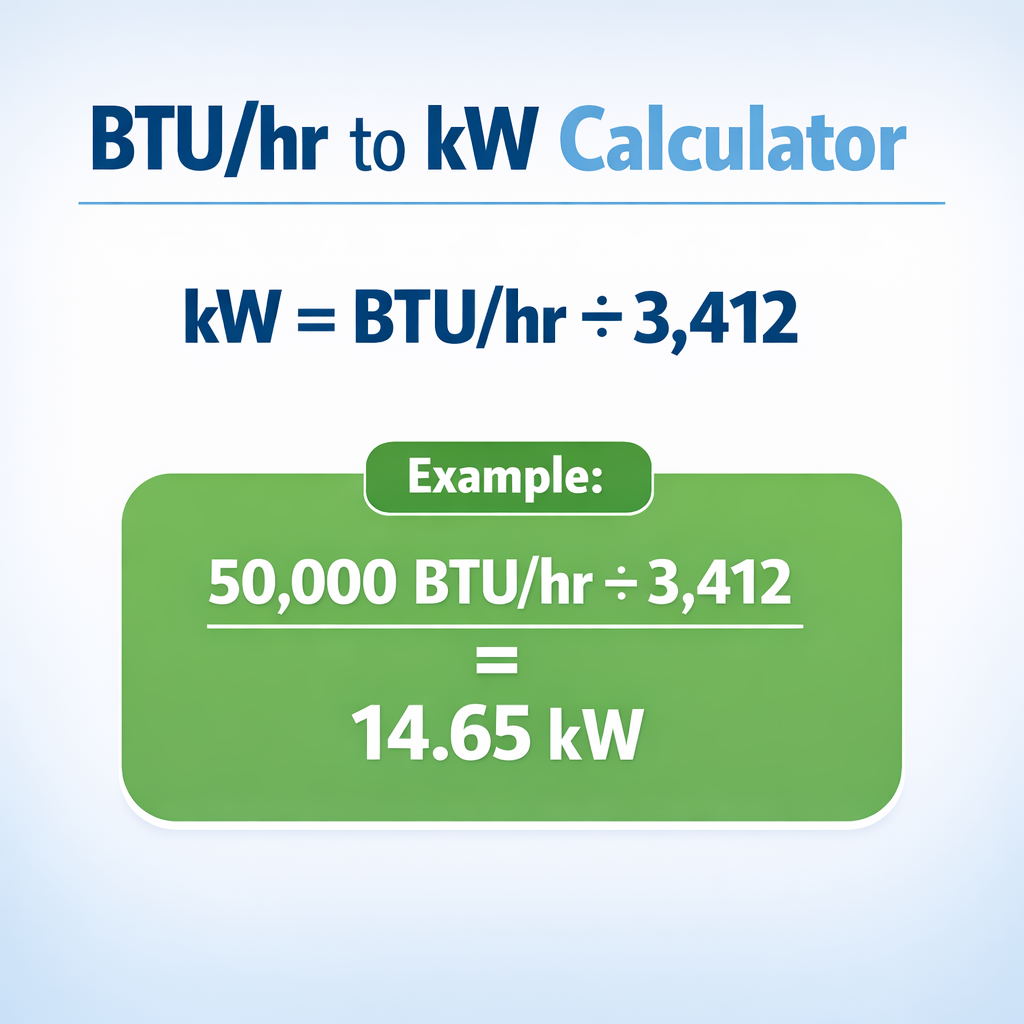
kW = BTU/hr ÷ 3412.14 · kWh = BTU ÷ 3412.14 · 1 ton = 12,000 BTU/hr = 3.517 kW
📊 Quick Reference Table
| BTU/hr | kW | Tons |
|---|---|---|
| 6,000 | 1.758 | 0.5 |
| 12,000 | 3.517 | 1.0 |
| 18,000 | 5.275 | 1.5 |
| 24,000 | 7.034 | 2.0 |
| 36,000 | 10.551 | 3.0 |
| 60,000 | 17.584 | 5.0 |
❓ Quick FAQ
How many kW is 12,000 BTU/hr?
3.517 kW. Formula: 12,000 ÷ 3,412.14 = 3.517 kW (1 ton of cooling).
Is BTU/hr the same as BTU?
No. BTU is energy, BTU/hr is power (energy per hour). kW converts from BTU/hr; kWh converts from BTU.
A BTU/hr to kW calculator is essential for anyone working with heating, cooling, or thermal engineering. In North America, HVAC equipment is rated in BTU/hr, while the rest of the world — and all scientific standards — use kilowatts. The conversion factor is fixed: divide BTU/hr by 3,412.14 to get kW. This page gives you an instant bidirectional calculator that also handles BTU-to-kWh energy conversions, a comprehensive table of standard HVAC ratings, the complete formula with step-by-step math, and six real-world examples covering air conditioners, furnaces, boilers, and chillers.
BTU/hr to kW Conversion Table — Standard HVAC Ratings
The table below converts every standard residential and commercial HVAC rating from 5,000 BTU/hr to 1,000,000 BTU/hr (1 MMBTU/hr) to kilowatts and tons of refrigeration. The conversion factor is 1 kW = 3,412.14 BTU/hr, and 1 ton = 12,000 BTU/hr = 3.517 kW.
| BTU/hr | kW | Tons | Typical HVAC Application |
|---|---|---|---|
| 5,000 | 1.465 | 0.42 | Small window AC unit (single room) |
| 6,000 | 1.758 | 0.50 | Window AC (bedroom) |
| 8,000 | 2.344 | 0.67 | Window AC (medium room) |
| 10,000 | 2.931 | 0.83 | Portable AC / large room |
| 12,000 | 3.517 | 1.00 | 1-ton mini-split / small room |
| 18,000 | 5.275 | 1.50 | 1.5-ton split system |
| 24,000 | 7.034 | 2.00 | 2-ton residential central AC |
| 30,000 | 8.793 | 2.50 | 2.5-ton residential AC |
| 36,000 | 10.551 | 3.00 | 3-ton central AC (avg US home) |
| 48,000 | 14.068 | 4.00 | 4-ton large residential |
| 60,000 | 17.584 | 5.00 | 5-ton large home / small commercial |
| 80,000 | 23.446 | 6.67 | Standard gas furnace |
| 100,000 | 29.307 | 8.33 | Large gas furnace / small boiler |
| 120,000 | 35.169 | 10.00 | 10-ton commercial rooftop unit |
| 200,000 | 58.614 | 16.67 | Commercial boiler |
| 400,000 | 117.228 | 33.33 | Industrial heater / large commercial |
| 1,000,000 | 293.071 | 83.33 | 1 MMBTU/hr — industrial boiler |
How to Convert BTU/hr to kW — Formulas Step by Step
BTU/hr and kW both measure power (rate of energy transfer), but they come from different measurement traditions. The conversion is based on the exact thermochemical definition of the BTU established by NIST.
BTU/hr to kW (power)
Step-by-step example: Convert 12,000 BTU/hr to kW.
1. Start with: 12,000 BTU/hr.
2. Divide by 3,412.14: 12,000 ÷ 3,412.14 = 3.517.
3. Result: 12,000 BTU/hr = 3.517 kW.
This is exactly 1 ton of refrigeration — the most common unit in residential AC sizing.
BTU to kWh (energy)
When dealing with energy (not power), BTU converts to kWh using the same factor. This is because 1 BTU/hr running for 1 hour produces 1 BTU of energy, and 1 kW running for 1 hour produces 1 kWh. The ratio stays the same: 3,412.14 BTU = 1 kWh.
MMBTU/hr to kW
MMBTU means one million BTU. Industrial boilers and large heaters are often rated in MMBTU/hr. To convert, multiply by 293.071 (which is 1,000,000 ÷ 3,412.14). A 10 MMBTU/hr boiler equals 10 × 293.071 = 2,930.71 kW (about 2.93 MW).
Where does 3,412.14 come from?
One BTU is defined as the energy needed to raise 1 pound of water by 1 °F. One kilowatt-hour equals exactly 3,600,000 joules. Since 1 BTU = 1,055.06 joules, dividing 3,600,000 by 1,055.06 gives 3,412.14. This is a fixed physical constant — it never changes regardless of the application. The factor is documented by ASHRAE in their Fundamentals Handbook.
BTU/hr vs kW — Understanding the Units
| Characteristic | BTU/hr | kW (kilowatt) |
|---|---|---|
| What it measures | Thermal power (rate of heat transfer) | Power (any form — thermal, electrical, mechanical) |
| System | Imperial / US customary | SI (International System of Units) |
| Where used | US, Canada — HVAC, furnaces, boilers | Worldwide — all engineering applications |
| Energy equivalent | BTU (energy) ≠ BTU/hr (power) | kWh (energy) ≠ kW (power) |
| 1 unit equals | 0.000293 kW | 3,412.14 BTU/hr |
| Refrigeration ton | 12,000 BTU/hr = 1 ton | 3.517 kW = 1 ton |
| On AC nameplate | Yes (US market) | Yes (international market) |
| On utility bills | Therms (100,000 BTU) for gas | kWh for electricity |
The key confusion: BTU is energy, BTU/hr is power. When someone says “a 12,000 BTU air conditioner,” they actually mean 12,000 BTU/hr — the rate at which it removes heat. The “/hr” is often dropped colloquially, but for accurate conversions you must know whether you are converting power (BTU/hr → kW) or energy (BTU → kWh).
kW to BTU/hr — Inverse Conversion
To reverse the conversion, multiply by 3,412.14:
| kW | BTU/hr | Tons |
|---|---|---|
| 1 | 3,412 | 0.28 |
| 2 | 6,824 | 0.57 |
| 3.517 | 12,000 | 1.00 |
| 5 | 17,061 | 1.42 |
| 7.034 | 24,000 | 2.00 |
| 10 | 34,121 | 2.84 |
| 10.551 | 36,000 | 3.00 |
| 20 | 68,243 | 5.69 |
| 50 | 170,607 | 14.22 |
| 100 | 341,214 | 28.43 |
Use the calculator above — switch the direction to “kW → BTU/hr” for instant results.
Solved Examples — 6 Real-World HVAC Cases
Example 1 — Window Air Conditioner (12,000 BTU/hr)
Data: Standard 1-ton window AC unit rated 12,000 BTU/hr.
Formula: kW = 12,000 ÷ 3,412.14 = 3.517 kW
This is exactly 1 refrigeration ton — the most common single-room AC size in the US. On international spec sheets, the same unit is listed as 3.5 kW cooling capacity.
Example 2 — Central AC System (36,000 BTU/hr)
Data: Residential 3-ton central air conditioning system, 36,000 BTU/hr.
Formula: kW = 36,000 ÷ 3,412.14 = 10.551 kW
The average US home uses a 3-ton system. The 10.5 kW cooling capacity determines the electrical load for the compressor and fan — typically drawing 3–4 kW of electrical input at an EER of 10.
Example 3 — Gas Furnace (80,000 BTU/hr)
Data: Residential gas furnace rated 80,000 BTU/hr input.
Formula: kW = 80,000 ÷ 3,412.14 = 23.446 kW
At 95% AFUE efficiency, the usable heat output is 76,000 BTU/hr = 22.27 kW. This is common for a 2,000–2,500 sq ft home in a cold climate.
Example 4 — Mini-Split Heat Pump (18,000 BTU/hr)
Data: Ductless mini-split rated 18,000 BTU/hr cooling.
Formula: kW = 18,000 ÷ 3,412.14 = 5.275 kW
A 1.5-ton mini-split. International manufacturers like Daikin, Mitsubishi, and LG list this same unit as “5.3 kW” on their global datasheets. Electrical input is about 1.5–1.8 kW at SEER 16.
Example 5 — Commercial Rooftop Unit (120,000 BTU/hr)
Data: 10-ton commercial RTU rated 120,000 BTU/hr.
Formula: kW = 120,000 ÷ 3,412.14 = 35.169 kW
A 10-ton rooftop unit is standard for small office buildings and retail spaces. The 35 kW cooling capacity is served by a compressor drawing about 10–12 kW of electrical power (EER ≈ 10–12).
Example 6 — Industrial Boiler (1,000,000 BTU/hr = 1 MMBTU/hr)
Data: Industrial steam boiler rated 1 MMBTU/hr.
Formula: kW = 1,000,000 ÷ 3,412.14 = 293.071 kW
Approximately 293 kW or 0.293 MW of thermal power. Industrial boilers are often rated in MMBTU/hr in the US, while international specs use MW thermal (MWt). A 10 MMBTU/hr boiler = 2.93 MW.
BTU/hr to kW in HVAC Systems — Practical Context
The BTU/hr-to-kW conversion is most important in HVAC because North American equipment uses BTU/hr while international standards, energy regulations, and scientific literature use kW. Here are the key applications:
Air conditioner sizing
US air conditioners are rated in BTU/hr or tons. The rest of the world uses kW. A “24,000 BTU” mini-split is the same as a “7 kW” unit on international datasheets. When comparing equipment across manufacturers or importing from international suppliers, you need this conversion to ensure you are comparing equivalent capacities.
Energy efficiency ratings
The US uses EER (BTU/hr per watt) and SEER (seasonal BTU/hr per watt), while the international standard is COP (kW output ÷ kW input). To compare across systems: COP = EER ÷ 3.412. An EER-10 unit has a COP of 2.93 — for every 1 kW of electricity consumed, it delivers 2.93 kW of cooling.
Furnace and boiler specifications
Gas furnaces in the US are rated by BTU/hr input. In Europe, the same equipment shows kW output. An 80,000 BTU/hr furnace at 95% efficiency delivers 76,000 BTU/hr = 22.27 kW of usable heat — which is how a European manufacturer would spec the same furnace.
Heat load calculations
Manual J (ACCA) calculates residential cooling loads in BTU/hr, while ISO 52016 uses kW. When transferring heat load calculations between US and international engineering teams, the ÷ 3,412.14 conversion is essential. A 48,000 BTU/hr cooling load equals 14.07 kW — both numbers represent the same thermal requirement.
Quick Equivalences — BTU/hr to kW
Direct answers for the most searched BTU-to-kW conversions. All use the factor 1 kW = 3,412.14 BTU/hr.
12,000 BTU/hr to kW
3.517 kW
Exactly 1 ton of refrigeration. The most common window AC and mini-split rating.
24,000 BTU/hr to kW
7.034 kW
2 tons. Standard residential split system for a medium-sized home.
36,000 BTU/hr to kW
10.551 kW
3 tons. Average US home central AC size.
48,000 BTU/hr to kW
14.068 kW
4 tons. Large residential or small commercial system.
60,000 BTU/hr to kW
17.584 kW
5 tons. Large home or small office building rooftop unit.
100,000 BTU/hr to kW
29.307 kW
Large gas furnace or small commercial boiler. Common input rating for heating systems.
1 MMBTU/hr to kW
293.071 kW
Industrial scale. 1 million BTU/hr = 293 kW = 0.293 MW thermal.
12,000 BTU to kWh
3.517 kWh
Energy equivalent: running a 1-ton AC for 1 hour consumes 12,000 BTU = 3.517 kWh of thermal energy.
1 kW to BTU/hr
3,412.14 BTU/hr
The base conversion factor. 1 kilowatt of thermal power equals 3,412.14 BTU per hour.
5,000 BTU/hr to kW
1.465 kW
Small window AC for a bedroom or dorm room. About 0.42 tons.
Frequently Asked Questions
How do you convert BTU/hr to kW?
Divide by 3,412.14. Formula: kW = BTU/hr ÷ 3,412.14. Example: 12,000 BTU/hr ÷ 3,412.14 = 3.517 kW. This conversion factor is a fixed physical constant.
How many kW is 12,000 BTU?
3.517 kW. This equals exactly 1 ton of refrigeration — the most common AC unit size. When manufacturers say “12,000 BTU,” they almost always mean 12,000 BTU/hr (power), which converts to 3.517 kW.
What is the conversion factor from BTU/hr to kW?
1 kW = 3,412.14 BTU/hr (or 1 BTU/hr = 0.000293071 kW). To convert BTU/hr to kW, divide by 3,412.14. To convert kW to BTU/hr, multiply by 3,412.14.
Is BTU the same as BTU/hr?
No. BTU is a unit of energy (like kWh). BTU/hr is a unit of power (like kW). “12,000 BTU/hr” means the system transfers 12,000 BTU of energy every hour. When AC units are colloquially called “12,000 BTU,” the “/hr” is implied but technically required.
How do you convert BTU to kWh?
Divide by 3,412.14 — the same factor. kWh = BTU ÷ 3,412.14. Example: 100,000 BTU = 100,000 ÷ 3,412.14 = 29.31 kWh. Use the calculator above in “BTU → kWh” mode.
How many BTU/hr is 1 kW?
3,412.14 BTU/hr. This means a 1 kW electric heater produces 3,412 BTU of heat per hour. All electric heaters convert electricity to heat at nearly 100% efficiency, so 1 kW input = 3,412 BTU/hr output.
How many kW is a 3-ton AC?
10.551 kW of cooling capacity. One ton = 12,000 BTU/hr = 3.517 kW, so 3 tons = 36,000 BTU/hr = 10.551 kW. The electrical input to the compressor is much less — typically 3–4 kW for a 3-ton unit (COP ≈ 3).
What is 1 MMBTU/hr in kW?
293.071 kW (approximately 0.293 MW). MMBTU means one million BTU. Industrial boilers and large heating plants commonly use this unit. Formula: 1,000,000 ÷ 3,412.14 = 293.071 kW.
How do I convert kW to BTU/hr?
Multiply by 3,412.14. Formula: BTU/hr = kW × 3,412.14. Example: 5 kW × 3,412.14 = 17,061 BTU/hr. Use the calculator above in “kW → BTU/hr” mode for instant results.
What is the difference between EER and COP?
EER uses BTU/hr per watt; COP uses kW per kW. To convert: COP = EER ÷ 3.412. An EER-12 unit has COP = 3.52, meaning it delivers 3.52 kW of cooling for every 1 kW of electrical input.
How many BTU/hr does a 5 kW heater produce?
17,061 BTU/hr. Calculation: 5 × 3,412.14 = 17,060.7 BTU/hr. Electric resistance heaters convert 100% of input power to heat, so the conversion is exact.
How do I convert BTU/hr to tons?
Divide by 12,000. Formula: Tons = BTU/hr ÷ 12,000. Example: 60,000 BTU/hr ÷ 12,000 = 5 tons. One ton of refrigeration was historically defined as the cooling produced by melting one short ton of ice in 24 hours.
Related Conversions
Explore more electrical and thermal conversion calculators on our site:
- Amp to kW Calculator — convert amperes to kilowatts for electrical loads.
- Amps to Watts Calculator — convert current to watts with formula and table.
- Appliance Power Calculator — calculate energy use and cost for any appliance.
- Generator Load Calculator — size your standby generator from running and starting watts.
- Air Density Calculator — calculate air density by altitude and temperature for HVAC airflow design.