VLN = VLL ÷ √3 · √3 ≈ 1.732 · Example: 480 V ÷ 1.732 = 277 V📊 Standard 3-Phase Voltage Pairs
| VLL | VLN | Region |
|---|---|---|
| 208 | 120 | US commercial |
| 380 | 220 | EU / Middle East |
| 400 | 231 | IEC standard (EU) |
| 415 | 240 | UK / Australia |
| 440 | 254 | India |
| 480 | 277 | US industrial |
| 600 | 347 | Canada industrial |
❓ Quick FAQ
What is 480 V line-to-neutral?
277 V. Formula: 480 ÷ √3 = 480 ÷ 1.732 = 277 V.
Why divide by √3?
In a balanced 3-phase wye system, each phase is offset 120°. The √3 factor is the geometric result of that angular relationship.
A line-to-line to line-to-neutral voltage calculator is one of the most frequently needed tools in three-phase electrical work. Every time you connect a single-phase load to a three-phase panel, size a neutral conductor, or verify voltage at a receptacle fed from a three-phase source, you need this conversion. The formula is straightforward: divide the line-to-line voltage (VLL) by √3 (1.732) to get the line-to-neutral voltage (VLN). This page gives you an instant bidirectional calculator with presets for every standard voltage worldwide, the complete derivation, a reference table, and six real-world examples from panel boards to international installations.
Line-to-Line to Line-to-Neutral Conversion Table — All Standard Voltages
The table below lists every standard three-phase voltage system in use worldwide, with the corresponding line-to-neutral voltage. All values are for balanced wye (star) configurations. The formula is VLN = VLL ÷ √3. These voltages are standardized in IEC 60038.
| VLL (Line-to-Line) | VLN (Line-to-Neutral) | System | Where Used |
|---|---|---|---|
| 120/208 V | 120 V | 3Φ 4-wire wye | US / Canada commercial |
| 220/380 V | 220 V | 3Φ 4-wire wye | EU, Middle East, South America |
| 230/400 V | 230 V | 3Φ 4-wire wye (IEC) | EU standard (nominal) |
| 240/415 V | 240 V | 3Φ 4-wire wye | UK, Australia, NZ |
| 254/440 V | 254 V | 3Φ 4-wire wye | India (older standard) |
| 277/480 V | 277 V | 3Φ 4-wire wye | US industrial / commercial |
| 347/600 V | 347 V | 3Φ 4-wire wye | Canada industrial |
| 2,400 V | 1,386 V | Medium voltage distribution | US utility feeders |
| 4,160 V | 2,402 V | Medium voltage distribution | US/Canada industrial |
| 12,470 V | 7,200 V | Primary distribution | US utility pole lines |
| 13,200 V | 7,621 V | Primary distribution | Various utilities |
| 13,800 V | 7,967 V | Primary distribution | US / Latin America |
| 34,500 V | 19,920 V | Sub-transmission | Rural distribution |
How to Convert VLL to VLN — Formula Step by Step
The relationship between line-to-line and line-to-neutral voltage comes from the geometry of a balanced three-phase wye (star) system. In a wye configuration, the neutral point is the center of the system, and each phase voltage (VLN) is separated by 120°. The line-to-line voltage is the vector difference between two phase voltages.
Where √3 ≈ 1.7320508. This factor is exact — it comes from the trigonometric relationship cos(30°) = √3/2, which describes the 120° phase separation in a balanced three-phase system.
Step-by-step example: Convert 480 V line-to-line to line-to-neutral.
1. Start with VLL = 480 V.
2. Divide by √3: 480 ÷ 1.732 = 277.13 V.
3. Result: 480 VLL = 277 VLN.
This is why 480/277 V panels have 277 V lighting circuits — each lighting branch is connected between one phase and neutral.
Why √3 and not 3?
A common mistake is dividing by 3 instead of √3. The line-to-line voltage is not three times the phase voltage — it is √3 times, because the three phase voltages are 120° apart, not 0°. If they were all in phase (0° apart), VLL would equal zero (the phases would cancel). The 120° offset creates the √3 factor through vector addition. Per IEEE power systems standards, this relationship holds for any balanced three-phase wye system regardless of frequency (50 Hz or 60 Hz).
What about VLL and VLN abbreviations?
You’ll see different abbreviations depending on the region and context: VLL (line-to-line), VL-L, VPP (phase-to-phase), Vff (fase-fase in Spanish). For line-to-neutral: VLN, VL-N, VPN (phase-to-neutral), Vfn. They all mean the same thing — the voltage measured between two lines or between one line and the neutral point.
Line-to-Line vs Line-to-Neutral — Key Differences
| Characteristic | Line-to-Line (VLL) | Line-to-Neutral (VLN) |
|---|---|---|
| Measured between | Two phase conductors (L1-L2, L2-L3, L1-L3) | One phase conductor and neutral (L1-N) |
| Relationship | VLL = VLN × √3 | VLN = VLL ÷ √3 |
| Used to power | 3-phase motors, heaters, welders | Single-phase loads: lights, outlets, PCs |
| Typical values | 208, 380, 400, 415, 440, 480, 600 V | 120, 220, 230, 240, 254, 277, 347 V |
| Neutral needed? | No — two hot conductors only | Yes — one hot + neutral |
| Where measured | Motor terminals, 3Φ disconnect switch | Outlet, lighting panel, single-Φ breaker |
| Applies to | Wye and delta systems | Wye (star) systems only* |
*Delta systems do not have a center neutral point, so line-to-neutral voltage doesn’t exist in a standard delta configuration. The exception is a corner-grounded delta or a “high-leg” delta (used in some US 240/120 V systems), which creates an unusual voltage relationship — not the standard √3 factor.
VLN to VLL — Inverse Conversion
To convert from line-to-neutral to line-to-line, multiply by √3:
| VLN | VLL | System |
|---|---|---|
| 120 V | 208 V | US/Canada commercial |
| 127 V | 220 V | Mexico, Brazil |
| 220 V | 381 V | EU/Asia (380 V nominal) |
| 230 V | 398 V | IEC standard (400 V nominal) |
| 240 V | 416 V | UK/Australia (415 V nominal) |
| 254 V | 440 V | India |
| 277 V | 480 V | US industrial |
| 347 V | 601 V | Canada industrial (600 V nominal) |
Use the calculator above — switch the direction to “VLN → VLL” for instant results.
Solved Examples — 6 Real-World Cases
Example 1 — US Commercial Panel: 208 V to 120 V
Data: 208/120 V 3-phase 4-wire wye panel, VLL = 208 V.
Formula: VLN = 208 ÷ 1.732 = 120.09 V
This is the most common US commercial system. Each single-phase outlet delivers 120 V (line-to-neutral). Three-phase equipment like HVAC condensers gets 208 V (line-to-line). Note that 208 V is NOT the same as 240 V — motors and heaters rated for 240 V run at reduced power on a 208 V system.
Example 2 — US Industrial: 480 V to 277 V
Data: 480/277 V 3-phase 4-wire wye panel, VLL = 480 V.
Formula: VLN = 480 ÷ 1.732 = 277.13 V
The workhorse of US commercial and industrial buildings. 277 V (L-N) powers fluorescent and LED lighting fixtures in commercial spaces. 480 V (L-L) feeds motors, chillers, and large HVAC equipment. NEC Article 210.6 restricts 277 V circuits to luminaires in commercial occupancies — not residential.
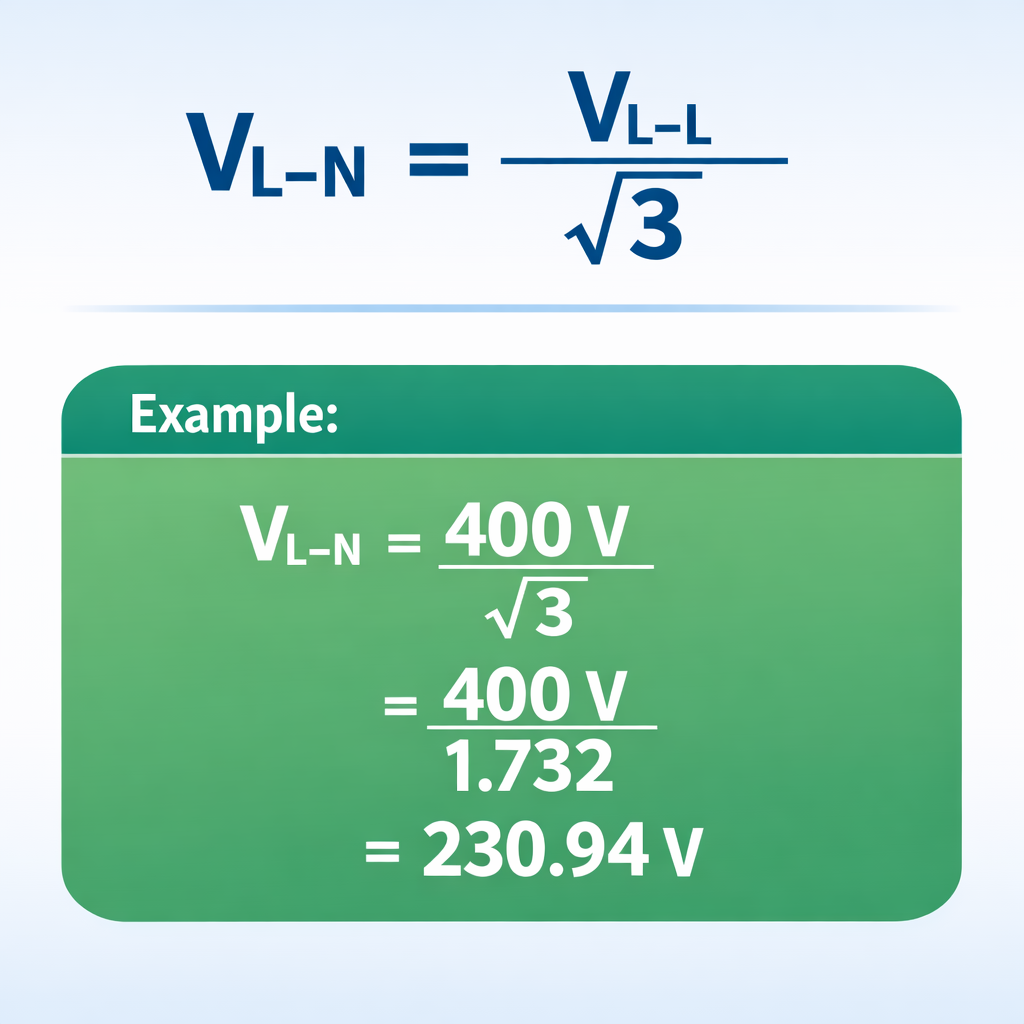
Example 3 — European System: 400 V to 230 V
Data: IEC standard 400 V 3-phase system, VLL = 400 V.
Formula: VLN = 400 ÷ 1.732 = 230.94 V
The nominal IEC voltage for Europe. Each household outlet delivers 230 V from one phase and neutral. Small businesses share the same transformer — the three phases are distributed across floors or sections of the building to balance the load.
Example 4 — UK/Australia: 415 V to 240 V
Data: UK/Australian 3-phase supply, VLL = 415 V.
Formula: VLN = 415 ÷ 1.732 = 239.60 V
Nominal 240 V single-phase at outlets. The 415 V line-to-line supply feeds three-phase equipment like commercial ovens, large pumps, and workshop machinery. Both countries share this voltage standard inherited from the old BS 7671 wiring regulations.
Example 5 — Canada Industrial: 600 V to 347 V
Data: Canadian industrial panel, VLL = 600 V.
Formula: VLN = 600 ÷ 1.732 = 346.41 V
600/347 V is unique to Canada and some northern US facilities. 347 V lighting circuits are standard in Canadian commercial buildings. Arc flash energy is higher at 600 V — PPE requirements per CSA Z462 are more stringent than for 480 V US systems.
Example 6 — Medium Voltage Distribution: 12,470 V to 7,200 V
Data: US utility primary distribution line, VLL = 12,470 V.
Formula: VLN = 12,470 ÷ 1.732 = 7,200.46 V
On pole-mounted distribution transformers, each single-phase transformer is connected line-to-neutral at 7,200 V primary. It steps down to 240/120 V for residential service. The 12.47 kV / 7.2 kV system is the most common primary distribution voltage in the US.
3-Phase Voltage Systems by Country
The √3 relationship between VLL and VLN is universal — but the actual voltage values differ by country. Here is a practical reference for engineers working on international projects:
North America
The US and Canada use multiple voltage levels. Residential service is 120/240 V split-phase (not three-phase). Commercial buildings use 208/120 V three-phase wye for offices and 480/277 V wye for industrial loads. Canada adds the 600/347 V level unique to Canadian commercial and industrial facilities. These standards are defined in ANSI C84.1 (US) and CSA CAN3-C235 (Canada).
Europe and IEC countries
The IEC standard voltage is 400/230 V three-phase wye (50 Hz). In practice, many older installations still operate at 380/220 V. The allowed tolerance per EN 50160 is ±10%, so actual measured voltages between 207 V and 253 V line-to-neutral are within spec. The UK and Australia use 415/240 V — slightly higher than the IEC standard but within the ±10% band.
Asia, Middle East, and developing markets
India uses 440/254 V (50 Hz), though many newer installations are migrating to the IEC 400/230 V standard. Japan uses 200/100 V (50 or 60 Hz depending on region — unique dual-frequency country). The Middle East generally follows the IEC 400/230 V standard, with some older installations at 380/220 V.
Quick Equivalences — VLL to VLN
Direct answers for the most searched voltage conversion queries.
208 V Line-to-Neutral
120 V (VLN)
US/Canada commercial standard. Each outlet delivers 120 V; 3-phase loads get 208 V.
480 V Line-to-Neutral
277 V (VLN)
US industrial standard. 277 V powers commercial lighting; 480 V feeds motors.
400 V Line-to-Neutral
231 V (VLN)
IEC/EU standard. Each household gets 230 V from one phase of the 400 V supply.
415 V Line-to-Neutral
240 V (VLN)
UK/Australia standard. 240 V at outlets; 415 V for commercial 3-phase equipment.
380 V Line-to-Neutral
220 V (VLN)
Older EU / Middle East / South America standard. Being replaced by 400/230 V.
440 V Line-to-Neutral
254 V (VLN)
India standard. Higher voltage than IEC nominal by about 10%.
600 V Line-to-Neutral
347 V (VLN)
Canada industrial. 347 V lighting is standard in Canadian commercial buildings.
VLL Full Form in Electrical
Voltage Line-to-Line
Also written as V(L-L), VPP (phase-to-phase), or Vff. Measured between any two phase conductors.
VLN Full Form in Electrical
Voltage Line-to-Neutral
Also written as V(L-N), VPN (phase-to-neutral), or Vfn. Measured between one phase and the neutral.
3-Phase to Single-Phase Voltage
VLN = VLL ÷ √3
To get the single-phase voltage from a 3-phase wye supply, divide the line-to-line voltage by 1.732.
Frequently Asked Questions
How do you convert line-to-line voltage to line-to-neutral?
Divide by √3 (1.732). Formula: VLN = VLL ÷ 1.732. Example: 480 V ÷ 1.732 = 277 V. This applies to any balanced three-phase wye (star) system.
What is 480 V line-to-neutral?
277 V. Calculation: 480 ÷ 1.732 = 277 V. In 480/277 V US systems, 277 V circuits power commercial lighting and 480 V feeds three-phase motors and HVAC equipment.
What is 208 V line-to-neutral?
120 V. Calculation: 208 ÷ 1.732 = 120 V. This is the standard US commercial voltage — 120 V outlets from line-to-neutral, 208 V for three-phase loads.
What does VLL mean in electrical?
VLL stands for Voltage Line-to-Line — the voltage measured between any two phase conductors in a three-phase system. Also called phase-to-phase voltage (VPP). Common values: 208 V, 380 V, 400 V, 415 V, 480 V, 600 V.
What does VLN mean in electrical?
VLN stands for Voltage Line-to-Neutral — the voltage measured between one phase conductor and the neutral point. Also called phase-to-neutral voltage (VPN). Common values: 120 V, 220 V, 230 V, 240 V, 277 V, 347 V.
Why do you divide by √3 and not by 3?
Because the three phase voltages are 120° apart, not in phase. The vector sum of two 120°-offset voltages gives a magnitude of √3 times the individual phase voltage. If you divide by 3 instead of √3 (1.732), your result will be 42% too low — a dangerous sizing error.
Does this formula work for delta systems?
No. Delta (triangle) configurations do not have a neutral point, so line-to-neutral voltage doesn’t exist in a standard delta system. The VLL ÷ √3 formula applies only to wye (star) systems. Some special configurations (high-leg delta, corner-grounded delta) have unusual voltage relationships that do not follow the √3 rule.
What is the line-to-neutral voltage for a 400 V system?
231 V. Calculation: 400 ÷ 1.732 = 230.94 V ≈ 231 V. The nominal IEC standard is 230 V. The slight difference (under 1%) is within normal tolerance per EN 50160 (±10%).
How do I convert line-to-neutral back to line-to-line?
Multiply by √3: VLL = VLN × 1.732. Example: 277 V × 1.732 = 480 V. Use the calculator above in “VLN → VLL” mode.
What is 3-phase to single-phase voltage?
In a wye system, the single-phase voltage (phase-to-neutral) is the three-phase line voltage divided by √3. For a 208 V three-phase supply, single-phase is 120 V. For 480 V three-phase, single-phase is 277 V. This is how buildings provide both three-phase and single-phase power from a single transformer.
Is 277 V dangerous?
Yes — all voltages above approximately 50 V AC are potentially lethal. 277 V is classified as a hazardous voltage per NFPA 70E and OSHA. Working on 277 V circuits requires proper lockout/tagout procedures, arc-rated PPE, and qualified electrician training. The arc flash energy at 277/480 V can be significant.
What is the neutral voltage in a balanced 3-phase system?
Zero volts relative to ground in a balanced system. When all three phases carry equal current, the neutral current cancels to zero. In practice, some imbalance always exists, causing a small neutral-to-ground voltage (typically under 2 V). Excessive neutral-to-ground voltage (>5 V) indicates a wiring problem or severe load imbalance.
Related Conversions
Explore more electrical conversion calculators on our site:
- Amp to kW Calculator — convert amperes to kilowatts with voltage and PF.
- Amps to Watts Calculator — convert current to watts with formula and table.
- Balanced and Unbalanced Load Calculation — three-phase load distribution guide.
- 3-Phase Panel Load Calculator — avoid neutral overloads with 120 V unbalance.
- Transformer kVA Sizing Calculator — size transformers from demand load.
- AWG to mm² Equivalences — wire gauge cross-reference for conductor sizing.