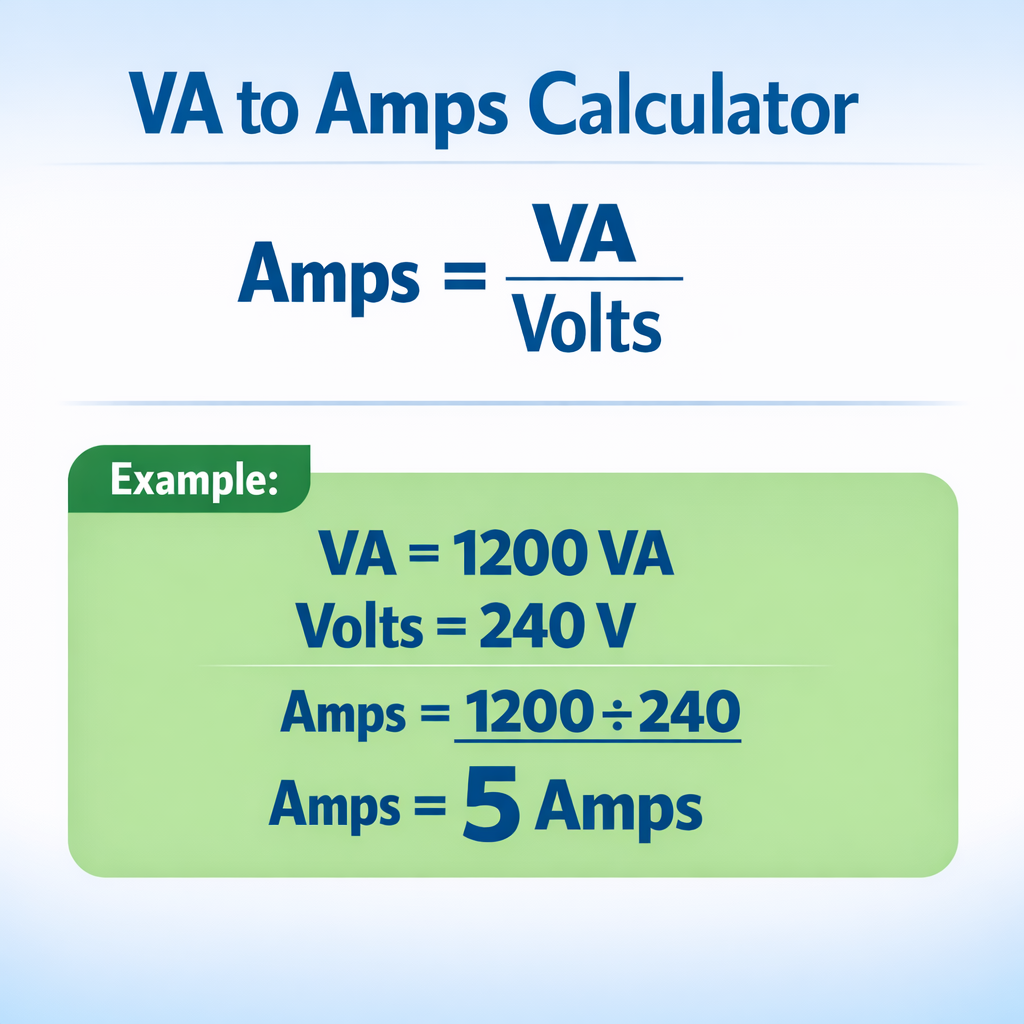
A = VA ÷ V · Example: 500 VA ÷ 120 V = 4.17 A
Single-phase: use the voltage across the load or transformer winding. Three-phase: use line-to-line voltage and the total three-phase VA rating.
📊 Quick Reference Table (single-phase)
| VA | A @120 V | A @220 V | A @240 V |
|---|---|---|---|
| 100 | 0.83 | 0.45 | 0.42 |
| 200 | 1.67 | 0.91 | 0.83 |
| 300 | 2.50 | 1.36 | 1.25 |
| 500 | 4.17 | 2.27 | 2.08 |
| 1000 | 8.33 | 4.55 | 4.17 |
| 2000 | 16.67 | 9.09 | 8.33 |
❓ Quick FAQ
How many amps is 500 VA at 120 V?
4.17 A. Formula: 500 ÷ 120 = 4.17 A.
Do I need power factor?
No. VA is apparent power, so you do not multiply or divide it by power factor. Use A = VA ÷ V for single-phase or A = VA ÷ (√3 × V) for balanced three-phase.
100 VA to amps: 24 V secondary or 120 V primary?
The same transformer VA rating gives a different current on each side. For a single-phase control transformer, divide VA by the voltage of the winding you are checking.
| Rating | 24 V secondary | 120 V side | 230 V side |
|---|---|---|---|
| 100 VA | 4.17 A | 0.83 A | 0.43 A |
| 450 VA | 18.75 A | 3.75 A | 1.96 A |
| 500 VA | 20.83 A | 4.17 A | 2.17 A |
| 1000 VA | 41.67 A | 8.33 A | 4.35 A |
Try 100 VA at 24 V: enter 100, choose single-phase, select 24 V. The result is 4.17 A. At 120 V, the ideal equivalent is 0.83 A. Actual primary input includes transformer losses; check the manufacturer’s input rating.
These values do not determine fuse size or starting-current capacity. For larger equipment use kVA to amps. For balanced industrial loads use the three-phase current calculator.
This VA to amps calculator converts apparent power to current using the voltage and phase connection. Use A = VA ÷ V for single-phase, or A = VA ÷ (√3 × V) for balanced three-phase with line-to-line voltage. For a UPS, an output VA rating gives output current at the stated load; it does not establish maximum mains input, battery runtime or branch-circuit size.
VA to Amps Conversion Table — Standard Equipment Ratings
Use the voltage across the load or winding. These are single-phase current conversions from 25 VA to 10000 VA, rounded to two decimals. For a UPS output rating, read them as output current; actual input includes conversion losses and battery charging.
| VA | A at 24 V | A at 48 V | A at 120 V | A at 220 V | A at 230 V | A at 240 V |
|---|---|---|---|---|---|---|
| 25 | 1.04 | 0.52 | 0.21 | 0.11 | 0.11 | 0.10 |
| 40 | 1.67 | 0.83 | 0.33 | 0.18 | 0.17 | 0.17 |
| 50 | 2.08 | 1.04 | 0.42 | 0.23 | 0.22 | 0.21 |
| 100 | 4.17 | 2.08 | 0.83 | 0.45 | 0.43 | 0.42 |
| 150 | 6.25 | 3.13 | 1.25 | 0.68 | 0.65 | 0.63 |
| 200 | 8.33 | 4.17 | 1.67 | 0.91 | 0.87 | 0.83 |
| 300 | 12.50 | 6.25 | 2.50 | 1.36 | 1.30 | 1.25 |
| 450 | 18.75 | 9.38 | 3.75 | 2.05 | 1.96 | 1.88 |
| 500 | 20.83 | 10.42 | 4.17 | 2.27 | 2.17 | 2.08 |
| 600 | 25.00 | 12.50 | 5.00 | 2.73 | 2.61 | 2.50 |
| 750 | 31.25 | 15.63 | 6.25 | 3.41 | 3.26 | 3.13 |
| 1000 | 41.67 | 20.83 | 8.33 | 4.55 | 4.35 | 4.17 |
| 1500 | 62.50 | 31.25 | 12.50 | 6.82 | 6.52 | 6.25 |
| 2000 | 83.33 | 41.67 | 16.67 | 9.09 | 8.70 | 8.33 |
| 3000 | 125.00 | 62.50 | 25.00 | 13.64 | 13.04 | 12.50 |
| 5000 | 208.33 | 104.17 | 41.67 | 22.73 | 21.74 | 20.83 |
| 10000 | 416.67 | 208.33 | 83.33 | 45.45 | 43.48 | 41.67 |
450 VA to amps: 3.75 A at 120 V, 2.05 A at 220 V, or 1.96 A at 230 V. The voltage is part of the answer.
How to Convert VA to Amps — Formula Step by Step
VA (volt-amperes) is the product of voltage and current: VA = V × A. To find the current, simply reverse the multiplication — divide VA by voltage. The formula differs slightly for three-phase because the effective voltage includes the √3 factor.
Single-Phase
At a 500 VA single-phase output load and 120 V output, current is 500 ÷ 120 = 4.17 A. This calculation uses output VA and output voltage. Maximum mains input is a separate UPS specification.
Three-Phase
For a balanced three-phase side, use line-to-line voltage and total VA. A 10000 VA rating at 480 V corresponds to 10000 ÷ (√3 × 480) = 12.03 A per line. The winding or side being checked must match the voltage.
Why no power factor in this formula?
VA already expresses apparent power at the measurement point, so no extra PF adjustment is needed. If the starting value is watts instead, use A = W ÷ (V × PF) for single-phase or A = W ÷ (√3 × V × PF) for balanced three-phase.
VA vs Amps — Understanding the Units
VA and amps are related but measure different things. Here is a side-by-side comparison:
| Characteristic | VA (Volt-Ampere) | Ampere (A) |
|---|---|---|
| What it measures | Apparent power (V × A product) | Electric current (electron flow rate) |
| Depends on voltage? | Yes — VA = V × A | Current is a separate quantity; its value depends on the circuit |
| Where you see it | UPS ratings, transformer nameplates | Breakers, fuses, wire ratings |
| Includes reactive power? | Yes — VA = total current × voltage | Yes — amps includes reactive current |
| Used to size | Transformers, UPS, generators | Wires, breakers, fuses, connectors |
| SI unit? | Not a base unit (derived: V × A) | Yes — one of 7 SI base units |
A 500 VA single-phase load corresponds to 4.17 A at 120 V or 2.27 A at 220 V. These compare equal apparent-power loads at different voltages; they do not show that one UPS can be connected to either supply. Use the equipment’s permitted voltage and input/output ratings.
Amps to VA — Inverse Conversion
To reverse the conversion, multiply instead of dividing:
| Amps | VA @ 120 V | VA @ 220 V | VA @ 240 V |
|---|---|---|---|
| 1 | 120 | 220 | 240 |
| 2 | 240 | 440 | 480 |
| 5 | 600 | 1,100 | 1,200 |
| 10 | 1,200 | 2,200 | 2,400 |
| 15 | 1,800 | 3,300 | 3,600 |
| 20 | 2,400 | 4,400 | 4,800 |
| 30 | 3,600 | 6,600 | 7,200 |
| 50 | 6,000 | 11,000 | 12,000 |
For the full inverse tool, check our Amperes to VA Calculator which converts directly from current and voltage to VA.
Solved Examples — 6 Real-World Cases
Example 1 — 100 VA Control Transformer (120 V / 24 V)
Data: A 100 VA single-phase control transformer has a 120 V side and a 24 V output.
Calculation: 100 ÷ 24 = 4.17 A on the 24 V output; 100 ÷ 120 = 0.83 A as the ideal primary equivalent.
Actual input includes excitation and losses. These values do not select a fuse or establish contactor inrush capability.
Example 2 — 300 VA Desktop UPS (120 V Output)
Data: 300 VA output apparent power at 120 V single-phase.
Calculation: 300 ÷ 120 = 2.50 A output.
Use the manufacturer’s maximum input-current rating for the supply circuit. Runtime also needs battery and load data; it cannot be inferred from 300 VA alone.
Example 3 — 500 VA Home UPS (220 V Output)
Data: 500 VA output apparent power at 220 V single-phase.
Calculation: 500 ÷ 220 = 2.27 A output.
Input current depends on input voltage, losses, input PF and charging. The output conversion does not confirm that an existing circuit can supply the UPS.
Example 4 — 200 VA Transformer (240 V / 120 V)
Data: A 200 VA single-phase transformer is rated 240 V primary and 120 V secondary.
Calculation: 200 ÷ 240 = 0.83 A ideal primary equivalent; 200 ÷ 120 = 1.67 A rated secondary current.
Use each winding’s voltage. Actual primary input differs because of losses and excitation.
Example 5 — 2000 VA Server UPS (120 V Output)
Data: 2000 VA output apparent power at 120 V single-phase.
Calculation: 2000 ÷ 120 = 16.67 A output.
This does not select a 20 A or 30 A input circuit. Consult the UPS input nameplate, plug arrangement, maximum charging demand and manufacturer installation instructions.
Example 6 — 5000 VA Three-Phase Transformer (480 V)
Data: 5000 VA total rating on a balanced 480 V three-phase side.
Calculation: 5000 ÷ (√3 × 480) = 6.01 A per line.
Use line-to-line voltage. Rated current, overcurrent protection and conductor ampacity are separate checks.
Practical Applications — When and Where You Need VA to Amps
UPS input and output current
An output VA rating and output voltage describe the output-current capability at that rating. The mains input has its own maximum current, input PF, conversion losses and battery-charging demand. Check the UPS installation manual for input, bypass and output circuit requirements. A VA conversion alone cannot select the input breaker or predict battery runtime.
Transformer primary and secondary current
Use the voltage of the winding being checked. For 500 VA at 120 V, the rating conversion is 4.17 A; at 24 V it is 20.83 A. Actual primary input includes losses and excitation. Protection depends on the transformer, voltage, primary/secondary protection arrangement and applicable installation rules.
Generator load calculation
Use simultaneous load kW, kVA and phase allocation along with starting requirements. A total VA conversion can estimate current for a balanced load; it cannot determine an unbalanced phase or neutral current, generator starting capacity or protective-device setting.
Stabilizer and inverter selection
Distinguish input from output ratings, continuous from peak capability, and operating from starting demand. For equipment stated in kVA, use the kVA to amps calculator; for input kW or motor HP, use the three-phase current calculator.
Quick Equivalences — VA to Amps
All values here are single-phase: A = VA ÷ V. Interpret an output VA rating as output current at that voltage.
100 VA to Amps
0.83 A at 120 V · 0.45 A at 220 V · 0.43 A at 230 V.
150 VA to Amps
1.25 A at 120 V · 0.68 A at 220 V · 0.65 A at 230 V.
200 VA to Amps
1.67 A at 120 V · 0.91 A at 220 V · 0.87 A at 230 V.
300 VA to Amps
2.50 A at 120 V · 1.36 A at 220 V · 1.30 A at 230 V.
450 VA to Amps
3.75 A at 120 V · 2.05 A at 220 V · 1.96 A at 230 V.
500 VA to Amps
4.17 A at 120 V · 2.27 A at 220 V · 2.17 A at 230 V.
1000 VA to Amps
8.33 A at 120 V · 4.55 A at 220 V · 4.35 A at 230 V.
1500 VA to Amps
12.50 A at 120 V · 6.82 A at 220 V · 6.52 A at 230 V.
2000 VA to Amps
16.67 A at 120 V · 9.09 A at 220 V · 8.70 A at 230 V.
3000 VA to Amps
25.00 A at 120 V · 13.64 A at 220 V · 13.04 A at 230 V.
5000 VA to Amps
41.67 A at 120 V · 22.73 A at 220 V · 21.74 A at 230 V.
Frequently Asked Questions
How do you convert VA to amps?
For single-phase, divide VA by voltage across the load: A = VA ÷ V. For balanced three-phase, A = total VA ÷ (√3 × line-to-line voltage). No additional PF factor is needed.
How many amps is 100 VA at 120 V?
100 ÷ 120 = 0.83 A for single-phase. At 24 V the same 100 VA corresponds to 4.17 A. Specify which transformer side or load voltage you mean.
How many amps is 300 VA?
For single-phase, 2.50 A at 120 V, 1.36 A at 220 V, or 1.30 A at 230 V. A UPS output rating does not establish mains input current.
How many amps is 500 VA at 220 V?
500 ÷ 220 = 2.27 A for single-phase. At 120 V it is 4.17 A; at 230 V it is 2.17 A.
How many amps is 200 VA?
200 VA corresponds to 1.67 A at 120 V, 0.91 A at 220 V, or 8.33 A at 24 V, all single-phase.
How many amps is 2000 VA at 220 V?
2000 ÷ 220 = 9.09 A for single-phase. At 120 V the result is 16.67 A. This rating conversion does not determine a UPS input-circuit size.
Do I need power factor to convert VA to amps?
No. VA already describes apparent power at the point being checked. PF is needed when converting watts to amps, not when VA is already known.
How many amps is 1000 VA at 120 V?
1000 ÷ 120 = 8.33 A for single-phase. If 1000 VA is a UPS output rating, this is output current at that load, not the maximum supply current.
What is the difference between VA and amps?
VA measures apparent power; amps measures current. Single-phase apparent power is V × A. For a balanced three-phase load, total apparent power is √3 × line-to-line V × line A.
How do I convert VA to amps for three-phase?
Use A = total VA ÷ (√3 × line-to-line V) for a balanced load. At 5000 VA and 480 V, line current is 6.01 A.
How many amps is 35 amperes in VA?
35 amperes is already a current. To convert it to single-phase VA, multiply by voltage: at 220 V, 35 × 220 = 7700 VA. For balanced three-phase at 220 V line-to-line, the result is 13336.79 VA.
How many amps does a 5000 VA UPS draw?
At a 5000 VA single-phase output load, current is 20.83 A at 240 V, 22.73 A at 220 V, or 41.67 A at 120 V. Mains input can differ because of input voltage, losses, PF and charging. Use the manufacturer’s maximum input-current specification.
How many amps is 450 VA at 230 V?
450 ÷ 230 = 1.96 A for single-phase. At 120 V it is 3.75 A, and at 24 V it is 18.75 A.
References: Schneider Electric — transformer apparent power and current; Eaton 93E installation manual, for the distinction between rectifier input including recharge, bypass and output current.
Related Conversions
Explore more electrical conversion calculators on our site:
- Amperes to VA Calculator — the inverse conversion from amps and voltage to VA.
- Amp to kW Calculator — convert amperes to kilowatts.
- Amps to Watts Calculator — convert current to watts with formula and table.
- UPS Size Calculator (kVA/kW) — find the exact UPS size for IT/servers.
- Transformer kVA Sizing Calculator — size transformers from demand load.