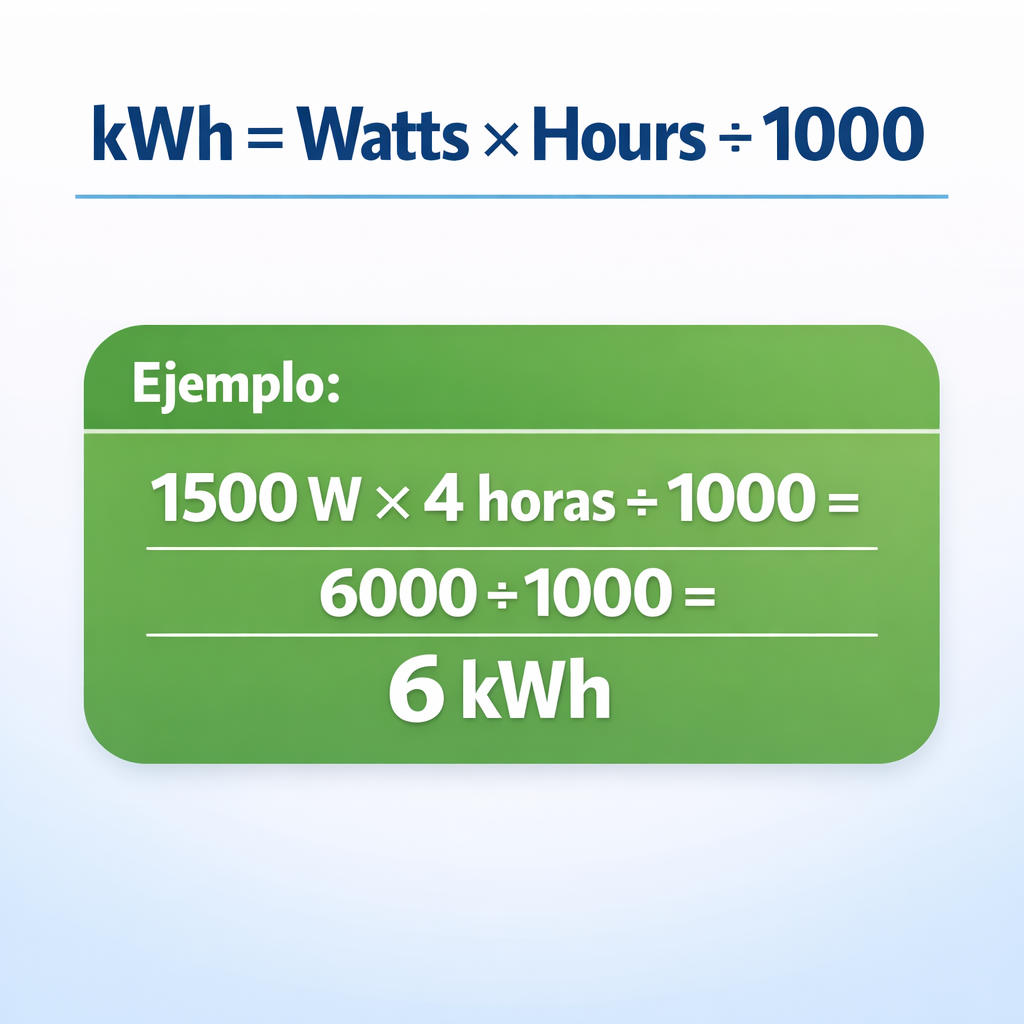
kWh = (W × hours) ÷ 1000 · kW = W ÷ 1000 · 1 kWh = 1000 Wh
📊 Quick Reference Table (1 hour)
| Watts | kWh (1 hr) | kW |
|---|---|---|
| 100 | 0.10 | 0.10 |
| 500 | 0.50 | 0.50 |
| 1,000 | 1.00 | 1.00 |
| 1,500 | 1.50 | 1.50 |
| 2,000 | 2.00 | 2.00 |
❓ Quick FAQ
How many kWh is 1000 watts?
1.0 kWh per hour. Formula: 1000 × 1 ÷ 1000 = 1.0 kWh.
Is kW the same as kWh?
No. kW is power (rate). kWh is energy (power × time). A 1 kW device running 1 hour uses 1 kWh.
A watts to kWh calculator answers the question homeowners, engineers, and students ask every day: “how much energy does this appliance consume?” Watts measure power — the rate of energy use at any instant. Kilowatt-hours measure energy — the total amount consumed over time. To convert between them, you multiply watts by hours and divide by 1,000. This page gives you an instant calculator that also estimates electricity cost, the complete formulas for watts-to-kWh and watts-to-kW, a conversion table for common appliances, and six real-world examples that show you exactly how to read your electricity bill in engineering terms.
Calculate several appliances and compare electricity costs
For a whole room, workshop or lighting installation, open the electricity cost calculator with an appliance inventory. Enter each item’s quantity, watts, daily hours, duty cycle, billing days and your own rate. You can save scenarios and download the inventory.
For example, four 12 W lamps used for 5 hours per day over 30 days consume 7.2 kWh. At an illustrative $0.20/kWh, their energy charge is $1.44. Fixed fees and taxes are separate.
If your starting figure is already in kilowatts, use the kW to kWh calculator directly. Do not multiply a kW input by 1,000 again.
Watts to kWh Conversion Table — Common Appliances
The table below shows common household appliance wattages converted to kWh for typical daily usage times. The formula is always kWh = (W × hours) ÷ 1000. Cost assumes $0.15/kWh (US average).
| Appliance | Watts | kW | Daily Hours | kWh/day | kWh/month | $/month |
|---|---|---|---|---|---|---|
| LED light bulb | 10 | 0.010 | 8 | 0.08 | 2.4 | $0.36 |
| Laptop | 65 | 0.065 | 8 | 0.52 | 15.6 | $2.34 |
| TV (55″ LED) | 120 | 0.120 | 5 | 0.60 | 18.0 | $2.70 |
| Refrigerator | 150 | 0.150 | 8* | 1.20 | 36.0 | $5.40 |
| Desktop PC | 300 | 0.300 | 8 | 2.40 | 72.0 | $10.80 |
| Window AC (5,000 BTU) | 500 | 0.500 | 8 | 4.00 | 120.0 | $18.00 |
| Microwave | 1,000 | 1.000 | 0.5 | 0.50 | 15.0 | $2.25 |
| Space heater | 1,500 | 1.500 | 6 | 9.00 | 270.0 | $40.50 |
| Hair dryer | 1,800 | 1.800 | 0.25 | 0.45 | 13.5 | $2.03 |
| Electric oven | 2,500 | 2.500 | 1 | 2.50 | 75.0 | $11.25 |
| Water heater | 4,500 | 4.500 | 3 | 13.50 | 405.0 | $60.75 |
| Central AC (3-ton) | 3,500 | 3.500 | 8 | 28.00 | 840.0 | $126.00 |
| EV charger (Level 2) | 7,200 | 7.200 | 5 | 36.00 | 1,080.0 | $162.00 |
* Refrigerator runs compressor intermittently; 8 hr effective = ~33% duty cycle over 24 hr.
How to Convert Watts to kWh — Formulas Step by Step
There are two related but distinct conversions that people search for when they say “watts to kWh.” Understanding the difference is crucial.
Watts to kWh (power → energy)
This converts a power rating (watts) into the energy consumed over a specific time period (kilowatt-hours). A 100 W light bulb running for 10 hours uses (100 × 10) ÷ 1000 = 1.0 kWh. This is the number that appears on your electricity bill — and what your utility charges you for.
Watts to kW (power → power, just scale)
This is a simple unit prefix conversion — no time involved. 1,500 W = 1.500 kW. It tells you the instantaneous power draw but says nothing about energy consumed. You need kW as an intermediate step when calculating kWh, or when comparing equipment ratings.
Wh to kWh (energy → energy, just scale)
Watt-hours and kilowatt-hours both measure energy. A 500 Wh battery stores 0.5 kWh. This conversion appears when working with battery capacities (laptop batteries are often rated in Wh) or small solar installations.
The key insight: time makes all the difference
A 2,000 W space heater and a 10 W LED bulb are wildly different in power — but if the heater runs for 1 hour (2 kWh) and the bulb runs for 200 hours (2 kWh), they consume the exact same energy. This is why the U.S. Energy Information Administration reports energy in kWh, not watts — consumption depends on both power and time.
Watts vs kW vs kWh — Understanding the Units
| Unit | Symbol | Measures | Analogy | Where You See It |
|---|---|---|---|---|
| Watt | W | Power (rate of energy use) | Speed of a car (km/h) | Appliance nameplates, light bulbs |
| Kilowatt | kW | Power (same as W, ×1000) | Speed in a larger unit | Generators, motors, solar panels |
| Kilowatt-hour | kWh | Energy (power × time) | Distance traveled (km) | Electricity bills, battery capacity |
| Watt-hour | Wh | Energy (same as kWh, ÷1000) | Distance in meters | Laptop batteries, small devices |
The car analogy helps: watts (power) is like your speedometer — it shows how fast you’re using energy right now. Kilowatt-hours (energy) is like your odometer — it shows the total “distance” of energy you’ve consumed. Driving at 60 km/h for 2 hours covers 120 km. Running a 1,000 W heater for 2 hours consumes 2 kWh. Same math, different units.
kWh to Watts — Inverse Conversion
To find watts from kWh, you need to know the time period:
| kWh | Time | Watts |
|---|---|---|
| 1 | 1 hour | 1,000 |
| 1 | 8 hours | 125 |
| 1 | 24 hours | 41.7 |
| 10 | 24 hours | 416.7 |
| 30 | 720 hours (month) | 41.7 |
| 900 | 720 hours (month) | 1,250.0 |
For the full watts-to-amps conversion, check our Amps to Watts Calculator.
Solved Examples — 6 Real-World Cases
Example 1 — LED Light Bulb (10 W, 8 hours/day)
Data: 10 W LED bulb, on for 8 hours per day, 30 days.
Formula: kWh = (10 × 8 × 30) ÷ 1000 = 2.4 kWh/month
At $0.15/kWh, this costs $0.36/month. Replacing a 60 W incandescent with a 10 W LED saves 12 kWh/month = $1.80/month per bulb.
Example 2 — 1000 Watt Microwave (30 min/day)
Data: 1,000 W microwave, used 0.5 hours per day, 30 days.
Formula: kWh = (1000 × 0.5 × 30) ÷ 1000 = 15.0 kWh/month
Despite being a “high wattage” appliance, the microwave uses relatively little energy because it runs for short periods. Cost: $2.25/month.
Example 3 — Space Heater (1500 W, 6 hours/day)
Data: 1,500 W portable heater, 6 hours per day, 30 days.
Formula: kWh = (1500 × 6 × 30) ÷ 1000 = 270.0 kWh/month
At $0.15/kWh this costs $40.50/month — one of the most expensive appliances to operate. This is why HVAC engineers recommend heat pumps (COP 3–4) over resistance heaters.
Example 4 — Water Heater (4500 W, 3 hours/day)
Data: Standard 4,500 W electric water heater element, 3 hours effective daily heating.
Formula: kWh = (4500 × 3 × 30) ÷ 1000 = 405.0 kWh/month
The single largest energy consumer in most US homes: $60.75/month. A heat-pump water heater cuts this by 60–70%, to about $18–24/month.
Example 5 — Watts to kW Simple Conversion (1500 W)
Data: Convert 1,500 watts to kilowatts (no time involved).
Formula: kW = 1500 ÷ 1000 = 1.500 kW
This is a pure unit conversion — 1,500 W and 1.5 kW are the same power expressed in different scales. You still need to multiply by hours to get kWh (energy).
Example 6 — EV Charger (7200 W, 5 hours/night)
Data: Level 2 EV charger, 7,200 W (30 A × 240 V), 5 hours nightly, 20 charging days/month.
Formula: kWh = (7200 × 5 × 20) ÷ 1000 = 720.0 kWh/month
720 kWh adds roughly 2,400–3,000 miles of range per month. At $0.15/kWh = $108/month — far cheaper than gasoline for equivalent miles. On a time-of-use rate ($0.08/kWh overnight), cost drops to $57.60.
How to Calculate Electricity Cost from Watts
The full cost formula combines watts, time, and your rate:
Your electricity rate is on your utility bill — US average is about $0.15–0.17/kWh in 2026, but it varies widely by state ($0.10 in the Southeast to $0.35+ in Hawaii and parts of California). The calculator above includes a rate input for instant cost estimates.
Reading your electricity bill
Your monthly bill shows total kWh consumed. To trace this back to specific appliances, use the watts-to-kWh formula for each device and add them up. This is exactly what an Appliance Power Calculator does — it automates the watt × hours ÷ 1000 calculation for your entire household.
The average US home consumes about 886 kWh per month (per EIA data). If your bill is significantly higher, the table above helps you identify the biggest consumers — typically the water heater, AC system, and space heaters.
Quick Equivalences — Watts to kWh
Direct answers for the most searched watts-to-kWh conversions.
1000 Watts in kWh
1.0 kWh per hour
1,000 W = 1 kW. Running for 1 hour = 1 kWh. This is the definition of a kilowatt-hour.
100 Watts to kWh
0.1 kWh per hour
A 100 W bulb uses 0.8 kWh in 8 hours, costing about $0.12/day at $0.15/kWh.
1500 Watts to kWh
1.5 kWh per hour
Space heater or electric kettle. 6 hours of daily use = 9 kWh/day = 270 kWh/month ($40.50).
Watts to Kilowatts
Divide by 1000
500 W = 0.5 kW, 1500 W = 1.5 kW, 5000 W = 5 kW. Pure prefix conversion, no time involved.
1 Watt to kWh
0.001 kWh per hour
One watt running 24/7 for a month uses 0.72 kWh ($0.11). Standby power on devices is typically 1–5 W each.
Wh to kWh
Divide Wh by 1000
A 5,000 Wh (5 kWh) home battery like Tesla Powerwall stores enough to run a 500 W fridge for 10 hours.
500 Watts to kWh
0.5 kWh per hour
Small window AC or desktop PC. 8 hours/day = 4 kWh/day = 120 kWh/month ($18.00).
2000 Watts to kWh
2.0 kWh per hour
Countertop oven or large heater. High power + long runtime = expensive. Use sparingly.
kWh to Watts
W = (kWh × 1000) ÷ Hours
If your bill shows 900 kWh/month, average power = 900 × 1000 ÷ 720 = 1,250 W drawn continuously.
Watt to Kilowatt
Divide by 1000
Same as watts to kW. 750 W = 0.75 kW. Used when comparing appliance ratings to generator or panel capacity.
Frequently Asked Questions
How do you convert watts to kWh?
Multiply watts by hours and divide by 1,000: kWh = (W × hours) ÷ 1000. Example: a 1,500 W heater running for 4 hours uses (1500 × 4) ÷ 1000 = 6.0 kWh.
How many kWh is 1000 watts?
1.0 kWh per hour. By definition, 1,000 watts (1 kW) running for 1 hour produces exactly 1 kilowatt-hour. Running for 8 hours produces 8 kWh.
How do you convert watts to kilowatts?
Divide by 1,000. Formula: kW = W ÷ 1000. Example: 2,500 W ÷ 1000 = 2.5 kW. This is a simple metric prefix change — no time or energy involved.
Is kW the same as kWh?
No. kW (kilowatt) measures power — the rate of energy use. kWh (kilowatt-hour) measures energy — the total amount consumed over time. A 2 kW heater running for 3 hours uses 6 kWh. The relationship is: kWh = kW × hours.
How many watts is 1 kWh?
1,000 watts for 1 hour, or 500 watts for 2 hours, or 100 watts for 10 hours. Any combination of watts × hours that multiplies to 1,000 watt-hours equals 1 kWh.
How much does 1 kWh cost?
$0.15–0.17 on average in the US (2026). Rates vary widely: $0.10 in the Southeast US, $0.25–0.35 in California, $0.30–0.50 in parts of Europe, and $0.03–0.08 in countries with heavily subsidized electricity.
How do I calculate my electricity bill from watts?
Cost = (Watts × Hours ÷ 1000) × Rate. Add up the kWh for each appliance and multiply by your rate. Example: a 1,500 W heater used 6 hours/day for 30 days: (1500 × 6 × 30) ÷ 1000 × $0.15 = $40.50.
How many kWh does a refrigerator use?
30–50 kWh per month for a modern Energy Star model. Older units can use 60–100 kWh/month. A typical fridge draws 100–200 W but runs its compressor only 30–50% of the time (duty cycle).
What is the difference between watts and watt-hours?
Watts measure power — the rate of energy use at any instant. Watt-hours (Wh) measure energy — total consumption over time. A 60 W bulb running 5 hours uses 300 Wh = 0.3 kWh. Watts is like speed; watt-hours is like distance.
How do you convert Wh to kWh?
Divide by 1,000. Formula: kWh = Wh ÷ 1000. A laptop battery rated 72 Wh stores 0.072 kWh of energy — about $0.01 worth of electricity per full charge.
How many watts does a solar panel produce per kWh?
A 400 W solar panel produces 400 W of peak power. In a location with 5 peak sun hours per day, it generates (400 × 5) ÷ 1000 = 2.0 kWh per day, or about 60 kWh per month.
How many kWh does an EV charger use?
A Level 2 charger (7,200 W at 240 V / 30 A) charging for 5 hours adds 36 kWh — enough for about 100–130 miles of range. Monthly usage of 500–1,000 kWh is typical for daily commuters.
Related Conversions
Explore more electrical conversion calculators on our site:
- Amps to Watts Calculator — convert current to watts with voltage.
- Amp to kW Calculator — convert amperes to kilowatts.
- Appliance Power Calculator — calculate energy use and cost for any appliance.
- Amperes to VA Calculator — amps to volt-amperes for UPS sizing.
- Motor Efficiency Calculator — calculate input vs output power and losses.