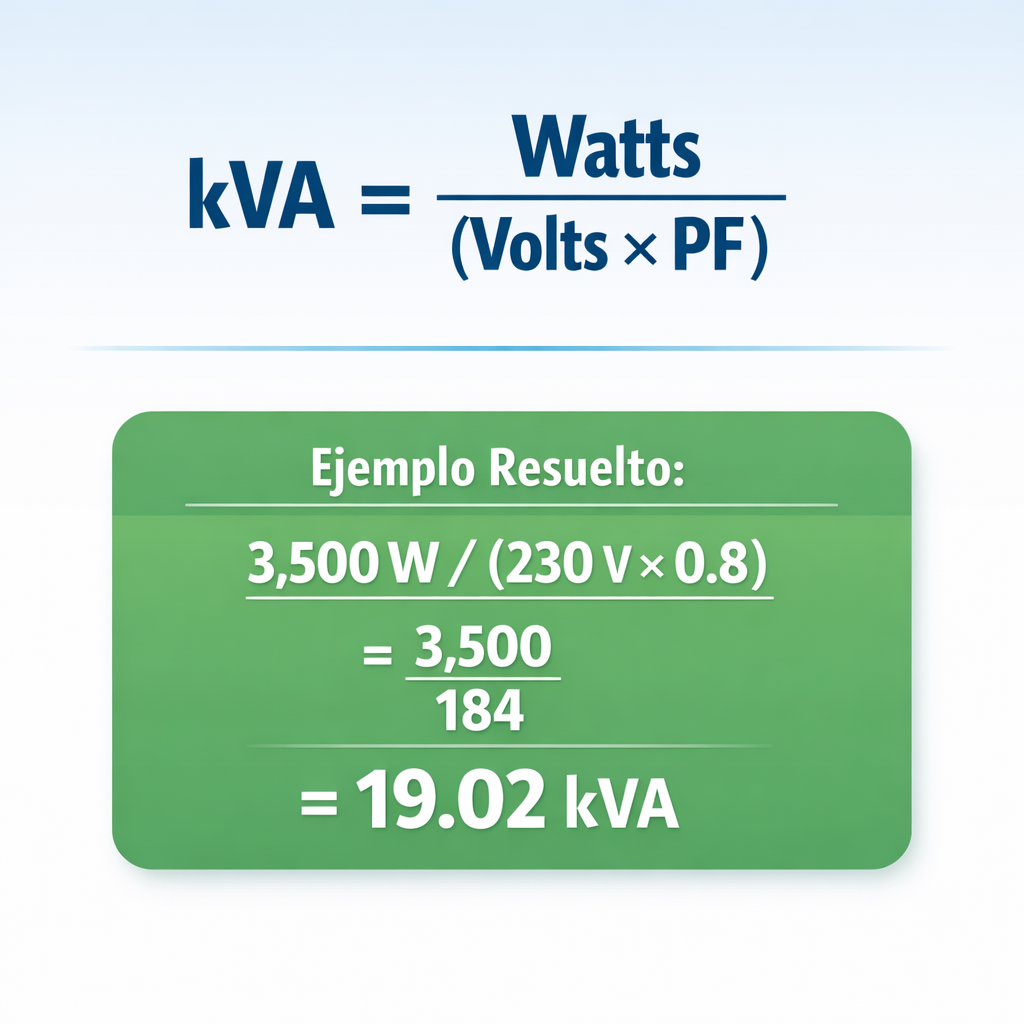
kVA = Watts ÷ (1000 × PF) · Watts = kVA × 1000 × PF · At PF = 1: kVA = kWQuick Reference Table
| Watts | kVA (PF 1.0) | kVA (PF 0.85) | kVA (PF 0.8) |
|---|---|---|---|
| 500 | 0.50 | 0.59 | 0.63 |
| 1,000 | 1.00 | 1.18 | 1.25 |
| 2,000 | 2.00 | 2.35 | 2.50 |
| 3,000 | 3.00 | 3.53 | 3.75 |
| 5,000 | 5.00 | 5.88 | 6.25 |
| 10,000 | 10.00 | 11.76 | 12.50 |
FAQ
What PF should I use?
Use measured load PF or manufacturer data for the operating point. The preset 0.85 is illustrative, not a guaranteed safe value. If unknown, compare assumptions instead of treating the result as an equipment rating.
At PF = 1, are kVA and kW the same?
Yes. With unity PF, all power is real — kVA = kW exactly.
Every time you size a UPS, specify a generator, or select a transformer, you need to convert watts to kVA. Watts measure the real power your equipment actually consumes, but transformers, generators, and UPS systems are rated in kVA — apparent power that includes the reactive component. The bridge between the two is power factor (PF). This Watts to kVA calculator gives you the answer in one step: enter your wattage, choose the PF, and read the kVA rating you need to spec.
Below you will find conversion tables at the three most common power factors (0.8, 0.9, and 1.0), the formula explained step by step, six solved examples from real installations, and direct answers for every popular watt-to-kVA query — from 500 W desktop UPS loads to 15,000 W industrial panels.
Watts to kVA: compare the effect of power factor
At PF 0.80: 3,000 W = 3.75 kVA; 5,000 W = 6.25 kVA; 10,000 W = 12.50 kVA. At PF 1, those loads are 3, 5 and 10 kVA. Use kVA = W ÷ (1,000 × PF); a positive PF is required.
For equipment selection, this estimates running apparent power only. Starting demand, load characteristics and the source’s independent watts limit need a separate check.
Continue your calculation:
Watts to kVA Conversion Tables — PF 0.8, 0.9 & 1.0
The tables below cover the wattage values you will actually encounter when sizing equipment. Three power factor columns let you read the kVA directly without doing any math. The “Typical Application” column tells you where each wattage range shows up in practice.
| Watts | kVA (PF 1.0) | kVA (PF 0.9) | kVA (PF 0.8) | Typical Application |
|---|---|---|---|---|
| 100 | 0.10 | 0.111 | 0.125 | LED monitor, router |
| 250 | 0.25 | 0.278 | 0.313 | Desktop PC idle |
| 500 | 0.50 | 0.556 | 0.625 | Desktop PC + monitor |
| 750 | 0.75 | 0.833 | 0.938 | Small server, gaming PC |
| 1,000 | 1.00 | 1.111 | 1.250 | Space heater, microwave |
| 1,500 | 1.50 | 1.667 | 1.875 | Portable AC unit |
| 2,000 | 2.00 | 2.222 | 2.500 | Small server rack |
| 3,000 | 3.00 | 3.333 | 3.750 | Residential standby panel |
| 4,000 | 4.00 | 4.444 | 5.000 | EV Level 2 charger |
| 5,000 | 5.00 | 5.556 | 6.250 | Data closet UPS |
| 6,000 | 6.00 | 6.667 | 7.500 | Small commercial kitchen |
| 7,500 | 7.50 | 8.333 | 9.375 | Large server rack |
| 10,000 | 10.00 | 11.111 | 12.500 | Small office floor, CNC machine |
| 15,000 | 15.00 | 16.667 | 18.750 | Restaurant main panel |
| 20,000 | 20.00 | 22.222 | 25.000 | Large retail store |
| 25,000 | 25.00 | 27.778 | 31.250 | Small manufacturing cell |
| 30,000 | 30.00 | 33.333 | 37.500 | HVAC chiller |
| 50,000 | 50.00 | 55.556 | 62.500 | Building main transformer |
| 75,000 | 75.00 | 83.333 | 93.750 | Factory feeder |
| 100,000 | 100.00 | 111.111 | 125.000 | Industrial MCC |
How to read: Find your wattage, then look at the column matching your PF. For example, 5,000 W at PF 0.8 requires a 6.25 kVA UPS or generator. Always round up to the next standard kVA rating (e.g., 7.5 kVA) to allow for startup surges and future load growth.
Step-by-Step Formulas: How to Convert Watts to kVA
The relationship between watts and kVA is governed by power factor. Real power (W) is the portion of apparent power (VA) that does actual work. The rest is reactive power, which flows back and forth between source and load without producing useful output. The formulas here are defined in IEEE 1459 (power definitions for modern AC systems) and referenced throughout IEC 61000-4-30.
Formula 1 — Watts to kVA
Where Watts is real power consumed, PF is power factor (0 to 1), and 1000 converts VA to kVA. At PF = 1 (purely resistive load), kVA equals kW exactly.
Example: A data closet draws 5,000 W at PF 0.90.
kVA = 5000 ÷ (1000 × 0.90) = 5000 ÷ 900 = 5.556 kVA. Select a 6 kVA UPS.
Formula 2 — kW to kVA (alternative form)
Since kW = Watts ÷ 1000, this is the same formula expressed in kilowatts. Equipment datasheets often list kW, so this form saves a step.
Example: A motor draws 22 kW at PF 0.86.
kVA = 22 ÷ 0.86 = 25.58 kVA. The transformer feeding this motor must be rated at least 25 kVA (next standard: 25 or 30 kVA).
Formula 3 — kVA to Watts (inverse)
This tells you how much real power a kVA-rated source can deliver at a given PF. A 10 kVA UPS at PF 0.80 delivers 10 × 1000 × 0.80 = 8,000 W of real power. Many people buy a “10 kVA” UPS expecting 10,000 W — and then overload it.
The power triangle
Watts, kVA, and kVAR form a right triangle: kVA² = kW² + kVAR². Power factor is the cosine of the angle between kW and kVA: PF = kW ÷ kVA = cos(φ). This geometric relationship is defined in NEMA standards and is the foundation for power factor correction capacitor sizing.
Watts vs kVA vs kW vs kVAR — What Is the Difference?
These four quantities describe different aspects of AC power. Confusing them is one of the most expensive mistakes in electrical engineering — it leads to undersized UPS systems, tripped generators, and utility PF penalties.
| Quantity | Symbol | Unit | What It Measures | PF Dependent? |
|---|---|---|---|---|
| Real Power | P | W / kW | Power doing useful work (heat, motion, computation) | Yes — P = S × PF |
| Apparent Power | S | VA / kVA | Total power source must deliver (V × I) | No — includes both real and reactive |
| Reactive Power | Q | VAR / kVAR | Power stored/returned by inductors and capacitors | Yes — Q = S × sin(φ) |
| Kilowatts | P | kW | Same as Watts ÷ 1000 | Yes |
Key insight: A UPS rated “10 kVA / 8 kW” has a built-in PF of 0.80. It can deliver up to 10,000 VA of current × voltage, but only 8,000 W of real power. If your server load is 9,000 W at PF 0.95, you need a UPS rated at least 9,000 ÷ 0.95 = 9,474 VA (9.5 kVA) — so a 10 kVA unit works. But if your load has PF 0.80, then 9,000 ÷ 0.80 = 11,250 VA — you need a 12 or 15 kVA UPS.
Inverse Conversion: kVA to Watts
| kVA | W (PF 1.0) | W (PF 0.9) | W (PF 0.8) |
|---|---|---|---|
| 1 | 1,000 | 900 | 800 |
| 2 | 2,000 | 1,800 | 1,600 |
| 3 | 3,000 | 2,700 | 2,400 |
| 5 | 5,000 | 4,500 | 4,000 |
| 6 | 6,000 | 5,400 | 4,800 |
| 7.5 | 7,500 | 6,750 | 6,000 |
| 10 | 10,000 | 9,000 | 8,000 |
| 15 | 15,000 | 13,500 | 12,000 |
| 20 | 20,000 | 18,000 | 16,000 |
| 30 | 30,000 | 27,000 | 24,000 |
| 50 | 50,000 | 45,000 | 40,000 |
| 75 | 75,000 | 67,500 | 60,000 |
| 100 | 100,000 | 90,000 | 80,000 |
Use the calculator above — switch direction to “kVA → Watts.” For current-based conversions, see our Amperes to VA calculator.
6 Solved Examples — Real-World Watts to kVA Conversions
Example 1 — 500 W Desktop PC + Monitor (Home Office UPS)
Data: PC + monitor draw 500 W total, PF = 0.95 (modern ATX PSU).
Formula: kVA = 500 ÷ (1000 × 0.95)
Result: 0.526 kVA
A 650 VA (0.65 kVA) desktop UPS handles this with ~20% headroom. This is the most common home-office UPS scenario.
Example 2 — 2,000 W Small Server Rack
Data: Two 1U servers draw 2,000 W combined, PF = 0.90.
Formula: kVA = 2000 ÷ (1000 × 0.90)
Result: 2.222 kVA
Select a 3 kVA rack-mount UPS. The 0.778 kVA margin covers peak spikes during disk-intensive operations. Our UPS sizing calculator automates this with headroom built in.
Example 3 — 3,000 W Residential Backup Panel
Data: Essential loads (fridge, lights, router, sump pump) total 3,000 W, PF = 0.85.
Formula: kVA = 3000 ÷ (1000 × 0.85)
Result: 3.529 kVA
A 5 kVA portable generator covers this comfortably. The extra capacity handles motor starting surges from the fridge compressor (LRA can be 3–5× running watts for the first second). Check our generator load-list calculator for a thorough sizing approach.
Example 4 — 5,000 W Data Closet
Data: Switches, servers, and a NAS draw 5,000 W, PF = 0.92.
Formula: kVA = 5000 ÷ (1000 × 0.92)
Result: 5.435 kVA
A 6 kVA online double-conversion UPS is the right pick. Double-conversion UPS units provide clean sinewave output — critical for sensitive IT loads. The 6 kVA rating gives 10% headroom above the 5.4 kVA requirement.
Example 5 — 10,000 W CNC Machine
Data: CNC spindle motor draws 10,000 W at PF = 0.80.
Formula: kVA = 10000 ÷ (1000 × 0.80)
Result: 12.500 kVA
This CNC needs a 15 kVA transformer (next standard above 12.5 kVA). The low PF (0.80) is typical for induction motor loads — consider adding PF correction capacitors to reduce the kVA demand and avoid utility penalties. See our Amps to kW calculator for the current draw at your voltage.
Example 6 — 15,000 W Restaurant Main Panel
Data: Ovens, fryers, HVAC combined load 15,000 W, PF = 0.88.
Formula: kVA = 15000 ÷ (1000 × 0.88)
Result: 17.045 kVA
The utility transformer feeding this restaurant should be rated at least 25 kVA (next standard above 17 kVA) to allow for future expansion. Use our transformer kVA sizing calculator with a 20% growth margin built in.
Watts to kVA for UPS Systems & Generator Sizing
This is the single most common application of the watts-to-kVA formula. UPS and generator manufacturers rate their equipment in kVA, but your load measurements are usually in watts. Here is how to bridge the gap properly.
UPS Power Factor Trap
Older UPS systems have an output PF of 0.70–0.80, meaning a “10 kVA” unit only delivers 7,000–8,000 W. Newer enterprise UPS (APC, Eaton, Vertiv) offer PF = 0.90–1.00, so a 10 kVA unit delivers 9,000–10,000 W. Always check the UPS datasheet for “kVA / kW” — both numbers are listed. Match your watt load to the kW rating, not the kVA rating.
Generator Sizing
Generators are rated in kVA (or kW at a stated PF, usually 0.80). A “10 kW” generator at PF 0.80 is actually 12.5 kVA. If your load is 10,000 W at PF 0.90, you need 10000 ÷ (1000 × 0.90) = 11.11 kVA. That 12.5 kVA generator covers it — but barely. Add 25% for motor starting surges.
Transformer Sizing
Transformers are always rated in kVA. To select the right transformer for a known watt load: calculate kVA = W ÷ (1000 × PF), then round up to the next standard kVA size (3, 5, 7.5, 10, 15, 25, 37.5, 45, 50, 75, 100, 112.5, 150, 225, 300, 500, 750, 1000 kVA). Use our motor efficiency calculator when motor loads dominate the panel.
Quick Equivalences — Most-Searched Watts to kVA Values
These are the specific values people search for most. Each result shows kVA at three common power factors plus a practical note.
500 Watts to kVA
0.50 kVA (PF 1.0) · 0.556 kVA (PF 0.9) · 0.625 kVA (PF 0.8)
Desktop PC with monitor. A 650 VA UPS covers this with margin.
1,000 Watts to kVA
1.00 kVA (PF 1.0) · 1.111 kVA (PF 0.9) · 1.250 kVA (PF 0.8)
Microwave oven, space heater. These are purely resistive (PF ≈ 1), so kVA ≈ kW.
2,000 Watts to kVA
2.00 kVA (PF 1.0) · 2.222 kVA (PF 0.9) · 2.500 kVA (PF 0.8)
Small server rack or hair dryer. Select a 3 kVA UPS for IT loads.
3,000 Watts to kVA
3.00 kVA (PF 1.0) · 3.333 kVA (PF 0.9) · 3.750 kVA (PF 0.8)
Essential home backup panel. A 5 kVA generator provides adequate headroom.
5,000 Watts to kVA
5.00 kVA (PF 1.0) · 5.556 kVA (PF 0.9) · 6.250 kVA (PF 0.8)
Data closet or large workshop. Most-searched query in this category.
7,500 Watts to kVA
7.50 kVA (PF 1.0) · 8.333 kVA (PF 0.9) · 9.375 kVA (PF 0.8)
Large server rack or small commercial kitchen. Select a 10 kVA UPS.
10,000 Watts to kVA
10.00 kVA (PF 1.0) · 11.111 kVA (PF 0.9) · 12.500 kVA (PF 0.8)
CNC machine, small office floor. Select a 15 kVA transformer or UPS.
15,000 Watts to kVA
15.00 kVA (PF 1.0) · 16.667 kVA (PF 0.9) · 18.750 kVA (PF 0.8)
Restaurant panel, HVAC chiller. A 25 kVA transformer covers this with growth margin.
20,000 Watts to kVA
20.00 kVA (PF 1.0) · 22.222 kVA (PF 0.9) · 25.000 kVA (PF 0.8)
Large retail store or small warehouse. Standard 25 kVA transformer size.
Watts to kVA at PF = 1
kVA = Watts ÷ 1000 (direct conversion)
Only valid for purely resistive loads (heaters, incandescent lights). For any load with motors or electronics, PF < 1 and kVA > kW.
Frequently Asked Questions
How do I convert Watts to kVA?
Divide watts by (1000 × PF). Formula: kVA = W ÷ (1000 × PF). Example: 5,000 W at PF 0.85 = 5000 ÷ 850 = 5.88 kVA.
What power factor should I use if I do not know it?
There is no universal safe PF default. For the same 5,000 W load, PF 0.85 gives 5.88 kVA, while PF 0.60 gives 8.33 kVA. Assuming too high a PF understates the apparent power needed. Use measured or manufacturer load data; starting demand and the source’s independent watts rating require separate checks.
Are kVA and kW the same thing?
Only at PF = 1. At any other power factor, kVA is larger than kW. The relationship is kW = kVA × PF. A 10 kVA load at PF 0.80 consumes only 8 kW of real power.
How many kVA is 5,000 Watts?
At PF 1.0: 5.00 kVA. At PF 0.9: 5.556 kVA. At PF 0.8: 6.25 kVA. The PF of your load determines the exact answer.
How many kVA is 10,000 Watts?
At PF 1.0: 10.00 kVA. At PF 0.9: 11.11 kVA. At PF 0.8: 12.50 kVA. For a CNC machine at PF 0.80, you need a 15 kVA transformer (next standard size above 12.5).
How do I convert kVA to Watts?
Multiply: W = kVA × 1000 × PF. Example: a 10 kVA UPS at PF 0.80 delivers 10 × 1000 × 0.80 = 8,000 W of real power.
Why is my UPS rated in kVA and not Watts?
Because UPS components (transformer, inverter, wiring) are limited by current, not by real power. Current is proportional to kVA (apparent power), regardless of how much is real vs reactive. The kVA rating ensures the UPS is not overloaded thermally.
Can I use Watts to kVA conversion for DC systems?
In DC there is no reactive power, so PF = 1 by definition. kVA = kW = Watts ÷ 1000. The formula still works — just set PF to 1.
How does low PF affect my electricity bill?
Many utilities charge a PF penalty when PF drops below 0.90 or 0.85. A low PF means the utility must supply more kVA (and thus more current) for the same kW of useful work. The excess current heats up transformers and cables. Correcting PF with capacitors reduces kVA demand, cuts penalties, and frees up transformer capacity.
What is the difference between VA and kVA?
kVA = VA ÷ 1000. They are the same unit at different scales — just like kW = W ÷ 1000. Small UPS units are rated in VA (e.g., 650 VA); larger equipment uses kVA (e.g., 10 kVA). See our Amperes to VA calculator for current-based conversions.
How do I size a transformer from Watts?
Step 1: kVA = W ÷ (1000 × PF). Step 2: Add 20–25% growth margin. Step 3: Round to next standard kVA (15, 25, 30, 45, 75, 100…). Example: 10,000 W at PF 0.85 = 11.76 kVA × 1.25 = 14.71 kVA → select 15 kVA transformer.
Does the Watts to kVA conversion change with voltage or phase?
No. The formula kVA = W ÷ (1000 × PF) is independent of voltage and phase. Voltage affects the current (amps) drawn for a given kVA, but not the kVA value itself. To find amps from kVA, use our Amps to Watts calculator.
Related Conversions
- Amperes to VA Calculator — current to apparent power
- Amps to kW Calculator — current to real power
- Amps to Watts Calculator — single-phase and three-phase
- UPS Sizing Calculator (kVA/kW) — exact UPS size for IT loads
- Transformer kVA Sizing Calculator — demand load with growth margin
- Balanced and Unbalanced Load Calculation — phase imbalance