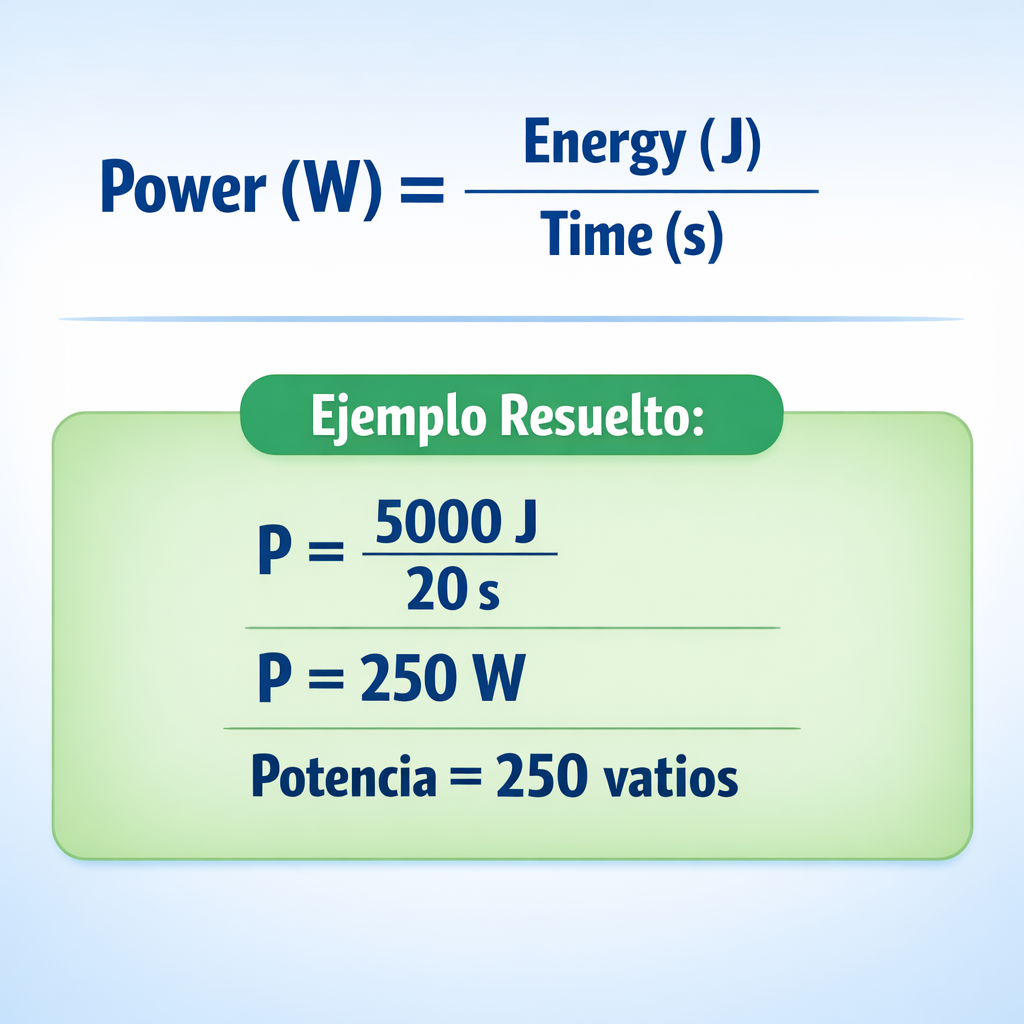
W = J ÷ s (watts = joules ÷ seconds) · 1 W = 1 J/s
📊 Quick Reference Table (t = 1 s)
| Joules | Watts (1 s) | Context |
|---|---|---|
| 1 | 1 | By definition |
| 100 | 100 | LED bulb |
| 1,000 | 1,000 | Microwave |
| 1,200 | 1,200 | UPS surge protector |
| 2,000 | 2,000 | Space heater |
❓ Quick FAQ
Is 1 joule equal to 1 watt?
Only if the time is 1 second. 1 watt = 1 joule per second (1 W = 1 J/s).
How many watts is 1200 joules?
1,200 watts if delivered in 1 second. If delivered over 60 seconds: 1200 ÷ 60 = 20 watts.
A joule to watts calculator converts energy into power — the two most fundamental quantities in physics and electrical engineering. Joules measure how much energy is stored or transferred; watts measure how fast that energy flows. The connection is time: watts = joules ÷ seconds. You encounter this conversion when comparing UPS joule ratings, sizing surge protectors, analyzing capacitor energy storage, or solving physics homework. This page gives you an instant bidirectional calculator, the complete formula with derivation, conversion tables, and six real-world examples from surge protection to industrial capacitor banks.
Joules to Watts Conversion Table
The table below converts common joule values to watts at different time intervals. Remember: the same amount of energy (joules) produces very different power levels (watts) depending on how quickly it is released. The formula is always W = J ÷ s.
| Joules (J) | W (in 1 s) | W (in 10 s) | W (in 60 s) | W (in 3600 s) | Practical Context |
|---|---|---|---|---|---|
| 1 | 1.000 | 0.100 | 0.017 | 0.0003 | 1 J = 1 W·s (by definition) |
| 10 | 10.000 | 1.000 | 0.167 | 0.003 | Small capacitor discharge |
| 100 | 100.000 | 10.000 | 1.667 | 0.028 | LED bulb running 1 second |
| 500 | 500.000 | 50.000 | 8.333 | 0.139 | Camera flash capacitor |
| 1,000 | 1,000.000 | 100.000 | 16.667 | 0.278 | Microwave for 1 second |
| 1,200 | 1,200.000 | 120.000 | 20.000 | 0.333 | Typical UPS joule rating |
| 1,700 | 1,700.000 | 170.000 | 28.333 | 0.472 | Mid-range surge protector |
| 2,000 | 2,000.000 | 200.000 | 33.333 | 0.556 | High-end surge protector |
| 3,600 | 3,600.000 | 360.000 | 60.000 | 1.000 | 1 Wh = 3,600 J |
| 3,600,000 | 3,600,000 | 360,000 | 60,000 | 1,000 | 1 kWh = 3,600,000 J |
How to Convert Joules to Watts — Formula Step by Step
The relationship between joules and watts is defined by time. A watt is literally one joule per second — this is the SI definition of the unit of power, established by the International Bureau of Weights and Measures (BIPM).
Where:
W = power in watts
J = energy in joules
t = time in seconds
Step-by-step example: A UPS absorbs a surge of 1,200 joules over 0.001 seconds (1 millisecond). What is the instantaneous power?
1. Start with: J = 1,200, t = 0.001 s.
2. Divide: 1,200 ÷ 0.001 = 1,200,000.
3. Result: 1,200,000 W = 1,200 kW = 1.2 MW.
This is why surge protection is rated in joules, not watts — a 1,200 J surge lasting 1 millisecond creates a momentary power spike of 1.2 megawatts.
Special case: t = 1 second
When the time period is exactly 1 second, the conversion is trivially simple: joules = watts (numerically). A 100 W light bulb consumes 100 joules every second. A 1,500 W space heater consumes 1,500 joules per second. This is the most common case in physics problems and the reason many people mistakenly think “joules and watts are the same” — they are, but only when you measure over exactly 1 second.
Converting to larger units
If you’re working with energy over hours instead of seconds, convert joules to watt-hours by dividing by 3,600 (the number of seconds in an hour). These relationships are standardized by IEC 80000-6 for electrical quantities.
Joules vs Watts — Understanding the Difference
| Characteristic | Joule (J) | Watt (W) |
|---|---|---|
| What it measures | Energy (total work done or stored) | Power (rate of energy use) |
| SI definition | kg·m²·s⁻² (derived unit) | kg·m²·s⁻³ = J/s (derived unit) |
| Time involved? | No — energy is a “total” quantity | Yes — power is energy per unit time |
| Analogy | Distance traveled (km) | Speed (km/h) |
| Where used | Surge protectors, capacitors, physics | Appliances, motors, generators |
| On a utility bill | No (too small — kWh used instead) | No (kW demand charge instead) |
| Relationship | J = W × s | W = J ÷ s |
The key insight: joules tell you “how much” energy; watts tell you “how fast” that energy flows. A surge protector rated 2,000 J can absorb 2,000 joules of total energy. Whether that energy arrives in 1 millisecond (= 2,000,000 W instantaneous power) or over 10 seconds (= 200 W) makes an enormous difference in the protective capability required.
Watts to Joules — Inverse Conversion
To convert watts back to joules, multiply by time:
| Watts | J (1 s) | J (60 s) | J (3600 s) |
|---|---|---|---|
| 1 | 1 | 60 | 3,600 |
| 10 | 10 | 600 | 36,000 |
| 100 | 100 | 6,000 | 360,000 |
| 500 | 500 | 30,000 | 1,800,000 |
| 1,000 | 1,000 | 60,000 | 3,600,000 |
| 1,500 | 1,500 | 90,000 | 5,400,000 |
Use the calculator above — switch the direction to “W → J” for instant results.
Solved Examples — 6 Real-World Cases
Example 1 — UPS Surge Rating (1200 J in 1 second)
Data: A UPS is rated for 1,200 joules of surge suppression. Time: 1 second.
Formula: W = 1200 ÷ 1 = 1,200 W
This means the UPS can dissipate surges at a rate of 1,200 watts sustained over 1 second. In reality, most surges last microseconds — so the instantaneous power is much higher for a much shorter time.
Example 2 — Camera Flash (500 J in 0.005 s)
Data: A professional camera flash releases 500 J in 5 milliseconds (0.005 s).
Formula: W = 500 ÷ 0.005 = 100,000 W (100 kW)
The flash tube delivers 100 kW of instantaneous power — but only for 5 ms. The energy comes from a capacitor that took several seconds to charge at a much lower power level (perhaps 50 W from the battery).
Example 3 — Microwave Oven (1000 J per second)
Data: A 1,000 W microwave running for 1 second.
Formula: W = 1000 ÷ 1 = 1,000 W
At 1,000 W, the microwave transfers 1,000 J of energy to your food every second. Heating for 60 seconds = 60,000 J = 60 kJ of total energy delivered.
Example 4 — Surge Protector (2000 J rating)
Data: A high-end surge protector rated 2,000 J. A lightning-induced surge lasts 0.001 s (1 ms).
Formula: W = 2000 ÷ 0.001 = 2,000,000 W (2 MW)
The surge protector must handle a 2 MW instantaneous power spike — this is why MOV (metal oxide varistor) components must be rated for extreme peak currents despite the relatively modest joule rating.
Example 5 — 1700 J Surge Protector (1 second equivalent)
Data: A mid-range surge protector rated 1,700 J. Time reference: 1 second.
Formula: W = 1700 ÷ 1 = 1,700 W
The 1,700 J rating is the total energy the protector can absorb over its lifetime. It doesn’t mean 1,700 watts continuous — after absorbing its rated joules in accumulated surges, the MOVs degrade and must be replaced.
Example 6 — Industrial Capacitor Bank (10,000 J in 0.1 s)
Data: A capacitor bank stores 10,000 J and discharges in 0.1 seconds for a spot welder.
Formula: W = 10000 ÷ 0.1 = 100,000 W (100 kW)
Spot welders use capacitor-discharge systems to deliver 100 kW pulses from a capacitor bank that charges slowly at maybe 2–3 kW from the mains. The time compression (slow charge, fast discharge) is the core principle of pulsed power systems.
Joules to Watts in UPS Ratings & Surge Protectors
The most common real-world application of the joule-to-watts conversion is understanding surge protector and UPS ratings. Here’s what the joule number actually means:
What does the joule rating on a surge protector mean?
The joule rating is the total energy absorption capacity over the protector’s lifetime. A 2,000 J surge protector can absorb a total of 2,000 joules of surge energy before its MOVs (metal oxide varistors) degrade beyond usefulness. This could be one large 2,000 J surge, two 1,000 J surges, or hundreds of small 10 J surges — the joules accumulate until the total is exhausted.
How to compare joule ratings
Higher joules = better protection. For basic electronics (lamps, clocks): 600–1,000 J is adequate. For computers and networking: 1,000–2,000 J minimum. For home entertainment systems: 2,000+ J. For server rooms and sensitive equipment: 3,000+ J, ideally with a connected equipment warranty. UL 1449 third edition requires surge protectors to be tested to specific let-through voltage levels — the joule rating adds the energy absorption dimension on top of the voltage clamping specification.
Why surge protectors don’t show watts
Because the power level during a surge depends on the duration — which varies wildly. A nearby lightning strike produces a microsecond-scale transient; motor switching events produce millisecond-scale surges; utility voltage sags last seconds. The same 1,200 J protector handles all of these, but the instantaneous watts are completely different in each case. Joules is the correct unit because it captures total energy regardless of timing.
Quick Equivalences — Joules to Watts
Direct answers for the most searched joule-to-watt conversions. All values assume t = 1 second unless stated otherwise.
1 Joule to Watts
1 W (at t = 1 s)
By definition: 1 watt = 1 joule per second. The foundational SI relationship.
1200 Joules to Watts
1,200 W (at t = 1 s)
Common UPS joule rating. In a 1 ms surge: 1,200,000 W = 1.2 MW instantaneous.
1700 Joules to Watts
1,700 W (at t = 1 s)
Mid-range surge protector rating. Good for home office computers and monitors.
2000 Joules to Watts
2,000 W (at t = 1 s)
High-end surge protector. Recommended minimum for gaming PCs and home entertainment systems.
100 Joules to Watts
100 W (at t = 1 s)
Equivalent to running a 100 W light bulb for 1 second.
500 Joules to Watts
500 W (at t = 1 s)
Energy stored in a camera flash capacitor. Delivered in milliseconds = hundreds of kW peak.
3600 Joules to Watts
3,600 W (at t = 1 s) = 1 Wh
3,600 joules = exactly 1 watt-hour. This is the bridge between joules and the Wh/kWh energy units.
1 Watt to Joules
1 J per second
Inverse: 1 W running for 60 s = 60 J. For 1 hour = 3,600 J = 1 Wh.
J to W Conversion
W = J ÷ seconds
Always specify the time. Without a time reference, joules cannot be converted to watts.
10000 Joules to Watts
10,000 W (at t = 1 s)
Industrial capacitor bank energy. At 0.1 s discharge = 100 kW for spot welding or pulsed power.
Frequently Asked Questions
How do you convert joules to watts?
Divide joules by time in seconds: W = J ÷ s. Example: 1,200 J in 1 second = 1,200 W. You must know the time period — without it, the conversion is impossible because joules (energy) and watts (power) are different physical quantities.
Is 1 joule equal to 1 watt?
Only when the time is 1 second. 1 watt equals 1 joule per second (1 W = 1 J/s). Over 2 seconds, 1 joule equals only 0.5 watts. Over 0.5 seconds, 1 joule equals 2 watts. The numerical equivalence only holds at t = 1 s.
How many watts is 1200 joules?
1,200 watts if delivered in 1 second. If delivered over 60 seconds: 1200 ÷ 60 = 20 watts. For UPS surge protectors rated 1,200 J, the actual surge power is typically in the megawatt range because surges last microseconds.
How many watts is 2000 joules?
2,000 watts at t = 1 second. This is a common surge protector rating. A 2,000 J protector can absorb surges totaling 2,000 joules over its lifetime before the MOV components degrade.
What is the difference between joules and watts?
Joules measure energy (total work done or stored). Watts measure power (the rate of energy flow). They are related by time: W = J ÷ s. Think of joules as “distance” and watts as “speed” — you can’t convert between them without knowing the time.
How do you convert watts to joules?
Multiply watts by time in seconds: J = W × s. Example: a 100 W bulb running for 60 seconds uses 100 × 60 = 6,000 J of energy. Running for 1 hour: 100 × 3,600 = 360,000 J = 0.1 kWh.
How many joules is 1 kWh?
3,600,000 joules (3.6 megajoules). Calculation: 1 kW = 1,000 W, and 1 hour = 3,600 seconds, so 1 kWh = 1,000 × 3,600 = 3,600,000 J. This is the standard conversion factor for electricity billing.
What does the joule rating on a surge protector mean?
It is the total energy the protector can absorb over its lifetime before the MOV (metal oxide varistor) components fail. A 2,000 J protector can handle one 2,000 J surge, or many smaller surges totaling 2,000 J. Higher joule ratings mean better and longer-lasting protection.
Can you convert joules to watts without knowing time?
No. Joules is energy; watts is power. Without a time reference, the conversion is undefined — like asking “how fast is 100 kilometers?” without knowing the travel time. Always specify or assume a time period (1 second is the standard default in physics problems).
How many watts is 1700 joules?
1,700 watts at t = 1 second. This is a common mid-range surge protector rating, suitable for protecting home office equipment like computers, monitors, and networking gear.
What is 1 watt-second in joules?
Exactly 1 joule. By definition, 1 W·s = 1 J. A watt-second and a joule are the same unit. This is why “watt-second” and “joule” are used interchangeably in energy calculations.
How do joules relate to kilowatt-hours on my electricity bill?
1 kWh = 3,600,000 J. Your electricity bill measures energy in kWh because joules would produce inconveniently large numbers. A typical US home uses about 886 kWh per month = 3.19 billion joules per month. The kWh unit is simply more practical for billing purposes.
Related Conversions
Explore more electrical conversion calculators on our site:
- Amps to Watts Calculator — convert current to watts with voltage.
- Amp to kW Calculator — convert amperes to kilowatts.
- Appliance Power Calculator — calculate energy use and cost for any appliance.
- Amperes to Resistance (Ohm’s Law) Calculator — find ohms from current and voltage.
- Amperes to VA Calculator — amps to volt-amperes for UPS sizing.