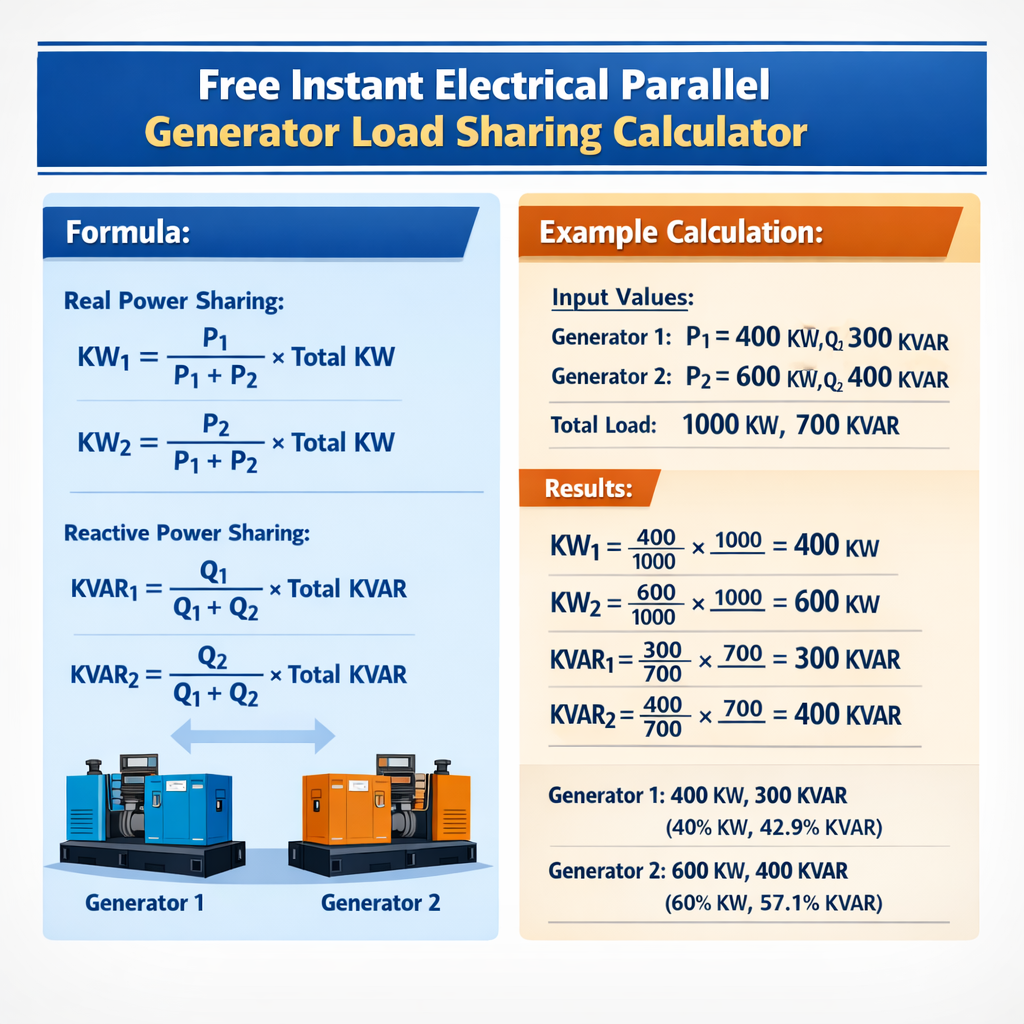
This article explains a free instant calculator for parallel generator load sharing and display screen.
Detailed formulas, examples, normative references, and practical steps for kW and kVar sharing with accuracy.
Overview of parallel generator load sharing principles
Parallel generator operation requires coordinated control of active (kW) and reactive (kVAr) power so that each unit supplies a stable portion of the total system demand. Proper sharing prevents overload, minimizes circulating currents, and maintains voltage and frequency within acceptable limits for the connected bus and loads. Active power is regulated primarily by speed/governor control and frequency droop characteristics; reactive power is regulated by voltage control and AVR droop. Both axes must be designed and tuned to avoid hunting, saturation, or unequal current contributions under transient and steady-state conditions.Key objectives for a load-sharing calculator screen
- Instantly compute kW and kVAr distribution among parallel units for given load conditions.
- Support multiple sharing strategies: capacity-proportional, droop-proportional, and manual setpoints.
- Provide per-unit normalization, overload checks, and warnings for protection limits.
- Display results in clear numerical and graphical form (bars, percentages, and dial indicators).
- Allow input of generator ratings, droop settings, governor/AVR parameters, and measured bus frequency/voltage.
Mathematical basis and formulas for load sharing
The calculator implements formulas for apparent power, power factor, per-unit normalization, capacity-based sharing and droop-proportional sharing. All formulas are presented in plain HTML math form and followed by definitions and typical values.Fundamental power relations
S = sqrt(P^2 + Q^2)
PF = P / S
Q = P * tan(acos(PF))
- P — Active power (kW). Typical: 0 to generator rated kW (e.g., 0–1000 kW).
- Q — Reactive power (kVAr). Typical: can be positive (inductive) or negative (capacitive), magnitude up to rated kvar.
- S — Apparent power (kVA). Typical: S = sqrt(P^2 + Q^2), used to check thermal limits.
- PF — Power factor (decimal). Typical values: 0.8 lagging (0.8), 0.95 leading/lagging (0.95).
Capacity-proportional sharing (rating-based)
Use when governors are set to equal droop and generators are intended to share in proportion to nameplate or available active capacity.P_i = P_total * (Rating_i / Sum(Rating_j))
- P_i — Active power assigned to generator i (kW).
- P_total — Total active power demand on the bus (kW).
- Rating_i — Rated active capacity of generator i (kW) or allowed share (can be available capacity after derating).
- Sum(Rating_j) — Sum of rated capacities of all parallel units (kW).
Droop-proportional sharing (frequency droop)
When governors are droop-controlled, active power share is proportional to the inverse of droop slope. The following simplified proportionality holds for steady-state sharing among n units connected to the same frequency:P_i = P_total * (W_i / Sum(W_j))
where W_i = 1 / R_i
P_i = P_total * (1 / R_i) / Sum(1 / R_j)
- R_i — Droop coefficient of generator i expressed in per-unit power per Hz or as fraction of nominal frequency per rated power. Often expressed as Droop% (e.g., 3% = 0.03).
- W_i — Weighting factor = 1 / R_i. Higher W_i means larger share for same P_total.
- Typical droop settings: 3%–5% for standby/close-paralleling; sensitive islanded systems might use 2%–5% depending on stability.
- If Droop% is used and all units have same nominal frequency f_n, R_i can be taken proportional to Droop% divided by rating, or R_i can be normalized to unit base. The calculator accepts droop percent and internally converts to consistent units before applying the inverse weighting formula.
Reactive sharing (voltage droop)
Reactives are shared by voltage regulator (AVR) droop, typically using a voltage-reactive droop coefficient. The idealized relationship:V = V_ref - K_q * Q
Q_i = Q_total * (1 / Rq_i) / Sum(1 / Rq_j)
- V — Bus voltage (V).
- V_ref — AVR voltage setpoint at no reactive load (V).
- K_q — Voltage droop coefficient (V/kVAr or %V per kVAr on base).
- Rq_i — Reactive droop coefficient for unit i. Often expressed as percent voltage droop at rated kvar.
Calculator screen design and input parameters
A robust calculator screen must accept these inputs and display immediate results: Inputs:- Generator count and identification.
- Nameplate active rating (kW) and apparent rating (kVA) per unit.
- Available derated kW (optional) and max kVAr limits.
- Governor droop percent (e.g., 4%).
- AVR reactive droop percent or voltage-droop coefficient.
- Total bus demand: P_total (kW) and PF or Q_total (kVAr).
- Nominal frequency and measured frequency (for off-nominal corrections).
- Measurement inputs: bus voltage, bus frequency (optional for real-time snapshots).
- Individual P_i, Q_i, S_i, %loading of each generator.
- Thermal headroom warnings (if S_i > rated kVA).
- Circulating power estimate and imbalance warnings.
- Suggested governor/AVR setting changes to achieve desired sharing.
- Printable report with timestamp and reference standards compliance checks.
Example of UI calculation flow (screen)
1. User selects number of generators and enters ratings and droop/AVR parameters. 2. User enters total load and PF or Q. 3. Calculator computes P_i and Q_i using chosen sharing strategy, checks kVA vs. rated kVA, and displays results. 4. If results exceed limits, calculator provides action suggestions (reduce load, change droop, take unit offline).Extensive tables of common values and lookup references
| Generator Type / Model (Example) | Typical kW Rating | Typical kVA Rating | Typical Droop (%) | Typical AVR Reactive Capability (kVAr) |
|---|---|---|---|---|
| Industrial Diesel (small) | 100 | 125 | 4 | ±80 |
| Industrial Diesel (medium) | 500 | 625 | 4 | ±400 |
| Large Prime Power | 1500 | 1875 | 3–5 | ±1200 |
| Gas Turbine | 3000 | 3750 | 3 | ±2500 |
| Common Load Cases | P_total (kW) | PF | Q_total (kVAr) | Notes |
|---|---|---|---|---|
| Light commercial | 200 | 0.95 | 65 | Mostly resistive, small reactive reserve needed |
| Hospital / critical | 1000 | 0.9 | 484 | Require strict sharing, N+1 redundancy |
| Industrial motor start | 800 | 0.75 | 826 | Large transient Q, check excitation limits |
Two full example calculations with detailed solutions
Example 1 — Equal rated generators using capacity-proportional sharing
Scenario: Two identical gensets, each rated 500 kW (625 kVA), are paralleled. Total load is 640 kW at PF = 0.8 lagging. Governors are set to identical droop; generator operator desires capacity-proportional sharing. Step 1 — Compute Q_total and S_total:Q_total = P_total * tan(acos(PF))
Q_total = 640 * 0.75 = 480 kVAr
S_total = sqrt(640^2 + 480^2) = sqrt(409600 + 230400) = sqrt(640000) = 800 kVA
P_1 = 640 * (500 / (500 + 500)) = 640 * 0.5 = 320 kW
P_2 = 320 kW
Q_1 = 480 * (500 / 1000) = 240 kVAr
Q_2 = 240 kVAr
S_1 = sqrt(320^2 + 240^2) = sqrt(102400 + 57600) = sqrt(160000) = 400 kVA
Example 2 — Unequal ratings and different droop settings with droop-proportional sharing
Scenario: Gen A rated 800 kW with droop 4% (Droop_A = 0.04). Gen B rated 500 kW with droop 3% (Droop_B = 0.03). Total bus load P_total = 900 kW at PF = 0.9 lagging. Use droop-proportional sharing (inverse droop weighting). Step 1 — Compute Q_total:PF = 0.9 -> acos(0.9) = 25.841922 degrees; tan = 0.4843
Q_total = 900 * 0.4843 = 435.87 kVAr (round to 436 kVAr)
W_A = 1 / 0.04 = 25
W_B = 1 / 0.03 = 33.3333
P_A = 900 * (25 / 58.3333) = 900 * 0.42857 = 385.714 kW ≈ 385.7 kW
P_B = 900 * (33.3333 / 58.3333) = 900 * 0.57143 = 514.286 kW ≈ 514.3 kW
- Option 1: Reduce P_B by tightening its droop to increase W_B? Actually tightening (reducing droop %) increases W_B further and would worsen overload; instead, increase droop% of Gen B to reduce its share or increase Gen A share by reducing Gen A droop%.
- Option 2: Force capacity-proportional distribution constrained by nameplate: P_B_max = 500 kW, therefore P_A = 900 - 500 = 400 kW. This yields P_A = 400 kW (50%) and P_B = 500 kW (50% but limited to rating).
- Option 3: Bring additional unit online or shed non-critical load to avoid overload of Gen B.
Q_A = 436 * (800 / (800 + 500)) = 436 * 0.61538 = 268.46 kVAr
Q_B = 436 * (500 / 1300) = 436 * 0.38462 = 167.54 kVAr
S_A = sqrt(385.7^2 + 268.46^2) = sqrt(148782 + 72056) = sqrt(220838) ≈ 469.9 kVA
S_B = sqrt(514.3^2 + 167.54^2) = sqrt(264492 + 28071) = sqrt(292563) ≈ 540.9 kVA
Advanced considerations and corrections
Governor and AVR interactions
- Governor droop and AVR droop must be tuned in tandem: aggressive active sharing with sloppy AVR droop will cause reactive circulation and vice versa.
- Voltage-regulating action that saturates excitation limits will cause one unit to become absorber of reactive power, altering the calculated Q share.
Protection, alarm and thermal margin checks
The calculator performs automatic checks:- If S_i > nameplate kVA, flag high thermal loading and calculate time-to-trip estimation where thermal time-constants are provided.
- Flag curtailment or redistribution strategies if any kW or kVAr exceed allowed continuous rating.
- Estimate circulating power due to voltage or frequency setpoint mismatch: Circulating P_circ ~ sum of small mismatches; the calculator approximates this using differential setpoint model when setpoints are entered.
Transient and harmonic considerations
Load sharing calculators are steady-state tools. For motor starting, transient parasitic effects and harmonic distortion can significantly alter instantaneous kVAr and kW. Use dynamic simulation or manufacturer software for transient stability and harmonic interaction studies.Normative references and authority links
For design, testing and operational compliance consult the following authoritative documents:- IEEE Std 1547 — Standard for Interconnection and Interoperability of Distributed Energy Resources with Associated Electric Power Systems Interfaces: https://standards.ieee.org/standard/1547-2018.html
- NFPA 110 — Standard for Emergency and Standby Power Systems (requirements for installation and operation of standby generators): https://www.nfpa.org/codes-and-standards/all-codes-and-standards/list-of-codes-and-standards/detail?code=110
- IEC 60034-1 — Rotating electrical machines — Rating and performance: https://www.iec.ch/
- Manufacturer guides on paralleling controllers (examples): Cummins Paralleling Control Systems Application Guides: https://www.cummins.com/ and Schneider Electric/Aggregate documentation on ATS/paralleling controllers.
Implementation best practices and tuning checklist
- Verify nameplate ratings and derate for altitude and ambient temperature before entering capacities.
- Choose a sharing strategy: capacity-proportional for fairness, droop-proportional for governor-based automatic control, or hybrid for rating-constrained systems.
- Confirm governor droop settings across units to achieve desired proportionality; compute inverse weighting to predict steady-state sharing.
- Tune AVR droop to avoid reactive circulating current; ensure excitation limits provide margin for expected Q.
- Simulate expected worst-case loading and transient events (motor starts, load steps) and verify protection settings.
- Use the calculator to generate operator action logs and recommended setpoint changes to correct imbalances.
Practical tips for on-site commissioning
- Start with low load and incrementally increase while observing kW/kVAr distribution and frequency/voltage behaviors.
- Log governor and AVR responses to step changes to validate droop coefficients.
- Keep one engine in reserve or plan staggered start to avoid overload during commissioning.
- Document all controller setpoints and record final calibrated droop/limit settings for maintenance use.
How the free instant calculator can be validated
Validation steps for any calculator:- Cross-check steady-state results with manual formula calculations (examples above).
- Compare calculated per-generator apparent power to nameplate kVA and measure actual currents on-site under controlled load steps.
- Use manufacturer controller telemetry and SCADA data to verify calculated shares match measured outputs within expected tolerances (± a few percent depending on measurement accuracy).
- Perform a controlled test with one generator temporarily isolated to confirm single-unit performance matches assumptions used in the calculator.
Final notes on operational safety and limitations
A calculator is a decision-support tool, not a replacement for protective systems, detailed dynamic studies, or manufacturer-specific control logic. Always follow applicable standards (NFPA, IEEE, IEC) and manufacturer instructions during paralleling, commissioning, and operation. Verify protective relays, breaker settings and synchronization margins before making unit changes. References (selection):- IEEE 1547 and IEEE Power & Energy resources: https://standards.ieee.org
- NFPA standards and guidance: https://www.nfpa.org
- IEC standards catalog (search for generator and AVR related standards): https://www.iec.ch/
- Manufacturer application notes (Cummins, Caterpillar, ABB, Schneider Electric) — consult specific model manuals for controller implementation details.