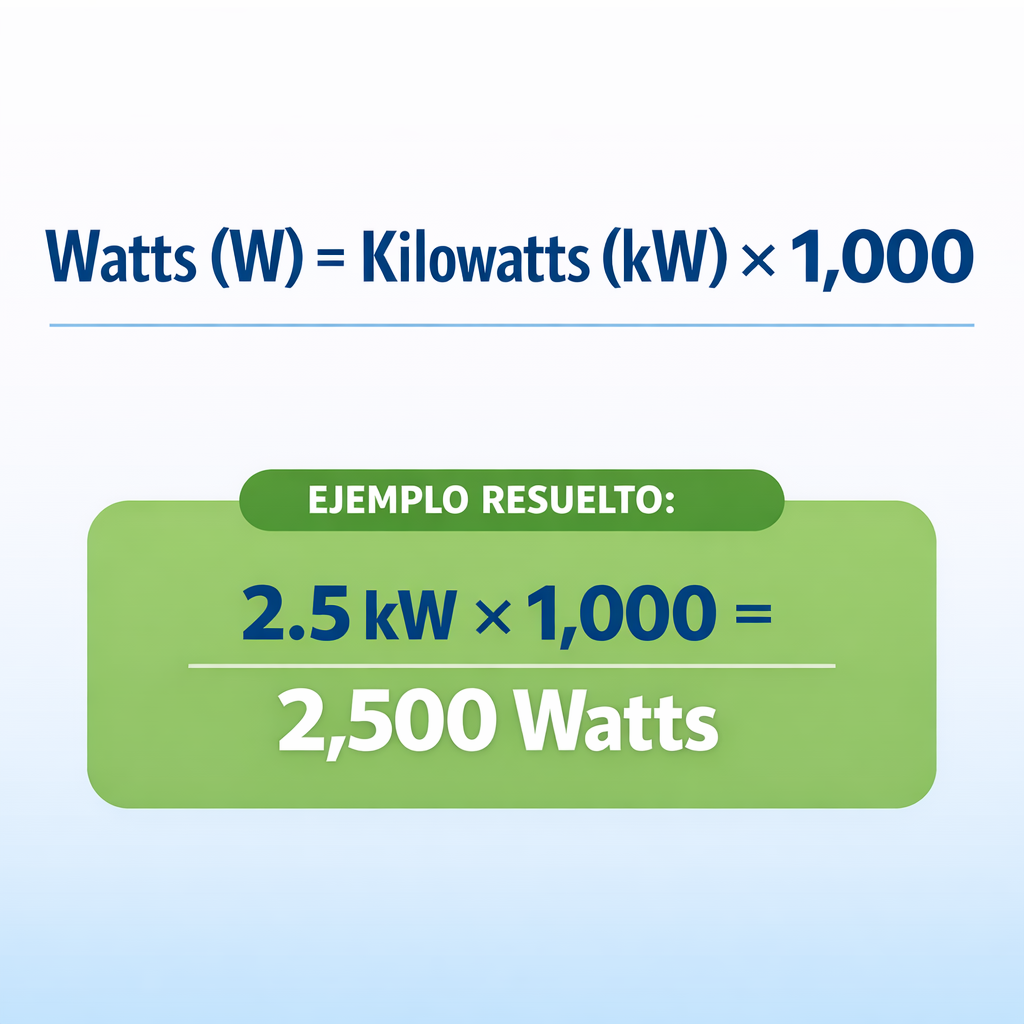
W = kW × 1000 | kW = W ÷ 1000📊 Quick Reference Table
| kW | Watts | Typical use |
|---|---|---|
| 0.1 | 100 | Light bulb |
| 0.25 | 250 | Desktop PC |
| 0.75 | 750 | Microwave oven |
| 1 | 1,000 | Space heater |
| 1.5 | 1,500 | Hair dryer |
| 2.5 | 2,500 | Electric oven |
| 5 | 5,000 | Central A/C unit |
| 7.5 | 7,500 | Industrial motor |
| 10 | 10,000 | Electric bus charger |
| 22 | 22,000 | EV DC fast charger |
❓ Quick FAQ
How many watts is 1 kW?
1 kW = 1,000 W exactly.
Is kW bigger than W?
Yes. 1 kilowatt equals 1,000 watts, so kW is the larger unit.
Converting kW to Watts is one of the most common tasks in electrical engineering, energy auditing, and everyday appliance sizing. Because the watt (W) is the SI base unit of power and the kilowatt (kW) is simply one thousand watts, the math is straightforward — yet mistakes happen when you skip a step or confuse nameplate ratings. This page gives you a free kW to Watts calculator, the exact conversion formula, a ready-to-use reference table, six fully worked examples, and a practical FAQ that covers the questions engineers and students ask most often.
Whether you are reading a motor nameplate in a factory, sizing a circuit breaker for a new appliance, checking a solar inverter spec sheet, or verifying your electricity bill, understanding how to convert kilowatts to watts — and back — is a foundational skill. The conversion itself is trivially simple (multiply or divide by 1,000), but the context matters: a 7.5 kW motor does not necessarily draw 7,500 W from the line because efficiency losses add extra watts. Throughout this guide, we address these practical subtleties so you can apply the conversion with confidence on the job site, in the classroom, or at home.
kW to Watts Conversion Table
The table below lists the kilowatt values you encounter most frequently on data sheets, motor nameplates, and utility bills — each converted to watts with a typical real-world application so you can validate your own calculations at a glance.
| Kilowatts (kW) | Watts (W) | Typical Application |
|---|---|---|
| 0.05 | 50 | Laptop charger |
| 0.1 | 100 | Incandescent light bulb |
| 0.2 | 200 | LCD television |
| 0.25 | 250 | Desktop computer |
| 0.5 | 500 | Window fan |
| 0.75 | 750 | Microwave oven (compact) |
| 1 | 1,000 | Portable space heater |
| 1.2 | 1,200 | Steam iron |
| 1.5 | 1,500 | Professional hair dryer |
| 2 | 2,000 | Electric kettle |
| 2.5 | 2,500 | Residential oven element |
| 3 | 3,000 | Tankless water heater (small) |
| 3.7 | 3,700 | 5 HP single-phase motor (input) |
| 5 | 5,000 | Central air-conditioning compressor |
| 7.5 | 7,500 | 10 HP three-phase motor (input) |
| 10 | 10,000 | Commercial kitchen range |
| 15 | 15,000 | Industrial compressor |
| 22 | 22,000 | EV DC fast-charger station |
| 50 | 50,000 | Medium industrial motor |
| 100 | 100,000 | Large industrial drive |
Notice how every value is simply the kW number multiplied by 1,000. If you keep that single factor in mind, you can convert any kilowatt figure to watts — and vice versa — in seconds.
Formulas: How to Convert kW to Watts Step by Step
The relationship between kilowatts and watts comes directly from the SI prefix “kilo-” which means one thousand. That gives us two symmetrical formulas — one for each direction.
To convert kilowatts to watts, take the kW value and multiply it by 1,000. The result is the equivalent power expressed in watts.
For the reverse path — watts to kilowatts — divide the watt value by 1,000.
The “kilo-” prefix is part of the International System of Units (SI) and behaves identically across all SI units: 1 kilometer = 1,000 meters, 1 kilogram = 1,000 grams, and 1 kilowatt = 1,000 watts. This consistency means you never need a special conversion constant for kW to watts — the factor is always exactly 1,000, making the result perfectly precise with zero rounding error. Contrast this with conversions that involve non-SI units like horsepower, where you need an irrational constant (1 HP ≈ 745.7 W) and inevitably introduce small rounding differences.
Step-by-step: Convert 2.5 kW to Watts
- Identify the value: 2.5 kW.
- Apply the formula: W = 2.5 × 1,000.
- Calculate: W = 2,500 W.
- Verify context: 2,500 W is consistent with a residential electric oven element — the number makes sense.
Because the factor is always exactly 1,000 (no rounding involved), the conversion is precise — there is zero error regardless of how many decimal places you carry. This is different from conversions like amps to kW, where you also need voltage and power factor.
kW vs. W — Units Compared
Both units measure power — the rate at which energy is consumed, produced, or transferred — but they sit at different scales. The table below highlights the key differences so you can choose the right unit for the right context.
| Attribute | Watt (W) | Kilowatt (kW) |
|---|---|---|
| SI symbol | W | kW |
| Magnitude | Base unit | 1,000 W |
| Named after | James Watt | James Watt |
| Defined by | 1 J/s (joule per second) | 1,000 J/s |
| Common context | Light bulbs, USB chargers, electronics | Appliances, motors, HVAC, solar arrays |
| Energy billing unit | Wh (watt-hour) | kWh (kilowatt-hour) |
| Typical range | 0.1 W – 2,000 W | 0.5 kW – 500 kW |
| Standard references | IEEE, IEC 80000-6 | Same standards |
Electricians and engineers in the field tend to use kW for any load above about 1,000 W because it keeps numbers short and reduces mistakes on one-line diagrams, load schedules, and panel labels. The NEMA nameplate standard, for example, rates motors in kW (or HP) — never in raw watts.
In residential settings, you will see watts on light bulb packaging, power-strip ratings, and small appliance labels. The moment you step into commercial or industrial work — switchgear schedules, generator sizing, transformer load calculations — everything shifts to kilowatts (or even megawatts for utility-scale equipment). Knowing when to use each unit prevents embarrassing zero-counting errors on bid documents and engineering drawings. A misplaced decimal turning 7.5 kW into 750 W could lead to an undersized cable, a nuisance trip, or worse — a thermal failure.
Watts to kW — Inverse Conversion
If you already know the wattage and need kilowatts, use the inverse formula:
| Watts (W) | Kilowatts (kW) | Example device |
|---|---|---|
| 100 | 0.1 | Incandescent lamp |
| 250 | 0.25 | Desktop PC |
| 500 | 0.5 | Window fan |
| 750 | 0.75 | Small microwave |
| 1,000 | 1 | Space heater |
| 1,500 | 1.5 | Hair dryer |
| 2,000 | 2 | Electric kettle |
| 3,000 | 3 | Small tankless water heater |
| 5,000 | 5 | Central A/C compressor |
| 10,000 | 10 | Commercial kitchen range |
For a dedicated inverse tool, try our Amps to Watts calculator, which also factors in voltage and power factor for more complex scenarios.
A practical tip: when you read an appliance label that says “2,000 W” and you want to know the cost of running it, convert to kW first (2 kW), then multiply by your electricity rate. Most utilities bill in kWh, so everything flows faster once you work in kilowatts. For instance, 2 kW × 5 hours = 10 kWh × $0.12/kWh = $1.20 — a quick energy-cost estimate you can do on a jobsite with no calculator at all.
6 Solved Examples — Real-World kW to Watts Problems
Example 1 — Portable Heater Rating
Data: A portable heater is rated at 1.5 kW.
Formula: W = kW × 1,000
Calculation: W = 1.5 × 1,000 = 1,500 W
You need 1,500 W to select the correct 15 A / 120 V branch circuit (1,500 W ÷ 120 V = 12.5 A). A standard 15 A circuit handles this, but there is almost no margin — a dedicated 20 A circuit is safer.
Example 2 — Solar Inverter Output
Data: A residential solar inverter is rated at 5 kW.
Formula: W = kW × 1,000
Calculation: W = 5 × 1,000 = 5,000 W
5,000 W tells you the inverter can feed up to twenty 250 W solar panels at peak production — important when sizing the AC disconnect and feeder breaker.
Example 3 — EV Charger Station
Data: A Level 2 EV charger is rated at 7.4 kW.
Formula: W = kW × 1,000
Calculation: W = 7.4 × 1,000 = 7,400 W
At 240 V single-phase, 7,400 W draws about 30.8 A — so you need at least a 40 A breaker (NEC 125% continuous load rule: 30.8 × 1.25 = 38.5 A → 40 A).
Example 4 — Industrial Pump Motor
Data: A three-phase pump motor nameplate reads 22 kW.
Formula: W = kW × 1,000
Calculation: W = 22 × 1,000 = 22,000 W
22,000 W is the shaft output. If the motor has 91% efficiency, the electrical input is 22,000 ÷ 0.91 ≈ 24,176 W (24.2 kW). That distinction matters when sizing cables and circuit breakers.
Example 5 — Small Appliance Label
Data: A blender label says 0.25 kW.
Formula: W = kW × 1,000
Calculation: W = 0.25 × 1,000 = 250 W
250 W on a 120 V outlet draws only 2.1 A — comfortably within a shared kitchen circuit. You can run this alongside a toaster without tripping the breaker.
Example 6 — Data Center UPS
Data: A data-center UPS module is rated at 100 kW.
Formula: W = kW × 1,000
Calculation: W = 100 × 1,000 = 100,000 W
100,000 W feeds roughly 200 server racks drawing 500 W each. Knowing the wattage helps the facility engineer calculate battery runtime: if batteries store 200 kWh, autonomy is about 2 hours at full load.
kW to Watts in Electric Motors
Motor nameplates can be confusing because they show the shaft output power in kW (or HP), not the electrical input. To get the actual wattage the motor draws from the supply, you need to factor in efficiency.
Here, η (eta) is the motor efficiency expressed as a decimal — for example, 0.92 for a 92%-efficient motor.
Motor conversion example
A 7.5 kW three-phase motor has a nameplate efficiency of 89.5%.
- Convert shaft power to watts: 7.5 × 1,000 = 7,500 W.
- Calculate electrical input: 7,500 ÷ 0.895 = 8,380 W (8.38 kW).
- The extra 880 W becomes heat inside the motor — and you must size your cable and breaker for 8,380 W, not 7,500 W.
This is why the distinction between rated kW and consumed watts is critical on every load schedule. If you are working with HP-rated motors, see our Amps to HP calculator for the full conversion path.
Typical motor efficiencies and input watts
The table below shows how the electrical input (in watts) increases as motor efficiency decreases. These are typical values for TEFC (totally enclosed fan-cooled) three-phase induction motors per NEMA MG 1 standards.
| Nameplate kW | Shaft watts (kW × 1,000) | Typical η (%) | Electrical input (W) | Heat loss (W) |
|---|---|---|---|---|
| 0.75 | 750 | 82.5 | 909 | 159 |
| 1.5 | 1,500 | 86.5 | 1,734 | 234 |
| 3.7 | 3,700 | 89.5 | 4,134 | 434 |
| 7.5 | 7,500 | 91.0 | 8,242 | 742 |
| 15 | 15,000 | 92.4 | 16,234 | 1,234 |
| 22 | 22,000 | 93.0 | 23,656 | 1,656 |
| 37 | 37,000 | 94.1 | 39,320 | 2,320 |
As you can see, a 22 kW motor does not draw 22,000 W — it draws closer to 23,656 W at full load. That extra 1,656 W turns into heat inside the frame. When you size variable-frequency drives (VFDs), motor circuit protectors, or feeder conductors, always calculate from the input watts, not the nameplate kW. Ignoring efficiency has caused many costly over-temperature shutdowns in real-world installations.
Quick Equivalences
1 kW in Watts
1,000 W
The baseline conversion. 1 kW always equals exactly 1,000 W — no rounding needed.
0.25 kW to Watts
250 W
Common for desktop PCs, blenders, and small power tools.
0.2 kW to Watts
200 W
Typical LED TV or game console at full load.
0.75 kW to Watts
750 W
Compact microwave or 1 HP motor shaft output.
1.2 kW to Watts
1,200 W
A steam iron or a medium-power toaster oven.
2.5 kW to Watts
2,500 W
Standard residential oven element or a large space heater.
22 kW to Watts
22,000 W
EV DC fast charger or a 30 HP three-phase industrial motor.
1 kW in W
1,000 W
Alternate query format — same answer: one kilowatt is one thousand watts.
Kilowatts to Watts
Multiply by 1,000
Generic rule. Works for any kW value — just move the decimal point three places to the right.
kW to Watt
× 1,000
Same formula whether you write “watt” or “watts.” The SI unit is always W.
FAQ — kW to Watts Conversion
How many watts are in 1 kilowatt?
1 kW equals exactly 1,000 W. The prefix “kilo-” means one thousand, so the conversion factor is always 1,000 — no exceptions, no rounding.
How do you convert kW to watts?
Multiply the kW value by 1,000. Formula: W = kW × 1,000. For example, 3.5 kW × 1,000 = 3,500 W.
Is 1 kW the same as 1,000 watts?
Yes, exactly. 1 kW = 1,000 W by definition of the SI prefix system. There is zero conversion error.
Why do motor nameplates show kW instead of watts?
Motors handle power levels in the thousands of watts. Using kW keeps the number compact — “7.5 kW” is easier to read than “7,500 W” on a small metal nameplate. Additionally, international standards like IEC 60034 require motor ratings in kW for consistency across manufacturers and countries. In North America, you will also see HP alongside kW; the IEC world standardized on kW decades ago to avoid the imperial-to-metric confusion that horsepower introduces.
What is the difference between kW and kWh?
kW measures power (rate of energy use). kWh measures energy (total consumption over time). If a 2 kW heater runs for 3 hours, it consumes 2 × 3 = 6 kWh. Think of kW as the speedometer reading and kWh as the odometer — one tells you the rate, the other tells you the accumulated total. Your electricity bill is always in kWh because the utility charges you for how much energy you used, not just how fast you used it.
How many watts is 1.5 kW?
1,500 W. Calculation: 1.5 × 1,000 = 1,500 W — a typical hair-dryer rating.
How do I convert watts back to kW?
Divide by 1,000. Formula: kW = W ÷ 1,000. For instance, 4,200 W ÷ 1,000 = 4.2 kW.
Is the conversion from kW to watts exact or approximate?
It is exact. The kilowatt is defined as 1,000 watts — there are no rounding uncertainties, unlike conversions between HP and kW (1 HP ≈ 0.7457 kW).
What does 0.75 kW mean in watts?
750 W. This value corresponds to about 1 HP shaft output, a common rating for fractional-horsepower motors in appliances.
How many watts is 22 kW?
22,000 W. You see 22 kW on EV DC fast-charger specifications and on 30 HP-class industrial three-phase motor nameplates.
Can I convert kW to watts for AC and DC equally?
Yes. The kW-to-watt conversion is purely a unit-scale change (× 1,000). It applies to AC power, DC power, and even mechanical shaft power without any difference. What does change between AC and DC is how you calculate kW in the first place — AC requires voltage, current, and power factor, while DC only needs voltage and current. But once you already have a kW value, multiplying by 1,000 gives you watts regardless of the type of circuit.
Why is my electricity bill in kWh and not Wh?
Because household consumption adds up to hundreds of thousands of watt-hours per month. Expressing it in kWh keeps numbers manageable — 350 kWh is easier to read than 350,000 Wh. Commercial and industrial facilities may consume millions of watt-hours, so their bills are often in MWh (megawatt-hours). The same kilo- prefix logic applies: 1 MWh = 1,000 kWh = 1,000,000 Wh.