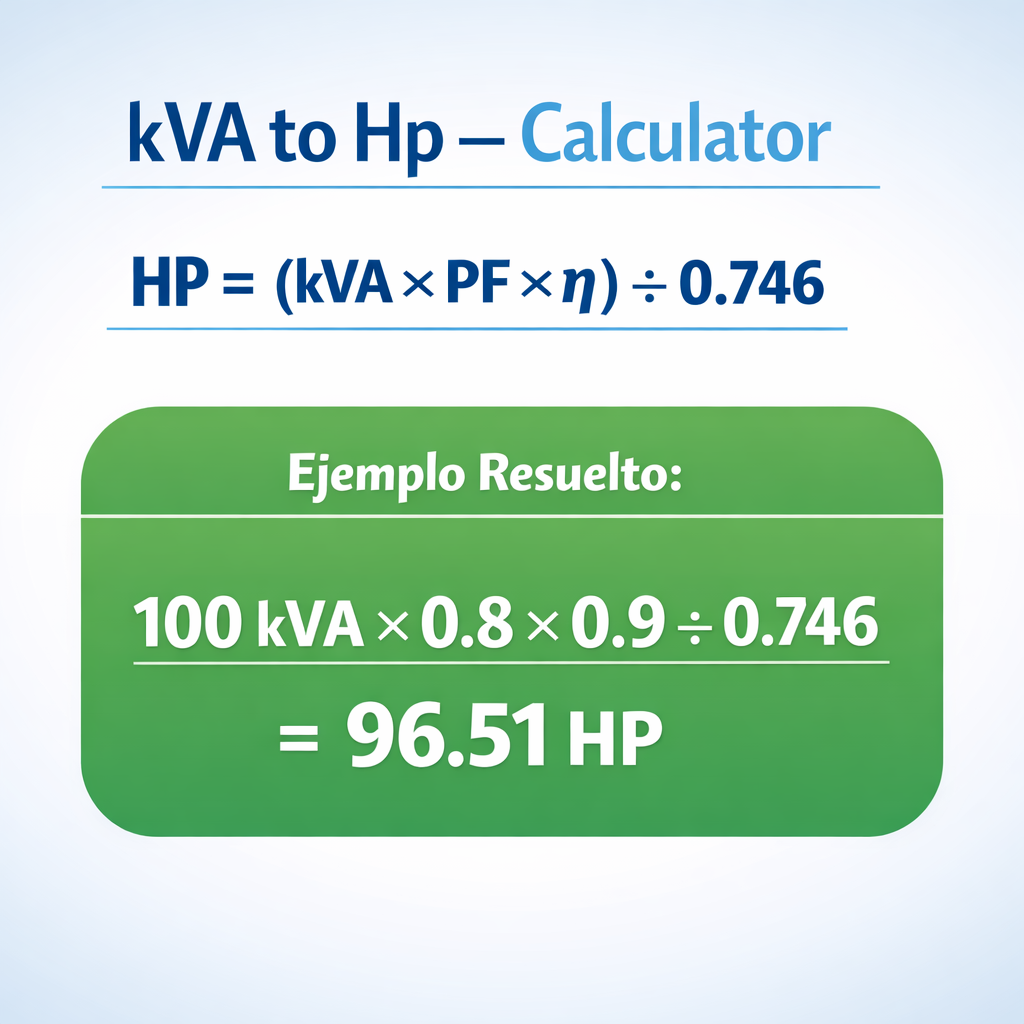
HP = (kVA × PF × η) ÷ 0.746 · kVA = (HP × 0.746) ÷ (PF × η) · 1 HP ≈ 746 W · Default: PF = 0.8, η = 0.90Quick reference table
| kVA | HP (PF 0.8, η 0.9) |
|---|
Formulas used
kVA → HP: HP = (kVA × PF × η) ÷ 0.746
HP → kVA: kVA = (HP × 0.746) ÷ (PF × η)
1 HP ≈ 746 W = 0.746 kW
Converting kVA to HP is essential whenever you need to match an electrical supply (rated in kilovolt-amperes) to the mechanical output of a motor or generator (rated in horsepower). The conversion is not a simple 1:1 ratio — it depends on two key variables: the power factor (PF) and the motor efficiency (η). This kVA to HP calculator handles both directions instantly, letting you size motors, generators, and transformers with confidence. Whether you are specifying a pump drive, auditing a plant, or selecting a standby generator, the formulas and tables below give you everything you need.
kVA to HP: electrical input or shaft output?
For motor shaft output, use HP = kVA × PF × efficiency ÷ 0.745699872. At illustrative PF 0.80 and efficiency 0.90, 5 kVA corresponds to 4.83 HP, 30 kVA to 28.97 HP and 100 kVA to 96.55 HP.
If you only need electrical real power, convert kVA to kW without applying motor efficiency. A generator’s kVA rating alone cannot establish the size of motor it can start.
Rounding in this calculator: the tool uses 1 HP = 0.746 kW. With the same PF and efficiency, it displays 4.83, 28.95 and 96.51 HP for 5, 30 and 100 kVA respectively. The examples above use the more precise 0.745699872 kW/HP constant.
Continue your calculation:
1. kVA to HP Conversion Table (Standard Motor Values)
This kVA to HP table covers the ratings you will encounter most often on motor nameplates, generator sets, and transformer specs. All values assume PF = 0.80 and η = 0.90, which are illustrative assumptions, not guaranteed conservative values for a particular motor. If your equipment has different PF or efficiency, use the kVA to HP calculator above for results under your entered assumptions.
| kVA | HP (PF 0.8, η 0.9) | HP (PF 0.85, η 0.92) | HP (PF 1.0, η 1.0) | Typical Application |
|---|---|---|---|---|
| 1 kVA | 0.97 HP | 1.05 HP | 1.34 HP | Small single-phase motor |
| 3 kVA | 2.89 HP | 3.14 HP | 4.02 HP | Workshop compressor |
| 5 kVA | 4.83 HP | 5.24 HP | 6.70 HP | Small generator, pump motor |
| 10 kVA | 9.65 HP | 10.48 HP | 13.40 HP | Commercial HVAC compressor |
| 15 kVA | 14.48 HP | 15.72 HP | 20.11 HP | Industrial fan, conveyor drive |
| 20 kVA | 19.30 HP | 20.96 HP | 26.81 HP | Elevator motor, large pump |
| 25 kVA | 24.13 HP | 26.21 HP | 33.51 HP | Large air compressor |
| 30 kVA | 28.95 HP | 31.45 HP | 40.21 HP | Industrial blower, crusher |
| 50 kVA | 48.26 HP | 52.41 HP | 67.02 HP | Medium industrial motor |
| 75 kVA | 72.39 HP | 78.62 HP | 100.54 HP | Large pump station |
| 80 kVA | 77.21 HP | 83.86 HP | 107.24 HP | Mining equipment, crane motor |
| 90 kVA | 86.86 HP | 94.34 HP | 120.64 HP | Large HVAC chiller |
| 100 kVA | 96.51 HP | 104.83 HP | 134.05 HP | Industrial drive, generator set |
| 125 kVA | 120.64 HP | 131.04 HP | 167.56 HP | Large compressor station |
| 150 kVA | 144.77 HP | 157.24 HP | 201.07 HP | Water treatment pump |
| 200 kVA | 193.03 HP | 209.65 HP | 268.10 HP | Mill drive, large generator |
| 250 kVA | 241.29 HP | 262.06 HP | 335.12 HP | Mining conveyor, plant feeder |
| 500 kVA | 482.57 HP | 524.13 HP | 670.24 HP | Large industrial motor, substation |
Note: All values calculated using HP = (kVA × PF × η) ÷ 0.746. Rounded to 2 decimals. Real-world results may differ slightly depending on operating temperature, altitude derating, and motor class.
2. Step-by-Step kVA to HP Formulas
The kVA to HP conversion requires understanding the relationship between apparent power (kVA), real power (kW), and mechanical output (HP). Here are all the formulas you need, broken down by direction and circuit type.
kVA to HP — Primary Formula
This formula converts the electrical apparent power supply (kVA) to the mechanical output of the motor (HP). The steps are: kVA × PF gives you real electrical power in kW, then × η converts to mechanical output, and ÷ 0.746 converts kW to HP. You need both PF and efficiency because kVA includes reactive power and motor losses.
Simplified Formula (When η Is Unknown)
If you don’t know the motor efficiency, this simplified version treats η = 1.0 (no losses). The result will be higher than actual HP output because real motors always have losses. Use this only for rough estimates — for equipment sizing, always include efficiency.
Three-Phase Motor kVA
If your motor nameplate shows voltage and current instead of kVA, calculate the apparent power first using this formula (for three-phase). Then apply the kVA to HP formula. For single-phase: kVA = (V × I) ÷ 1000.
Using Watts Directly
If you already know the mechanical output in Watts, simply divide by 746. This skips the PF and η steps because you are working with the final output power. Use our Amps to Watts calculator if you need to find Watts from current and voltage first.
Variable Reference
| Variable | Unit | Description |
|---|---|---|
| kVA | Kilovolt-Amperes | Apparent power — total power the source delivers (includes reactive power) |
| HP | Horsepower | Mechanical output power of the motor shaft (1 HP ≈ 746 W) |
| PF | Dimensionless (0–1) | Power factor — ratio of real power to apparent power |
| η (eta) | Dimensionless (0–1) | Motor efficiency — ratio of mechanical output to electrical input |
| 0.746 | kW/HP | Conversion constant (1 HP = 0.746 kW = 746 W) |
| VL-L | Volts | Line-to-line voltage in three-phase systems |
3. Motor Types & Efficiency Differences
The result of your kVA to HP conversion changes significantly depending on the type of motor and its efficiency class. A high-efficiency motor extracts more mechanical HP from the same kVA supply than a standard motor. Here is a comparison of the most common motor types and how they affect the conversion.
| Motor Type | Typical PF | Typical η | HP per kVA | Notes |
|---|---|---|---|---|
| Standard Induction (NEMA MG 1) | 0.78 – 0.85 | 0.85 – 0.91 | 0.89 – 1.04 | Most common industrial motor. PF drops at partial load. |
| NEMA Premium Efficiency | 0.82 – 0.90 | 0.91 – 0.96 | 1.00 – 1.16 | 2–6% higher η. Saves energy over lifetime. |
| Synchronous Motor | 0.90 – 1.00 | 0.92 – 0.97 | 1.11 – 1.30 | Can run at unity or leading PF. Used for PF correction. |
| Single-Phase Induction | 0.60 – 0.80 | 0.70 – 0.85 | 0.56 – 0.91 | Lower PF and η than three-phase. Residential/light commercial. |
| DC Motor | 1.00 | 0.85 – 0.95 | 1.14 – 1.27 | PF = 1.0 (no reactive power). Good speed control. |
| Variable Frequency Drive (VFD) | 0.95 – 0.98 | 0.90 – 0.96 | 1.15 – 1.26 | Input PF near unity due to rectifier front-end. |
Key takeaway: A standard induction motor at PF 0.80 and η 0.90 delivers about 0.965 HP per kVA. A synchronous motor at PF 0.95 and η 0.95 delivers about 1.21 HP per kVA — 25% more mechanical output from the same electrical supply. This is why the kVA to HP calculator asks for both PF and efficiency.
4. Reverse Conversion: HP to kVA
When you know the motor HP rating and need to determine the kVA demand for transformer or generator sizing, use the reverse formula:
This is critical for sizing the electrical supply. A motor rated at 50 HP does not draw 50 × 0.746 = 37.3 kW from the supply — it draws more, because you must account for motor losses (η) and the reactive power component (PF). For reliable transformer sizing, see our transformer kVA sizing calculator.
| Motor HP | PF 0.80, η 0.90 → kVA | PF 0.85, η 0.92 → kVA | PF 0.90, η 0.95 → kVA |
|---|---|---|---|
| 1 HP | 1.04 kVA | 0.95 kVA | 0.87 kVA |
| 5 HP | 5.18 kVA | 4.77 kVA | 4.36 kVA |
| 10 HP | 10.36 kVA | 9.54 kVA | 8.72 kVA |
| 15 HP | 15.54 kVA | 14.30 kVA | 13.08 kVA |
| 25 HP | 25.90 kVA | 23.84 kVA | 21.81 kVA |
| 50 HP | 51.81 kVA | 47.67 kVA | 43.61 kVA |
| 75 HP | 77.71 kVA | 71.51 kVA | 65.42 kVA |
| 100 HP | 103.61 kVA | 95.40 kVA | 87.25 kVA |
| 200 HP | 207.22 kVA | 190.69 kVA | 174.44 kVA |
5. Solved Examples — Real-World kVA to HP Conversions
Here are six practical kVA to HP conversion examples covering motors, generators, and transformers. Each one walks through the complete calculation with real numbers.
Example 1 — Industrial Pump Motor
Data: Motor fed from a 75 kVA supply. Nameplate PF = 0.85, efficiency η = 0.92.
Formula: HP = (kVA × PF × η) ÷ 0.746 = (75 × 0.85 × 0.92) ÷ 0.746 = 78.62 HP
This 75 kVA supply can feed a motor delivering approximately 78.6 HP of mechanical output — enough for a large centrifugal pump in a water treatment plant or irrigation station.
Example 2 — Standby Generator Capacity
Data: Generator rated at 200 kVA. Expected loads are motors with average PF = 0.80 and η = 0.90.
Formula: HP = (200 × 0.80 × 0.90) ÷ 0.746 = 193.03 HP
Your 200 kVA generator can support roughly 193 HP of total motor load. Remember to leave 15–20% headroom for motor starting surges. For precise generator sizing, use our generator load-list calculator.
Example 3 — Small Workshop Compressor
Data: Single-phase supply: 5 kVA. Motor PF = 0.75, η = 0.85.
Formula: HP = (5 × 0.75 × 0.85) ÷ 0.746 = 4.27 HP
A 5 kVA single-phase supply can run a compressor motor of about 4.3 HP. If your compressor is rated at 5 HP, the supply is undersized — you would need approximately 5.85 kVA to safely run a 5 HP motor at this PF and η.
Example 4 — Mining Conveyor Drive (Reverse: HP to kVA)
Data: Conveyor motor rated at 100 HP. PF = 0.82, η = 0.91.
Formula: kVA = (HP × 0.746) ÷ (PF × η) = (100 × 0.746) ÷ (0.82 × 0.91) = 99.97 kVA
A 100 HP conveyor motor draws approximately 100 kVA from the supply. The transformer feeding this motor must be rated at least 100 kVA — plus margin for voltage drop, starting current, and future load growth. A 125 kVA transformer would be the standard next-size-up selection.
Example 5 — HVAC Chiller with VFD
Data: Chiller compressor driven by VFD, supply rated at 90 kVA. VFD input PF = 0.97, motor η = 0.94.
Formula: HP = (90 × 0.97 × 0.94) ÷ 0.746 = 110.00 HP
The VFD’s near-unity power factor means this 90 kVA supply delivers significantly more HP than the same supply with a standard motor (compare 110 HP vs. 86.9 HP at PF 0.80). VFDs maximize the usable capacity of your electrical infrastructure.
Example 6 — Transformer Sizing for Motor Room
Data: Total motor load: 250 HP. Average PF = 0.83, average η = 0.91.
Formula: kVA = (250 × 0.746) ÷ (0.83 × 0.91) = 246.92 kVA
The motor room requires roughly 247 kVA of transformer capacity. The next standard transformer size is 300 kVA (per IEEE C57.12), providing about 21% headroom for load growth and starting surges.
6. kVA to HP on Motor Nameplates
Motor nameplates rarely list kVA directly. Instead, they show voltage, current (FLA), HP, efficiency, and power factor. Here is how to use nameplate data with the kVA to HP calculator.
Calculating kVA from Nameplate Data
For a three-phase motor: read V (voltage) and FLA (full load amps) from the nameplate, then compute:
For a single-phase motor:
Once you have kVA, use HP = (kVA × PF × η) ÷ 0.746 to verify the nameplate HP — or to determine the actual HP output if the motor is running at a different load point. For detailed motor efficiency analysis, check our electric motor efficiency calculator.
Why kVA Input Exceeds HP Output
A motor rated at 100 HP draws more than 100 HP worth of apparent power because of two losses:
| Loss Source | What It Does | Typical Impact |
|---|---|---|
| Power Factor (PF < 1) | Reactive power circulates but does no work — inflates kVA relative to kW | Adds 10–30% to kVA demand vs. kW |
| Efficiency (η < 1) | Copper losses, core losses, friction, windage dissipate energy as heat | Adds 4–15% to electrical input vs. mechanical output |
So a 100 HP motor at PF 0.80 and η 0.90 draws: kVA = (100 × 0.746) ÷ (0.80 × 0.90) = 103.61 kVA from the supply — not 74.6 kVA (which would only be true if PF and η were both 1.0). This is why proper kVA to HP conversion is essential for electrical system design.
7. Quick Equivalences — Common kVA to HP Values
Here are instant answers for the most searched kVA to HP conversions. Each assumes PF = 0.80 and η = 0.90 unless stated otherwise. Use the kVA to HP calculator above for custom PF and η values.
1 kVA to HP
0.97 HP (PF 0.8, η 0.9)
A 1 kVA supply delivers just under 1 HP. Common for small fractional motors and bench tools.
3 kVA to HP
2.89 HP (PF 0.8, η 0.9)
Typical for small portable generators. At PF 1.0 and η 1.0 (ideal): 4.02 HP.
5 kVA to HP
4.83 HP (PF 0.8, η 0.9)
Common for residential generators and small workshop motors. Can run a 5 HP motor only if PF and η are high enough.
10 kVA to HP
9.65 HP (PF 0.8, η 0.9)
Typical commercial HVAC compressor supply. Nearly matches a 10 HP motor at standard conditions.
75 kVA to HP
72.39 HP (PF 0.8, η 0.9)
Large pump station or industrial blower. At PF 0.85 and η 0.92: 78.62 HP.
80 kVA to HP
77.21 HP (PF 0.8, η 0.9)
Used for mining equipment, crane motors, and medium industrial drives.
90 kVA to HP
86.86 HP (PF 0.8, η 0.9)
Large HVAC chiller or industrial fan motor. With a VFD (PF 0.97, η 0.94): 110 HP.
100 kVA to HP
96.51 HP (PF 0.8, η 0.9)
Industrial drive or generator set. A 100 kVA supply can comfortably run a 75 HP motor with starting margin.
125 kVA to HP
120.64 HP (PF 0.8, η 0.9)
Large compressor stations and medium-scale manufacturing drives.
200 kVA to HP
193.03 HP (PF 0.8, η 0.9)
Standby generator capacity for small industrial plants or large commercial buildings.
250 kVA to HP
241.29 HP (PF 0.8, η 0.9)
Heavy mining conveyors, crushers, and plant distribution feeders.
500 kVA to HP
482.57 HP (PF 0.8, η 0.9)
Large industrial substations, mill drives, and primary distribution transformers.
8. FAQ — kVA to HP Conversion
What is the formula to convert kVA to HP?
HP = (kVA × PF × η) ÷ 0.746. Multiply the kVA by the power factor and motor efficiency, then divide by 0.746 (since 1 HP = 0.746 kW). For example, 100 kVA × 0.8 × 0.9 ÷ 0.746 = 96.51 HP.
How many HP is 1 kVA?
At PF = 0.80 and η = 0.90, 1 kVA = 0.97 HP. At ideal conditions (PF = 1.0, η = 1.0), 1 kVA = 1.34 HP. The exact answer always depends on PF and efficiency.
Why can’t I just multiply kVA by 1.34 to get HP?
Because 1.34 assumes PF = 1 and η = 1, which never happens in real motors. Real induction motors have PF = 0.78–0.90 and η = 0.85–0.96, so the actual HP output is significantly less. Using 1.34 will oversize your motor estimate and undersize your transformer.
What PF and efficiency should I use if I don’t know them?
PF = 0.80 and η = 0.90 are safe conservative defaults for standard three-phase induction motors. These give ~0.965 HP per kVA. For single-phase motors, use PF = 0.70 and η = 0.82 as a starting point.
How do I convert HP to kVA?
kVA = (HP × 0.746) ÷ (PF × η). For example, a 50 HP motor at PF 0.80 and η 0.90 requires: (50 × 0.746) ÷ (0.80 × 0.90) = 51.81 kVA of supply capacity.
Is kVA to HP the same for single-phase and three-phase?
The conversion formula is identical — HP = (kVA × PF × η) ÷ 0.746. However, single-phase motors typically have lower PF (0.60–0.80) and lower efficiency (0.70–0.85) than three-phase motors, so they produce fewer HP from the same kVA.
Does a VFD change the kVA to HP ratio?
Yes, significantly. A VFD (variable frequency drive) raises the effective input power factor to 0.95–0.98 thanks to its rectifier front-end. This means more of the kVA supply is converted to useful HP. A 90 kVA supply with a VFD (PF 0.97, η 0.94) delivers ~110 HP vs ~87 HP without a VFD.
Why does my generator kVA rating not match the HP I can run?
Because of motor starting current (inrush). Induction motors draw 5–8× their rated current during startup, lasting 0.5–5 seconds. A generator must handle this transient surge without excessive voltage drop. A 100 kVA generator can run ~96 HP in steady state, but may struggle starting a 75 HP motor across-the-line. Use reduced-voltage starters or VFDs to manage inrush.
What is the relationship between kVA, kW, and HP?
kW = kVA × PF (real power from apparent power). HP = kW ÷ 0.746 (mechanical HP from electrical kW, assuming η = 1; otherwise HP = kW × η ÷ 0.746). So kVA → kW → HP, with PF and η as the bridge factors at each step.
Can kVA to HP conversion apply to generators?
Yes. For generators, the kVA rating is the electrical output capacity, and HP tells you the mechanical load it can feed. A 200 kVA generator at PF 0.80 can power up to 193 HP of motor load (at η 0.90). Generator nameplates also list kW — usually kVA × 0.80 — which is the real power limit.
What standards define HP and kVA ratings?
NEMA MG 1 defines motor HP ratings, efficiency classes, and nameplate requirements for North America. IEC 60034 is the international equivalent, using kW instead of HP for motor output. IEEE C57.12 governs transformer kVA ratings.
How do I convert kVA to HP for a transformer?
Use the same formula: HP = (kVA × PF × η) ÷ 0.746. Here, kVA is the transformer rating, PF is the power factor of the connected load, and η is the efficiency of the motors being fed. For a 500 kVA transformer feeding motors at PF 0.82 and η 0.91: HP = (500 × 0.82 × 0.91) ÷ 0.746 = 500.1 HP of total motor capacity.
9. Related Conversions
If you found this kVA to HP calculator useful, these related tools can help with your next electrical project:
- Amps to HP Calculator — convert current directly to horsepower for any voltage.
- Amps to kW Calculator — convert current to kilowatts for single-phase and three-phase.
- Amperes to VA Calculator — find apparent power from current and voltage.
- Amps to Watts Calculator — convert current to real power in Watts.
- Electric Motor Efficiency Calculator — analyze motor input vs. output power and losses.
- Balanced and Unbalanced Load Calculation — distribute loads evenly across three-phase panels.