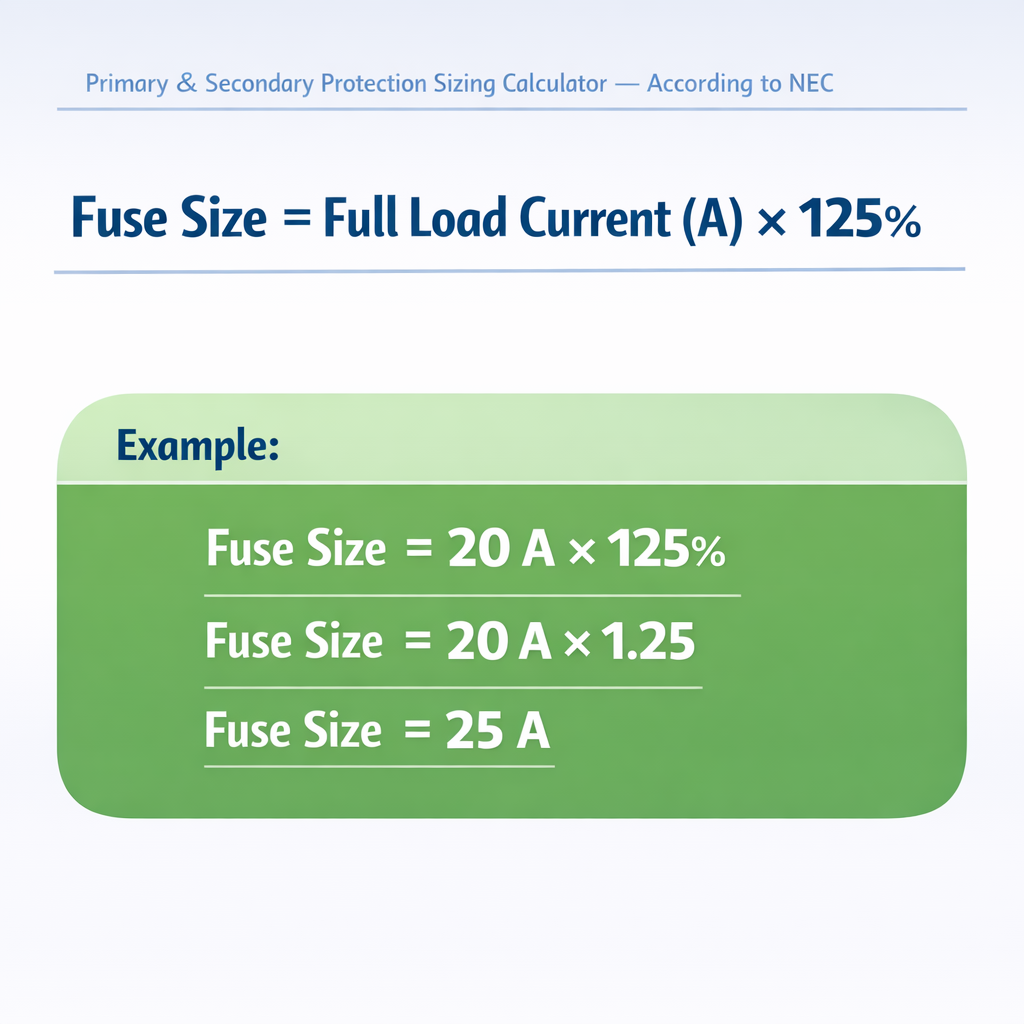
FLA₁φ = kVA × 1,000 ÷ V · FLA₃φ = kVA × 1,000 ÷ (V × √3) · Primary OCPD ≤ 125 % FLA (or 250 % with secondary OCPD)📊 NEC 240.6(A) Standard Sizes
15, 20, 25, 30, 35, 40, 45, 50, 60, 70, 80, 90, 100, 110, 125, 150, 175, 200, 225, 250, 300, 350, 400, 450, 500, 600, 700, 800, 1000, 1200, 1600, 2000 A
Fuse-only: 1, 3, 6, 10, 601 A
The primary and secondary protection sizing calculator determines the correct overcurrent protection device (OCPD) ratings for transformers rated 1,000 V or below, according to NEC Article 450.3(B). You enter the transformer kVA, primary and secondary voltages, phase configuration, and protection method—and the calculator returns the full-load amperes, the NEC-mandated maximum percentage, and the compliant standard breaker or fuse size per NEC 240.6(A). Getting this right prevents two problems: oversized protection that fails to protect transformer windings, and undersized protection that causes nuisance tripping from magnetizing inrush current.
Whether you are sizing a 15 kVA lighting panel transformer or a 500 kVA unit substation, the NEC process is identical: compute FLA, apply the percentage from Table 450.3(B), and round to the correct standard device. Use the calculator above for an instant code-compliant answer, or read on for the full formula derivation, NEC tables, and six worked examples covering real installations.
Protection Sizing Table — Common 480 V Primary Transformers (3-Phase)
The table below shows full-load amps and maximum OCPD sizes for common three-phase transformer ratings with a 480 V primary and 208 V secondary. Values follow NEC 450.3(B) for both the primary-only (125 %) and primary + secondary (250 % / 125 %) methods. All standard sizes are per NEC 240.6(A).
| kVA | Pri FLA (480 V) | 125 % → Std OCPD | 250 % → Std OCPD | Sec FLA (208 V) | Sec 125 % → Std OCPD |
|---|---|---|---|---|---|
| 15 | 18.04 | 22.6 → 25 A | 45.1 → 45 A | 41.63 | 52.0 → 60 A |
| 30 | 36.08 | 45.1 → 50 A | 90.2 → 90 A | 83.27 | 104.1 → 110 A |
| 45 | 54.13 | 67.7 → 70 A | 135.3 → 125 A | 124.90 | 156.1 → 175 A |
| 75 | 90.21 | 112.8 → 125 A | 225.5 → 225 A | 208.17 | 260.2 → 300 A |
| 112.5 | 135.32 | 169.2 → 175 A | 338.3 → 300 A | 312.25 | 390.3 → 400 A |
| 150 | 180.42 | 225.5 → 250 A | 451.1 → 450 A | 416.33 | 520.4 → 600 A |
| 225 | 270.63 | 338.3 → 350 A | 676.6 → 600 A | 624.50 | 780.6 → 800 A |
| 300 | 360.84 | 451.1 → 500 A | 902.1 → 800 A | 832.67 | 1040.8 → 1200 A |
| 500 | 601.41 | 751.8 → 800 A | 1503.5 → 1200 A | 1387.78 | 1734.7 → 2000 A |
Key: For the 125 % column, “next higher standard size” is allowed per NEC when FLA ≥ 9 A. For the 250 % column, “next higher” is not allowed—you must use the next lower standard size. This distinction is one of the most commonly misunderstood aspects of NEC 450.3(B).
NEC Formulas for Transformer Protection — Step by Step
Every NEC protection sizing calculation begins with finding the transformer’s full-load amperes, then applying the correct percentage from Table 450.3(B), and finally selecting the nearest compliant standard OCPD from 240.6(A).
Step 1 — Full-Load Amps (FLA)
Example: 75 kVA, 3-phase, 480 V primary → FLA = 75,000 ÷ (480 × 1.732) = 75,000 ÷ 831.36 = 90.21 A.
Step 2 — Apply NEC 450.3(B) Percentage
Primary-only protection (no secondary OCPD):
• FLA ≥ 9 A → OCPD ≤ 125 % of FLA. “Next higher standard size” allowed.
• 2 A ≤ FLA < 9 A → OCPD ≤ 167 %. No round-up to next standard.
• FLA < 2 A → OCPD ≤ 300 %. No round-up.
Primary + secondary protection:
• Primary OCPD ≤ 250 % of primary FLA. No round-up.
• Secondary OCPD ≤ 125 % of secondary FLA (≥ 9 A). Next higher allowed.
• Secondary FLA < 9 A → OCPD ≤ 167 %. No round-up.
Step 3 — Select Standard Size per NEC 240.6(A)
After calculating the maximum allowed OCPD value, select the nearest compliant standard size. If “next higher” is permitted, round up; otherwise, round down. Standard sizes: 15, 20, 25, 30, 35, 40, 45, 50, 60, 70, 80, 90, 100, 110, 125, 150, 175, 200, 225, 250, 300, 350, 400, 450, 500, 600, 700, 800, 1000, 1200, 1600, 2000 A. See our Amps to kW calculator for current-to-power conversions.
Primary-Only vs. Primary + Secondary Protection
NEC 450.3(B) provides two compliant paths. Choosing between them affects OCPD sizing, conductor sizing, and panel layout.
| Feature | Primary-Only | Primary + Secondary |
|---|---|---|
| NEC reference | 450.3(B), Column A | 450.3(B), Columns B + C |
| Primary OCPD max | 125 % FLA (≥ 9 A) | 250 % FLA (no round-up) |
| Secondary OCPD | None required by Art. 450 | 125 % secondary FLA (≥ 9 A) |
| Next-higher allowed? | Yes (125 %, ≥ 9 A only) | Primary: No · Secondary: Yes (≥ 9 A) |
| Secondary conductors | Must comply with 240.21(C) | Protected by secondary OCPD |
| Typical use | Small dry-type, single panel | Large transformers, multiple panels |
| Inrush tolerance | Tight (125 %) | Generous (250 % primary) |
The primary + secondary method is preferred above 45 kVA because the 250 % primary device accommodates magnetizing inrush (8–12× FLA) without nuisance tripping, and the secondary device provides close-in overcurrent protection. For related conductor protection, see our Transformer kVA Sizing Calculator.
Standard OCPD Sizes — NEC 240.6(A)
You must select from the standard list—custom ratings like 155 A or 275 A are not permitted. Note that 160 A is not a standard NEC size; the sizes between 150 A and 200 A are 150 and 175 only.
| Range | Standard Sizes (A) |
|---|---|
| 15–100 A | 15, 20, 25, 30, 35, 40, 45, 50, 60, 70, 80, 90, 100 |
| 110–600 A | 110, 125, 150, 175, 200, 225, 250, 300, 350, 400, 450, 500, 600 |
| 700–6000 A | 700, 800, 1000, 1200, 1600, 2000, 2500, 3000, 4000, 5000, 6000 |
| Fuse-only additions | 1, 3, 6, 10, 601 |
6 Solved Examples — NEC Transformer Protection Sizing
Example 1 — 45 kVA, 3-Phase, 480→208 V, Primary-Only
Data: kVA = 45, 3φ, V_pri = 480 V
FLA: 45,000 ÷ (480 × 1.732) = 54.13 A
125 %: 54.13 × 1.25 = 67.66 A
OCPD: 70 A (next higher per 240.6(A))
Standard dry-type feeding a single 208/120 V panelboard. Secondary conductors must independently comply with NEC 240.21(C)(1)—typically the 10-foot tap rule.
Example 2 — 75 kVA, 3-Phase, 480→208 V, Primary + Secondary
Data: kVA = 75, 3φ, V_pri = 480 V, V_sec = 208 V
Primary FLA: 90.21 A → 250 % = 225.53 A → no round-up → 225 A primary
Secondary FLA: 208.17 A → 125 % = 260.21 A → next higher → 300 A secondary
Common commercial building configuration. The 225 A primary absorbs inrush without tripping. The 300 A secondary serves as the panelboard main breaker and provides conductor protection. See our Transformer Secondary Fault Current Calculator for AIC verification.
Example 3 — 15 kVA, 1-Phase, 240→120/240 V, Primary-Only
Data: kVA = 15, 1φ, V_pri = 240 V
FLA: 15,000 ÷ 240 = 62.50 A
125 %: 62.50 × 1.25 = 78.13 A
OCPD: 80 A (next higher per 240.6(A))
Residential step-down transformer for a sub-panel. Secondary FLA is also 62.50 A (at 240 V), requiring #6 AWG Cu minimum per NEC 310.16 at 75 °C. See our AWG to mm² equivalences.
Example 4 — 112.5 kVA, 3-Phase, 480→208 V, Primary + Secondary
Data: kVA = 112.5, 3φ, V_pri = 480 V, V_sec = 208 V
Primary FLA: 135.32 A → 250 % = 338.30 A → no round-up → 300 A primary
Secondary FLA: 312.25 A → 125 % = 390.31 A → next higher → 400 A secondary
The most popular commercial transformer size. The 300 A primary (rounded down from 338.3) still provides adequate inrush tolerance. See our Balanced Load Calculation for downstream distribution.
Example 5 — Small Transformer: 3 kVA, 1-Phase, 480→120 V, Primary-Only
Data: kVA = 3, 1φ, V_pri = 480 V
FLA: 3,000 ÷ 480 = 6.25 A
Rule: 2 A ≤ 6.25 A < 9 A → 167 %, no round-up
167 %: 6.25 × 1.67 = 10.44 A
OCPD: 10 A fuse (per 240.6(A) supplementary sizes)
Small control power transformer. The 167 % rule applies and “next higher” is not permitted, so a 10 A fuse is the correct choice. A 15 A CB would exceed 167 % and is non-compliant.
Example 6 — 500 kVA, 3-Phase, 480→208 V, Primary + Secondary
Data: kVA = 500, 3φ, V_pri = 480 V, V_sec = 208 V
Primary FLA: 601.41 A → 250 % = 1,503.5 A → no round-up → 1,200 A primary
Secondary FLA: 1,387.78 A → 125 % = 1,734.7 A → next higher → 2,000 A secondary
Large unit substation. The secondary main is typically a draw-out air circuit breaker (ACB) with AIC rating ≥ 65 kA. See our Arc Flash Calculator for incident energy analysis at this fault level.
NEC Code Requirements — Key Articles
NEC 450.3(B): The master rule for transformer overcurrent protection at ≤ 1,000 V. Table 450.3(B) specifies maximum OCPD percentages for primary-only and primary + secondary configurations, with different limits based on whether the current is ≥ 9 A, 2–9 A, or < 2 A.
NEC 240.6(A): Lists every permissible OCPD size. The protection sizing calculator above selects from this list automatically. Any device not on this list requires special justification.
NEC 240.21(C): Governs secondary conductor protection. When primary-only protection is used, secondary conductors are not automatically protected. Section 240.21(C) tap rules (10-ft, 25-ft, unlimited-length) define how far secondary conductors can run before reaching their own OCPD. This is especially critical for the primary-only method.
NEC 450.3(B) Note 2: On the secondary side, up to six OCPDs grouped at one location may replace a single main. The sum of their ratings must not exceed the single-device value. Common in multi-panel commercial distributions.
For the latest edition, refer to NFPA 70. For transformer thermal standards, see IEEE C57.12.00. For motor-circuit protection coordination, see NEMA AB-4.
Quick Reference — Common Transformer Sizes
45 kVA 480 V 3φ
FLA = 54.13 A
Primary-only: 70 A. With secondary: 125 A primary / 175 A secondary.
75 kVA 480 V 3φ
FLA = 90.21 A
Primary-only: 125 A. With secondary: 225 A primary / 300 A secondary.
112.5 kVA 480 V 3φ
FLA = 135.32 A
Most popular commercial size. P+S: 300 A / 400 A. Primary-only: 175 A.
NEC 450.3(B) Table
125 % or 250 % of FLA
125 % for primary-only (next ↑ allowed, ≥ 9 A). 250 % for primary with secondary OCPD (no ↑).
NEC 240.6(A)
Standard OCPD sizes
15–6,000 A. Note: 160 A is NOT standard — use 150 or 175.
NEC 240.21(C)
Secondary conductor tap rules
10-ft, 25-ft, and unlimited-length rules for secondary conductors with primary-only protection.
3-Phase FLA Formula
kVA × 1,000 ÷ (V × 1.732)
V = line-to-line voltage. Works for both primary and secondary sides.
1-Phase FLA Formula
kVA × 1,000 ÷ V
V = winding voltage. For 120/240 V secondary, use 240 V.
Frequently Asked Questions — NEC Transformer Protection
What does NEC 450.3(B) require?
NEC 450.3(B) sets maximum overcurrent protection sizes for transformers ≤ 1,000 V. You either protect on the primary only (max 125 % of FLA for ≥ 9 A) or on both primary (max 250 %) and secondary (max 125 %). The percentages change for smaller currents: 167 % for 2–9 A and 300 % for < 2 A.
How do I calculate transformer full-load amps?
For 1-phase: FLA = kVA × 1,000 ÷ V. For 3-phase: FLA = kVA × 1,000 ÷ (V × 1.732). Example: 75 kVA, 3φ, 480 V → 75,000 ÷ 831.36 = 90.21 A.
Can I round up to the next standard breaker size?
Only for the 125 % rule when FLA ≥ 9 A (both primary-only and secondary). For the 250 %, 167 %, and 300 % rules, you must use the next lower standard size if the calculated value falls between two standards.
Is 160 A a standard NEC breaker size?
No. 160 A does not appear in NEC 240.6(A). The standard sizes between 150 A and 200 A are 150 and 175 only. If your calculation yields 156 A with next-higher allowed, select 175 A.
Do I still need to protect secondary conductors with primary-only protection?
Yes. NEC 450.3 protects the transformer, not the secondary conductors. You must separately comply with 240.21(C), which provides tap rules (10-ft, 25-ft, unlimited) that limit how far secondary conductors can run before reaching their own OCPD.
What is the six-disconnect rule?
NEC 450.3(B) Note 2 allows up to six OCPDs at one location on the secondary instead of a single main breaker. The sum of their ratings must not exceed the allowed single-device value. This is standard in commercial setups with multiple panel feeders from one transformer.
Why is the 250 % primary rule so much higher than 125 %?
Because the secondary has its own OCPD providing close-in protection. The 250 % primary device accommodates transformer inrush current (8–12× FLA for the first few cycles) without nuisance tripping, while the secondary device handles normal overcurrent events.
Should I use breakers or fuses?
Either is NEC-compliant. Fuses are faster-acting and current-limiting (better arc-flash performance). Breakers are resettable and provide a visible disconnect. For small control transformers in the 2–9 A range, dual-element fuses are preferred because their time-delay handles inrush without oversizing.
Does Delta vs. Wye affect protection sizing?
No. The FLA formula uses line-to-line voltage regardless of winding configuration. Delta and Wye affect neutral availability and harmonic behavior, but not OCPD sizing per 450.3(B).
Does NEC 450.3(B) cover transformers over 1,000 V?
No. Transformers with primary voltage over 1,000 V are governed by NEC 450.3(A), which has different tables and requirements for supervised vs. unsupervised locations. This calculator covers only ≤ 1,000 V.
How does this calculator handle the 2–9 A range?
For primary-only protection with FLA between 2 A and 9 A, the calculator applies the 167 % rule and selects the next lower standard size (no round-up). For example, 6.25 A × 167 % = 10.44 A → 10 A fuse.
What conductor size do I need for the secondary?
Per NEC 310.16, the secondary conductor must have ampacity ≥ secondary FLA. For a 112.5 kVA, 208 V, 3φ transformer (FLA = 312.25 A), use 500 kcmil copper (75 °C = 380 A) or parallel 3/0 runs. See our AWG to mm² calculator.
Related Calculators
- Transformer Secondary Fault Current Calculator — panel labeling per NEC 110.24.
- Arc Flash Calculator (IEEE 1584) — incident energy for PPE selection.
- Transformer kVA Sizing Calculator — size from demand load.
- Inrush Current Estimate Calculator — estimate energization current from an input multiplier.
- Balanced & Unbalanced Load Calculation — 3-phase distribution.
- AWG to mm² Equivalences — conductor sizing cross-reference.
- Amps to kW Calculator — current to power conversion.