This guide explains instant NEC 220 calculations for 14 receptacle show window loads and quickly.
Engineers require precise sizing, circuits, and fast calculators to comply with code and safety standards.
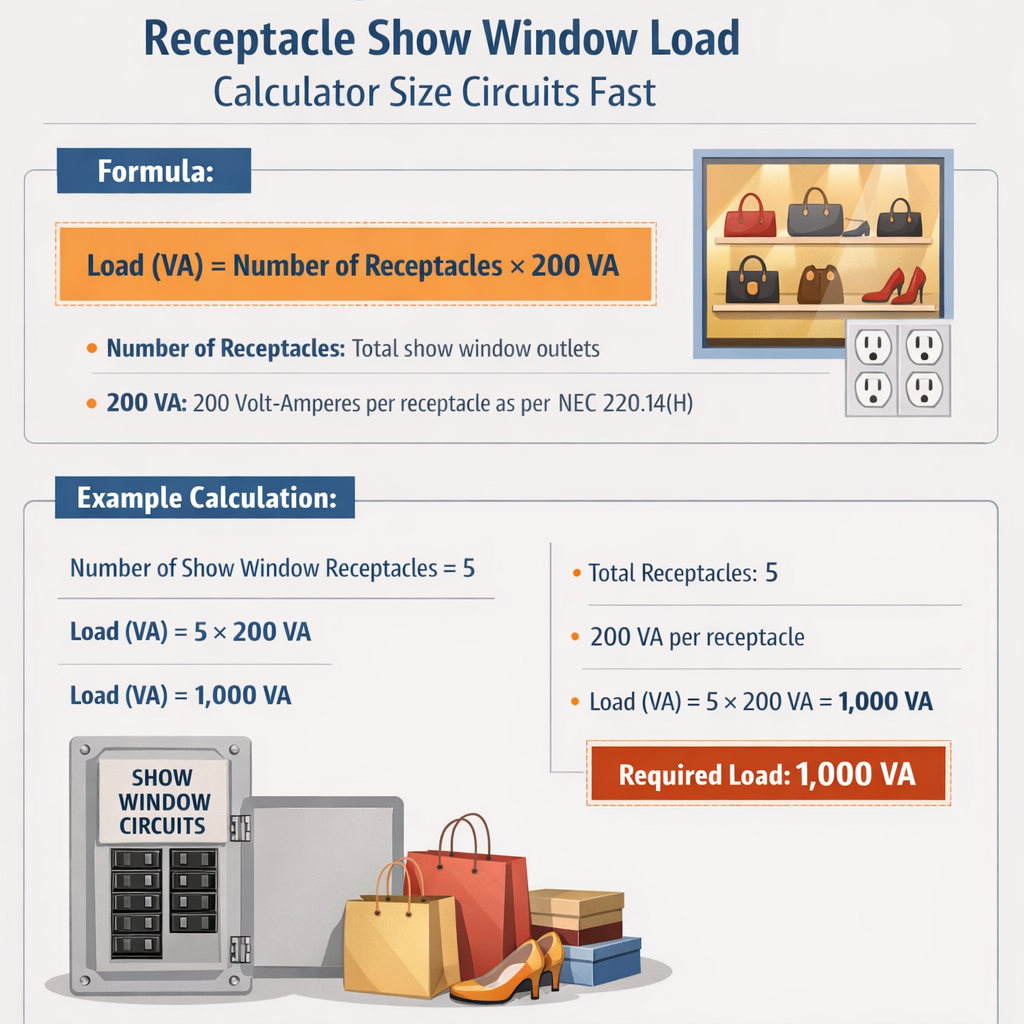
NEC 220.14 Show-Window Receptacle Load and Branch-Circuit Sizing Calculator (VA, A, number of circuits)
Overview of NEC 220 methodology applied to show window receptacles
Article 220 of the National Electrical Code (NEC) establishes the procedures to determine the calculated electrical load of a building or portion of a building. For show windows and display areas, the calculated load must include lighting, receptacle loads for displays and merchandise, dedicated equipment, and any heating or signage loads. The objective of an "instant" NEC 220 calculation is to transform measured or estimated connected loads into required circuit counts and conductor/breaker sizes using NEC demand factors and continuous-load rules where applicable.
Key categories of load for show windows
- General lighting: display and accent lighting (LED, halogen, fluorescent)
- Receptacle loads: temporary display devices, demonstration equipment, cash registers
- Dedicated equipment: transformers, heater tapes, neon or LED signage
- Continuous loads: any load expected to run for 3 hours or more (NEC definition)
- Miscellaneous loads: security lighting, motion sensors, controllers
Terminology and NEC principles applied
- Connected Load (VA): sum of equipment nameplate volt-ampere ratings or measured wattages converted to VA.
- Continuous Load: per NEC, loads expected to operate for 3 hours or more require derating (multiply by 125% for conductor sizing).
- Demand Factors: where allowed, NEC permits application of demand factors for groups of loads; local amendments may vary.
- Branch Circuit Sizing: choose conductor and overcurrent protection based on required ampacity after applying continuous-load multiplier.
Step-by-step procedure for an instant NEC 220 calculation
- Inventory connected loads: list each lighting fixture, receptacle circuit expected loads, signage, heating elements, and miscellaneous devices.
- Convert wattages to VA where necessary: for resistive and lighting loads, VA ≈ W for single-phase circuits; for motors or inductive loads use nameplate VA.
- Identify continuous loads and apply a 125% factor for conductor ampacity calculation.
- Apply NEC demand factors where allowed (e.g., multiple receptacles or multi-family common areas), referencing NEC 220 tables or local amendments.
- Calculate required ampacity and select appropriate conductor gauge and overcurrent protection.
- Allocate number of 120 V or 240 V branch circuits as needed to distribute load and meet code spacing/control requirements.
Fundamental formulas (HTML format)
Total Connected Load (VA) = ∑ (Quantity × Unit Load (VA))
Basic Current (A) = Total Load (VA) ÷ Voltage (V)
Design Ampacity for Continuous Loads (A) = Basic Current (A) × 1.25
Available Continuous VA on Circuit (VA) = Circuit Voltage × Circuit Rating (A) × 0.8
Explanation of variables and typical values
- Quantity: number of identical items (fixtures or receptacles).
- Unit Load (VA): rated VA per item. Typical values: LED accent lamp = 10–30 VA; linear LED strip = 5–20 VA per foot; small appliance receptacle load estimation often uses 180 VA per receptacle for dwelling unit loads (where applicable) — verify per NEC Article 220 and local practice.
- Total Load (VA): summed VA of all items before demand or continuous multipliers.
- Voltage (V): typically 120 V for receptacles and accent lighting circuits in North America; 277 V for commercial lighting in some systems; 240 V for heating or specialized equipment.
- Circuit Rating (A): nominal breaker size (e.g., 15 A, 20 A, 30 A).
Extensive tables with common values
| Category | Typical Unit Load (VA) | Notes / Use |
|---|---|---|
| LED accent lamp (small) | 10–30 | Spot or accent LED lamps, common in display windows |
| Linear LED strip | 5–20 per foot | High density strips can approach higher end; manufacturer data preferred |
| Small appliance receptacle (design assumption) | 180 | Common design assumption for general-purpose receptacles (verify per project) |
| Cash register / POS | 200–400 | Include monitors, printers; use nameplate where available |
| Display transformer (low-voltage lighting) | Nameplate VA | Count full VA of transformer primary |
| Signage (LED, small) | 50–500 | Varies widely; confirm with manufacturer |
| Heater tape (for glazing) | 100–1000 | Often 120 V or 240 V; high priority for conductor sizing |
| Security lighting / sensors | 10–100 | Low draw but often continuous |
| Conductor AWG (Copper, THHN typical) | Common Ampacity (A) | Common Branch-Circuit Breaker Size | Approx. Continuous VA at 120 V |
|---|---|---|---|
| 14 AWG | 15 | 15 A | 120 V × 15 A × 0.8 = 1,440 VA |
| 12 AWG | 20 | 20 A | 120 V × 20 A × 0.8 = 1,920 VA |
| 10 AWG | 30 | 30 A | 120 V × 30 A × 0.8 = 2,880 VA |
| 8 AWG | 40 | 40 A | 120 V × 40 A × 0.8 = 3,840 VA |
| 6 AWG | 55 | 55 A (or 60 A standard) | 120 V × 60 A × 0.8 = 5,760 VA (if 60 A used) |
How to size circuits: practical rules and calculations
Start from total connected load per circuit and determine whether loads are continuous. For continuous loads: multiply current by 1.25 when determining conductor ampacity and select overcurrent device so that trip rating is equal to or greater than conductor ampacity but consistent with NEC protection rules.
Circuit allocation approach (practical)
- Group lighting loads and allocate across 120 V lighting/receptacle circuits, or use 277 V lighting if the building has a 277/480 V system.
- Keep display transformers and remote drivers on dedicated circuits if their inrush or harmonic content is significant.
- For equipment exceeding a branch-circuit ampacity, provide a dedicated circuit sized to nameplate current × 125% (if continuous).
Example 1 — Small show window, quick calculation and circuit sizing
Scenario: Single show window 20 ft long × 6 ft high. Loads consist of 12 LED accent fixtures (20 W each), LED strip lighting 10 ft at 10 W/ft, two display receptacles for demonstration devices (assume 180 VA each), and one small sign at 60 W. All loads are 120 V. No large continuous heating elements.
Step-by-step calculation
1) Compute connected loads (VA):
LED accent = 12 × 20 W = 240 W → 240 VA
LED strip = 10 ft × 10 W/ft = 100 W → 100 VA
Display receptacles = 2 × 180 VA = 360 VA
Sign = 60 W → 60 VA
Total connected load (VA) = 240 + 100 + 360 + 60 = 760 VA
2) Determine whether any loads are continuous. Assume lighting may operate continuously during business hours (>3 hours), so treat total lighting as continuous. Conservatively apply continuous multiplier to entire load: design ampacity = Basic Current × 1.25.
5) Choose conductor and overcurrent protection. The next standard breaker size is 15 A with 14 AWG conductor.
6) Verify continuous allowance on 15 A circuit: available continuous VA = 120 V × 15 A × 0.8 = 1,440 VA, which exceeds 760 VA connected; therefore a single 15 A (14 AWG) circuit is sufficient for these loads.
Result and comments
- Total connected load: 760 VA
- Design ampacity (continuous): ≈ 7.92 A
- Recommended circuit: one 15 A, 14 AWG branch circuit at 120 V
- Note: if any single device has high inrush (transformer or LED driver) check manufacturer inrush and consider dedicated circuit or soft-start controls.
Example 2 — Larger storefront display with heating tape and multiple receptacles
Scenario: A 30 ft wide storefront with intense merchandising. Loads: 40 LED accent fixtures at 25 W each; 30 ft LED strip at 12 W/ft; six general-purpose display receptacles estimated at 180 VA each; heater tape along bottom edge rated 800 W at 120 V (continuous when ON); and a neon/LED sign 300 W. Determine required circuits and conductor sizes.
Step-by-step calculation
1) Compute connected loads (VA):
LED accent = 40 × 25 W = 1,000 W → 1,000 VA
LED strip = 30 ft × 12 W/ft = 360 W → 360 VA
Display receptacles = 6 × 180 VA = 1,080 VA
Heater tape = 800 W → 800 VA (continuous)
Sign = 300 W → 300 VA
Total connected load (VA) = 1,000 + 360 + 1,080 + 800 + 300 = 3,540 VA
2) Identify continuous loads. Heater tape is continuous; lighting may be considered continuous during business hours. Conservative approach: treat lighting, heater tape, and sign as continuous. At minimum, heater tape must be treated as continuous.
3) Compute basic current (A):
5) Select conductor and breaker size. Conductor must have ampacity ≥ 36.875 A. The next standard commercial conductor and breaker commonly used would be 40 A circuit with 8 AWG copper (depending on temperature correction). A 40 A breaker with 8 AWG copper (ampacity typically 50 A for 8 AWG depending on insulation and termination) is acceptable. Alternatively, split loads across multiple 20 A or 30 A circuits for load balancing.
6) Determine number of 15 A/20 A circuits if designer prefers multiple circuits rather than a single large one. For 20 A circuit, continuous VA allowance = 120 × 20 × 0.8 = 1,920 VA per circuit.
Number of 20 A circuits required = ceil(Total continuous VA ÷ 1,920 VA) = ceil(3,540 ÷ 1,920) = ceil(1.84375) = 2 circuits
Verification for 2 × 20 A circuits: combined continuous capacity = 1,920 × 2 = 3,840 VA, which exceeds 3,540 VA connected.
Detailed solution and recommendation
- Total connected load: 3,540 VA
- Design ampacity (if treated as continuous): ≈ 36.9 A
- Options:
- Provide one 40 A circuit with 8 AWG copper (suitable for combined loads; verify handling of multiple branch circuits on same cable run and local code).
- Provide two 20 A circuits (12 AWG) at 120 V dedicated to lighting + general receptacles distribution—balance fixtures across circuits—this simplifies replacement and limits outage risk.
- Because heater tape is continuous and probably the highest single continuous load, consider placing it on a dedicated 15 A or 20 A circuit sized to nameplate and continuous multiplier if necessary.
- Ensure overcurrent protection and conductor ampacity selections account for ambient temperature and conduit fill derating per NEC 310.15.
Practical tips for fast, accurate calculations
- Create standard templates: common show window dimensions with pre-assigned fixture counts and unit loads speeds initial calculations.
- Use manufacturer luminaire and transformer nameplate VA rather than rule-of-thumb values when available.
- Mark continuous items clearly in the inventory so the 1.25 multiplier is applied correctly.
- Distribute loads across circuits to avoid nuisance tripping and to meet code spacing for receptacles (NEC 210.x family).
- Check inrush current for LED drivers and transformers—consider soft-start or inrush limiting where multiple transformers start simultaneously.
Formulas for circuit counts and ampacity again (clear)
Considerations beyond simple VA calculations
- Voltage drop: for long branch circuits, compute voltage drop and increase conductor size if voltage drop exceeds typical limits (3% for branch circuits recommended for sensitive lighting).
- Harmonics: LED drivers and electronic transformers may inject harmonics; for large installations, review total harmonic distortion and consider K-rated transformers or harmonic-mitigating equipment.
- Ambient temperature and conduit fill: adjust conductor ampacity per NEC 310.15(B)(2) and correction factors when multiple current-carrying conductors share a raceway.
- Emergency egress and life-safety lighting: ensure required circuits are connected to appropriate emergency systems or transfer switches where code demands.
Advanced table: Standard breakers vs continuous allowable VA for 120 V and 277 V circuits
| Breaker Size (A) | 120 V Continuous Allowable (VA) | 277 V Continuous Allowable (VA) | Suggested Typical Use |
|---|---|---|---|
| 15 A | 1,440 VA | 3,348 VA | Small accent lighting, few receptacles |
| 20 A | 1,920 VA | 4,216 VA | Lighting banks, multiple receptacles |
| 30 A | 2,880 VA | 6,462 VA | Heavy lighting + small equipment |
| 40 A | 3,840 VA | 8,856 VA | Large displays or combined loads |
| 60 A | 5,760 VA | 13,416 VA | High-demand equipment, heaters |
Regulatory guidance, references, and authoritative sources
- NEC (NFPA 70) — Main reference for load calculations and conductor sizing. Consult the latest edition and local amendments: https://www.nfpa.org/NEC
- NFPA online resources for code interpretation and handbook guidance: https://www.nfpa.org/
- Manufacturer datasheets for LED fixtures, drivers, and transform ers (e.g., Philips, Osram, Sign Manufacturers). Use nameplate VA for precise calculation.
- IEEE resources on harmonics and power quality for installations using many LED drivers: https://www.ieee.org/
- UL certification information for luminaires and sign equipment: https://www.ul.com/
- Energy Use and Lighting design guidance: U.S. Department of Energy Lighting Facts and design guides: https://www.energy.gov/
Notes on code interpretation and local authority
NEC provides minimum requirements. Local jurisdictions may adopt modifications or require additional demand-factor tables. Always confirm with the Authority Having Jurisdiction (AHJ) before finalizing designs. When in doubt, use nameplate ratings and conservative engineering judgment.
Checklist for fast site-ready NEC 220 calculations
- Measure or document display dimensions and count fixtures.
- Collect nameplate VA or wattage and convert to VA.
- Identify continuous loads and mark them.
- Compute total connected VA and basic current.
- Apply 1.25 multiplier for continuous loads to determine conductor ampacity.
- Select circuits using continuous allowable VA (Voltage × Breaker × 0.8), and round up to next breaker standard.
- Verify voltage drop and adjust conductor size if necessary.
- Document results and include calculations in job packet for AHJ review.
Final technical recommendations (practical)
- Standardize typical show-window load templates in your design software for instant calculation capability.
- Favor distributing loads across multiple 20 A circuits for redundancy and better maintenance separation.
- Always use manufacturer data for drivers and transformers; if unavailable, use conservative assumed VA and document assumptions.
- Consider providing separate circuits for continuous heater elements to avoid nuisance tripping and overloading lighting circuits.
- Include commissioning checks: measure actual current draw after installation to validate assumptions and record final as-built loads.
References and further reading
- NFPA 70, National Electrical Code® (latest edition). Available from NFPA: https://www.nfpa.org/NEC
- NEC Article 220: Branch-Circuit and Feeder Load Calculations — consult the code book for tables and demand factor rules.
- NEC Article 210: Branch Circuits — for receptacle requirements and circuit rules.
- NEC Article 110 and 310: Conductors and Ampacity Tables — for conductor sizing and derating guidance.
- U.S. Department of Energy — Lighting energy and lighting design guides: https://www.energy.gov/eere/buildings/articles/lighting
- UL Product Database — verify luminaire and driver UL listing: https://www.ul.com/resources/ul-product-database
- IEEE Standards Library — guidance on harmonics and power quality: https://standards.ieee.org/
This article provides a structured, NEC 220–based approach to rapidly calculate show window and receptacle loads, convert them to required circuit counts, and size conductors and overcurrent devices. Always verify with the latest NEC edition and your AHJ before implementation.