This article explains an instant voltage drop calculator for single and three-phase electrical systems installations.
It covers Cu and Al conductors in AWG and kcmil, volts, formulas, tables, and examples.
Instant Voltage Drop Calculator — Single / Three-Phase (Cu / Al, AWG / kcmil)
Scope and purpose of an instant voltage drop calculator
An instant voltage drop calculator quickly estimates AC voltage loss across conductors for short-term design decisions. It is intended for engineers, electricians, and specifiers who need immediate validation of conductor sizing, expected voltage at a load, and compliance with recommended limits for percent voltage drop.
Fundamental formulas and when to use them
Voltage drop must be computed with AC formulas that include conductor resistance and series reactance. Use different formulas for single-phase and three-phase systems; include power factor for realistic results.
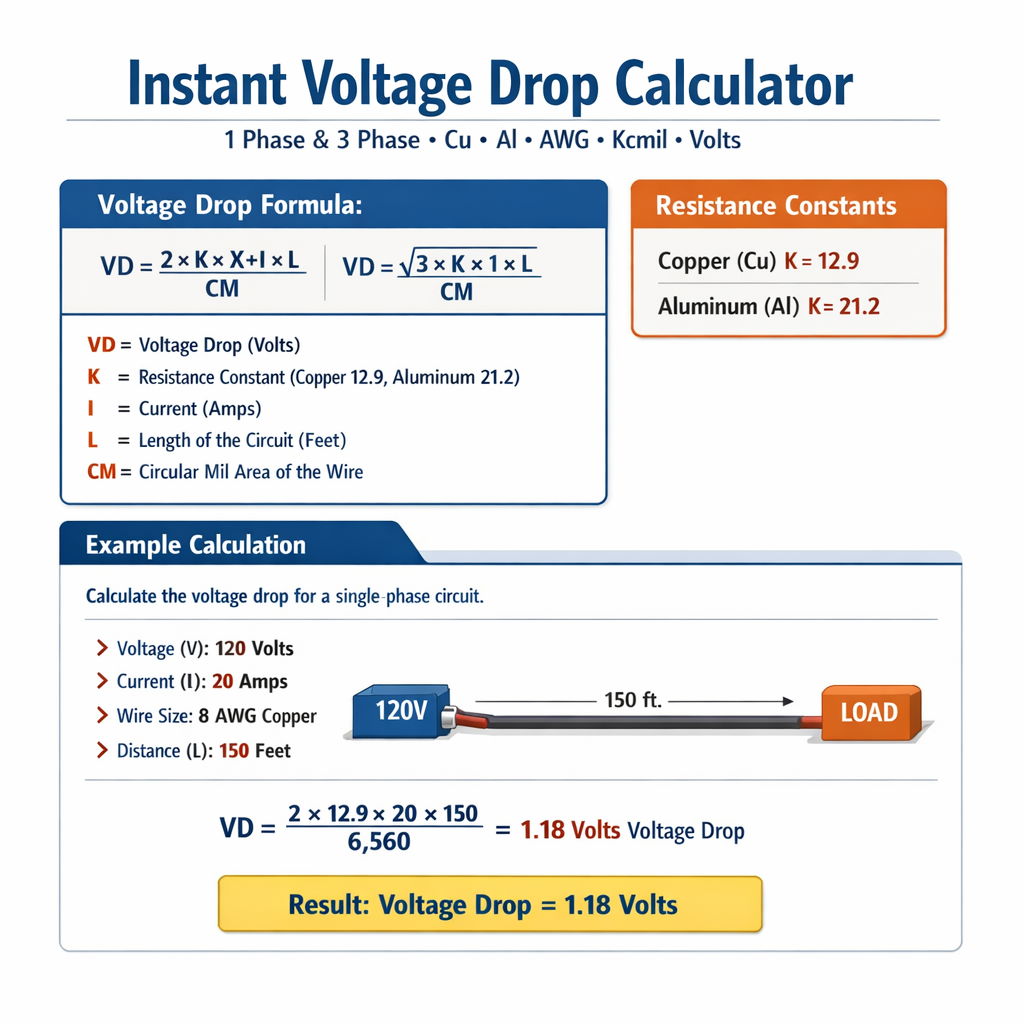
Single-phase formula (two-wire or split-phase)
Use the following expression for single-phase circuits, where the return conductor doubles the path length:
- I = load current (A)
- R = conductor series resistance per unit length (Ω/ft or Ω/m)
- X = conductor series reactance per unit length (Ω/ft or Ω/m)
- cosφ = power factor (unitless, lagging positive)
- sinφ = √(1 − cos²φ) or determined from power factor angle (unitless)
- L = one-way conductor length (ft or m)
Three-phase formula (line-to-line connected load)
For balanced three-phase systems use:
- √3 ≈ 1.732
- Other variables as defined above, and L is one-way conductor length
Percent voltage drop
To express the drop as a percentage of nominal system voltage:
- Vnominal = system line voltage (e.g., 120 V, 208 V, 240 V, 480 V)
Variable definitions, units, and typical values
When using an instant calculator, ensure units are consistent. Below are typical variable units and conversions commonly implemented:
- Length L: use feet (ft) or meters (m). Convert: 1 m = 3.28084 ft.
- Resistance R: often given as ohms per 1000 feet (Ω/kft). Convert to Ω/ft by dividing by 1000.
- Reactance X: typically provided in Ω/kft for overhead or conduit runs; convert similarly to Ω/ft.
- Temperature effects: conductor resistance values are temperature dependent; many tables use 75°C or 20°C base—apply correction factors as needed.
Extensive conductor property tables (typical values)
Below are common copper AWG resistances and representative reactance values per 1000 feet. Values are typical and intended for instant calculation use; for precision, use manufacturer or code tables with temperature corrections.
| AWG | Cross-section (mm²) | R (Ω/1000 ft) ≈ | R (Ω/ft) | X (Ω/1000 ft) typical | X (Ω/ft) | Typical ampacity (60°C / 75°C) A |
|---|---|---|---|---|---|---|
| 14 | 2.08 | 2.525 | 0.002525 | 0.085 | 0.000085 | 15 / 15 |
| 12 | 3.31 | 1.588 | 0.001588 | 0.081 | 0.000081 | 20 / 20 |
| 10 | 5.26 | 0.999 | 0.000999 | 0.078 | 0.000078 | 30 / 35 |
| 8 | 8.37 | 0.6282 | 0.0006282 | 0.075 | 0.000075 | 40 / 50 |
| 6 | 13.3 | 0.3951 | 0.0003951 | 0.072 | 0.000072 | 55 / 65 |
| 4 | 21.2 | 0.2485 | 0.0002485 | 0.068 | 0.000068 | 70 / 85 |
| 2 | 33.6 | 0.1563 | 0.0001563 | 0.065 | 0.000065 | 95 / 115 |
| 1/0 | 53.5 | 0.0983 | 0.0000983 | 0.061 | 0.000061 | 150 / 170 |
| 4/0 | 107 | 0.0490 | 0.0000490 | 0.055 | 0.000055 | 230 / 260 |
Next table contains common kcmil sizes for copper and aluminum along with representative resistances (Ω/1000 ft). Aluminum resistances are approximately 1.6× copper for equivalent cross-section; reactances shown are typical for bundled conduits or similar spacing.
| Size | Cu R (Ω/1000 ft) | Cu R (Ω/ft) | Al R (Ω/1000 ft) | Al R (Ω/ft) | X (Ω/1000 ft) typical | X (Ω/ft) |
|---|---|---|---|---|---|---|
| 250 kcmil | 0.0403 | 0.0000403 | 0.0645 | 0.0000645 | 0.049 | 0.000049 |
| 350 kcmil | 0.0287 | 0.0000287 | 0.0459 | 0.0000459 | 0.044 | 0.000044 |
| 500 kcmil | 0.0204 | 0.0000204 | 0.0326 | 0.0000326 | 0.040 | 0.000040 |
| 750 kcmil | 0.0136 | 0.0000136 | 0.0218 | 0.0000218 | 0.036 | 0.000036 |
| 1000 kcmil | 0.0102 | 0.0000102 | 0.0163 | 0.0000163 | 0.034 | 0.000034 |
Temperature, conductor material, and correction factors
Resistance increases with temperature. Instant calculators must either use resistance values at the operating temperature or apply a correction factor:
- α (copper) ≈ 0.00393 /°C
- α (aluminum) ≈ 0.0039 /°C (approximate)
For example, if base R is specified at 20°C and expected conductor temperature is 75°C, multiply base R by [1 + α × 55°C].
Implementing an instant calculator algorithm (engineering details)
An effective instant voltage drop calculator should follow these computational steps:
- Gather inputs: system type (1φ / 3φ), nominal voltage, load current, one-way length (or loop), conductor size and material, power factor, and conductor arrangement.
- Look up R and X per unit length for chosen conductor; convert to consistent units (Ω/ft or Ω/m).
- Apply temperature correction to R if the operating temperature differs from the table base.
- Compute Vdrop using the appropriate formula (single- or three-phase).
- Compute percent voltage drop and compare with project criteria (e.g., ≤3% branch, ≤5% feeder+branch recommended).
- If percent drop exceeds limits, iterate by selecting next larger conductor or reducing length or current (or consider parallel conductors).
Considerations for accuracy
- Reactance X is geometry-dependent (spacing, conduit, parallel runs). Instant tools often use representative X values; adjust for precise designs.
- Harmonics and non-sinusoidal currents increase RMS heating and may necessitate derating conductor ampacity and higher effective voltage drop.
- Parallel conductors: combine resistances appropriately (Rparallel = Rsingle / number_parallels) and compute reactance interactions if spacing is significant.
- Unbalanced three-phase systems need phase-by-phase analysis if currents differ substantially.
Example 1: Single-phase residential branch circuit (detailed)
Problem statement: Calculate voltage drop for a 120 V single-phase lighting and receptacle circuit supplied by 6 AWG copper, one-way length 100 ft, load 50 A, power factor 0.9 (lagging). Determine percent drop and evaluate compliance with a typical 3% branch recommendation.
Step-by-step calculation
- Given: Vnominal = 120 V, I = 50 A, L = 100 ft (one-way), conductor = Cu AWG 6.
- From table: R = 0.3951 Ω/1000 ft → R = 0.0003951 Ω/ft.
- Typical X (AWG 6) = 0.072 Ω/1000 ft → X = 0.000072 Ω/ft.
- Compute cosφ = 0.9; sinφ = √(1 − 0.9²) = √(1 − 0.81) = √0.19 ≈ 0.43589.
- Compute the combined impedance factor per foot: R×cosφ + X×sinφ = (0.0003951×0.9) + (0.000072×0.43589) = 0.00035559 + 0.00003138 = 0.00038697 Ω/ft.
- Loop length factor for single-phase = 2 × L = 200 ft → total series factor = 0.00038697 × 200 = 0.077394 Ω.
- Voltage drop Vdrop = I × total_series_factor = 50 × 0.077394 = 3.8697 V.
- Percent drop = (3.8697 / 120) × 100 = 3.22%.
Interpretation and recommendation
- Result 3.22% exceeds the commonly recommended 3% for branch circuits, though it is below 5% combined feeder+branch guidance.
- To meet ≤3% for branch, choose next larger conductor (AWG 4). Recalculate quickly: AWG 4 R = 0.2485 Ω/1000 ft → 0.0002485 Ω/ft; X ≈ 0.068 Ω/1000 ft → 0.000068 Ω/ft.
- New combined per ft: (0.0002485×0.9) + (0.000068×0.43589) = 0.00022365 + 0.00002966 = 0.00025331 Ω/ft.
- Total series = 0.00025331 × 200 = 0.050662 Ω. Vdrop = 50 × 0.050662 = 2.5331 V → 2.11%.
- AWG 4 meets the ≤3% branch recommendation and provides margin for temperature and additional connections.
Example 2: Three-phase industrial feeder with aluminum conductors (detailed)
Problem statement: Industrial feeder at 480 V three-phase supplies a motor bank with balanced current of 200 A. Conductor selected provisionally: 250 kcmil aluminum, one-way length 150 ft, power factor 0.85 lagging. Calculate voltage drop, percent drop, and evaluate whether 250 kcmil Al is acceptable.
Step-by-step calculation
- Given: Vnominal = 480 V (line-to-line), I = 200 A, L = 150 ft, conductor = 250 kcmil Al.
- From table: Al R ≈ 0.0645 Ω/1000 ft → R = 0.0000645 Ω/ft.
- Typical X (for this size and spacing) = 0.049 Ω/1000 ft → X = 0.000049 Ω/ft.
- Compute cosφ = 0.85; sinφ = √(1 − 0.85²) = √(1 − 0.7225) = √0.2775 ≈ 0.5268.
- Combined factor per foot: R×cosφ + X×sinφ = (0.0000645×0.85) + (0.000049×0.5268) = 0.000054825 + 0.00002582 = 0.000080645 Ω/ft.
- Apply three-phase formula: Vdrop = √3 × I × (combined) × L = 1.732 × 200 × 0.000080645 × 150.
- Compute intermediate: I × L × combined = 200 × 150 × 0.000080645 = 2.418 ≈2.41835.
- Then Vdrop = 1.732 × 2.41835 ≈ 4.191 V.
- Percent drop = (4.191 / 480) × 100 ≈ 0.87%.
Interpretation and recommendation
- The resulting voltage drop is ≈0.87%, well below typical recommended limits. The 250 kcmil Al conductor is acceptable from a voltage drop standpoint.
- Confirm ampacity of 250 kcmil Al at the applicable temperature and derating factors per NEC Article 310 before final selection.
- For long runs at higher currents, consider copper alternatives or paralleling aluminum conductors for lower drop and reduced losses.
Practical calculator features and UX considerations
An instant voltage drop calculator intended for deployment on web or mobile platforms should expose the following:
- Input fields: system type (1φ/3φ), nominal voltage, current or load power (W or kW with option to auto-calc current), conductor material (Cu/Al), conductor size selector (AWG/kcmil), length units toggle, power factor input, temperature option.
- Output: absolute Vdrop, percent Vdrop, recommended minimum conductor to meet target percent drop, and estimated power loss in watts (P_loss = I² × R_total).
- Advanced options: parallel conductor calculation, temperature-corrected R, harmonic content factor, and adjustable reactance for conductor arrangement.
- Validation: warn when percent drop exceeds project thresholds and provide suggestions (increase conductor, reduce length, parallel conductors).
Power loss and economic implications
Voltage drop is associated with I²R losses that waste energy and produce heating. Instant calculators commonly compute line losses so engineers can estimate operational costs and conductor heating:
- R_total = series resistance seen by the current (Ω) including loop factor for single phase and appropriate factor for three-phase
- Annual energy loss (kWh) ≈ Power_loss (W) × operating_hours_per_year / 1000
- Use present value analysis to justify larger conductors when energy cost savings offset higher capital cost.
Compliance and normative references
Voltage drop itself is not strictly mandatory in many codes but numerous recommendations and informative annexes guide practice. Use authoritative references for final design decisions:
- NFPA 70, National Electrical Code (NEC) — see Informational Annex on voltage drop recommendations: https://www.nfpa.org/
- IEEE Std 141 (The Red Book) — grounding and system design discussions that impact voltage regulation: https://standards.ieee.org/
- IEC 60364 series for electrical installations – guidance on voltage limits and supply quality: https://www.iec.ch/
- Manufacturer and industry tables: e.g., Southwire and other cable manufacturers publish conductor resistance/ampacity tables used in calculators: https://www.southwire.com/
- Useful conversion and physical constants: NIST reference material: https://www.nist.gov/
Note: Consult local codes, utility requirements, and installation standards. NEC often references that voltage drop should be "kept to a minimum" and provides recommended targets (3% for branch circuits and 5% combined feeder plus branch) as guidance rather than mandatory rules.
Limitations, advanced topics, and verification
Instant calculators are designed for quick decisions. For final design or when near limits, perform detailed analysis:
- Perform phase-by-phase analysis for unbalanced loads.
- Model conductor bundling, mutual coupling, and exact impedance for parallel runs or complex geometries.
- Include temperature rise due to loading and ambient conditions to verify insulation ratings and ampacity derating.
- Consider voltage regulation provided by transformers and generator sources (internal impedance) when calculating point-of-connection voltages.
- For long high-voltage runs, consider distributed parameter models or frequency-dependent effects.
Summary of recommended engineering practice
- Always use the correct formula for single-phase or three-phase systems and verify units through the calculation chain.
- Use representative R/X values from manufacturer or standard tables and apply temperature corrections when appropriate.
- Aim to remain under recommended percent voltage drop (commonly ≤3% branch, ≤5% combined) unless utility or equipment manufacturer specifies other limits.
- For borderline cases, increase conductor size, use multiple parallel conductors, or evaluate transformer tap adjustments.
- Document assumptions (R/X table source, conductor temperature, power factor) and store them with the calculation for traceability.
Further reading and authoritative links
- NFPA (NEC): https://www.nfpa.org/ — for authoritative electrical installation requirements and informative guidance on voltage drop.
- IEEE Xplore: https://ieeexplore.ieee.org/ — for technical standards and papers on power system voltage regulation.
- IEC: https://www.iec.ch/ — for international electrical installation rules and guidance.
- Southwire conductor tables: https://www.southwire.com/ — practical conductor tables and ampacity charts.
- NIST: https://www.nist.gov/ — for physical constants and reference conversions.
If you need, I can produce an instant-calculator algorithm in pseudocode, a downloadable spreadsheet template with the included tables and formulas, or custom tables calibrated to specific conductor temperature bases and installation configurations.