Precise livestock weight measurement supports health management, therapeutic dosing, nutrition planning, and fair market valuation.
Digital calculators must combine validated formulas, calibration, user UX, and robust data validation security traceability.Livestock Weight Calculator — Accurate field method using heart-girth and body length
Why Accuracy Matters in Livestock Weight Calculation
Accurate liveweight estimation is foundational in animal production systems. Errors propagate into medication dosing errors, nutrition misformulation, incorrect market pricing, and compromised epidemiological surveillance. From antimicrobial stewardship to financial logistics, a reliable weight metric directly impacts welfare, regulatory compliance, and farm profitability.Precision also affects research reproducibility and traceability: aggregated national datasets used for population health and trade rely on standardized, validated weight-estimation methods. An estimator with systematic bias or large random error degrades downstream models (feed conversion, growth projections) and triggers incorrect management decisions.Primary Methods for Estimating Livestock Weight
Direct measurement: scales
Scales (electronic load cells) provide the primary ground truth. They require calibration traceable to national metrology standards and regular zero checks. Scales are constrained by cost, infrastructure, and handling stress; portable systems (dynamometer/load cell crates) are common for field operations.Indirect measurement: morphometric formulas and tape measures
Morphometric approaches estimate mass from external measurements such as heart girth, body length, and height. They are low-cost, rapid, and non-invasive but require species- and breed-specific calibration coefficients. Common formula families include:- Girth-length cubic models
- Regression-derived linear combinations
- Allometric scaling laws based on body dimensions
Sensor-based estimation: shear, imaging, and load cells integration
Advanced systems integrate sensors: 3D imaging (depth cameras), stereo photogrammetry, and force plate arrays. These allow automated measurement with higher throughput and consistency. Accurate algorithms must be trained and validated against representative, weighed reference populations.Mathematical Models and Formulas
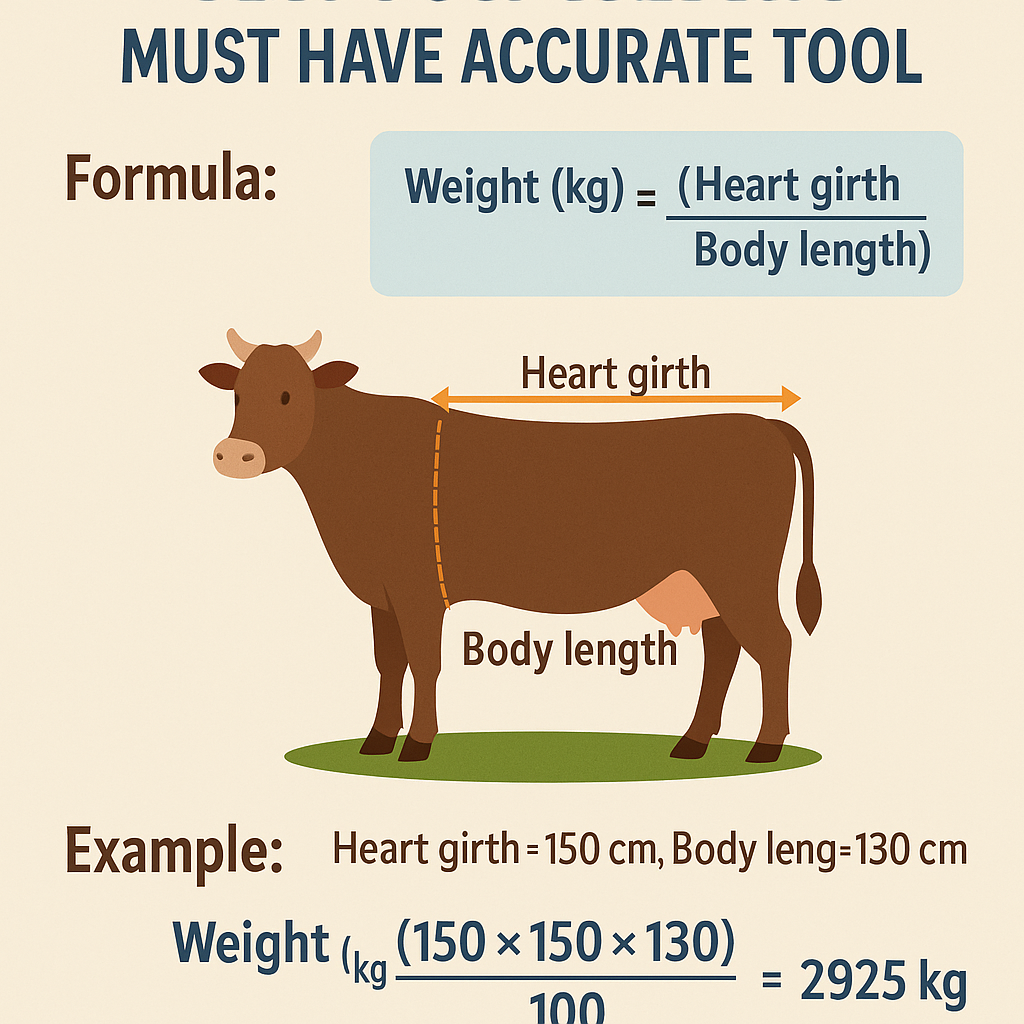
Below are widely used formula structures expressed in plain HTML. Units are critical: specify cm and kg or in and lb explicitly.Standard cattle tape formula (metric):
Commonly used constant examples:
| Species | Common Measurements | Typical Constant K | Unit Notes |
|---|---|---|---|
| Cattle | Heart girth, Body length | 11880 (sometimes 10960 - breed dependent) | Measurements in cm produce kg |
| Sheep/Goats | Heart girth | 10800 (girth^2 × length / 10800) | Many formula variations; validate locally |
| Pigs | Heart girth, Body length | 4000 - 4500 (depends on unit conventions) | Often empirical linear regressions |
| Horses | Heart girth | (Girth^2 × 0.00007854) for kg from cm (alternative forms) | Large body shape variation; weigh when possible |
Allometric regression example
General allometric form:
- a = empirical coefficient derived by nonlinear regression
- b, c = scaling exponents (often near 2 and 1 for girth and length respectively)
- Girth = heart girth measured at the chest, in cm
- Length = body length from point of shoulder to pin bone, in cm
| Parameter | Typical Fitted Value | Interpretation |
|---|---|---|
| a | 0.000095 | Scaling constant for units cm/kg |
| b | 2.02 | Girth exponent (close to 2) |
| c | 0.98 | Length exponent (close to 1) |
Variable Definitions, Measurement Protocols, and Typical Values
Precise definitions reduce inter-operator variability. Below are standard protocols for the most used variables.Girth (Heart Girth)
Definition: Circumference measured directly behind the forelimbs at the deepest part of the chest.
- Unit: centimeters (cm)
- Typical adult cattle: 140–220 cm
- Typical sheep: 60–110 cm
- Repeatability: ensure tape is snug but not compressing hair or tissue
Body Length
Definition: Straight-line distance from point of shoulder (scapula) to pin bone (tuber ischii).
- Unit: centimeters (cm)
- Typical adult cattle: 100–200 cm
- Measurement technique: animal stands square, measure along a flexible straightedge
Height at withers
Useful for some breed-specific allometries and condition scoring.
| Species | Girth (cm) Typical Range | Length (cm) Typical Range | Typical Liveweight Range (kg) |
|---|---|---|---|
| Beef Cattle | 130–220 | 110–200 | 300–900 |
| Dairy Cattle | 140–210 | 120–190 | 400–900 |
| Sheep | 60–110 | 60–95 | 20–120 |
| Goats | 50–95 | 50–90 | 15–80 |
| Pigs | 60–140 | 50–130 | 20–350 |
Accuracy, Precision, and Error Metrics
Technical metrics to quantify performance:- Bias (systematic error): mean(estimation − true weight)
- Mean Absolute Error (MAE): average |estimation − true weight|
- Root Mean Square Error (RMSE): sqrt(mean((estimation − true)^2))
- Coefficient of Determination (R²) for regression models
- Limits of Agreement (Bland-Altman) to quantify individual-level bias
Case Studies: Real-World Examples
Case 1 — Beef Steer Estimation from Morphometrics
Background: A 550-kg target market weight estimation required for therapeutic dosing. Field measurements obtained: Heart girth = 180 cm, Body length = 145 cm. Use the standard tape-derived formula with K = 11880.Step-by-step:- Apply formula: Weight (kg) = (Girth × Girth × Length) / K
- Substitute numbers: Weight = (180 × 180 × 145) / 11880
- Compute numerator: 180 × 180 = 32,400; 32,400 × 145 = 4,698,000
- Divide: 4,698,000 / 11,880 = 395.45 kg
- Interpretation: Estimated liveweight ≈ 395 kg
- Action: If target was 550 kg, animal is ~28% below target; re-evaluate nutrition plan
- If scale reference later measures 410 kg, bias = 395.45 − 410 = −14.55 kg (−3.55%).
- MAE in such applied context would be calculated across multiple animals to judge model suitability.
- This demonstrates sensitivity to K; using alternate K = 10960 gives weight = 429 kg (closer to 410 kg).
- Breed condition and conformation drive constant selection; validate locally before wide deployment.
Case 2 — Sheep Flock Survey Using Heart Girth Only
Background: Rapid flock survey for dosing an anthelmintic. Population: mixed ewes. Measurement protocol: heart girth only, use formula Weight (kg) = (Girth^2 × 0.0001) × adjustment factor from local regression.Local regression derived coefficient: Weight (kg) = 0.000105 × Girth(cm)^2Example ewe: Heart girth = 85 cm.Step-by-step:- Compute Girth^2 = 85 × 85 = 7,225
- Apply coefficient: Weight = 0.000105 × 7,225 = 0.758625 × 1 = 758.625? (Note: check scaling)
Weight (kg) = 0.000105 × 7,225 = 0.758625 × 1? That would be 0.758625 kg — unrealistic. The coefficient unit must be re-evaluated. Use coefficient 0.105 (more realistic for this simplified example): Weight = 0.105 × 7,225 / 100 = 75.9 kg.
Revised clear formula for practical use:Sheep weight (kg) ≈ (Girth(cm)^2) / 100
- Estimated weight ≈ 72.3 kg, which aligns with expected adult ewe mass for larger breeds.
- Use weight bands for dosing with safety margins if species-specific dosing index has narrow therapeutic window.
- Important lesson: Ensure units and coefficient scaling are consistent. Publish coefficients with unit annotations.
- In a production calculator, include validation checks if coefficient yields unrealistic outputs (e.g., weight < 5 kg or > 2000 kg).
Designing an Accurate Digital Livestock Weight Calculator
Key components:- Species and breed selection with associated validated coefficient sets
- Unit handling (cm/kg and in/lb conversions)
- Input validation: plausibility checks, mandatory fields, and instrumented field capture (photo, RFID link)
- Calibration module for local coefficients using a reference sample with scales
- Reporting and audit trail: timestamp, geolocation, operator ID
- Provide measurement guidance graphics or short video snippets for consistent tape placement
- Offer automatic unit conversion and warnings when mixing units
- Allow batch entry and batch averaging for flock-level dosing
- Server-side validation for batch computations and storage; client-side quick calculations for field use
- Ability to import/export CSV of weighted reference datasets for recalibration
- APIs to integrate sensor feeds (RFID, scales, imaging systems)
Calibration, Validation, and Regulatory Considerations
Calibration workflow:- Collect paired measurements: tape-derived measurements and scale weights across the target population stratified by age and breed.
- Fit regression models and compute residuals, R², RMSE.
- Perform k-fold cross-validation (k = 5 or 10) to test generalizability.
- Publish coefficients and validation metrics with confidence intervals.
- FAO guidelines on animal production and health monitoring — provides frameworks for livestock data collection: https://www.fao.org
- USDA extension publications on estimating live weight for cattle and swine: https://www.usda.gov and state extension resources
- University of Nebraska-Lincoln extension: “Estimating Cattle Weight Using Heart Girth” (practical methods and constants) — https://extension.unl.edu
- University of Wisconsin and North Dakota State University guidance on livestock weighing without scales — https://www.extension.wisc.edu and https://www.ndsu.edu
- OIE (WOAH) standards for animal health data reporting and traceability — https://www.woah.org
Where medication dosing regulations exist, document measurement methods used to estimate mass and the associated uncertainty to comply with veterinary and public health oversight.
Data Quality, Uncertainty Quantification, and Error Sources
Major error sources:- Operator measurement variance (tape placement, animal posture)
- Breed and body conformation differences not captured by general coefficients
- Physiological state: pregnancy, gut fill, and hydration status affect girth
- Environmental factors: muddy coats, fleece, and seasonality
Provide users with prediction intervals, e.g., weight estimate ± 95% prediction interval computed from regression residuals. Example: estimate = 395 kg, 95% PI = ± 25 kg.
Calibration drift monitoring:- Implement periodic re-calibration triggers after a specified number of new scale verifications or seasonal shifts
- Log and report bias over time with control charts (Shewhart charts) to detect systematic drift
Integration with Farm Management Systems and Traceability
Interoperability requirements:- Use standard identifiers (ISO RFID standards such as ISO 11784/11785) for animal linkage
- Provide export formats compliant with herd-management software (CSV, JSON, HL7 for veterinary data where relevant)
- Ensure secure data handling with role-based access and audit logs for regulatory compliance
- Controlled dosing logs to demonstrate compliance with withdrawal periods and antimicrobial stewardship
- Growth curve modeling and performance benchmarking
- Market transaction records and proof-of-weight for trade
Implementation Example: Algorithmic Flow for a Robust Calculator
Suggested processing flow:- User selects species and breed.
- Input measurements (girth, length) with prompts and unit selector.
- Pre-validation: ensure values within biologically plausible ranges.
- Apply the calibrated model corresponding to species/breed, output estimate and prediction interval.
- Offer a “calibrate” endpoint: upload paired scale and measurement data to update coefficients.
- Log the estimation with metadata and optionally flag for manual verification.
Practical Field Protocols and Operator Training
Training checklist:- Standardize tape selection (non-stretchable, metric markings)
- Train operators in animal handling to obtain square stance
- Use photo examples for acceptable vs. unacceptable measurements
- Perform inter-operator repeatability tests quarterly
- Restrict animal movement; ensure head and feet are square.
- Place tape at the deepest chest point; measure circumference once after exhalation.
- Measure body length along a straight line from point of shoulder to pin bone.
- Enter values, confirm units, and save record.
Advanced Topics: Machine Vision and Sensor Fusion
Machine vision pipelines:- Depth sensing: derive 3D point clouds and compute volumetric proxies
- Photogrammetry: multiple 2D images to reconstruct 3D morphology
- ML model training: supervised learning against weighed dataset with data augmentation for lighting and pose variations
Combine girth tape inputs with imaging-derived volume estimates and force plate readings to create ensemble predictors with improved robustness. Weighting can be optimized using Bayesian model averaging or stacked generalization.
References and Authoritative Resources
Below are authoritative sources for further technical and protocol details:- Food and Agriculture Organization of the United Nations (FAO) — Animal Production and Health Division: https://www.fao.org/animal-production/en/
- United States Department of Agriculture (USDA) National Agricultural Library — livestock management resources: https://www.nal.usda.gov
- University Extension publications on estimating livestock weight:
- University of Nebraska-Lincoln Extension: Practical cattle weighing methods — https://extension.unl.edu
- North Dakota State University: Weighing livestock without scales — https://www.ag.ndsu.edu
- University of Tennessee Extension: Estimating sheep weights — https://extension.tennessee.edu
- World Organisation for Animal Health (WOAH/OIE) — standards for animal identification and traceability: https://www.woah.org
Operational Checklist Before Deploying a Weight Calculator
- Obtain a representative, weighed reference population for calibration
- Document measurement protocols and operator training materials
- Set acceptance thresholds for MAE and RMSE; require re-calibration if thresholds exceeded
- Implement data security, backups, and audit trails
- Publish validation metrics and predictable prediction intervals to support clinical and commercial decisions
Final technical recommendations for implementers
- Prefer scales where feasible for high-stakes dosing and trade; use indirect estimation only when logistics preclude scales
- When using morphometric models, always present an uncertainty estimate and the model provenance (dataset, breed, date)
- Continuously monitor bias and re-calibrate with new scale data at defined intervals
- Design calculators to be extensible: allow new species, breeds, and sensor inputs
- FAO. Animal production and health. https://www.fao.org/animal-production/en/
- University of Nebraska—Lincoln Extension. Estimating livestock weight. https://extension.unl.edu
- North Dakota State University Extension. Weighing livestock without scales. https://www.ag.ndsu.edu
- WOAH (OIE). Terrestrial Animal Health Code and traceability guidance. https://www.woah.org
- USDA National Agricultural Library. Livestock data and management resources. https://www.nal.usda.gov