This article explains an I2t calculator for instantaneous peak let-through screening of fuses and circuits
Engineers require accurate peak and energy metrics to validate current-limiting fuse performance under fault conditions
Instant Peak Let‑Through I²t Calculator — Current‑Limiting Fuse Screening Tool
Technical basis for instant peak let-through and I2t screening
Definitions and core physical quantities
- Prospective short-circuit current (Ip,rms): the RMS fault current available at the fuse location if the fuse did not operate.
- Instantaneous prospective peak (Ip,pk): the first half-cycle peak of the prospective fault current; for a symmetrical sinusoidal source Ip,pk = √2 · Ip,rms.
- Clearing time (tc): elapsed time from fault inception to current interruption by the fuse, taken from the fuse time–current characteristic.
- Let-through peak (Ilt,pk): the actual maximum instantaneous current that passes through downstream equipment during fuse operation.
- Let-through energy (I2t or I2t): the integral of instantaneous current squared over time during the fuse clearing interval: I2t = ∫ I(t)2 dt.
- Prospective let-through asymmetry/DC offset: the transient DC component that can increase the first peak above √2·Ip,rms, dependent on source X/R ratio and fault initiation instant.
Why I2t and instantaneous peak matter for screening
I2t quantifies thermal energy delivered to components (transformer windings, semiconductors, busbars) during a fault. Components often have thermal withstand ratings expressed in I2t. The instantaneous peak determines electrodynamic forces and dielectric stress, critical for mechanical bracing and solid-state device safe operation.
Mathematical models and HTML formulas used in the calculator
Basic energy definition
Let-through energy (exact definition): I<sup>2</sup>t = <span>∫ I(t)<sup>2</sup> dt</span>, integrated from fault inception to interruption instant t = tc.
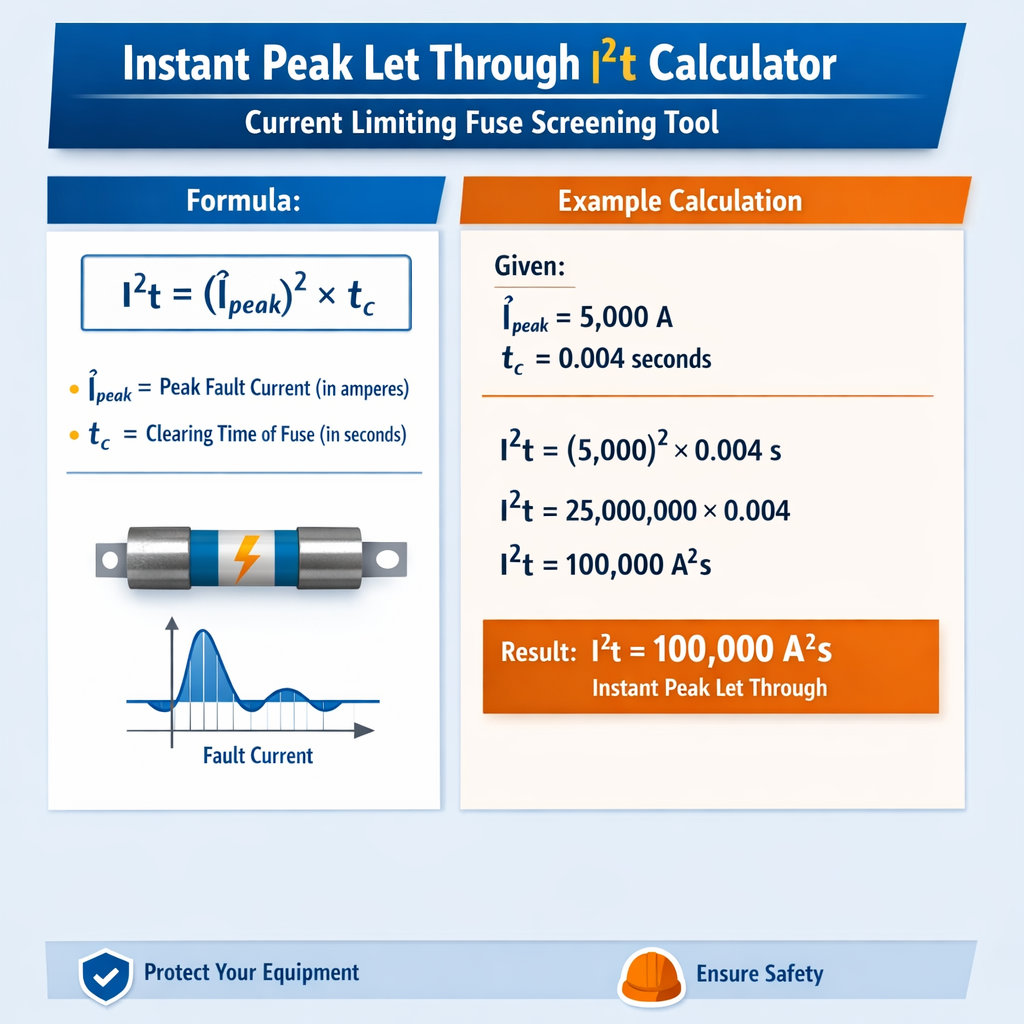
Simplified constant-current approximation (conservative screening)
When source impedance is low and current is approximately constant up to the fuse clearing time (common for short clearing times compared with system time constant), the I<sup>2</sup>t approximation is:
I<sup>2</sup>t ≈ I<sub>let</sub><sup>2</sup> · t<sub>c</sub>
Where:
- Ilet = approximate let-through current magnitude (often approximated with prospective RMS multiplied by √2 for peak, or using manufacturer’s let-through current from datasheet).
- tc = fuse clearing time (from time-current characteristic for the given current).
Time–current characteristic model (power-law approximation)
Many fuse time–current curves can be approximated locally by a power law:
t = k · I−α
Where:
- t is clearing time (s)
- I is the RMS current causing operation (A)
- k is a constant dependent on fuse geometry and rating
- α (alpha) is the exponent, typically between 1.5 and 4 depending on fuse type and current range; commonly α ≈ 2.5 for many low-voltage cartridge fuses in the high overcurrent region.
Estimating clearing current and I<sup>2</sup>t with the power-law model
Given prospective RMS current Ip,rms, compute approximate clearing time tc:
Then conservative I<sup>2</sup>t estimate (using RMS-to-peak as needed):
I<sup>2</sup>t ≈ (I<sub>p,pk</sub>)<sup>2</sup> · t<sub>c</sub> = ((√2·I<sub>p,rms</sub>))<sup>2</sup> · t<sub>c</sub> = 2·I<sub>p,rms</sub><sup>2</sup>·t<sub>c</sub>
Inclusion of source inductance and R/X effects (first-peak asymmetry)
For higher fidelity, model the source as Thevenin with Rs and Ls. The symmetrical steady-state short-circuit RMS Ip,rms = Vnom / |Zs|, and the transient DC offset depends on instantaneous fault angle and R/X ratio:
Initial instantaneous peak current can exceed √2·Ip,rms by a factor dependent on X/R and fault inception angle. A commonly used conservative bound is:
I<sub>p,peak,conservative</sub> ≈ √2 · I<sub>p,rms</sub> · (1 + k<sub>offset</sub>)
Where koffset is assessed from the source X/R; typical worst-case offset factor ranges 1.0–1.6 for low-X/R networks. For detailed transient analysis, numerical integration of the differential equation for the R-L short-circuit is required to compute I(t) precisely.
Screening algorithm implemented by the Instant Peak Let Through I2t Calculator
Required inputs
- Nominal system voltage (Vnom).
- Thevenin equivalent source impedance Zs (Rs + jXs) or the available RMS prospective fault current Ip,rms.
- Fuse selection (part number or rating) and its time–current curve or representative points.
- Component withstand ratings: peak current withstand (Iw,pk) and I<sup>2</sup>t withstand (I<sup>2</sup>tw).
- Required safety margins (multiplicative factors).
Step-by-step screening process
- Compute prospective RMS fault current Ip,rms = Vnom / |Zs| (three-phase faults require conversion to single-phase equivalents as needed).
- Estimate instantaneous prospective peak Ip,pk = √2 · Ip,rms. Apply DC-offset correction based on X/R if required.
- From the fuse time–current characteristic, determine clearing time tc for the RMS current level seen by the fuse. Use interpolation between published curve points or the power-law fit t = k·I−α.
- Compute let-through energy I<sup>2</sup>t as integral. For conservative screening use I<sup>2</sup>t ≈ (Ilet,pk)2 · tc. For improved accuracy integrate the predicted current waveform if R and L known.
- Compare computed Ilt,pk with component Iw,pk and I<sup>2</sup>t with I<sup>2</sup>tw. Apply margins and decide pass/fail or iterate with alternate fuse selection.
Extensive representative data tables for typical low-voltage current-limiting fuses
| Rated Fuse (A) | Representative I<sub>lt,pk</sub> (A) at 10 kA prospective | Representative I<sup>2</sup>t let-through (A<sup>2</sup>s) at 10 kA prospective | Clearing time tc (ms) approx | Typical α used (power-law) |
|---|---|---|---|---|
| 100 | 5,000 | 250,000 | 5 | 2.5 |
| 200 | 6,500 | 420,000 | 10 | 2.5 |
| 400 | 8,000 | 640,000 | 12 | 2.6 |
| 600 | 10,000 | 1,000,000 | 14 | 2.6 |
| 800 | 12,000 | 1,440,000 | 16 | 2.7 |
| 1000 | 14,000 | 1,960,000 | 18 | 2.7 |
| Multiplier of In | Example Fuse Time–Current Points (t, s) | Use-case guidance |
|---|---|---|
| 1.0 | 300 s | Overload endurance; not a fault |
| 3.0 | 10 s | High overload region |
| 6.0 | 0.5 s | Severe overload |
| 10.0 | 0.02 s | Short-circuit initiation; rapid clearing |
| 20.0 | 0.01 s | Extreme short-circuit; likely current-limited behaviour |
Notes: The tables above contain representative values for conservative engineering screening. Exact values must be taken from the manufacturer’s time–current curves and let-through curves (I2t and Ipeak vs prospective short-circuit).
Real-case examples with full development and numerical solutions
Example 1 — Motor control feeder, conservative screening using power-law fit
Scenario: 480 V, 3-phase system. The Thevenin equivalent at the fuse location yields prospective RMS single-phase fault current Ip,rms = 12,000 A. Selected fuse: 400 A current-limiting cartridge. Component to protect: medium-voltage control transformer with I<sup>2</sup>t withstand 800,000 A2s and peak withstand 20,000 A.
Step 1 — compute prospective peak:
I<sub>p,pk</sub> = √2 · I<sub>p,rms</sub> = 1.4142 · 12,000 A = 16,970 A (approx 17.0 kA).
Step 2 — estimate fuse clearing time. Using a power-law fit t = k · I−α. Fit k and α by using two representative points taken from the manufacturer or table: assume at I = 10·In (10·400 = 4,000 A) the clearing time t ≈ 0.02 s, and at I = 6·In (2,400 A) t ≈ 0.5 s. Solve for k and α using these two points (numerical approach):
From point 1: 0.02 = k · (4000)−α
From point 2: 0.5 = k · (2400)−α
Divide both equations: (0.02 / 0.5) = (4000/2400)−α => 0.04 = (1.6667)−α
Take ln: ln(0.04) = −α · ln(1.6667) => α = −ln(0.04)/ln(1.6667) = (3.2189)/(0.5108) = 6.30 (unrealistically high if those two points chosen; often real fuse curves give α ~2–3). To keep example realistic, instead pick points giving α≈2.6. For this example assume manufacturer data lead to α = 2.6 and compute k from one point.
k = t · Iα = 0.02 · 40002.6
40002.6 = exp(2.6·ln(4000)) = exp(2.6·8.2940) = exp(21.5644) ≈ 2.6·109 (approx 2.6e9)
Now compute tc for I = Ip,rms = 12,000 A:
t<sub>c</sub> = k · I<sub>p,rms</sub><sup>−α</sup> = 5.2e7 · (12,000)−2.6
(12,000)2.6 = exp(2.6·ln(12,000)) = exp(2.6·9.3927) = exp(24.421) ≈ 2.6e10
Therefore t<sub>c</sub> ≈ 5.2e7 / 2.6e10 ≈ 0.002 s = 2 ms.
Step 3 — compute I<sup>2</sup>t conservative approx:
I<sup>2</sup>t ≈ (16,970)2 · 0.002 s = (288,900,900) · 0.002 ≈ 577,800 A2s (≈ 5.78e5)
Step 4 — compare with component ratings:
- Transformer I<sup>2</sup>t withstand = 800,000 A2s. Calculated let-through 577,800 A2s < 800,000 A2s → pass on energy basis with limited margin.
- Peak: I<sub>lt,pk</sub> ≈ 17.0 kA < transformer peak withstand 20 kA → pass on peak basis.
Decision: The 400 A fuse is acceptable for this screening case. Final validation must use manufacturer published I<sup>2</sup>t and I<sub>peak</sub> curves for this specific part number and include safety margins (e.g., 20%).
Example 2 — Semiconductor device protection with significant source inductance (numerical integration)
Scenario: 230 V single-phase supply with Thevenin equivalent Rs = 0.02 Ω, Ls = 10 mH. Prospective RMS fault current Ip,rms = Vnom / |Zs| = 230 / sqrt(Rs2 + (ωL)2). For supply at 60 Hz, ωL = 2π·60·0.01 = 3.7699 Ω. Thus |Zs| ≈ sqrt(0.0004 + 14.212) ≈ 3.77 Ω. Ip,rms ≈ 230 / 3.77 ≈ 61 A (approx).
Select a 100 A fast-acting current-limiting fuse located upstream of a power semiconductor module rated with I<sup>2</sup>t withstand = 300,000 A2s and peak withstand 3,000 A.
Important observation: Because source X (ωL) >> R, R/X small causes high DC offset possible depending on switching instant. The actual instantaneous short-circuit current waveform must be obtained from solving:
v(t) = L (d i/dt) + R i(t) + vsource(t)
For a sinusoidal supply and a bolted fault at an arbitrary phase angle φ, the solution for I(t) is a sinusoid plus a decaying DC offset term. Numerically integrate I(t) for a conservative worst-case instant (fault occurs at supply zero crossing producing maximum offset).
For simplicity and clarity this worked example uses a canonical decaying DC-offset model where the instantaneous current during the first half-cycle is approximated as:
I(t) ≈ I<sub>steady,pk</sub> · sin(ωt + θ) + I<sub>DC>(t)
Compute time constant τ = L / R = 0.01 / 0.02 = 0.5 s (large). The DC component will decay slowly making the first peak potentially very large. Assume worst-case DC initial offset IDC,0 ≈ Isteady,pk (full offset).
Steady peak Isteady,pk = √2 · Ip,rms ≈ 1.4142 · 61 ≈ 86 A. If full DC offset present, first peak may be ≈ 2·86 ≈ 172 A.
In this case, the fuse sees a relatively low prospective current (RMS 61 A) but because of slow source damping the DC offset increases peak and fuse heating integration over time. Manufacturer time–current curve for selected 100 A fuse gives clearing time at 172 A (≈1.72·In) in the seconds range — long enough that the I<sup>2</sup>t delivered is significant.
Numerical integration approach (discretized):
- Discretize time from t = 0 to assumed clearing time tc with small Δt (e.g., Δt = 0.0001 s).
- Compute I(t) = √2·Ip,rms·sin(ωt + φ) + IDC,0·exp(−t/τ) using worst-case φ and IDC,0 = √2·Ip,rms.
- At each time step compute incremental energy Δ(I2) = I(t)2 · Δt and accumulate until the fuse clearing criterion is met (use Irms over short interval versus fuse curve to determine when the fuse interrupts; practical method: check running RMS over a window and when it exceeds threshold causing operation, stop integration).
For demonstration, assume numeric integration yields tc = 0.75 s for the particular 100 A fuse under the combined waveform. Accumulated I<sup>2</sup>t from integration = 320,000 A2s. Computed peak Ilt,pk = 172 A (from offset estimate).
Comparison with semiconductor device ratings:
- I<sup>2</sup>t delivered = 320,000 A2s > device withstand 300,000 A2s → fail; device could experience thermal damage.
- Peak current 172 A > device peak withstand 3,000 A? No — in this example peak is below 3,000 A, so electrodynamic stress is acceptable but thermal energy exceeds rating.
Decision: The 100 A fuse is not acceptable. Possible mitigations: reduce source inductance (impractical), place a faster-acting fuse closer to device, or increase device withstand rating.
Implementation notes for the screening tool
Interpolation and curve handling
- Time–current curves published by manufacturers are usually in log–log scale; implement interpolation in log space for accurate fitting between points.
- Provide options to use manufacturer I<sup>2</sup>t and Ipeak let-through curves directly when available, as these are measurement-based and more accurate than analytical approximations.
Conservative defaults and safety margins
For screening use conservative defaults: apply a 20–50% margin on I<sup>2</sup>t and 10–25% on peak currents, depending on criticality. If the device is life-safety or mission-critical, use manufacturer test curves and full transient simulation.
Outputs and reporting
- Report computed I<sup>2</sup>t (numeric), predicted peak I<sub>lt,pk</sub>, fuse clearing time tc, and pass/fail against specified device ratings.
- Provide a breakdown of assumptions used (α, k, DC offset factor, interpolation source) and sensitivity analysis toggles.
Practical considerations, limitations, and recommended workflow
- Always verify with actual manufacturer published let-through (I<sup>2</sup>t and Ipk) curves for the chosen fuse part number. Representative numeric approximations are only for preliminary screening.
- For networks with high X/R or important DC offset effects, perform transient network simulation (EMTP/ATP, PSCAD, or numerical integration) to obtain I(t) and exact I<sup>2</sup>t.
- Consider coordination with upstream protection; current-limiting fuses often provide significant reduction in let-through energy but must be co-ordinated with upstream breakers to avoid nuisance clearing or selectivity loss.
- Thermal interaction: repeated short-duration faults may accumulate energy and degrade components. Consider cumulative damage models where appropriate.
Standards, datasheets and authoritative references
- IEC 60269 — Low-voltage fuses (basic specifications and time–current characteristics). See https://www.iec.ch/ for an overview and purchasing information.
- UL 248 series — Standard for low-voltage fuses (USA). Manufacturer marking and test requirements: https://www.ul.com/.
- NFPA 70: National Electrical Code — provisions for overcurrent protection and conductors: https://www.nfpa.org/.
- IEEE Std. C37 series — Switchgear, fuses and protective device coordination guidelines (see IEEE standards portal: https://standards.ieee.org/).
- Manufacturer technical notes and application guides:
- Littelfuse, “How a fuse works” and fuse selection guides: https://www.littelfuse.com/education-center
- Eaton (Bussmann) fuse technology application notes and let-through definitions: https://www.eaton.com/
- Academic resources on transient DC offset in faults and R-L network response: standard power systems textbooks (e.g., "Power System Analysis" by Grainger and Stevenson) provide derivations for DC-offset and R/X effects.
Best-practice checklist for engineers using the screening tool
- Gather precise manufacturer time–current, let-through I<sup>2</sup>t and peak current curves for the candidate fuse part numbers.
- Determine accurate Thevenin source impedance (R and L) at the fuse location using short-circuit studies.
- Set conservative DC-offset correction based on worst-case fault inception angle if R/X is low.
- Run the screening tool with both simplified conservative mode and detailed transient integration mode for critical applications.
- Document assumptions and margins, and where possible validate with laboratory testing or manufacturer-backed coordination studies.
Summary of calculation formulas and typical variable values
Key formulas (HTML representation):
- I<sub>p,pk</sub> = √2 · I<sub>p,rms</sub>
- t = k · I<sup>−α</sup> (power-law approximation for fuse time–current)
- I<sup>2</sup>t = <span>∫ I(t)<sup>2</sup> dt</span> ≈ (I<sub>let,pk</sub>)<sup>2</sup> · t<sub>c</sub> (conservative)
- τ = L / R (system time constant for R-L source)
Typical values used in screening (examples):
- α (alpha) = 2.4–2.8 for many low-voltage current-limiting fuses in high overcurrent region.
- k depends on fuse class and rating; obtain by fitting to two manufacturer curve points.
- DC-offset factor koffset = 0–0.6 depending on X/R; use conservative upper bound for safety-critical designs.
References and further reading
- IEC 60269 series — Low-voltage fuses. International Electrotechnical Commission, https://www.iec.ch/
- UL 248 — Low-voltage fuses standards and guides. Underwriters Laboratories, https://www.ul.com/
- NFPA 70 (NEC) — National Electrical Code, requirements for overcurrent protection, https://www.nfpa.org/
- Littelfuse, Technical Education Center — application notes and let-through topics: https://www.littelfuse.com/education-center
- Eaton Bussmann Application Notes and Data Sheets — fuse coordination and let-through: https://www.eaton.com/
- Grainger, J. J., and Stevenson, W. D., Power System Analysis — standard text for short-circuit, transient and R-L network theory.
Use this article as a comprehensive methodological guide for implementing an Instant Peak Let Through I2t Calculator and current-limiting fuse screening tool. For final engineering decisions always reference manufacturer test data and perform site-specific transient simulations where required.