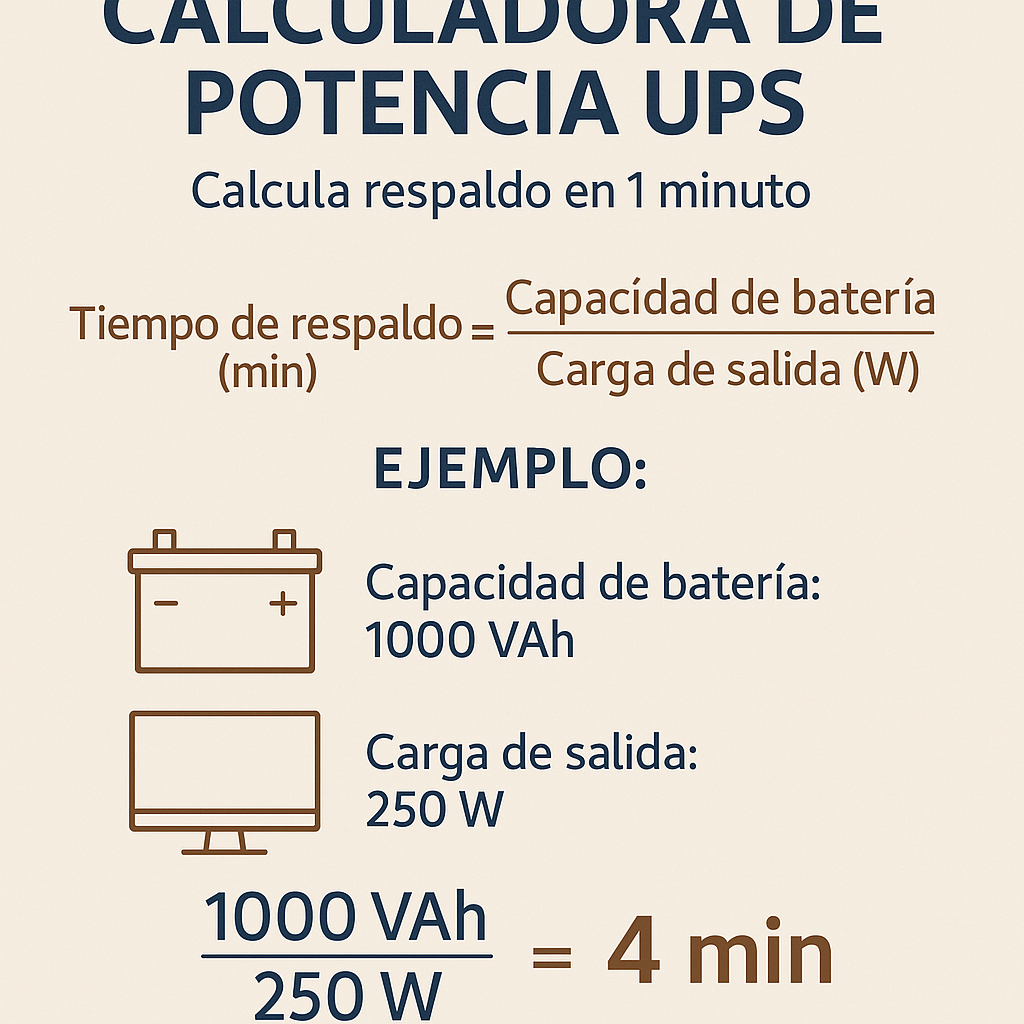
calculadora de potencia UPS: calcula respaldo en 1 minuto
This article provides a technical UPS power calculator to estimate backup time in one minute.
Detailed formulas, examples, and standards guidance enable accurate runtime and VA sizing for diverse environments.
Calculadora de potencia UPS — dimensionamiento de kVA y capacidad de baterías
How the one-minute UPS backup calculator works
A one-minute UPS backup calculator is an algorithmic sequence that turns measured or estimated load parameters into a runtime (minutes or hours) and a recommended UPS VA rating. The intended workflow is fast, repeatable, and conservative to provide reliable backup-time estimates for IT closets, telecom sites, medical devices, and industrial control systems.
The calculator reduces the problem to three core questions:
What is the continuous load in watts (W)?
What is the UPS and battery system usable energy (Wh)?
What safety and environmental derating factors apply (efficiency, power factor, depth of discharge, temperature)?
Using rapid field measurements or system documentation, the calculator applies standardized formulas and returns:
Required UPS apparent power (VA)
Estimated runtime at the requested load
Recommended battery configuration and margin
Key equations and their usage
This section gives the primary formulas used by the calculator. Each formula is shown followed by variable definitions and typical values. All formulas are presented using plain characters and standard mathematical operators.
Apparent power (VA) from active power (W)
VA = W ÷ PF
Variables:
VA: Apparent power required by the UPS (volt-amperes)
W: Active power of the load (watts)
PF: Power factor (unitless, typical 0.6–1.0; IT equipment often 0.9–1.0)
Inverter_efficiency: Efficiency of DC→AC inverter (typical 0.9–0.98 depending on UPS)
Rewrite showing losses explicitly:
Runtime_hours = (Battery_Ah × Battery_Vnom × N_parallel × DOD_factor × Battery_efficiency × Inverter_efficiency) ÷ Load_W
Note: If a UPS reports runtime based on VA or percentage load, convert VA to W using PF before applying the above runtime estimate.
Simple sizing margin
Recommended_VA = (W × Safety_margin) ÷ PF
Typical safety margins:
Small deployments: 1.2 (20% headroom)
Critical or expandable sites: 1.3–1.5
Common component parameter tables
Below are tables with typical values for loads, UPS efficiency levels, battery sizes, and an extended mapping table of UPS VA ratings to expected runtimes for typical battery configurations.
Device/Load Type
Typical Power (W)
Typical Power Factor (PF)
Notes
Desktop PC (idle)
50–100
0.9–1.0
LCD monitor excluded
Desktop PC (active)
150–400
0.9–1.0
Depends on PSU efficiency and CPU/GPU load
Network switch (enterprise)
30–200
0.95–1.0
PoE switches consume additional power per port
Single U server (1U, moderate)
300–800
0.95–1.0
Server power supply PFC common
Server rack (full) 6–8 kW
2000–8000
0.95–1.0
Highly variable by CPU density and storage
VoIP gateway / PBX
30–150
0.9–1.0
Often low and constant
Medical imaging (small)
1000–3000
0.8–1.0
Consult manufacturer for inrush
Industrial PLC & sensors
50–500
0.8–1.0
Includes solenoids and actuators
Battery Type
Nominal Voltage (V)
Typical Ah Range
Typical Efficiency
Recommended DOD
Sealed Lead Acid (VRLA)
12
7–200
0.85–0.95
0.5–0.8 (for life)
Flooded Lead Acid
12
50–300+
0.85–0.95
0.5–0.8
Nickel Cadmium (NiCd)
1.2 per cell
varies
0.8–0.9
0.6–0.8
Lithium Iron Phosphate (LiFePO4)
3.2–3.3 per cell
10–2000+
0.95+
0.8–0.9 (depending on BMS)
Mapping UPS VA ratings to common runtimes (reference)
This extended mapping uses typical battery string configurations (48 V nominal string built from 4 × 12 V modules) and common Ah ratings. The runtime is estimated at 50% DOD and inverter efficiency 95%. Use these rows for quick field reference. Adjust for actual battery counts, temperature, and age.
UPS VA Rating
Typical Load W (PF=0.9)
Battery Config
Total Usable Wh (50% DOD)
Estimated Runtime @ Load
1000 VA
900 W
48 V, 100 Ah, 1 string
48 V × 100 Ah × 1 × 0.5 = 2400 Wh
2400 Wh ÷ (900 W ÷ 0.95) ≈ 2.53 h
1500 VA
1350 W
48 V, 100 Ah, 1 string
2400 Wh
2400 ÷ (1350 ÷ 0.95) ≈ 1.69 h
3000 VA
2700 W
48 V, 100 Ah, 2 strings
2400 Wh × 2 = 4800 Wh
4800 ÷ (2700 ÷ 0.95) ≈ 1.69 h
6000 VA
5400 W
48 V, 100 Ah, 4 strings
2400 × 4 = 9600 Wh
9600 ÷ (5400 ÷ 0.95) ≈ 1.69 h
10 kVA
9000 W
48 V, 200 Ah, 4 strings
9600 Wh × 2 (200 Ah) = 19200 Wh
19200 ÷ (9000 ÷ 0.95) ≈ 2.03 h
Note: These are illustrative. Real systems use battery cabinets and detailed runtime curves published by UPS manufacturers.
Step-by-step one-minute calculator method
Use this sequence in the field or within an application UI. The method is intentionally algorithmic and suited for rapid entry.
Determine active power (W). If only VA is known, convert: W = VA × PF.
Select desired safety margin (typically 1.2) and compute required VA: Required_VA = (W × margin) ÷ PF.
Obtain battery bank data: nominal voltage, Ah per string, number of parallel strings planned.
Apply DOD and battery efficiency: Usable_Wh = Nominal_Wh × DOD_factor × Battery_efficiency.
Compute runtime: Runtime_h = Usable_Wh ÷ (W ÷ Inverter_efficiency).
Round down to the nearest conservative value and present recommended UPS VA and estimated minutes of runtime.
This method returns an estimate quickly; for final procurement or critical systems, perform detailed battery modelling and consult manufacturer runtime charts.
Real-world example 1 — Small office / network closet (detailed)
Scenario: A small office has:
3 desktop PCs (active) at 250 W each
1 network switch at 100 W
1 router and modem combined 30 W
Desired runtime: 30 minutes (0.5 hours)
Step 1 — Calculate total load W:
Total_W = 3 × 250 + 100 + 30 = 750 + 100 + 30 = 880 W
Assume PF = 0.95 (modern PSUs and network equipment).
Calculate required VA with 20% margin:
Required_VA = (880 W × 1.20) ÷ 0.95 = 1056 ÷ 0.95 ≈ 1111 VA → Round to 1500 VA commercial UPS (next common rating).
Step 2 — Determine battery requirement for 0.5 h runtime:
Choose candidate battery string: 48 V nominal built from 4 × 12 V, 100 Ah batteries → Nominal_Wh per string = 48 × 100 = 4800 Wh.
Assume DOD_factor = 0.5 (to protect SLA lifetime) and battery_efficiency = 0.9, inverter_efficiency = 0.95.
Usable_Wh = 4800 × 0.5 × 0.9 = 2160 Wh
Compute runtime:
Runtime_h = Usable_Wh ÷ (Load_W ÷ Inverter_efficiency) = 2160 ÷ (880 ÷ 0.95) = 2160 ÷ 926.32 ≈ 2.33 hours
Result:
A single 48 V, 100 Ah string provides ~2.3 hours — significantly more than required 0.5 hours. So a 1500 VA UPS with a single 100 Ah string meets the 30-minute requirement comfortably. Optionally, a smaller 1000–1500 VA unit could be chosen, but verify manufacturer runtime charts.
Discussion:
This shows the one-minute calculation returns conservative results because battery reserves and deratings were applied. For cost optimization, you might select a lower DOD or smaller battery Ah, but check battery life trade-offs.
Real-world example 2 — Small datacenter rack (detailed)
Scenario: A rack with:
2 × 1U servers at 700 W each
2 × 2U storage nodes at 900 W total
1 top-of-rack switch at 200 W
Total target runtime: 15 minutes (0.25 hours) to safely perform graceful shutdowns
Step 1 — Calculate total load:
Total_W = 2×700 + 900 + 200 = 1400 + 900 + 200 = 2500 W
Use PF = 0.95, safety margin 1.25 (critical rack).
Required_VA = (2500 × 1.25) ÷ 0.95 = 3125 ÷ 0.95 ≈ 3289 VA → Round to next standard UPS rating: 4000 VA (4 kVA).
Step 2 — Battery sizing for 15 minutes:
Choose battery solution: 48 V, 200 Ah string (nominal) → Nominal_Wh = 48 × 200 = 9600 Wh.
Assume DOD_factor = 0.6 (short runtime, acceptable deeper discharge for emergency), battery_efficiency = 0.92, inverter_efficiency = 0.96.
Usable_Wh = 9600 × 0.6 × 0.92 = 5299.2 Wh
Compute runtime at 2500 W:
Runtime_h = 5299.2 ÷ (2500 ÷ 0.96) = 5299.2 ÷ 2604.17 ≈ 2.034 hours
But this result looks large because battery energy is large. For 15 minutes we could significantly reduce battery size.
Compute required usable Wh for 0.25 h:
Required_Wh = (Load_W ÷ Inverter_efficiency) × Runtime_h = (2500 ÷ 0.96) × 0.25 ≈ 2604.17 × 0.25 = 651.04 Wh
This seems low; check calculation—unit mismatch: 2500 W × 0.25 h = 625 Wh, divided by inverter efficiency? Let's recompute properly:
Energy_needed_Wh = Load_W × Runtime_h = 2500 × 0.25 = 625 Wh (AC energy)
Allow for inverter loss: Battery_energy_needed = Energy_needed_Wh ÷ Inverter_efficiency = 625 ÷ 0.96 ≈ 651 Wh
Now account for battery DOD and battery_efficiency:
Nominal_Wh_needed = Battery_energy_needed ÷ (DOD_factor × Battery_efficiency) = 651 ÷ (0.6 × 0.92) ≈ 651 ÷ 0.552 ≈ 1179 Wh
Convert to Ah at 48 V:
Ah_needed = Nominal_Wh_needed ÷ 48 ≈ 24.56 Ah
Therefore a single 48 V, 30 Ah string (or small modular batteries) would supply ~15 minutes with margin.
Result:
For a 4 kVA UPS supporting a 2.5 kW load for 15 minutes, a 48 V 30 Ah battery is sufficient. In practice, UPS manufacturers have minimum battery cabinet sizes, and for redundancy or temperature derating you may choose 50–100 Ah.
Discussion:
This example shows that for short runtimes, battery Ah required can be modest. However, for critical systems you must consider load surges, parallel redundancy, autonomy for multiple shutdown attempts, and battery aging.
Standards, safety and authoritative references
Selecting and sizing UPS and batteries requires compliance with electrical and safety standards. Key normative references:
IEC 62040 series — Uninterruptible power systems (IEC provides safety and EMC requirements). See https://www.iec.ch/standards
NFPA 70 — National Electrical Code (requirements for electrical installations in the USA). See https://www.nfpa.org/
NFPA 110 — Standard for Emergency and Standby Power Systems (applicable to engine-generator and related systems). See https://www.nfpa.org/
IEEE Recommended Practices — for example IEEE Std 446 (Emergency and standby power systems recommended practice). See https://standards.ieee.org/
Battery safety and transport regulations — UN Manual of Tests and Criteria and manufacturer datasheets
Also consult UPS manufacturer runtime curves and battery manufacturer specifications to ensure the calculator’s assumptions match certified product performance.
Practical derating factors and environmental corrections
Battery performance is sensitive to temperature and age. The one-minute calculator applies conservative deratings, but field engineers should adjust for site conditions.
Important derating factors:
Temperature: For lead-acid, capacity typically decreases ~0.5–1% per °C above 25 °C; manufacturers provide correction charts.
Age: Battery capacity declines with cycle count and calendar life; plan for 80% of nameplate at replacement interval.
Self-discharge and float charge: In long-term standby, float voltage and maintenance matter for expected Wh.
Parallel string imbalance: When using multiple strings, ensure equalization and monitoring; effective capacity may be lower.
Adjustment example:
If site temperature is 35 °C and manufacturer indicates −10% capacity at that temperature, multiply usable Wh by 0.9. If battery is at 70% of nominal due to age, multiply by 0.7.
UX and calculator input fields recommendation
Designing a one-minute calculator UI should minimize the number of inputs while enabling expert overrides. Recommended fields:
Load input: Allow W or VA with PF field
Desired runtime (minutes or hours)
Battery nominal voltage and Ah (or select common battery pack)
Number of parallel strings (default 1)
Sensitivity toggles: margin percentage, DOD preference, temperature correction
Output: Required VA, recommended UPS model class, battery configuration, runtime chart
Provide quick presets:
Small office preset (PCs, switch)
Server rack preset (per-U or per-rack)
Telecom closet preset (low W, long runtime)
Common pitfalls and mitigation
Using VA alone: Always convert VA to W using a conservative PF estimate.
Ignoring inverter efficiency: Especially important for small UPS where efficiency can dip at low loads.
Assuming new battery capacity: Always apply an age factor and temperature correction.
Overlooking surge/inrush: Some loads have large starting currents; ensure UPS can handle peak demand.
Neglecting redundancy: For N+1 systems, perform calculations per string and for fault scenarios.
NFPA 110 — Standard for Emergency and Standby Power Systems: https://www.nfpa.org/
IEEE Standards and guides — search for relevant UPS and emergency power documents: https://standards.ieee.org/
Manufacturer runtime and battery datasheets — consult UPS vendors (APC, Eaton, Vertiv) for validated runtime charts
By following the formulas, tables, and examples above, an engineer can reliably use a one-minute calculator to size UPS systems, estimate backup time, and determine appropriate battery configurations for a wide range of installations.Calculadora De Potencia Ups Calcula Respaldo En 1 Minuto — fast UPS backup estimator